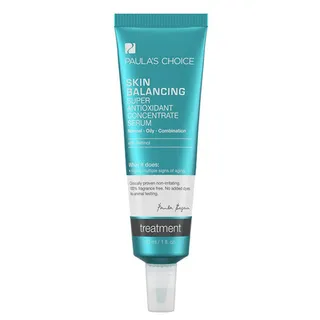
Paula's choice Skin Balancing Super Antioxidant Concentrate Serum with Retinol

Paula's choice Skin Balancing Super Antioxidant Concentrate Serum with Retinol

Efficacy100/100IrritancyMedium

Works for

Anti-aging
Retinol, Retinyl palmitate + 3 more
Works well

This product can help reduce and prevent fine lines and wrinkles, improve skin elasticity and firmness because it contains retinol.

These ingredients in the product can also be helpful, even though there is less evidence for their effectiveness: retinyl palmitate, vitis vinifera seed extract.

Keep in mind that it typically takes at least 6 weeks to notice any results because the changes that are needed to improve fine lines and elasticity happen in the deeper layers of the skin. No topical anti-aging product can “erase” wrinkles or fully reverse signs of aging.

RetinolHeroEffect: HighTwo steps removed from the active form of vitamin A - retinoic acid. Once converted to the retinoic acid in the skin, retinol is proven to be effective against all signs of aging. It improves skin cell turnover, helps fight blemishes and clogged pores, can regulate excess oil production and even skin tone. It can, however, be quite irritating~1.3–1.9%
Retinyl palmitateKey activeEffect: MediumThree steps removed from the active form of vitamin A - retinoic acid. To have an effect in the skin, it first needs to be converted twice to become the retinoic acid. This means it is less potent than retinol, but could also be less irritating. Once converted to the retinoic acid in the skin, it helps against all signs of aging, improves skin cell turnover and helps fight blemishes and clogged pores. However, in many cosmetic formulations, it is used in a concentration that is too low to have the full effect~2–3%
Vitis vinifera seed extractKey activeEffect: MediumA plant extract that contains resveratrol and other anti-oxidant compounds that can help neutralize free radicals, reduce inflammation in skin and even out its tone. Can be also used to stabilize the product formulation~0.2–0.8%
Camellia sinensis leaf extractEffect: Low, below effective doseCan contain potent anti-oxidant compounds (abbreviated ECG, GCG, EGC, and EGCG) that might help protect the skin from free radicals. Can help calm down inflammation and has some anti-bacterial properties. Unfortunately, these antioxidants are unstable and lose their effectiveness very quickly in products. The concentration of the antioxidant compounds in the extract also tends to be low to be effective in topical formulation~0.4–0.95%
Tetrahexyldecyl ascorbateUnder-dosedBeing a lipid soluble form of vitamin C, it is more stable than ascorbic acid, but still degrades quickly and needs to be stabilized in a formulation with another ingredient. It is claimed to penetrate skin better than pure vitamin C and have the the similar benefits, but solid studies of its effectiveness are lacking. Is likely to require a higher concentration in a product than pure vitamin C to be effective. It might be able to help reduce pore clogging.~0.9–1.35%
Anti-oxidation
Side benefit · Retinol, Haematococcus pluvialis extract + 10 more
Works well

This product contains antioxidants (camellia oleifera leaf extract, retinol, vitis vinifera seed extract) that can help neutralize free radicals in skin. By doing so, they can lessen the damage the skin gets from the UV light (sun).

The following ingredients - ginkgo biloba leaf extract, haematococcus pluvialis extract also can have an antioxidant effect, but there is less evidence to confirm their effectiveness in skin.

RetinolKey activeEffect: HighTwo steps removed from the active form of vitamin A - retinoic acid. Once converted to the retinoic acid in the skin, retinol is proven to be effective against all signs of aging. It improves skin cell turnover, helps fight blemishes and clogged pores, can regulate excess oil production and even skin tone. It can, however, be quite irritating~1.3–1.9%
Haematococcus pluvialis extractKey activeEffect: MediumGreen algae extract that might contain antioxidant astaxanthin~0.55–1.25%
Camellia oleifera leaf extractKey activeEffect: HighA plant extract that can help neutralize free radicals and reduce inflammation, even though it is not usually used in sufficient concentration in cosmetics~0.35–0.85%
Vitis vinifera seed extractKey activeEffect: HighA plant extract that contains resveratrol and other anti-oxidant compounds that can help neutralize free radicals, reduce inflammation in skin and even out its tone. Can be also used to stabilize the product formulation~0.2–0.8%
Ginkgo biloba leaf extractKey activeEffect: MediumA plant extract that might help neutralize free radicals and reduce inflammation in skin. It can be irritating~0.15–0.7%
Tocopheryl acetateEffect: LowA more stable but less bio-available form of vitamin E compared to Tocopherol. Might help moisturize and protect the skin from free radicals, but mostly used in low concentrations to stabilize other ingredients.~1–1.5%
Vaccinium macrocarpon fruit extractEffect: LowA berry extract. Might have some anti-oxidant properties~0.15–0.55%
Rubus idaeus fruit extractEffect: LowA fruit extract that might have some anti-oxidant properties but evidence of effectiveness in skin is lacking~0.15–0.5%
BisabololEffect: Low, below effective doseAn active component of chamomile plant that historically has been used to calm down irritated skin. A recent study shows that bisabolol indeed can have some anti-inflammatory effect on skin, even though conclusive data is lacking. Bisabolol has a sweet floral scent and can be added to products for its aromatic properties~0.45–1%
Betula alba bark extractEffect: Low, below effective doseHas astringent properties. Creates a tightening and drying effect on the skin. Can be irritating~0.1–0.4%
Tetrahexyldecyl ascorbateUnder-dosedBeing a lipid soluble form of vitamin C, it is more stable than ascorbic acid, but still degrades quickly and needs to be stabilized in a formulation with another ingredient. It is claimed to penetrate skin better than pure vitamin C and have the the similar benefits, but solid studies of its effectiveness are lacking. Is likely to require a higher concentration in a product than pure vitamin C to be effective. It might be able to help reduce pore clogging.~0.9–1.35%
Camellia sinensis leaf extractUnder-dosedCan contain potent anti-oxidant compounds (abbreviated ECG, GCG, EGC, and EGCG) that might help protect the skin from free radicals. Can help calm down inflammation and has some anti-bacterial properties. Unfortunately, these antioxidants are unstable and lose their effectiveness very quickly in products. The concentration of the antioxidant compounds in the extract also tends to be low to be effective in topical formulation~0.4–0.95%
Exfoliation
Side benefit · Retinol, Retinyl palmitate
Works well

This product can help exfoliate the skin. In other words, it helps break down the bonds between dead cells on the surface of the skin and speed up the skin turnover. Skin often appears softer and brighter after exfoliation, but overdoing it can result in disrupted skin barrier. The following ingredient is doing the exfoliating job in this product: retinol.

RetinolKey activeEffect: HighTwo steps removed from the active form of vitamin A - retinoic acid. Once converted to the retinoic acid in the skin, retinol is proven to be effective against all signs of aging. It improves skin cell turnover, helps fight blemishes and clogged pores, can regulate excess oil production and even skin tone. It can, however, be quite irritating~1.3–1.9%
Retinyl palmitateEffect: LowThree steps removed from the active form of vitamin A - retinoic acid. To have an effect in the skin, it first needs to be converted twice to become the retinoic acid. This means it is less potent than retinol, but could also be less irritating. Once converted to the retinoic acid in the skin, it helps against all signs of aging, improves skin cell turnover and helps fight blemishes and clogged pores. However, in many cosmetic formulations, it is used in a concentration that is too low to have the full effect~2–3%
Evens skin tone
Side benefit · Retinol, Retinyl palmitate + 2 more
Works well

This product can help reduce hypepigmentation and even out the skin tone because it contains the following effective ingredients: retinol.

The following ingredient (ingredients) in this product might be helpful, but there is no evidence to confirm that it actually can help even out the skin tone: retinyl palmitate.

Keep in mind that you would need to apply any topical skincare targetted at hypigmentation consistently for a couple of months to get a result. No topical skincare product can help get rid of hyperpigmentation (including post-acne marks and age spots) instantly.

RetinolHeroEffect: HighTwo steps removed from the active form of vitamin A - retinoic acid. Once converted to the retinoic acid in the skin, retinol is proven to be effective against all signs of aging. It improves skin cell turnover, helps fight blemishes and clogged pores, can regulate excess oil production and even skin tone. It can, however, be quite irritating~1.3–1.9%
Retinyl palmitateKey activeEffect: MediumThree steps removed from the active form of vitamin A - retinoic acid. To have an effect in the skin, it first needs to be converted twice to become the retinoic acid. This means it is less potent than retinol, but could also be less irritating. Once converted to the retinoic acid in the skin, it helps against all signs of aging, improves skin cell turnover and helps fight blemishes and clogged pores. However, in many cosmetic formulations, it is used in a concentration that is too low to have the full effect~2–3%
Camellia sinensis leaf extractEffect: Low, below effective doseCan contain potent anti-oxidant compounds (abbreviated ECG, GCG, EGC, and EGCG) that might help protect the skin from free radicals. Can help calm down inflammation and has some anti-bacterial properties. Unfortunately, these antioxidants are unstable and lose their effectiveness very quickly in products. The concentration of the antioxidant compounds in the extract also tends to be low to be effective in topical formulation~0.4–0.95%
Tetrahexyldecyl ascorbateUnder-dosedBeing a lipid soluble form of vitamin C, it is more stable than ascorbic acid, but still degrades quickly and needs to be stabilized in a formulation with another ingredient. It is claimed to penetrate skin better than pure vitamin C and have the the similar benefits, but solid studies of its effectiveness are lacking. Is likely to require a higher concentration in a product than pure vitamin C to be effective. It might be able to help reduce pore clogging.~0.9–1.35%
Anti-blemish
Side benefit · Retinol, Retinyl palmitate + 2 more
Works well

This product can help reduce breakouts and clogged pores because it contains the following ingredient: retinol. This ingredient is used for treating acne and can have a noticeable effect.

The following ingredient (ingredients) in this product might be helpful, but there is no evidence to confirm that it actually works: retinyl palmitate

RetinolHeroEffect: HighTwo steps removed from the active form of vitamin A - retinoic acid. Once converted to the retinoic acid in the skin, retinol is proven to be effective against all signs of aging. It improves skin cell turnover, helps fight blemishes and clogged pores, can regulate excess oil production and even skin tone. It can, however, be quite irritating~1.3–1.9%
Retinyl palmitateKey activeEffect: MediumThree steps removed from the active form of vitamin A - retinoic acid. To have an effect in the skin, it first needs to be converted twice to become the retinoic acid. This means it is less potent than retinol, but could also be less irritating. Once converted to the retinoic acid in the skin, it helps against all signs of aging, improves skin cell turnover and helps fight blemishes and clogged pores. However, in many cosmetic formulations, it is used in a concentration that is too low to have the full effect~2–3%
Ginkgo biloba leaf extractEffect: LowA plant extract that might help neutralize free radicals and reduce inflammation in skin. It can be irritating~0.15–0.7%
Camellia sinensis leaf extractEffect: Low, below effective doseCan contain potent anti-oxidant compounds (abbreviated ECG, GCG, EGC, and EGCG) that might help protect the skin from free radicals. Can help calm down inflammation and has some anti-bacterial properties. Unfortunately, these antioxidants are unstable and lose their effectiveness very quickly in products. The concentration of the antioxidant compounds in the extract also tends to be low to be effective in topical formulation~0.4–0.95%
Moisturizing
Side benefit · Cyclopentasiloxane, Isododecane + 7 more
Works

This product can help soften the skin and reduce its moisture loss with emollients and occlusives: caprylic/capric triglyceride, glycine soja oil.

Keep in mind that this product does not contain effective ingredients to attract water to the upper layer of the skin. This is why an additional product with humectants like glycerin or hyaluronic acid can be helpful (apply it before this product for the best results).

CyclopentasiloxaneKey active· EmollientEffect: MediumA silicone that helps improve the product texture and spreadability. Can absorb oil creating a short-term mattifying effect on the skin~23–34%
IsododecaneKey active· Emollient, OcclusiveEffect: MediumAn emollient that helps soften the skin and can decrease moisture loss. Helps create a nice product texture~6–8.9%
Dimethicone crosspolymerKey activeEffect: MediumUsed to create a thicker product texture. Helps soften the upper layer of the skin and might be able to prevent moisture loss from its surface~3.6–5.4%
Caprylic/capric triglycerideKey active· Emollient, OcclusiveEffect: HighA good mix of fatty acids that forms a protective layer on the skin. Improves the shelf life of products. Derived from coconut and glycerin~1.8–2.7%
Glycine soja oilKey active· EmollientEffect: HighA good emollient that helps soften the skin and helps repair its barrier function. It can clog pores if used in high concentrations.~0.15–0.55%
Cyclohexasiloxane· EmollientEffect: LowA silicone that serves as an emollient. Helps create a nice non-greasy feels~4.5–6.7%
Neopentyl glycol diheptanoate· EmollientEffect: LowHelps soften the upper layer of the skin and create a nice product consistency~2.8–4.2%
Camellia sinensis leaf extractEffect: Low, below effective doseCan contain potent anti-oxidant compounds (abbreviated ECG, GCG, EGC, and EGCG) that might help protect the skin from free radicals. Can help calm down inflammation and has some anti-bacterial properties. Unfortunately, these antioxidants are unstable and lose their effectiveness very quickly in products. The concentration of the antioxidant compounds in the extract also tends to be low to be effective in topical formulation~0.4–0.95%
Betula alba bark extractEffect: Low, below effective doseHas astringent properties. Creates a tightening and drying effect on the skin. Can be irritating~0.1–0.4%

Can it cause trouble?

Irritancy
2 strong irritants: Retinyl palmitate, Retinol
Medium risk
We flagged 12 ingredients with irritancy potential. Severity depends on your sensitivity threshold; the table lists the worst offenders first.
IngredientFunctionIrritationEst. amount
Retinyl palmitateThree steps removed from the active form of vitamin A - retinoic acid. To have an effect in the skin, it first needs to be converted twice to become the retinoic acid. This means it is less potent than retinol, but could also be less irritating. Once converted to the retinoic acid in the skin, it helps against all signs of aging, improves skin cell turnover and helps fight blemishes and clogged pores. However, in many cosmetic formulations, it is used in a concentration that is too low to have the full effectHigh~2–3%est.
RetinolTwo steps removed from the active form of vitamin A - retinoic acid. Once converted to the retinoic acid in the skin, retinol is proven to be effective against all signs of aging. It improves skin cell turnover, helps fight blemishes and clogged pores, can regulate excess oil production and even skin tone. It can, however, be quite irritatingHigh~1.3–1.9%est.
Chamomilla recutita flower extractPlant extract that can have healing and anti-inflammatory properties. It is a potential allergen and can be irritatingHigh~0.4–0.95%est.
Ginkgo biloba leaf extractA plant extract that might help neutralize free radicals and reduce inflammation in skin. It can be irritatingHigh~0.15–0.7%est.
Vaccinium macrocarpon fruit extractA berry extract. Might have some anti-oxidant propertiesHigh~0.15–0.55%est.
Betula alba bark extractHas astringent properties. Creates a tightening and drying effect on the skin. Can be irritatingHigh~0.1–0.4%est.
Caprylic/capric triglycerideA good mix of fatty acids that forms a protective layer on the skin. Improves the shelf life of products. Derived from coconut and glycerinMedium~1.8–2.7%est.
Tocopheryl acetateA more stable but less bio-available form of vitamin E compared to Tocopherol. Might help moisturize and protect the skin from free radicals, but mostly used in low concentrations to stabilize other ingredients.Medium~1–1.5%est.
Tetrahexyldecyl ascorbateBeing a lipid soluble form of vitamin C, it is more stable than ascorbic acid, but still degrades quickly and needs to be stabilized in a formulation with another ingredient. It is claimed to penetrate skin better than pure vitamin C and have the the similar benefits, but solid studies of its effectiveness are lacking. Is likely to require a higher concentration in a product than pure vitamin C to be effective. It might be able to help reduce pore clogging.Medium~0.9–1.35%est.
Haematococcus pluvialis extractGreen algae extract that might contain antioxidant astaxanthinMedium~0.55–1.25%est.
Rubus idaeus fruit extractA fruit extract that might have some anti-oxidant properties but evidence of effectiveness in skin is lackingMedium~0.15–0.5%est.
Glycine soja oilA good emollient that helps soften the skin and helps repair its barrier function. It can clog pores if used in high concentrations.Medium~0.15–0.55%est.
Comedogenic
1 ingredient rated 2 or more on the 0–5 pore-clogging scale
1 flagged
These ingredients have a comedogenic rating of 2 or more on a 0–5 scale; the table shows each one's rating. In leave-on products they can clog pores in acne-prone skin.
IngredientFunctionRatingEst. amount
Glycine soja oilA good emollient that helps soften the skin and helps repair its barrier function. It can clog pores if used in high concentrations.2/5~0.15–0.55%est.
Did this help you decide?

User reviews

Would you recommend?
No community reviews yet.

Be the first — your take helps the next person decide.

Ingredients

Filter by role to see what each ingredient is doing.

Cyclopentasiloxane~23–34%
Key active
Irritation risk
Low
Works for
MoisturizingMattifying

A silicone that helps improve the product texture and spreadability. Can absorb oil creating a short-term mattifying effect on the skin

More about Cyclopentasiloxane
Isododecane~6–8.9%
Key active
Irritation risk
Low
Works for
Moisturizing

An emollient that helps soften the skin and can decrease moisture loss. Helps create a nice product texture

More about Isododecane
Cyclohexasiloxane~4.5–6.7%
Formula
Irritation risk
Low
Works for
Moisturizing

A silicone that serves as an emollient. Helps create a nice non-greasy feels

More about Cyclohexasiloxane
Dimethicone crosspolymer~3.6–5.4%
Key active
Irritation risk
Low
Works for
Moisturizing

Used to create a thicker product texture. Helps soften the upper layer of the skin and might be able to prevent moisture loss from its surface

More about Dimethicone crosspolymer
Neopentyl glycol diheptanoate~2.8–4.2%
Formula
Irritation risk
Low
Works for
Moisturizing

Helps soften the upper layer of the skin and create a nice product consistency

More about Neopentyl glycol diheptanoate
Retinyl palmitate~2–3%
Key activeIrritant · high
Irritation risk
High
Works for
Evens skin toneAnti-blemishAnti-agingExfoliation

Three steps removed from the active form of vitamin A - retinoic acid. To have an effect in the skin, it first needs to be converted twice to become the retinoic acid. This means it is less potent than retinol, but could also be less irritating. Once converted to the retinoic acid in the skin, it helps against all signs of aging, improves skin cell turnover and helps fight blemishes and clogged pores. However, in many cosmetic formulations, it is used in a concentration that is too low to have the full effect

More about Retinyl palmitate
Caprylic/capric triglyceride~1.8–2.7%
Key activeIrritant · medium
Irritation risk
Medium
Works for
Moisturizing

A good mix of fatty acids that forms a protective layer on the skin. Improves the shelf life of products. Derived from coconut and glycerin

More about Caprylic/capric triglyceride
Retinol~1.3–1.9%
Hero · Anti-aging, Evens skin tone, Anti-blemishIrritant · high
Irritation risk
High
Works for
Anti-agingAnti-oxidationExfoliationMattifyingAnti-blemishEvens skin tone

Two steps removed from the active form of vitamin A - retinoic acid. Once converted to the retinoic acid in the skin, retinol is proven to be effective against all signs of aging. It improves skin cell turnover, helps fight blemishes and clogged pores, can regulate excess oil production and even skin tone. It can, however, be quite irritating

More about Retinol
Tocopheryl acetate~1–1.5%
Irritant · medium
Irritation risk
Medium
Works for
Anti-oxidation

A more stable but less bio-available form of vitamin E compared to Tocopherol. Might help moisturize and protect the skin from free radicals, but mostly used in low concentrations to stabilize other ingredients.

More about Tocopheryl acetate
Tetrahexyldecyl ascorbate~0.9–1.35%
Under-dosedIrritant · medium
Irritation risk
Medium
Works for
Anti-agingAnti-oxidationEvens skin tone

Being a lipid soluble form of vitamin C, it is more stable than ascorbic acid, but still degrades quickly and needs to be stabilized in a formulation with another ingredient. It is claimed to penetrate skin better than pure vitamin C and have the the similar benefits, but solid studies of its effectiveness are lacking. Is likely to require a higher concentration in a product than pure vitamin C to be effective. It might be able to help reduce pore clogging.

More about Tetrahexyldecyl ascorbate
Haematococcus pluvialis extract~0.55–1.25%
Key activeIrritant · medium
Irritation risk
Medium
Works for
Anti-oxidation

Green algae extract that might contain antioxidant astaxanthin

More about Haematococcus pluvialis extract
Bisabolol~0.45–1%
Formula
Irritation risk
Low
Works for
Reduces irritationAnti-inflammatoryAnti-oxidation

An active component of chamomile plant that historically has been used to calm down irritated skin. A recent study shows that bisabolol indeed can have some anti-inflammatory effect on skin, even though conclusive data is lacking. Bisabolol has a sweet floral scent and can be added to products for its aromatic properties

More about Bisabolol
Chamomilla recutita flower extract~0.4–0.95%
Irritant · high
Irritation risk
High
Works for
Anti-inflammatory

Plant extract that can have healing and anti-inflammatory properties. It is a potential allergen and can be irritating

More about Chamomilla recutita flower extract
Camellia sinensis leaf extract~0.4–0.95%
Under-dosed
Irritation risk
Low
Works for
AntibacterialAnti-oxidationAnti-agingEvens skin toneMoisturizingAnti-blemish

Can contain potent anti-oxidant compounds (abbreviated ECG, GCG, EGC, and EGCG) that might help protect the skin from free radicals. Can help calm down inflammation and has some anti-bacterial properties. Unfortunately, these antioxidants are unstable and lose their effectiveness very quickly in products. The concentration of the antioxidant compounds in the extract also tends to be low to be effective in topical formulation

More about Camellia sinensis leaf extract
Camellia oleifera leaf extract~0.35–0.85%
Key active
Irritation risk
Low
Works for
Anti-oxidationAnti-inflammatory

A plant extract that can help neutralize free radicals and reduce inflammation, even though it is not usually used in sufficient concentration in cosmetics

More about Camellia oleifera leaf extract
Salix alba leaf extract~0.3–0.75%
Formula
Vitis vinifera seed extract~0.2–0.8%
Key active
Irritation risk
Low
Works for
Anti-oxidationAnti-inflammatoryAnti-agingAntibacterial

A plant extract that contains resveratrol and other anti-oxidant compounds that can help neutralize free radicals, reduce inflammation in skin and even out its tone. Can be also used to stabilize the product formulation

More about Vitis vinifera seed extract
Ginkgo biloba leaf extract~0.15–0.7%
Key activeIrritant · high
Irritation risk
High
Works for
Anti-oxidationAntibacterialAnti-blemishAnti-inflammatory

A plant extract that might help neutralize free radicals and reduce inflammation in skin. It can be irritating

More about Ginkgo biloba leaf extract
Calluna vulgaris flower extract~0.15–0.65%
Formula
Vaccinium macrocarpon fruit extract~0.15–0.55%
Irritant · high
Irritation risk
High
Works for
Anti-oxidation

A berry extract. Might have some anti-oxidant properties

More about Vaccinium macrocarpon fruit extract
Rubus idaeus fruit extract~0.15–0.5%
Irritant · medium
Irritation risk
Medium
Works for
Anti-oxidation

A fruit extract that might have some anti-oxidant properties but evidence of effectiveness in skin is lacking

More about Rubus idaeus fruit extract
Betula alba bark extract~0.1–0.4%
Irritant · high
Irritation risk
High
Works for
Anti-oxidationMoisturizing

Has astringent properties. Creates a tightening and drying effect on the skin. Can be irritating

More about Betula alba bark extract
Glycine soja oil~0.15–0.55%
Key activeComedogenic 2/5Irritant · medium
Irritation risk
Medium
Comedogenicity
2/5
Works for
Moisturizing

A good emollient that helps soften the skin and helps repair its barrier function. It can clog pores if used in high concentrations.

More about Glycine soja oil
Silica~0.15–0.6%
Formula
Irritation risk
Low

Used to absorb oil and can temporarily mattify skin

More about Silica
Phenoxyethanol~0.1–0.35%
Formula
Irritation risk
Low

A preservative. It helps prevent bacterial growth in cosmetic products

More about Phenoxyethanol
Ingredient list view

Cyclopentasiloxane, Isododecane, Cyclohexasiloxane, Dimethicone crosspolymer, Neopentyl glycol diheptanoate, Retinyl palmitate, Caprylic/capric triglyceride, Retinol, Tocopheryl acetate, Tetrahexyldecyl ascorbate, Haematococcus pluvialis extract, Bisabolol, Chamomilla recutita flower extract, Camellia sinensis leaf extract, Camellia oleifera leaf extract, Salix alba leaf extract, Vitis vinifera seed extract, Ginkgo biloba leaf extract, Calluna vulgaris flower extract, Vaccinium macrocarpon fruit extract, Rubus idaeus fruit extract, Betula alba bark extract, Glycine soja oil, Silica, Phenoxyethanol

Compare prices

Retailers ranked by price — lowest first.

No pricing data available yet for this product.

Worth comparing, line by line.

Match % combines shared ingredients, the first five ingredients, shared actives and hero ingredients, irritancy (lower counts in the alternative's favour), texture and body area. Only products in the same routine step are compared.

Side-by-side comparison of this product against its closest alternatives
Paula's choiceSkin Balancing Super Antioxidant Concentrate Serum with RetinolYOUR PRODUCTSothysCosmeceutique RX Retinol DermoboosterTrader Joe'sNourish Antioxidant Facial SerumElizabeth ArdenCeramide Capsules with Retinol
Match—70%69%69%
Price———$30.53
Shared key ingredients—4 of 126 of 123 of 12
Key difference—GlycerinPanthenolPalmitoyl Tripeptide-1
Irritancy Medium Medium High Medium
Drying alcohol————
View product Shop Shop Shop

More alternatives: Dr. Denese Triple Strength Peptide Super DropsMedik8 Retinol 6TR Serum

Cheaper alternatives? Browse formulas in the same category.
We compare ingredient profiles across our catalog — pick the closest match for your budget.
Open dupe finder

Product summary

"Paula's choice - Skin Balancing Super Antioxidant Concentrate Serum with Retinol" is effective for: Anti-aging, Exfoliation, Evens skin tone and Anti-blemish

This product could be helpful for: Anti-inflammatory and Moisturizing, but its actives are not the most effective or are not well-studied.

Ingredient callouts

  • this product contains an effective form of Retinoids (vitamin A): retinol 1.30% - 1.90%. Retinoids are potent multitasking actives. They work to improve and prevent early signs of aging, reduce hyperpigmentation (age spots and post-acne marks), and prevent inflamed blemishes and clogged pores. The downside of Retinoids is that they can be irritating. If you are not already using a Retinoid in your routine, it is best to start slowly and apply the Retinoid product only a few times per week. If your skin tolerates it well, you can gradually increase the frequency to daily.

Price

The product retails for 28.80$ in the United States.

For a detailed price comparison: click here.

Sources cited in this review

Every concentration estimate and effectiveness label is anchored to one of these 14 studies and safety reviews.

  1. 1
  2. 2
  3. 3
  4. 4
  5. 5
  6. 6
Paula's choice Skin Balancing Super Antioxidant Concentrate Serum with Retinol
Paula's choiceSkin Balancing Super Antioxidant Concentrate Serum with Retinol

Affiliate links · As an Amazon Associate, WIMJ earns from qualifying purchases.

As an Amazon Associate, WIMJ earns from qualifying purchases.