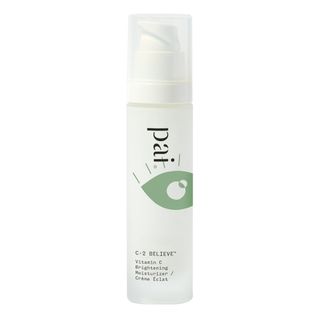
Pai Skincare C-2 Believe Vitamin C Brightening Moisturiser
Works for
1 of 1 advertised claim delivered
Moisturizing19 ingredients credited for this claimGood support
“C-2 Believe Vitamin C Brightening Moisturiser”
This product can help improve hydration of the skin with the two types of ingredients.
The first type is called “humectants”:
these ingredients help attract water.
When humectants are on the surface of the skin, they “pull in” the moisture from the outside environment, or from
within deeper layers of the skin. The following ingredients in this product do the job:
fructose, glycerin.
This product also contains ingredients called “occlusives”. They help reduce the speed with which our skin loses moisture to the outside environment. These ingredients also help soften the upper layer of the skin, so it feels less tight and nicer to the touch. The following ingredients in this product do the job: helianthus annuus seed oil, camellia oleifera seed oil.
Can it cause trouble?
Irritancy2 strong irritants: Backhousia citriodora leaf extract, Citrus limon peel oilMedium risk
Comedogenic4 ingredients rated 2 or more on the 0–5 pore-clogging scale4 flagged
User reviews
Be the first — your take helps the next person decide.
Ingredients
Filter by role to see what each ingredient is doing.
Water~45–55%
Coconut alkanes~7.2–8.8%
- Irritation risk
- Medium
- Comedogenicity
- 2/5
An emollient that helps soften the skin
More about Coconut alkanesPentylene glycol~4.2–5.2%
- Irritation risk
- Medium
Used to preserve products, dissolve other ingredients and create a nice product texture
More about Pentylene glycolCamellia oleifera seed oil~3.2–3.9%
- Irritation risk
- Medium
An emollient that does not leave a greasy finish
More about Camellia oleifera seed oilCamellia japonica seed oil~2.4–2.9%
- Irritation risk
- Low
A plant oil that helps to soften the upper layer of the skin and can help restore skin's barrier function. Might have an anti-oxidant effect
More about Camellia japonica seed oilTheobroma cacao seed butter~1.9–2.4%
- Irritation risk
- Low
- Comedogenicity
- 3/5
Helps soften the upper layer of the skin and can be helpful in restoring the skin barrier function. Might have some anti-oxidant effect
More about Theobroma cacao seed butterCetearyl alcohol~1.6–2%
- Irritation risk
- Low
- Comedogenicity
- 2/5
A non-drying alcohol. Works as an emollient. Helps water and oil mix together and creates a nice product texture
More about Cetearyl alcoholMangifera indica seed butter~1.4–1.7%
- Irritation risk
- Low
Helps to soften the upper layer of the skin and might have some anti-oxidant effect
More about Mangifera indica seed butterHeptyl undecylenate~1.3–1.5%
- Irritation risk
- Medium
Helps soften the upper layer of the skin, reduce water loss from the skin surface over time and create a nice product finish
More about Heptyl undecylenatePrunus domestica seed oil~0.9–1.1%
- Irritation risk
- Medium
Helps soften the upper layer of the skin
More about Prunus domestica seed oilMyristyl myristate~0.75–1.1%
- Irritation risk
- Medium
- Comedogenicity
- 3/5
An emollient. Is not recommended for acne-prone skin as it can be comedogenic
More about Myristyl myristatePrunus armeniaca kernel oil~0.6–0.9%
- Irritation risk
- Medium
An emollient that helps soften the skin
More about Prunus armeniaca kernel oilGlycerin~0.55–0.8%
- Irritation risk
- Low
One of the best moisturizing ingredients. Naturally present in skin. It attracts water to the upper layer of the skin working as a humectant
More about GlycerinAscorbyl tetraisopalmitate~0.45–0.7%
- Irritation risk
- Medium
A vitamin C derivative. Studies show that is might be effective in reducing hyperpigmentation, but there are no studies confirming that it is effectively converted into the bioavailable form of Vitamin C in skin. It is not clear how this derivative compares in effectiveness to the topical application of bioavailable form of vitamin C (L-ascorbic acid)
More about Ascorbyl tetraisopalmitateCetearyl glucoside~0.4–0.65%
- Irritation risk
- Medium
Helps water and oil in the product mix well together and improves product texture
More about Cetearyl glucosideInulin~0.35–0.65%
- Irritation risk
- Low
Helps attract water to the upper layer of the skin. Is claimed to support the growth of "good" bacteria in skin (as a "prebiotic"), but the research is lacking
More about InulinHelianthus annuus seed oil~0.4–0.65%
- Irritation risk
- Low
A great emollient due to its high linoleic acid content. One of the most effective plant oils in helping skin hydration and repairing skin barrier function
More about Helianthus annuus seed oilMicrocrystalline cellulose~0.35–0.6%
Vaccinium myrtillus seed oil~0.25–0.5%
- Irritation risk
- Low
Vaccinium myrtillus fruit extract~0.25–0.45%
- Irritation risk
- Medium
A plant extract that might help neutralize free radicals in skin, but research on its efficacy in skin is lacking
More about Vaccinium myrtillus fruit extractCellulose~0.25–0.45%
- Irritation risk
- Low
Can be used to help absorb oil as well as add volume and imporve texture of products.
More about CelluloseSodium stearoyl glutamate~0.3–0.55%
- Irritation risk
- Medium
Helps oil and water mix together
More about Sodium stearoyl glutamateXanthan gum~0.2–0.35%
- Irritation risk
- Low
Used to create a thicker product consistency
More about Xanthan gumSymphytum officinale leaf extract~0.2–0.35%
- Irritation risk
- High
A plant extract that has an anti-bacterial effect
More about Symphytum officinale leaf extractSymphytum officinale extract~0.15–0.3%
- Irritation risk
- Low
Lactic acid~0.2–0.35%
- Irritation risk
- Medium
An exfoliating and moisturizing alpha-hydroxy acid (AHA). Typically causes less irritation than other AHAs, for example, glycolic acid. At high concentrations (about 15%), lactic acid can help reduce lines and wrinkles. Recent studies show that lactic acid can support the "good" bacteria living on skin's surface (healthy skin microbiome)
More about Lactic acidFructose~0.15–0.3%
- Irritation risk
- Low
Helps attract water to the upper layer of the skin
More about FructoseMagnolia officinalis bark extract~0.15–0.3%
- Irritation risk
- Low
Sodium hyaluronate~0.15–0.3%
- Irritation risk
- Low
One of the best moisturizing ingredients. Attracts water into the upper layer of the skin
More about Sodium hyaluronateSodium phytate~0.15–0.25%
Tocopherol~0.15–0.25%
- Irritation risk
- Low
Pure form of vitamin E. Can help moisturise and protect the skin from free radicals. Often used to help stabilise other ingredients or the formula itself
More about TocopherolGlyceryl caprylate~0.15–0.3%
- Irritation risk
- Low
An emollient that can also help water and oil mix together, as well as prevent bacteria growth in products
More about Glyceryl caprylateBackhousia citriodora leaf extract~0.1–0.15%
- Irritation risk
- High
A plant extract used mostly as a fragrance. Can have some anti-microbial and anti-oxidant properties
More about Backhousia citriodora leaf extractCitrus limon peel oil~0.05–0.1%
Ingredient list view
Water, Coconut alkanes, Pentylene glycol, Camellia oleifera seed oil, Camellia japonica seed oil, Theobroma cacao seed butter, Cetearyl alcohol, Mangifera indica seed butter, Heptyl undecylenate, Prunus domestica seed oil, Myristyl myristate, Prunus armeniaca kernel oil, Glycerin, Ascorbyl tetraisopalmitate, Cetearyl glucoside, Inulin, Helianthus annuus seed oil, Microcrystalline cellulose, Vaccinium myrtillus seed oil, Vaccinium myrtillus fruit extract, Cellulose, Sodium stearoyl glutamate, Xanthan gum, Symphytum officinale leaf extract, Symphytum officinale extract, Lactic acid, Fructose, Magnolia officinalis bark extract, Sodium hyaluronate, Sodium phytate, Tocopherol, Glyceryl caprylate, Backhousia citriodora leaf extract, Citrus limon peel oil
Compare prices
Retailers ranked by price — lowest first.

Sources cited in this review
Every concentration estimate and effectiveness label is anchored to one of these 24 studies and safety reviews.
- 1
- 2Extraction and Characteristics of Seed Kernel Oil from Mangopdfs.semanticscholar.org
- 3
- 4
- 5
- 6

Affiliate links · As an Amazon Associate, WIMJ earns from qualifying purchases.