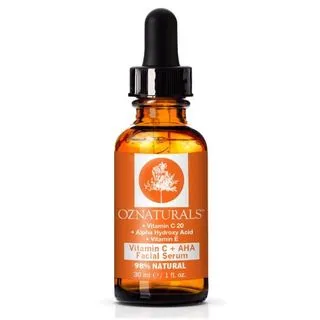
Works for
Evens skin toneGlycolic acid, Magnesium ascorbyl phosphate + 1 moreWorks well
“Combining antioxidant-rich Vitamin C and brightening agent AHA, this 2-in-1 serum targets hyperpigmentation and signs of aging by evening out skin tone and combating free radicals, leaving skin supple and soft.”
This product can help reduce hypepigmentation and even out the skin tone because it contains the following effective ingredients: glycolic acid
Keep in mind that you would need to apply any topical skincare targetted at hypigmentation consistently for a couple of months to get a result. No topical skincare product can help get rid of hyperpigmentation (including post-acne marks and age spots) instantly.
Anti-agingGlycolic acid, Sodium ascorbyl phosphate + 3 moreWorks well
“Combining antioxidant-rich Vitamin C and brightening agent AHA, this 2-in-1 serum targets hyperpigmentation and signs of aging by evening out skin tone and combating free radicals, leaving skin supple and soft.”
This product can help reduce and prevent fine lines and wrinkles, improve skin elasticity and firmness because it contains glycolic acid.
Keep in mind that it typically takes at least 6 weeks to notice any results because the changes that are needed to improve fine lines and elasticity happen in the deeper layers of the skin. No topical anti-aging product can “erase” wrinkles or fully reverse signs of aging.
ExfoliationSide benefit · Glycolic acidWorks well
This product can help exfoliate the skin. In other words, it helps break down the bonds between dead cells on the surface of the skin and speed up the skin turnover. Skin often appears softer and brighter after exfoliation, but overdoing it can result in disrupted skin barrier. The following ingredient is doing the exfoliating job in this product: glycolic acid.
MoisturizingSide benefit · Glycerin, Caprylyl glycol + 1 moreWorks
This product contains good ingredients to attract water to the upper layer of the skin. These ingredients are called "humectants": glycerin, caprylyl glycol.
When humectants are on the surface of the skin, they “pull in” the moisture from the outside environment, or from within deeper layers of the skin. If the air is dry, humectants can speed up the moisture loss from the skin. This is why it is a good idea to use another product on top of this one to help "seal in" the moisture (look for ingredients like dimethicone, squalane, oils and butters).
Can it cause trouble?
Irritancy8 flagged ingredientsLow risk
ComedogenicClean of flagged comedogenic ingredientsNone flagged

User reviews
Be the first — your take helps the next person decide.
Ingredients
Filter by role to see what each ingredient is doing.
Water~40–60%
Propanediol~4.4–6.6%
- Irritation risk
- Low
Acts as a solvent for other ingredients. Speeds up the absorption of other ingredients into the skin
More about PropanediolSodium magnesium silicate~3.4–5.1%
- Irritation risk
- Low
Glycolic acid~2.5–3.8%
- Irritation risk
- High
An alpha-hydroxy acid (AHA) that helps to remove the dead skin cells on the surface of the skin reveling a more even, smoother complexation. It is also able to stimulate collagen production with long-term use. Could help to reduce pore congestion. It can be irritating to the skin. Apply sunscreen daily if using products with glycolic acid
More about Glycolic acidSodium ascorbyl phosphate~1.8–2.7%
- Irritation risk
- Medium
A stable derivative of vitamin C. It is oil-soluble which means it is more likely to penetrate the skin compared to the pure form of vitamin C (which is water-soluble), but it is less bio-available and is way less effective in stimulating collagen and reducing wrinkles compared to the pure form of vitamin C (L-ascorbic acid) and its other derivatives (for example, magnesium ascorbyl phosphate). At the same time, this vitamin C derivative has been shown in studies to be effective in reducing acne, blemishes and clogged pores. It is less irritating then the pure form of vitamin C
More about Sodium ascorbyl phosphateMagnesium ascorbyl phosphate~1.4–2%
- Irritation risk
- Medium
A derivative of vitamin C that is more stable, but less bioavailable than the pure form of vitamin C. It does not penetrate the skin well, but has been shown to convert to pure vitamin C once in skin. It can be helpful in stimulating collagen production and lightening the skin tone, but the required concentration is likely to be very high
More about Magnesium ascorbyl phosphateArrabidaea chica leaf/stem extract~1.2–1.8%
- Irritation risk
- Low
Glycerin~1.1–1.7%
- Irritation risk
- Low
One of the best moisturizing ingredients. Naturally present in skin. It attracts water to the upper layer of the skin working as a humectant
More about GlycerinXanthan gum~0.85–1.25%
- Irritation risk
- Low
Used to create a thicker product consistency
More about Xanthan gumSodium ascorbate~0.5–1.15%
Phenylpropanol~0.4–0.9%
- Irritation risk
- High
Helps mask the smell of other ingredients and helps preserve the product formulation
More about PhenylpropanolCaprylyl glycol~0.35–0.85%
- Irritation risk
- Medium
Helps preserve products and creates a nice product texture
More about Caprylyl glycolTocopherol~0.15–0.6%
- Irritation risk
- Low
Pure form of vitamin E. Can help moisturise and protect the skin from free radicals. Often used to help stabilise other ingredients or the formula itself
More about TocopherolP-anisic acid~0.1–0.4%
- Irritation risk
- High
Helps preserve products. Can mask unpleasant smell. Could be irritating
More about P-anisic acidMagnesium chloride~0.05–0.25%
Sodium citrate~0.05–0.1%
- Irritation risk
- Medium
Helps to control the skin's pH level. Maintains the skin's natural film of amino-lactic acids and oils. Helps to preserve products
More about Sodium citrateCitric acid~0.01–0.05%
- Irritation risk
- Medium
Can work as an exfoliant but is typically used to adjust the product pH
More about Citric acidSodium hydroxide~0.01–0.1%
Ingredient list view
Water, Propanediol, Sodium magnesium silicate, Glycolic acid, Sodium ascorbyl phosphate, Magnesium ascorbyl phosphate, Arrabidaea chica leaf/stem extract, Glycerin, Xanthan gum, Sodium ascorbate, Phenylpropanol, Caprylyl glycol, Tocopherol, P-anisic acid, Magnesium chloride, Sodium citrate, Citric acid, Sodium hydroxide
Worth comparing, line by line.
Match % combines shared ingredients, the first five ingredients, shared actives and hero ingredients, irritancy (lower counts in the alternative's favour), texture and body area. Only products in the same routine step are compared.
| Oz NaturalsVitamin C + AHA Facial SerumYOUR PRODUCT | PayotHealthy Glow Serum | EmerginCVitamin C Serum 20% | SwisseVitamin C 10% Brightening Booster Serum | |
|---|---|---|---|---|
| Match | — | 53% | 51% | 51% |
| Price | — | $87.22 | $61.58 | $20.35 |
| Shared key ingredients | — | 3 of 4 | 3 of 4 | 2 of 4 |
| Key difference | — | Lactic Acid | Linoleic Acid | Niacinamide |
| Irritancy | Low | Medium | High | Low |
| Drying alcohol | — | — | — | — |
| View product | Shop | Shop | Shop |


More alternatives: Differin 4% Niacinamide Dark Spot Correcting SerumSwissline Radiance Booster
Sources cited in this review
Every concentration estimate and effectiveness label is anchored to one of these 16 studies and safety reviews.
- 1
- 2Glycolic acid peel therapy – a current reviewncbi.nlm.nih.gov
- 3
- 4
- 5Sodium ascorbyl phosphate in topical microemulsionssciencedirect.com
- 6
