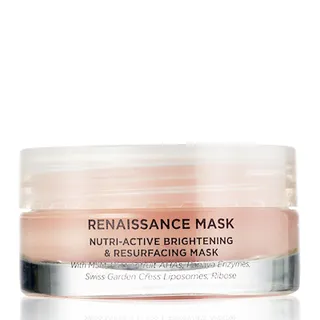
OSKIA Renaissance Brightening and Resurfacing Mask
Works for
ExfoliationLactic acidWorks well
“Designed to increase cell turnover, boost radiance and packed with OSKIA’s trademark blend of beauty-boosting nutrients, this luxuriously-textured exfoliating mask leaves the complexion smoother, more refined and illuminated.”
This product can help exfoliate the skin. In other words, it helps break down the bonds between dead cells on the surface of the skin and speed up the skin turnover. Skin often appears softer and brighter after exfoliation, but overdoing it can result in disrupted skin barrier. The following ingredient is doing the exfoliating job in this product: lactic acid.
Anti-agingLactic acidMay help
“for immediate spa facial results and long term anti-ageing & brightening.”
This product contains lactic acid. There is some human evidence that this ingredient helps reduce and prevent fine lines and wrinkles and improve skin elasticity and firmness, though it is smaller or less consistent than the evidence for the best anti-aging ingredients.
Evens skin toneSide benefit · Lactic acidWorks well
This product can help reduce hypepigmentation and even out the skin tone because it contains the following effective ingredients: lactic acid
Keep in mind that you would need to apply any topical skincare targetted at hypigmentation consistently for a couple of months to get a result. No topical skincare product can help get rid of hyperpigmentation (including post-acne marks and age spots) instantly.
MoisturizingSide benefit · Glycerin, Lactic acid + 7 moreWorks
This product contains good ingredients to attract water to the upper layer of the skin. These ingredients are called "humectants": glycerin, lactic acid.
When humectants are on the surface of the skin, they “pull in” the moisture from the outside environment, or from within deeper layers of the skin. If the air is dry, humectants can speed up the moisture loss from the skin. This is why it is a good idea to use another product on top of this one to help "seal in" the moisture (look for ingredients like dimethicone, squalane, oils and butters).
Can it cause trouble?
Irritancy12 strong irritants: Citrus limon fruit extract, Carica papaya fruit extract + 10 more — patch-test recommendedHigh risk
ComedogenicClean of flagged comedogenic ingredientsNone flagged

User reviews
Be the first — your take helps the next person decide.
Ingredients
Filter by role to see what each ingredient is doing.
Glycerin~22–33%
- Irritation risk
- Low
One of the best moisturizing ingredients. Naturally present in skin. It attracts water to the upper layer of the skin working as a humectant
More about GlycerinWater~12–18%
Cetearyl olivate~3.8–5.8%
Sorbitan olivate~2.9–4.4%
Lactic acid~2.3–3.5%
- Irritation risk
- Medium
An exfoliating and moisturizing alpha-hydroxy acid (AHA). Typically causes less irritation than other AHAs, for example, glycolic acid. At high concentrations (about 15%), lactic acid can help reduce lines and wrinkles. Recent studies show that lactic acid can support the "good" bacteria living on skin's surface (healthy skin microbiome)
More about Lactic acidSodium lactate~1.7–2.5%
- Irritation risk
- Medium
Helps attract water to the upper layer of the skin. Is often used to adjust the pH level of the product
More about Sodium lactateDimethyl sulfone~1.5–2.2%
Ribose~1.2–1.9%
- Irritation risk
- Low
Citrus limon fruit extract~1.1–1.7%
- Irritation risk
- High
Used as a fragrance. Can be irritating and cause photosensitivity
More about Citrus limon fruit extractCarica papaya fruit extract~0.9–1.4%
- Irritation risk
- High
Vitis vinifera fruit extract~0.55–1.25%
- Irritation risk
- Medium
A plant extract that helps attract water to the upper layer of the skin. It might be helpful in neutralizing free radicals in skin, but is less potent than the extract from the seeds
More about Vitis vinifera fruit extractPassiflora quadrangularis fruit extract~0.5–1.1%
- Irritation risk
- Low
Ananas sativus fruit extract~0.45–1%
- Irritation risk
- Medium
A fruit extract that might help to attract water to the upper layer of the skin, but there is no evidence for any other benefits to the skin
More about Ananas sativus fruit extractPetasites japonicus root extract~0.4–0.95%
- Irritation risk
- Low
Lepidium sativum sprout extract~0.4–0.9%
- Irritation risk
- Low
Rhodinols~0.35–0.85%
- Irritation risk
- Low
Alpha-glucan oligosaccharide~0.4–1%
- Irritation risk
- Low
Helps attract water to the upper layer of the skin
More about Alpha-glucan oligosaccharideInulin~0.35–0.8%
- Irritation risk
- Low
Helps attract water to the upper layer of the skin. Is claimed to support the growth of "good" bacteria in skin (as a "prebiotic"), but the research is lacking
More about InulinDehydroacetic acid~0.3–0.6%
Lecithin~0.35–0.85%
- Irritation risk
- Low
Used mostly for creating emulsions - helping oil and water mix together. Helps soften the upper layer of the skin
More about LecithinJuniperus mexicana wood oil~0.2–0.75%
- Irritation risk
- Low
Cymbopogon martini oil~0.15–0.7%
- Irritation risk
- High
Aromatic plant oil used in cosmetics as a fragrance. A likely irritant
More about Cymbopogon martini oilAlcohol denat.~0.2–0.7%
- Irritation risk
- High
Produces temporary toning effect. Can help dissolve other ingredients or preserve products
More about Alcohol denat.Xanthan gum~0.15–0.65%
- Irritation risk
- Low
Used to create a thicker product consistency
More about Xanthan gumCinnamomum camphora linalooliferum wood oil~0.15–0.6%
- Irritation risk
- High
Pelargonium graveolens oil~0.15–0.6%
Eugenia caryophyllus bud oil~0.15–0.55%
Anthemis nobilis flower oil~0.15–0.6%
- Irritation risk
- High
An essential oil that is used as a fragrance and can be irritating. It might have some anti-oxidant effect in skin
More about Anthemis nobilis flower oilPotassium sorbate~0.3–0.6%
Rosa damascena flower oil~0.15–0.7%
- Irritation risk
- High
Used as a fragrance. Can be irritating
More about Rosa damascena flower oilMaltodextrin~0.2–0.75%
- Irritation risk
- Low
Used to stabilize the product formulation and can help absorb oil
More about MaltodextrinPhenoxyethanol~0.15–0.6%
- Irritation risk
- Low
A preservative. It helps prevent bacterial growth in cosmetic products
More about PhenoxyethanolBenzyl alcohol~0.1–0.4%
- Irritation risk
- High
A preservative. Can be used to mask unpleasant smell. Can be irritating
More about Benzyl alcoholCitronellol~0.1–0.35%
Geraniol~0.05–0.25%
Linalool~0.05–0.25%
Eugenol~0.05–0.2%
Ci 77491~0.05–0.2%
- Irritation risk
- Low
A red colorant made of iron oxide. Typically is not irritating
More about Ci 77491Iron oxides~0.05–0.15%
- Irritation risk
- Low
An umbrella term for the following three colorants: CI 77491, CI 77492, CI 77499. They might be able to offer some protection against visible light, but the degree of the protection is not clear
More about Iron oxidesIngredient list view
Glycerin, Water, Cetearyl olivate, Sorbitan olivate, Lactic acid, Sodium lactate, Dimethyl sulfone, Ribose, Citrus limon fruit extract, Carica papaya fruit extract, Vitis vinifera fruit extract, Passiflora quadrangularis fruit extract, Ananas sativus fruit extract, Petasites japonicus root extract, Lepidium sativum sprout extract, Rhodinols, Alpha-glucan oligosaccharide, Inulin, Dehydroacetic acid, Lecithin, Juniperus mexicana wood oil, Cymbopogon martini oil, Alcohol denat., Xanthan gum, Cinnamomum camphora linalooliferum wood oil, Pelargonium graveolens oil, Eugenia caryophyllus bud oil, Anthemis nobilis flower oil, Potassium sorbate, Rosa damascena flower oil, Maltodextrin, Phenoxyethanol, Benzyl alcohol, Citronellol, Geraniol, Linalool, Eugenol, Ci 77491, Iron oxides
Compare prices
Retailers ranked by price — lowest first.
Affiliate links · As an Amazon Associate, WIMJ earns from qualifying purchases.
Worth comparing, line by line.
Match % combines shared ingredients, the first five ingredients, shared actives and hero ingredients, irritancy (lower counts in the alternative's favour), texture and body area. Only products in the same routine step are compared.
| OSKIARenaissance Brightening and Resurfacing MaskYOUR PRODUCT | Cultured SkincareBiome One Mask | FaceGymCheat Mask | RITUALSThe Ritual of Namaste Glow Mask | |
|---|---|---|---|---|
| Match | — | 65% | 63% | 62% |
| Price | — | $63.49 | $87.68 | $39.55 |
| Shared key ingredients | — | 4 of 5 | 3 of 5 | 3 of 5 |
| Key difference | — | Potassium Azeloyl Diglycinate | Madecassic Acid | Saccharum Officinarum Extract |
| Irritancy | High | Low | Medium | High |
| Drying alcohol | Contains drying alcohol | — | — | — |
| View product | Shop | Shop | Shop |


More alternatives: Zelens Instant Recharge Renewal MaskRen Skincare Glycol Latic Radiance Renewal Mask
Product summary
"OSKIA - Renaissance Brightening and Resurfacing Mask" is effective for: Exfoliation and Evens skin tone
This product could be helpful for: Anti-aging and Moisturizing, but its actives are not the most effective or are not well-studied.
Ingredient callouts
- This product contains acids (lactic acid 2.30% - 3.50%). Their concentration is low, and they will not have a strong exfoliating effect. Instead, they work to support the skin natural acid mantle and to attract water (as humectants). Lactic acid is particularly good in attracting water to the upper layer of the skin and improving the skin barrier.
- Humectants (sodium lactate 1.70% - 2.50%, lactic acid 2.30% - 3.50% and glycerin 22.00% - 33.00%). These ingredients help attract water to the upper layer of the skin and improve the skin hydration.
Price
The product retails for 17.99£ in the United Kingdom.
For a detailed price comparison: click here.
Sources cited in this review
Every concentration estimate and effectiveness label is anchored to one of these 9 studies and safety reviews.
- 1
- 2Epidermal and dermal effects of topical lactic acidncbi.nlm.nih.gov
- 3Dual Effects of Alpha-Hydroxy Acids on the Skinpdfs.semanticscholar.org
- 4
- 5
- 6

Affiliate links · As an Amazon Associate, WIMJ earns from qualifying purchases.