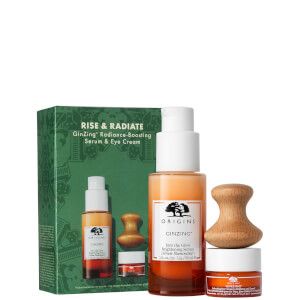
Origins Rise and Radiate Ginzing Radiance-Boosting Serum and Eye Cream
Works for
1 of 3 advertised claims delivered
Moisturizing37 ingredients credited for this claimStrong support
“GinZing™ Refreshing Eye Cream to Brighten and Depuff in Original 5ml This eye treatment with Vitamin C and Niacinamide helps reduce the look of dark circles—instantly—while it depuffs, brightens and hydrates.”
This product can help improve hydration of the skin with the two types of ingredients.
The first type is called “humectants”:
these ingredients help attract water.
When humectants are on the surface of the skin, they “pull in” the moisture from the outside environment, or from
within deeper layers of the skin. The following ingredients in this product do the job:
algae extract, glycerin.
This product also contains ingredients called “occlusives”. They help reduce the speed with which our skin loses moisture to the outside environment. These ingredients also help soften the upper layer of the skin, so it feels less tight and nicer to the touch. The following ingredients in this product do the job: dimethicone, squalane.
The following ingredients in this product are especially good for supporting the skin barrier and helping with the hydration level: phytosphingosine
Exfoliation3 ingredients credited for this claimLimited support
“GinZing™ Into the Glow Brightening Serum 15ml This multi-action serum brightens the look of dull skin in one shot.”
This product might help exfoliate the skin with tartaric acid, but This ingredient is not the most effective.
Anti-aging7 ingredients credited for this claimLimited support
“GinZing™ Refreshing Eye Cream to Brighten and Depuff in Original 5ml This eye treatment with Vitamin C and Niacinamide helps reduce the look of dark circles—instantly—while it depuffs, brightens and hydrates.”
This product does not contain ingredients that are able to reduce fine lines and wrinkles or help with skin elasticity, but it can improve the look of the skin temporarily through moisturization. Well-moisturized skin might also be able to repair the sun damage better.
This ingredient tartaric acid might be able to help neutralize free radicals in skin and help it fight off some of the sun damage.
Anti-oxidationNot advertised by the brand · 17 ingredients credited for this claimModerate support
This product contains antioxidants (tartaric acid) that might be able to help neutralize free radicals in skin to lessen the damage it gets from the UV light (sun). There is not enough evidence to confirm their effectiveness in skin though.
Can it cause trouble?
Irritancy13 strong irritants: Citrus grandis peel oil, Citrus limon peel oil + 11 more — patch-test recommendedHigh risk
Comedogenic4 ingredients rated 2 or more on the 0–5 pore-clogging scale4 flagged


User reviews
Be the first — your take helps the next person decide.
Ingredients
Filter by role to see what each ingredient is doing.
Water~45–55%
Butylene glycol~5.5–6.7%
- Irritation risk
- Low
Used to create a nice product texture and help delivery of other ingredients. Might be somewhat helpful in attracting water to the upper layer of the skin
More about Butylene glycolC9-12 alkane~4.4–5.3%
Citric acid~3–3.7%
- Irritation risk
- Medium
Can work as an exfoliant but is typically used to adjust the product pH
More about Citric acidSodium hydroxide~2.2–2.7%
Tartaric acid~1.8–2.2%
- Irritation risk
- Medium
An AHA (alpha-hydroxy acid). It oxidizes quickly which makes it less effective in skincare formulations. It can support skin's barrier and moisture levels
More about Tartaric acidSodium polyacryloyldimethyl taurate~1.5–1.8%
- Irritation risk
- Medium
Helps oil and water mix together
More about Sodium polyacryloyldimethyl taurateLactic acid~1.2–1.5%
- Irritation risk
- Medium
An exfoliating and moisturizing alpha-hydroxy acid (AHA). Typically causes less irritation than other AHAs, for example, glycolic acid. At high concentrations (about 15%), lactic acid can help reduce lines and wrinkles. Recent studies show that lactic acid can support the "good" bacteria living on skin's surface (healthy skin microbiome)
More about Lactic acidCitrus grandis peel oil~0.95–1.15%
- Irritation risk
- High
A plant oil with high content of volatile compounds that, especially when exposed to air, can cause allergic reactions and irritate the skin
More about Citrus grandis peel oilCitrus limon peel oil~0.65–1%
Citrus aurantium dulcis peel oil~0.5–0.75%
- Irritation risk
- High
An essentil oil from orange peel. Potential allergen and can be irritating
More about Citrus aurantium dulcis peel oilMentha viridis leaf oil~0.4–0.65%
Citral~0.3–0.6%
Linalool~0.3–0.5%
Limonene~0.25–0.45%
- Irritation risk
- High
A common frangrance that can easily irritate skin, especially if exposed to air, light or heat
More about LimonenePanax ginseng root extract~0.3–0.5%
- Irritation risk
- High
A plant extract that might have some anti-inflammatory properties, but solid evidence is lacking. It can be irritating
More about Panax ginseng root extractCoffea arabica seed extract~0.25–0.45%
- Irritation risk
- Low
Might be helpful in neutralizing free radicals in skin
More about Coffea arabica seed extractCarica papaya fruit extract~0.2–0.4%
- Irritation risk
- High
Pyruvic acid~0.2–0.35%
- Irritation risk
- Low
Salicylic acid~0.15–0.3%
- Irritation risk
- High
Used for skin exfoliation. It has an anti-inflammatory and anti-bacterial effect, helps to unclog pores, prevent blemishes and speed up healing of the existing ones. Sometimes referred to as a BHA (beta-hydroxy acid)
More about Salicylic acidCaffeine~0.15–0.3%
- Irritation risk
- Medium
Might be helpful in neutralizing free radicals. Can have a dehydration effect that might somewhat decrease the look of puffy eyes
More about CaffeineTetrahexyldecyl ascorbate~0.15–0.3%
- Irritation risk
- Medium
Being a lipid soluble form of vitamin C, it is more stable than ascorbic acid, but still degrades quickly and needs to be stabilized in a formulation with another ingredient. It is claimed to penetrate skin better than pure vitamin C and have the the similar benefits, but solid studies of its effectiveness are lacking. Is likely to require a higher concentration in a product than pure vitamin C to be effective. It might be able to help reduce pore clogging.
More about Tetrahexyldecyl ascorbateTocopheryl acetate~0.15–0.25%
- Irritation risk
- Medium
A more stable but less bio-available form of vitamin E compared to Tocopherol. Might help moisturize and protect the skin from free radicals, but mostly used in low concentrations to stabilize other ingredients.
More about Tocopheryl acetateAvena sativa kernel extract~0.15–0.3%
- Irritation risk
- Low
An effective moisturizing and skin barrier repair ingredient. Helps calm down inflammation and has some anti-oxidant properties
More about Avena sativa kernel extractSodium hyaluronate~0.15–0.25%
- Irritation risk
- Low
One of the best moisturizing ingredients. Attracts water into the upper layer of the skin
More about Sodium hyaluronateTrehalose~0.15–0.25%
- Irritation risk
- Low
A sugar that attracts water to the upper layer of the skin
More about TrehaloseSqualane~0.2–0.35%
- Irritation risk
- Low
An oil naturally present in skin. Works as an emollient to soften the skin and form a protective layer on its surface without a greasy feeling.
More about SqualaneGlycerin~0.15–0.3%
- Irritation risk
- Low
One of the best moisturizing ingredients. Naturally present in skin. It attracts water to the upper layer of the skin working as a humectant
More about GlycerinAlgae extract~0.2–0.35%
- Irritation risk
- Low
- Comedogenicity
- 3/5
Plant extract that helps the skin to attract water and make it more smooth for touch. Also shows promise of anti-aging properties, but research is not extensive yet
More about Algae extractMenthol~0.1–0.2%
- Irritation risk
- High
Lecithin~0.15–0.3%
- Irritation risk
- Low
Used mostly for creating emulsions - helping oil and water mix together. Helps soften the upper layer of the skin
More about LecithinCoco-caprylate/caprate~0.15–0.3%
- Irritation risk
- Low
Helps to soften the upper layer of the skin without creating a greasy texture
More about Coco-caprylate/caprateXanthan gum~0.15–0.25%
- Irritation risk
- Low
Used to create a thicker product consistency
More about Xanthan gumHydroxyethyl acrylate/sodium acryloyldimethyl taurate copolymer~0.15–0.25%
- Irritation risk
- Medium
A gelling agent that thickens the product consistency and leaves the skin with a velvety finish
More about Hydroxyethyl acrylate/sodium acryloyldimethyl taurate copolymerPolysorbate 20~0.15–0.3%
Polysorbate 60~0.15–0.3%
Ppg-5-ceteth-20~0.15–0.3%
- Irritation risk
- Medium
A solvent with some emollient properties
More about Ppg-5-ceteth-20Plankton extract~0.15–0.25%
- Irritation risk
- Medium
- Comedogenicity
- 3/5
Can help attract water to the upper layer of the skin
More about Plankton extractCaprylyl glycol~0.15–0.3%
- Irritation risk
- Medium
Helps preserve products and creates a nice product texture
More about Caprylyl glycolEthylhexylglycerin~0.15–0.25%
Bht~0.15–0.25%
Phenoxyethanol~0.15–0.25%
- Irritation risk
- Low
A preservative. It helps prevent bacterial growth in cosmetic products
More about PhenoxyethanolCitrus aurantium dulcis oil~0.15–0.25%
- Irritation risk
- High
Used as a fragrance. It can be irritating and cause photosensitivity
More about Citrus aurantium dulcis oilDatem~0.15–0.3%
Cream~0.15–0.3%
- Irritation risk
- Low
Water~0.15–0.25%
Butylene glycol~0.15–0.25%
- Irritation risk
- Low
Used to create a nice product texture and help delivery of other ingredients. Might be somewhat helpful in attracting water to the upper layer of the skin
More about Butylene glycolPeg-100 stearate~0.2–0.4%
- Irritation risk
- Low
Helps oil and water mix togehter and creates a nice product texture
More about Peg-100 stearateDimethicone~0.2–0.35%
- Irritation risk
- Low
A silicone that helps to reduce water loss from the surface of the skin. Can temporarily "fill in" lines and wrinkles, absorb oil, and create a nice product finish
More about DimethiconeSilica~0.25–0.45%
Cetyl ricinoleate~0.15–0.3%
- Irritation risk
- Low
An emollient that helps soften the upper layer of the skin
More about Cetyl ricinoleateOlea europaea fruit oil~0.15–0.25%
- Irritation risk
- Medium
An emollient that helps soften the skin but is not effective for restoring its barrier function. Might be helpful to calm down inflammation
More about Olea europaea fruit oilGlycerin~0.15–0.3%
- Irritation risk
- Low
One of the best moisturizing ingredients. Naturally present in skin. It attracts water to the upper layer of the skin working as a humectant
More about GlycerinPanax ginseng root extract~0.15–0.3%
- Irritation risk
- High
A plant extract that might have some anti-inflammatory properties, but solid evidence is lacking. It can be irritating
More about Panax ginseng root extractCoffea arabica seed oil~0.15–0.25%
- Irritation risk
- Medium
Might be helpful in neutralizing free radicals in skin
More about Coffea arabica seed oilCaffeine~0.15–0.25%
- Irritation risk
- Medium
Might be helpful in neutralizing free radicals. Can have a dehydration effect that might somewhat decrease the look of puffy eyes
More about CaffeineCitrus aurantium dulcis peel extract~0.1–0.2%
Aminopropyl ascorbyl phosphate~0.1–0.2%
- Irritation risk
- Medium
A more stable but less potent derivative of vitamin C. It can help neautralize free radicals and even out the skin tone if used in high enough concentration (required levels are likely to be much higher than for pure vitamin C, and solid studies are lacking at the moment)
More about Aminopropyl ascorbyl phosphateCaprylic/capric triglyceride~0.2–0.4%
- Irritation risk
- Medium
A good mix of fatty acids that forms a protective layer on the skin. Improves the shelf life of products. Derived from coconut and glycerin
More about Caprylic/capric triglycerideHypnea musciformis extract~0.15–0.3%
- Irritation risk
- Low
- Comedogenicity
- 3/5
Might help to attract water to the upper layer of the skin
More about Hypnea musciformis extractGelidiella acerosa extract~0.15–0.3%
- Irritation risk
- High
An algae extract that can help attract water to the upper layer of the skin and have some anti-oxidant properties
More about Gelidiella acerosa extractSigesbeckia orientalis extract~0.15–0.25%
- Irritation risk
- Medium
A plant extract that can contain an anti-inflammatory compound
More about Sigesbeckia orientalis extractAscophyllum nodosum extract~0.15–0.3%
- Irritation risk
- Low
Brown seaweed extract. Can help attract water to the upper layer of the skin and might have some antioxidant effect
More about Ascophyllum nodosum extractChrysanthellum indicum extract~0.15–0.3%
Asparagopsis armata extract~0.15–0.3%
- Irritation risk
- Low
Red seaweed extract. Can help attract water to the upper layer of the skin and might have some antioxidant effect
More about Asparagopsis armata extractCucumis sativus fruit extract~0.2–0.35%
- Irritation risk
- Medium
Might be somewhat helpful in reducing hyperpigmentation and neutralizing free radicals but its typical concentration in a product is too low for having an effect
More about Cucumis sativus fruit extractPyrus malus fruit extract~0.15–0.3%
- Irritation risk
- Medium
Can have some moisturizing properties due to its sugar content
More about Pyrus malus fruit extractScutellaria baicalensis root extract~0.15–0.25%
- Irritation risk
- High
A plant extract that might contain a compound baicalin that could be helpful in neutralizing free radicals and reducing inflammation in skin. The baicalin concentration in skincare products is often too low for an effective action. Can be used for its fragrant properties
More about Scutellaria baicalensis root extractMolasses extract~0.15–0.3%
- Irritation risk
- Low
Helps attract water to the upper layer of the skin. Might have a weak skin-lightening effect, but solid research is missing
More about Molasses extractSaccharum officinarum extract~0.15–0.3%
- Irritation risk
- Low
Sugar extract that helps attract water to the upper layer of the skin
More about Saccharum officinarum extractButyrospermum parkii butter~0.2–0.4%
- Irritation risk
- Low
- Comedogenicity
- 3/5
A great moisturising ingredient that softens the skin and reduces water loss from its upper layer. It also can be helpful in protecting skin from free radicals
More about Butyrospermum parkii butterSimmondsia chinensis seed oil~0.25–0.45%
- Irritation risk
- Medium
Softens the upper layer of skin and helps restore the healthy skin barrier. Has shown to help calm down inflammation in skin. It is a stable oil, meaning that it retains its properties even when exposed to air.
More about Simmondsia chinensis seed oilSodium hyaluronate~0.2–0.35%
- Irritation risk
- Low
One of the best moisturizing ingredients. Attracts water into the upper layer of the skin
More about Sodium hyaluronateNiacinamide~0.2–0.35%
- Irritation risk
- Low
Is proven to be effective in reducing blemishes, evening out skin tone and helping to improve lines and wrinkles. It helps the skin to repair sun damage, calm down inflammation and keep maintain good levels of moisture. The concentration of about 2% is effective for supporting the skin barrier and evening out the skin tone. Concentration of 4-6% is better for helping with acne and balancing the sebum production
More about NiacinamideLinoleic acid~0.3–0.55%
- Irritation risk
- Low
An excellent emollient. Helps soften the skin, restore its barrier function, and can help to calm down inflammation. It can be helpful to prevent blemishes and clogged pores
More about Linoleic acidPhytosphingosine~0.25–0.45%
- Irritation risk
- Low
A type of lipid that is naturally present in skin. It might help in repairing skin barrier function and has anti-bacterial effect
More about PhytosphingosineTocopheryl acetate~0.2–0.4%
- Irritation risk
- Medium
A more stable but less bio-available form of vitamin E compared to Tocopherol. Might help moisturize and protect the skin from free radicals, but mostly used in low concentrations to stabilize other ingredients.
More about Tocopheryl acetateMethyl trimethicone~0.2–0.35%
- Irritation risk
- Low
A type of silicone that helps create a silky product finish and dissolve other ingredients
More about Methyl trimethiconeTrehalose~0.2–0.4%
- Irritation risk
- Low
A sugar that attracts water to the upper layer of the skin
More about TrehaloseTribehenin~0.25–0.45%
- Irritation risk
- Low
Used to create a thicker product consistency and soften the upper layer of the skin
More about TribeheninInulin~0.2–0.4%
- Irritation risk
- Low
Helps attract water to the upper layer of the skin. Is claimed to support the growth of "good" bacteria in skin (as a "prebiotic"), but the research is lacking
More about InulinSorbitol~0.25–0.4%
- Irritation risk
- Low
Helps attract water to the upper layer of the skin and improves the product texture
More about SorbitolEthylhexylglycerin~0.25–0.45%
Caprylyl glycol~0.25–0.45%
- Irritation risk
- Medium
Helps preserve products and creates a nice product texture
More about Caprylyl glycolTocopherol~0.25–0.45%
- Irritation risk
- Low
Pure form of vitamin E. Can help moisturise and protect the skin from free radicals. Often used to help stabilise other ingredients or the formula itself
More about TocopherolMyristyl alcohol~0.25–0.45%
- Irritation risk
- High
Helps to stabilize the product formulation while softening the upper layer of the skin. Can be irritating
More about Myristyl alcoholHydrogenated lecithin~0.25–0.45%
- Irritation risk
- Low
Helps to retain moisture by creating a protective barrier on the skin. Rich in fatty acids. Improves product texture and helps with the penetration of other ingredients.
More about Hydrogenated lecithinJojoba wax peg-120 esters~0.25–0.45%
Carbomer~0.25–0.45%
- Irritation risk
- Low
Helps create a thicker or gel-like product texture. It is not a surfactant but can be used in gentle cleansing formulations
More about CarbomerBehenyl alcohol~0.3–0.55%
- Irritation risk
- Low
Non-drying alcohol that helps water and oil mix together. Also serves as an emollient
More about Behenyl alcoholSodium hydroxide~0.25–0.4%
Bht~0.2–0.4%
Hydroxyacetophenone~0.25–0.45%
Sodium metabisulfite~0.1–0.2%
Sodium sulfite~0.1–0.2%
Disodium edta~0.25–0.45%
Phenoxyethanol~0.25–0.5%
- Irritation risk
- Low
A preservative. It helps prevent bacterial growth in cosmetic products
More about PhenoxyethanolChlorphenesin~0.16–0.32%
Sorbic acid~0.25–0.45%
Potassium sorbate~0.25–0.45%
Mica~0.25–0.45%
- Irritation risk
- Low
Creates an illusion of smoother and more radiant skin tone. Adds shimmer to the skin by reflecting light
More about MicaTitanium dioxide~0.3–0.55%
- Irritation risk
- Low
Works as a UV filter when used in high concentrations. It is photostable and is effective mostly against the UVB light, with some protection in the UVA range. In small concentrations, used for its ability to improve the color of cosmetic products. Is usually well tolerated by the skin
More about Titanium dioxideCi 77891~0.15–0.3%
- Irritation risk
- Low
Iron oxides~0.15–0.25%
- Irritation risk
- Low
An umbrella term for the following three colorants: CI 77491, CI 77492, CI 77499. They might be able to offer some protection against visible light, but the degree of the protection is not clear
More about Iron oxidesCi 77491~0.15–0.3%
- Irritation risk
- Low
A red colorant made of iron oxide. Typically is not irritating
More about Ci 77491Iron oxides~0.15–0.25%
- Irritation risk
- Low
An umbrella term for the following three colorants: CI 77491, CI 77492, CI 77499. They might be able to offer some protection against visible light, but the degree of the protection is not clear
More about Iron oxidesCi 77492~0.1–0.15%
Ci 77163~0.1–0.15%
Ingredient list view
Unknown, Water, Butylene glycol, C9-12 alkane, Citric acid, Sodium hydroxide, Tartaric acid, Sodium polyacryloyldimethyl taurate, Lactic acid, Citrus grandis peel oil, Citrus limon peel oil, Citrus aurantium dulcis peel oil, Mentha viridis leaf oil, Citral, Linalool, Limonene, Panax ginseng root extract, Coffea arabica seed extract, Carica papaya fruit extract, Pyruvic acid, Salicylic acid, Caffeine, Tetrahexyldecyl ascorbate, Tocopheryl acetate, Avena sativa kernel extract, Sodium hyaluronate, Trehalose, Squalane, Glycerin, Algae extract, Menthol, Lecithin, Coco-caprylate/caprate, Xanthan gum, Hydroxyethyl acrylate/sodium acryloyldimethyl taurate copolymer, Polysorbate 20, Polysorbate 60, Ppg-5-ceteth-20, Plankton extract, Caprylyl glycol, Ethylhexylglycerin, Bht, Phenoxyethanol, Citrus aurantium dulcis oil, Datem, Cream, Water, Butylene glycol, Peg-100 stearate, Dimethicone, Silica, Cetyl ricinoleate, Olea europaea fruit oil, Glycerin, Panax ginseng root extract, Coffea arabica seed oil, Caffeine, Citrus aurantium dulcis peel extract, Aminopropyl ascorbyl phosphate, Caprylic/capric triglyceride, Hypnea musciformis extract, Gelidiella acerosa extract, Sigesbeckia orientalis extract, Ascophyllum nodosum extract, Chrysanthellum indicum extract, Asparagopsis armata extract, Cucumis sativus fruit extract, Pyrus malus fruit extract, Scutellaria baicalensis root extract, Molasses extract, Saccharum officinarum extract, Butyrospermum parkii butter, Simmondsia chinensis seed oil, Sodium hyaluronate, Niacinamide, Linoleic acid, Phytosphingosine, Tocopheryl acetate, Methyl trimethicone, Trehalose, Tribehenin, Inulin, Sorbitol, Ethylhexylglycerin, Caprylyl glycol, Tocopherol, Myristyl alcohol, Hydrogenated lecithin, Jojoba wax peg-120 esters, Carbomer, Behenyl alcohol, Sodium hydroxide, Bht, Hydroxyacetophenone, Sodium metabisulfite, Sodium sulfite, Disodium edta, Phenoxyethanol, Chlorphenesin, Sorbic acid, Potassium sorbate, Mica, Titanium dioxide, Ci 77891, Iron oxides, Ci 77491, Iron oxides, Ci 77492, Ci 77163
Compare prices
Retailers ranked by price — lowest first.

Affiliate links · prices updated regularly
Worth comparing, line by line.
Match % combines shared ingredients, the first five ingredients, shared actives and hero ingredients, irritancy (lower counts in the alternative's favour), texture and body area. Only products in the same routine step are compared.
| OriginsRise and Radiate Ginzing Radiance-Boosting Serum and Eye CreamYOUR PRODUCT | CeraVeBlemish Control Gel Moisturiser with 2% Salicylic Acid & Niacinamide for Blemish-Prone Skin | Paula's choiceC5 Super Boost Moisturizer | SkinfixResurface+ AHA/BHA Enzyme Exfoliating Pads for Face and Targeted Body | |
|---|---|---|---|---|
| Match | — | 75% | 72% | 69% |
| Price | $46.27 | $14.54−$31.73 | $45.00−$1.27 | $88.79+$42.52 |
| Shared key ingredients | — | 6 of 23 | 3 of 23 | 3 of 23 |
| Key difference | — | Glycolic Acid | Ascorbyl Glucoside | Glycolic Acid |
| Irritancy | High | Low | Medium | Medium |
| Drying alcohol | — | — | — | — |
| View product | Shop | Shop | Shop |


Product summary
"Origins - Rise and Radiate Ginzing Radiance-Boosting Serum and Eye Cream" has a good moisturizing formula. This moisturizer uses a good combo of humectants and emollients. These both types of ingredients are essentials for improving the skin hydration and keeping the skin barrier healthy. Algae extract, glycerin, sodium hyaluronate, trehalose and hypnea musciformis extract in this product (humectants) attract water molecules to the upper layer of the skin (the water comes from the outside air or from the deeper layers of the skin if the air is dry). Emollients in this formulation (phytosphingosine, algae extract, dimethicone, squalane and cetyl ricinoleate) help to reduce the moisture loss from the skin. They also soften the skin surface and relieve the feeling of dryness and tightness.
Ingredient callouts
- Another benefit is that this moisturizer contain ceramides (phytosphingosine 0.25% - 0.45%). Ceramides are an important part of our natural skin barrier. The ceramides used in skincare are synthetic or come from plants. They help soften the skin and can help "fill the gaps" in the skin barrier, keeping the skin hydrated and resilient for longer.
Irritation risk
This moisturizer contains a bunch of common irritants, including ingredients that do not provide any known benefit for the skin. It might not be the best choice if your skin is sensitive. We assess the overall irritancy of this moisturizer to be high. For a detailed overview of all potential irritants: click here
You can see the detailed formula review with the breakdown of all actives in the product and the full ingredient list with estimated concentrations in the tables below.
Price
The product retails for 35.00£ in the United Kingdom.
For a detailed price comparison: click here.
Sources cited in this review
Every concentration estimate and effectiveness label is anchored to one of these 45 studies and safety reviews.
- 1
- 2
- 3Method of treating wrinkles using tartaric acidpatents.google.com
- 4
- 5Epidermal and dermal effects of topical lactic acidncbi.nlm.nih.gov
- 6Dual Effects of Alpha-Hydroxy Acids on the Skinpdfs.semanticscholar.org

Affiliate links · As an Amazon Associate, WIMJ earns from qualifying purchases.