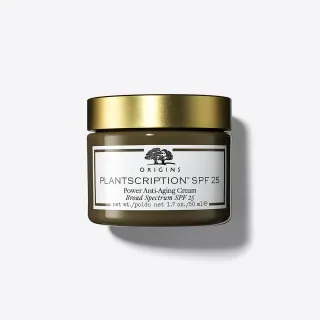
Works for
2 of 2 advertised claims delivered
MoisturizingLinoleic acid, Phytosphingosine + 27 moreStrong evidence
“Our best anti-aging cream—delivers age-correcting hydration, UV protection & a youthful look all in one.”
This product can help improve hydration of the skin with the two types of ingredients.
The first type is called “humectants”:
these ingredients help attract water.
When humectants are on the surface of the skin, they “pull in” the moisture from the outside environment, or from
within deeper layers of the skin. The following ingredients in this product do the job:
glucosamine hcl, glycerin.
This product also contains ingredients called “occlusives”. They help reduce the speed with which our skin loses moisture to the outside environment. These ingredients also help soften the upper layer of the skin, so it feels less tight and nicer to the touch. The following ingredients in this product do the job: dimethicone, myristyl myristate.
The following ingredients in this product are especially good for supporting the skin barrier and helping with the hydration level: acetyl hexapeptide-8, linoleic acid, phytosphingosine
Anti-agingAcetyl hexapeptide-8, Glucosamine hcl + 2 moreModerate evidence
“This SPF moisturizer protects skin from the sun to help prevent future signs of aging while delivering anti-aging hydration & reduces the appearance of lines.”
This product contains acetyl hexapeptide-8. This ingredient might be able to help reduce and prevent fine lines and wrinkles, improve skin elasticity and firmness, but there is not enough evidence that it actually works.
Evens skin toneNot advertised by the brand · Glucosamine hcl, Pisum sativum extract + 1 moreModerate evidence
The following ingredient (ingredients) in this product might be helpful, but there is no evidence to confirm that it actually works: glucosamine hcl.
Can it cause trouble?
Irritancy16 strong irritants: Rosa damascena flower oil, Lavandula angustifolia oil + 14 more — patch-test recommendedHigh risk
Comedogenic6 ingredients rated 2 or more on the 0–5 pore-clogging scale6 flagged


User reviews
Be the first — your take helps the next person decide.
Ingredients
Filter by role to see what each ingredient is doing.
Butyl methoxydibenzoylmethane3%
- Irritation risk
- Medium
Avobenzone. An organic, or so-called "chemical" UV filter. Protects against both UVA and UVB rays. Needs to be combined with other filters in a formulation to be stable.
More about Butyl methoxydibenzoylmethaneHomosalate5%
- Irritation risk
- Medium
A weak sunscreen that offers some protection against the sun rays that cause sunburn (UVB), but does not offer meaningful protection against protect against the most aging sun rays (UVA). It loses its effectiveness quickly when exposed to sunlight. It is an organic, or so called "chemical" sunscreen. When used in low concentrations, helps to stabilize the product formulation
More about HomosalateEthylhexyl salicylate4.5%
- Irritation risk
- Low
Octisalate. A UV filter. It offers some protection against the sun rays that cause sunburn (UVB), but does not protect against the most aging sun rays (UVA). It loses its effectiveness quickly when exposed to sunlight. It is an organic, or so called "chemical" sunscreen
More about Ethylhexyl salicylateOctocrylene2.8%
- Irritation risk
- Medium
A weak sunscreen that protects against the sun rays that cause sunburn (UVB) and is somewhat effective against the UVA rays. It is quite stable and can help stabilize other, more vulnerable, sunscreen ingredients like Avobenzone. It is an organic, or so called "chemical" sunscreen
More about OctocryleneWater~45–55%
Butyloctyl salicylate~6.4–7.9%
- Irritation risk
- Medium
A synthetic ester of salicylic acid that is used to help disperse pigments and boost effectiveness of sunscreen ingredients. It is able to absorb UV light (working as an organic, or chemical filter), but is not approved as a sunscreen ingredient on its own
More about Butyloctyl salicylateNylon-12~5.7–7%
Behenyl alcohol~4.6–5.6%
- Irritation risk
- Low
Non-drying alcohol that helps water and oil mix together. Also serves as an emollient
More about Behenyl alcoholOctyldodecyl neopentanoate~3.4–4.1%
- Irritation risk
- Low
An emollient that helps soften the skin. Often used to stabilize other ingredients, for example, sunscreen
More about Octyldodecyl neopentanoateMyristyl myristate~2.6–3.2%
- Irritation risk
- Medium
- Comedogenicity
- 3/5
An emollient. Is not recommended for acne-prone skin as it can be comedogenic
More about Myristyl myristateDimethicone~2–2.4%
- Irritation risk
- Low
A silicone that helps to reduce water loss from the surface of the skin. Can temporarily "fill in" lines and wrinkles, absorb oil, and create a nice product finish
More about DimethiconeCetyl esters~1.6–1.9%
- Irritation risk
- Low
Helps soften upper layer of the skin and can enhance penetration of other ingredients into the upper layer of the skin
More about Cetyl estersPolyethylene~1.6–1.9%
Butylene glycol~1–1.2%
- Irritation risk
- Low
Used to create a nice product texture and help delivery of other ingredients. Might be somewhat helpful in attracting water to the upper layer of the skin
More about Butylene glycolAmmonium acryloyldimethyltaurate/vp copolymer~0.75–1.15%
- Irritation risk
- Low
Increases thickness of a product. Texture enhancer for oil-in-water emulsions
More about Ammonium acryloyldimethyltaurate/vp copolymerGlycerin~0.65–1%
- Irritation risk
- Low
One of the best moisturizing ingredients. Naturally present in skin. It attracts water to the upper layer of the skin working as a humectant
More about GlycerinRosa damascena flower oil~0.55–0.85%
- Irritation risk
- High
Used as a fragrance. Can be irritating
More about Rosa damascena flower oilLavandula angustifolia oil~0.5–0.8%
- Irritation risk
- High
An essential oil. Potential allergen and can be irritating. It has some anti-bacterial properties
More about Lavandula angustifolia oilPelargonium graveolens flower oil~0.5–0.75%
- Irritation risk
- High
An essential oil. Can be irritating. Can become an allergen with oxidation
More about Pelargonium graveolens flower oilIllicium verum fruit/seed oil~0.5–0.8%
- Irritation risk
- Low
Citrus aurantium bergamia fruit oil~0.45–0.7%
- Irritation risk
- High
A plant oil with a high content of volatile compounds that can irritate the skin and lead to allergic reactions. Can lead to photosensitivity
More about Citrus aurantium bergamia fruit oilCarthamus tinctorius seed oil~0.55–0.8%
- Irritation risk
- Low
An emollient that helps soften the skin and might help calm down inflammation
More about Carthamus tinctorius seed oilMyristica fragrans kernel oil~0.4–0.65%
Citrus aurantium dulcis peel oil~0.35–0.65%
- Irritation risk
- High
An essentil oil from orange peel. Potential allergen and can be irritating
More about Citrus aurantium dulcis peel oilCitrus nobilis peel oil~0.3–0.6%
- Irritation risk
- High
A plant oil with high content of volatile compounds that, especially when exposed to air, can cause allergic reactions and irritate the skin
More about Citrus nobilis peel oilCitrus limon peel oil~0.3–0.55%
Litsea cubeba fruit oil~0.3–0.5%
- Irritation risk
- High
An essential oil with a lemon-like smell that is extracted from a fruit grown in Asia. Used as a fragrance
More about Litsea cubeba fruit oilHibiscus abelmoschus extract~0.3–0.6%
- Irritation risk
- Low
Geraniol~0.3–0.55%
Linalool~0.3–0.55%
Citronellol~0.3–0.55%
Limonene~0.3–0.55%
- Irritation risk
- High
A common frangrance that can easily irritate skin, especially if exposed to air, light or heat
More about LimoneneCitral~0.3–0.55%
Peg-6~0.3–0.6%
- Irritation risk
- Low
Helps to dissolve other ingredients and attract water to the upper layer of the skin
More about Peg-6Peg-100 stearate~0.45–0.65%
- Irritation risk
- Low
Helps oil and water mix togehter and creates a nice product texture
More about Peg-100 stearateGlyceryl stearate~0.45–0.65%
- Irritation risk
- Low
An emollient that softens the skin and forms a protective layer on its surface. Helps water and oil mix together
More about Glyceryl stearateCaprylic/capric triglyceride~0.45–0.7%
- Irritation risk
- Medium
A good mix of fatty acids that forms a protective layer on the skin. Improves the shelf life of products. Derived from coconut and glycerin
More about Caprylic/capric triglycerideHydrogenated vegetable oil~0.4–0.65%
- Irritation risk
- Low
- Comedogenicity
- 2/5
An oil from a mixture of different vegetables. Helps soften the upper layer of the skin
More about Hydrogenated vegetable oilSteareth-21~0.45–0.65%
Anogeissus leiocarpus bark extract~0.3–0.6%
- Irritation risk
- High
A tree bark extract that has antibacterial properties and might have an anti-oxidant effect. Its effectiveness in skin has not been studied
More about Anogeissus leiocarpus bark extractSigesbeckia orientalis extract~0.3–0.55%
- Irritation risk
- Medium
A plant extract that can contain an anti-inflammatory compound
More about Sigesbeckia orientalis extractCentaurium erythraea extract~0.3–0.55%
- Irritation risk
- Medium
A plant extract that can help calm down inflammation in skin
More about Centaurium erythraea extractRubus idaeus leaf extract~0.3–0.55%
- Irritation risk
- Medium
A plant extract that might have some anti-oxidant properties but evidence of effectiveness in skin is lacking
More about Rubus idaeus leaf extractRosmarinus officinalis leaf extract~0.3–0.55%
- Irritation risk
- High
Can be helpful in reducing inflammation in skin, including inflamed acne. It can be irritating
More about Rosmarinus officinalis leaf extractTriticum vulgare germ extract~0.4–0.65%
- Irritation risk
- Medium
- Comedogenicity
- 3/5
Plant extract that might have moisturizing properties. Avoid if you suffer from wheat or gluten intolerance
More about Triticum vulgare germ extractHordeum vulgare extract~0.4–0.65%
- Irritation risk
- Medium
A plant extract that might have some anti-oxidant properties. Avoid if you are sensitive to gluten
More about Hordeum vulgare extractBambusa vulgaris extract~0.3–0.55%
- Irritation risk
- Low
Peucedanum graveolens extract~0.3–0.55%
- Irritation risk
- High
A plant extract. Might have an antioxidant effect. Can be used as a fragrance
More about Peucedanum graveolens extractCoffea arabica seed extract~0.3–0.55%
- Irritation risk
- Low
Might be helpful in neutralizing free radicals in skin
More about Coffea arabica seed extractLaminaria digitata extract~0.3–0.6%
- Irritation risk
- Low
- Comedogenicity
- 3/5
Seaweed extract that helps the skin to attract water and make it more smooth for touch. Also shows promise of anti-aging properties, but good research is lacking at the moment
More about Laminaria digitata extractTrehalose~0.3–0.55%
- Irritation risk
- Low
A sugar that attracts water to the upper layer of the skin
More about TrehaloseCassia alata leaf extract~0.3–0.6%
- Irritation risk
- Medium
Might have some anti-oxidant properties. Can be used as a fragrance. Can be irritating
More about Cassia alata leaf extractTetrahexyldecyl ascorbate~0.3–0.6%
- Irritation risk
- Medium
Being a lipid soluble form of vitamin C, it is more stable than ascorbic acid, but still degrades quickly and needs to be stabilized in a formulation with another ingredient. It is claimed to penetrate skin better than pure vitamin C and have the the similar benefits, but solid studies of its effectiveness are lacking. Is likely to require a higher concentration in a product than pure vitamin C to be effective. It might be able to help reduce pore clogging.
More about Tetrahexyldecyl ascorbateSodium hyaluronate~0.3–0.55%
- Irritation risk
- Low
One of the best moisturizing ingredients. Attracts water into the upper layer of the skin
More about Sodium hyaluronateCaffeine~0.3–0.55%
- Irritation risk
- Medium
Might be helpful in neutralizing free radicals. Can have a dehydration effect that might somewhat decrease the look of puffy eyes
More about CaffeineAcetyl hexapeptide-8~0.3–0.55%
- Irritation risk
- Low
A type of peptide. Peptides are excellent moisturizers and might be able support collagen production reducing fine lines and wrinkles
More about Acetyl hexapeptide-8Di-ppg-2 myreth-10 adipate~0.4–0.65%
Caprylyl glycol~0.4–0.6%
- Irritation risk
- Medium
Helps preserve products and creates a nice product texture
More about Caprylyl glycolMicrococcus lysate~0.3–0.55%
- Irritation risk
- Low
Consists of remains of dead bacteria cells. Is likely helpful in attracting water to the upper layer of the skin. Might be helpful in reducing inflammation and neutralizing free radicals in skin. It is claimed to be a "DNA repair enzyme"
More about Micrococcus lysateCholesterol~0.45–0.65%
- Irritation risk
- Low
An emollient that is naturally found in skin
More about CholesterolLecithin~0.45–0.65%
- Irritation risk
- Low
Used mostly for creating emulsions - helping oil and water mix together. Helps soften the upper layer of the skin
More about LecithinTrisiloxane~0.3–0.55%
Linoleic acid~0.5–0.75%
- Irritation risk
- Low
An excellent emollient. Helps soften the skin, restore its barrier function, and can help to calm down inflammation. It can be helpful to prevent blemishes and clogged pores
More about Linoleic acidPhytosphingosine~0.45–0.65%
- Irritation risk
- Low
A type of lipid that is naturally present in skin. It might help in repairing skin barrier function and has anti-bacterial effect
More about PhytosphingosineEthylhexylglycerin~0.3–0.55%
Sodium pca~0.3–0.55%
- Irritation risk
- Low
Naturally present in skin and helps to attract water to its upper layer
More about Sodium pcaSqualane~0.45–0.7%
- Irritation risk
- Low
An oil naturally present in skin. Works as an emollient to soften the skin and form a protective layer on its surface without a greasy feeling.
More about SqualaneGlucosamine hcl~0.3–0.55%
- Irritation risk
- Low
Might be able to stimulate production of skin's natural moisturizing compounds such as hyaluronic acid. Could be helpful for evening the skin tone.
More about Glucosamine hclPisum sativum extract~0.35–0.6%
- Irritation risk
- Medium
Might be helpful in protecting skin collagen and elastin from breaking down but solid research is lacking
More about Pisum sativum extractTocopheryl acetate~0.3–0.6%
- Irritation risk
- Medium
A more stable but less bio-available form of vitamin E compared to Tocopherol. Might help moisturize and protect the skin from free radicals, but mostly used in low concentrations to stabilize other ingredients.
More about Tocopheryl acetateCrithmum maritimum extract~0.3–0.6%
- Irritation risk
- Low
- Comedogenicity
- 3/5
An algae extract that might have anti-oxidant properties
More about Crithmum maritimum extractHydrolyzed algin~0.3–0.55%
- Irritation risk
- Low
- Comedogenicity
- 3/5
Derived from brown algae. Helps attract water to the upper layer of the skin
More about Hydrolyzed alginSodium dehydroacetate~0.3–0.55%
Maltodextrin~0.4–0.6%
- Irritation risk
- Low
Used to stabilize the product formulation and can help absorb oil
More about MaltodextrinHexylene glycol~0.25–0.45%
- Irritation risk
- Medium
Helps create a more spreadable product texture
More about Hexylene glycolCitric acid~0.25–0.45%
- Irritation risk
- Medium
Can work as an exfoliant but is typically used to adjust the product pH
More about Citric acidPotassium sorbate~0.25–0.5%
Disodium edta~0.25–0.45%
Phenoxyethanol~0.25–0.45%
- Irritation risk
- Low
A preservative. It helps prevent bacterial growth in cosmetic products
More about PhenoxyethanolMica~0.25–0.45%
- Irritation risk
- Low
Creates an illusion of smoother and more radiant skin tone. Adds shimmer to the skin by reflecting light
More about MicaIngredient list view
Butyl methoxydibenzoylmethane, Homosalate, Ethylhexyl salicylate, Octocrylene, Water, Butyloctyl salicylate, Nylon-12, Behenyl alcohol, Octyldodecyl neopentanoate, Myristyl myristate, Dimethicone, Cetyl esters, Polyethylene, Butylene glycol, Ammonium acryloyldimethyltaurate/vp copolymer, Glycerin, Rosa damascena flower oil, Lavandula angustifolia oil, Pelargonium graveolens flower oil, Illicium verum fruit/seed oil, Citrus aurantium bergamia fruit oil, Carthamus tinctorius seed oil, Myristica fragrans kernel oil, Citrus aurantium dulcis peel oil, Citrus nobilis peel oil, Citrus limon peel oil, Litsea cubeba fruit oil, Hibiscus abelmoschus extract, Geraniol, Linalool, Citronellol, Limonene, Citral, Peg-6, Peg-100 stearate, Glyceryl stearate, Caprylic/capric triglyceride, Hydrogenated vegetable oil, Steareth-21, Anogeissus leiocarpus bark extract, Sigesbeckia orientalis extract, Centaurium erythraea extract, Rubus idaeus leaf extract, Rosmarinus officinalis leaf extract, Triticum vulgare germ extract, Hordeum vulgare extract, Bambusa vulgaris extract, Peucedanum graveolens extract, Coffea arabica seed extract, Laminaria digitata extract, Trehalose, Cassia alata leaf extract, Tetrahexyldecyl ascorbate, Sodium hyaluronate, Caffeine, Acetyl hexapeptide-8, Di-ppg-2 myreth-10 adipate, Caprylyl glycol, Micrococcus lysate, Cholesterol, Lecithin, Trisiloxane, Linoleic acid, Phytosphingosine, Ethylhexylglycerin, Sodium pca, Squalane, Glucosamine hcl, Pisum sativum extract, Tocopheryl acetate, Crithmum maritimum extract, Hydrolyzed algin, Sodium dehydroacetate, Maltodextrin, Hexylene glycol, Citric acid, Potassium sorbate, Disodium edta, Phenoxyethanol, Mica
Compare prices
Retailers ranked by price — lowest first.
Worth comparing, line by line.
Match % combines shared ingredients, the first five ingredients, shared actives and hero ingredients, irritancy (lower counts in the alternative's favour), texture and body area. Only products in the same routine step are compared.
| OriginsPlantscriptionYOUR PRODUCT | CliniqueRepairwear Laser Focus Night Line Smoothing Cream | OleHenriksenStrength Trainer Peptide Boost Moisturiser | |
|---|---|---|---|
| Match | — | 58% | 50% |
| Price | $67.15 | $52.70−$14.45 | $43.11−$24.04 |
| Shared key ingredients | — | 12 of 24 | 8 of 24 |
| Key difference | — | Aminopropyl Ascorbyl Phosphate | Acetyl Octapeptide-3 |
| Irritancy | High | Medium | High |
| Drying alcohol | — | — | — |
| View product | Shop | Shop |
Product summary
Based on the ingredients included, "Origins - Plantscription" works well for moisturizing the skin. The formulation is based on a combination of good humectants and emollients. Both are needed to increase the skin hydration level. Humectants in this product (acetyl hexapeptide-8, glucosamine hcl, glycerin, sodium hyaluronate and sodium pca) help to increase the water content in the upper layer of the skin. (These ingredients do so by "capturing" water molecules from the outside air or from within the deeper layers of the skin). Emollients in this formulation (phytosphingosine, paraffinum liquidum, petrolatum, carthamus tinctorius seed oil and cholesterol) help to reduce the moisture loss from the skin. They also soften the skin surface and relieve the feeling of dryness and tightness.
Ingredient callouts
- Another benefit is that this moisturizer contain ceramides (phytosphingosine 0.50% - 1.20%). Ceramides are an important part of our natural skin barrier. The ceramides used in skincare are synthetic or come from plants. They help soften the skin and can help "fill the gaps" in the skin barrier, keeping the skin hydrated and resilient for longer.
- This moistruizer also contains peptides (acetyl hexapeptide-8 0.45% - 1.05%). Peptides is a very big group of ingredients. They all consist of a different combination of amino-acids. Our skin produces peptides naturally. Some of them work as natural anti-biotics, promote wound-healing and production of collagen. The scientists are still studying how effective the topical application of peptides is, but it is very likely that peptides in skincare are helpful. They might be able to support skin barrier restoration and even have an anti-aging benefit. At the very least, they certainly help attract water to the skin and support the hydration in this way.
- Another helpful ingredient in this moisturizer is Linoleic Acid. It is one of the fatty acids naturally present in skin. It is part of the skin barrier. Preliminary research shows that it might be able to reduce clogged pores.
Irritation risk
There are quite a few common irritants in this product, including ingredients without particular skin benefits. We would not recommend it for sensitive skin. We assess the overall irritancy of this moisturizer to be high. For a detailed overview of all potential irritants: click here
You can see the detailed formula review with the breakdown of all actives in the product and the full ingredient list with estimated concentrations in the tables below.
Price
The product retails for 100.00A$ in Australia, from 47.71$ up to 71.00$ in the United States and for 38.44£ in the United Kingdom.
For a detailed price comparison: click here.
Sources cited in this review
Every concentration estimate and effectiveness label is anchored to one of these 38 studies and safety reviews.
- 1
- 2
- 3
- 4
- 5Final Report on the Safety Assessment of Dimethicone Copolyoljournals.sagepub.com
- 6

Affiliate links · As an Amazon Associate, WIMJ earns from qualifying purchases.