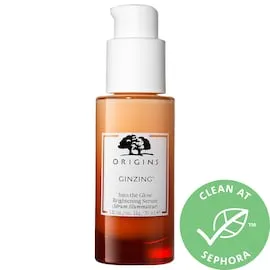
Origins GinZing Into the Glow Brightening Serum

Origins GinZing Into the Glow Brightening Serum

Efficacy37/100IrritancyHigh

Works for

Moisturizing
Tartaric acid, Algae extract + 11 more
Works
What the product description says
“Infused with potent Vitamin C, this fast-acting formula visibly brightens dull-looking skin in one use, while Hyaluronic Acid plumps skin with hydration.”
Source: Origins

This product can help improve hydration of the skin with the two types of ingredients.

The first type is called “humectants”:
these ingredients help attract water. When humectants are on the surface of the skin, they “pull in” the moisture from the outside environment, or from within deeper layers of the skin. The following ingredients in this product do the job: algae extract, glycerin.

This product also contains ingredients called “occlusives”. They help reduce the speed with which our skin loses moisture to the outside environment. These ingredients also help soften the upper layer of the skin, so it feels less tight and nicer to the touch. The following ingredients in this product do the job: squalane, algae extract.

Tartaric acidKey activeEffect: MediumAn AHA (alpha-hydroxy acid). It oxidizes quickly which makes it less effective in skincare formulations. It can support skin's barrier and moisture levels~1.8–2.2%
Algae extractKey active· Humectant, EmollientEffect: HighPlant extract that helps the skin to attract water and make it more smooth for touch. Also shows promise of anti-aging properties, but research is not extensive yet~0.3–0.55%
SqualaneKey active· Emollient, OcclusiveEffect: HighAn oil naturally present in skin. Works as an emollient to soften the skin and form a protective layer on its surface without a greasy feeling.~0.3–0.5%
GlycerinKey active· HumectantEffect: HighOne of the best moisturizing ingredients. Naturally present in skin. It attracts water to the upper layer of the skin working as a humectant~0.25–0.5%
Sodium hyaluronateKey active· HumectantEffect: HighOne of the best moisturizing ingredients. Attracts water into the upper layer of the skin~0.25–0.4%
TrehaloseKey active· HumectantEffect: HighA sugar that attracts water to the upper layer of the skin~0.25–0.4%
Plankton extractKey activeEffect: MediumCan help attract water to the upper layer of the skin~0.25–0.5%
Coco-caprylate/caprateKey active· EmollientEffect: MediumHelps to soften the upper layer of the skin without creating a greasy texture~0.25–0.45%
Butylene glycol· HumectantEffect: LowUsed to create a nice product texture and help delivery of other ingredients. Might be somewhat helpful in attracting water to the upper layer of the skin~5.5–6.7%
Caprylyl glycol· Humectant, EmollientEffect: LowHelps preserve products and creates a nice product texture~0.25–0.5%
LecithinEffect: Low, below effective doseUsed mostly for creating emulsions - helping oil and water mix together. Helps soften the upper layer of the skin~0.25–0.5%
Lactic acidUnder-dosedAn exfoliating and moisturizing alpha-hydroxy acid (AHA). Typically causes less irritation than other AHAs, for example, glycolic acid. At high concentrations (about 15%), lactic acid can help reduce lines and wrinkles. Recent studies show that lactic acid can support the "good" bacteria living on skin's surface (healthy skin microbiome)~1.3–1.6%
Avena sativa kernel extractUnder-dosedAn effective moisturizing and skin barrier repair ingredient. Helps calm down inflammation and has some anti-oxidant properties~0.25–0.45%
Evens skin tone
Lactic acid ~1.3–1.6%, below the ~2% it needs + 1 more
Under-dosed
What the product description says
“This multi-action brightening serum visibly brightens dull skin in one shot.”
Source: Origins

Effective ingredients missing or their concentration is too low

Salicylic acidEffect: Low, below effective doseUsed for skin exfoliation. It has an anti-inflammatory and anti-bacterial effect, helps to unclog pores, prevent blemishes and speed up healing of the existing ones. Sometimes referred to as a BHA (beta-hydroxy acid)~0.25–0.45%
Lactic acidUnder-dosedAn exfoliating and moisturizing alpha-hydroxy acid (AHA). Typically causes less irritation than other AHAs, for example, glycolic acid. At high concentrations (about 15%), lactic acid can help reduce lines and wrinkles. Recent studies show that lactic acid can support the "good" bacteria living on skin's surface (healthy skin microbiome)~1.3–1.6%
Tetrahexyldecyl ascorbateUnder-dosedBeing a lipid soluble form of vitamin C, it is more stable than ascorbic acid, but still degrades quickly and needs to be stabilized in a formulation with another ingredient. It is claimed to penetrate skin better than pure vitamin C and have the the similar benefits, but solid studies of its effectiveness are lacking. Is likely to require a higher concentration in a product than pure vitamin C to be effective. It might be able to help reduce pore clogging.~0.25–0.45%
Anti-oxidation
Side benefit · Tartaric acid, Coffea arabica seed extract + 5 more
May help

This product contains antioxidants (tartaric acid) that can help neutralize free radicals in skin to lessen the damage it gets from the UV light (sun). There is some human evidence for this effect in skin, though it is smaller or less consistent than the evidence for the best antioxidants.

Tartaric acidKey activeEffect: MediumAn AHA (alpha-hydroxy acid). It oxidizes quickly which makes it less effective in skincare formulations. It can support skin's barrier and moisture levels~1.8–2.2%
Coffea arabica seed extractEffect: LowMight be helpful in neutralizing free radicals in skin~0.3–0.55%
CaffeineEffect: LowMight be helpful in neutralizing free radicals. Can have a dehydration effect that might somewhat decrease the look of puffy eyes~0.25–0.45%
Panax ginseng root extractEffect: Low, below effective doseA plant extract that might have some anti-inflammatory properties, but solid evidence is lacking. It can be irritating~0.35–0.65%
Tocopheryl acetateEffect: Low, below effective doseA more stable but less bio-available form of vitamin E compared to Tocopherol. Might help moisturize and protect the skin from free radicals, but mostly used in low concentrations to stabilize other ingredients.~0.25–0.45%
Avena sativa kernel extractEffect: Low, below effective doseAn effective moisturizing and skin barrier repair ingredient. Helps calm down inflammation and has some anti-oxidant properties~0.25–0.45%
Tetrahexyldecyl ascorbateUnder-dosedBeing a lipid soluble form of vitamin C, it is more stable than ascorbic acid, but still degrades quickly and needs to be stabilized in a formulation with another ingredient. It is claimed to penetrate skin better than pure vitamin C and have the the similar benefits, but solid studies of its effectiveness are lacking. Is likely to require a higher concentration in a product than pure vitamin C to be effective. It might be able to help reduce pore clogging.~0.25–0.45%

Can it cause trouble?

Irritancy
9 strong irritants: Citrus grandis peel oil, Citrus limon peel oil + 7 more — patch-test recommended
High risk
We flagged 25 ingredients with irritancy potential. Severity depends on your sensitivity threshold; the table lists the worst offenders first.
IngredientFunctionIrritationEst. amount
Citrus grandis peel oilA plant oil with high content of volatile compounds that, especially when exposed to air, can cause allergic reactions and irritate the skinHigh~1–1.2%est.
Citrus limon peel oilA highly irritating fragranceHigh~0.7–1.05%est.
Citrus aurantium dulcis peel oilAn essentil oil from orange peel. Potential allergen and can be irritatingHigh~0.55–0.85%est.
Mentha viridis leaf oilUsed as a fragrance and can be irritatingHigh~0.5–0.7%est.
CitralA fragrance with a lemon scent. A likely irritantHigh~0.4–0.6%est.
LinaloolA fragrance. Can be irritatingHigh~0.35–0.65%est.
LimoneneA common frangrance that can easily irritate skin, especially if exposed to air, light or heatHigh~0.3–0.6%est.
Panax ginseng root extractA plant extract that might have some anti-inflammatory properties, but solid evidence is lacking. It can be irritatingHigh~0.35–0.65%est.
Carica papaya fruit extract—High~0.3–0.55%est.
Salicylic acidUsed for skin exfoliation. It has an anti-inflammatory and anti-bacterial effect, helps to unclog pores, prevent blemishes and speed up healing of the existing ones. Sometimes referred to as a BHA (beta-hydroxy acid)High~0.25–0.45%est.
Menthol—High~0.2–0.35%est.
Citric acidCan work as an exfoliant but is typically used to adjust the product pHMedium~3.1–3.7%est.
Tartaric acidAn AHA (alpha-hydroxy acid). It oxidizes quickly which makes it less effective in skincare formulations. It can support skin's barrier and moisture levelsMedium~1.8–2.2%est.
Sodium polyacryloyldimethyl taurateHelps oil and water mix togetherMedium~1.5–1.9%est.
Lactic acidAn exfoliating and moisturizing alpha-hydroxy acid (AHA). Typically causes less irritation than other AHAs, for example, glycolic acid. At high concentrations (about 15%), lactic acid can help reduce lines and wrinkles. Recent studies show that lactic acid can support the "good" bacteria living on skin's surface (healthy skin microbiome)Medium~1.3–1.6%est.
CaffeineMight be helpful in neutralizing free radicals. Can have a dehydration effect that might somewhat decrease the look of puffy eyesMedium~0.25–0.45%est.
Tetrahexyldecyl ascorbateBeing a lipid soluble form of vitamin C, it is more stable than ascorbic acid, but still degrades quickly and needs to be stabilized in a formulation with another ingredient. It is claimed to penetrate skin better than pure vitamin C and have the the similar benefits, but solid studies of its effectiveness are lacking. Is likely to require a higher concentration in a product than pure vitamin C to be effective. It might be able to help reduce pore clogging.Medium~0.25–0.45%est.
Tocopheryl acetateA more stable but less bio-available form of vitamin E compared to Tocopherol. Might help moisturize and protect the skin from free radicals, but mostly used in low concentrations to stabilize other ingredients.Medium~0.25–0.45%est.
Hydroxyethyl acrylate/sodium acryloyldimethyl taurate copolymerA gelling agent that thickens the product consistency and leaves the skin with a velvety finishMedium~0.25–0.5%est.
Polysorbate 60Helps oil and water mix togetherMedium~0.3–0.5%est.
Ppg-5-ceteth-20A solvent with some emollient propertiesMedium~0.3–0.55%est.
Plankton extractCan help attract water to the upper layer of the skinMedium~0.25–0.5%est.
Caprylyl glycolHelps preserve products and creates a nice product textureMedium~0.25–0.5%est.
EthylhexylglycerinA preservativeMedium~0.2–0.35%est.
BhtA preservativeMedium~0.2–0.35%est.
Comedogenic
2 ingredients rated 2 or more on the 0–5 pore-clogging scale
2 flagged
These ingredients have a comedogenic rating of 2 or more on a 0–5 scale; the table shows each one's rating. In leave-on products they can clog pores in acne-prone skin.
IngredientFunctionRatingEst. amount
Algae extractPlant extract that helps the skin to attract water and make it more smooth for touch. Also shows promise of anti-aging properties, but research is not extensive yet3/5~0.3–0.55%est.
Plankton extractCan help attract water to the upper layer of the skin3/5~0.25–0.5%est.
Did this help you decide?

User reviews

Would you recommend?
No community reviews yet.

Be the first — your take helps the next person decide.

Ingredients

Filter by role to see what each ingredient is doing.

Water~45–55%
Formula
Irritation risk
Low

Plain old water

More about Water
Butylene glycol~5.5–6.7%
Formula
Irritation risk
Low
Works for
Moisturizing

Used to create a nice product texture and help delivery of other ingredients. Might be somewhat helpful in attracting water to the upper layer of the skin

More about Butylene glycol
C9-12 alkane~4.4–5.4%
Formula
Irritation risk
Low

Helps dissolve other ingredients in a formulation

More about C9-12 alkane
Citric acid~3.1–3.7%
Irritant · medium
Irritation risk
Medium

Can work as an exfoliant but is typically used to adjust the product pH

More about Citric acid
Sodium hydroxide~2.3–2.8%
Formula
Irritation risk
Low

Used to adjust the product's pH

More about Sodium hydroxide
Tartaric acid~1.8–2.2%
Key activeIrritant · medium
Irritation risk
Medium
Works for
ExfoliationAnti-oxidationMoisturizing

An AHA (alpha-hydroxy acid). It oxidizes quickly which makes it less effective in skincare formulations. It can support skin's barrier and moisture levels

More about Tartaric acid
Sodium polyacryloyldimethyl taurate~1.5–1.9%
Irritant · medium
Irritation risk
Medium

Helps oil and water mix together

More about Sodium polyacryloyldimethyl taurate
Lactic acid~1.3–1.6%
Under-dosedIrritant · medium
Irritation risk
Medium
Works for
Evens skin toneMoisturizingExfoliationAnti-aging

An exfoliating and moisturizing alpha-hydroxy acid (AHA). Typically causes less irritation than other AHAs, for example, glycolic acid. At high concentrations (about 15%), lactic acid can help reduce lines and wrinkles. Recent studies show that lactic acid can support the "good" bacteria living on skin's surface (healthy skin microbiome)

More about Lactic acid
Citrus grandis peel oil~1–1.2%
Irritant · high
Irritation risk
High

A plant oil with high content of volatile compounds that, especially when exposed to air, can cause allergic reactions and irritate the skin

More about Citrus grandis peel oil
Citrus limon peel oil~0.7–1.05%
Irritant · high
Irritation risk
High

A highly irritating fragrance

More about Citrus limon peel oil
Citrus aurantium dulcis peel oil~0.55–0.85%
Irritant · high
Irritation risk
High

An essentil oil from orange peel. Potential allergen and can be irritating

More about Citrus aurantium dulcis peel oil
Mentha viridis leaf oil~0.5–0.7%
Irritant · high
Irritation risk
High

Used as a fragrance and can be irritating

More about Mentha viridis leaf oil
Citral~0.4–0.6%
Irritant · high
Irritation risk
High

A fragrance with a lemon scent. A likely irritant

More about Citral
Linalool~0.35–0.65%
Irritant · high
Irritation risk
High

A fragrance. Can be irritating

More about Linalool
Limonene~0.3–0.6%
Irritant · high
Irritation risk
High

A common frangrance that can easily irritate skin, especially if exposed to air, light or heat

More about Limonene
Panax ginseng root extract~0.35–0.65%
Irritant · high
Irritation risk
High
Works for
Anti-inflammatoryAnti-oxidation

A plant extract that might have some anti-inflammatory properties, but solid evidence is lacking. It can be irritating

More about Panax ginseng root extract
Coffea arabica seed extract~0.3–0.55%
Formula
Irritation risk
Low
Works for
Anti-oxidation

Might be helpful in neutralizing free radicals in skin

More about Coffea arabica seed extract
Carica papaya fruit extract~0.3–0.55%
Irritant · high
Pyruvic acid~0.3–0.55%
Formula
Irritation risk
Low
More about Pyruvic acid
Salicylic acid~0.25–0.45%
Irritant · high
Irritation risk
High
Works for
Anti-inflammatoryAnti-blemishExfoliationAntibacterialEvens skin tone

Used for skin exfoliation. It has an anti-inflammatory and anti-bacterial effect, helps to unclog pores, prevent blemishes and speed up healing of the existing ones. Sometimes referred to as a BHA (beta-hydroxy acid)

More about Salicylic acid
Caffeine~0.25–0.45%
Irritant · medium
Irritation risk
Medium
Works for
De-puffingAnti-oxidation

Might be helpful in neutralizing free radicals. Can have a dehydration effect that might somewhat decrease the look of puffy eyes

More about Caffeine
Tetrahexyldecyl ascorbate~0.25–0.45%
Under-dosedIrritant · medium
Irritation risk
Medium
Works for
Evens skin toneAnti-oxidationAnti-aging

Being a lipid soluble form of vitamin C, it is more stable than ascorbic acid, but still degrades quickly and needs to be stabilized in a formulation with another ingredient. It is claimed to penetrate skin better than pure vitamin C and have the the similar benefits, but solid studies of its effectiveness are lacking. Is likely to require a higher concentration in a product than pure vitamin C to be effective. It might be able to help reduce pore clogging.

More about Tetrahexyldecyl ascorbate
Tocopheryl acetate~0.25–0.45%
Irritant · medium
Irritation risk
Medium
Works for
Anti-oxidation

A more stable but less bio-available form of vitamin E compared to Tocopherol. Might help moisturize and protect the skin from free radicals, but mostly used in low concentrations to stabilize other ingredients.

More about Tocopheryl acetate
Avena sativa kernel extract~0.25–0.45%
Under-dosed
Irritation risk
Low
Works for
Anti-inflammatoryReduces irritationMoisturizingReduces rednessAnti-oxidation

An effective moisturizing and skin barrier repair ingredient. Helps calm down inflammation and has some anti-oxidant properties

More about Avena sativa kernel extract
Sodium hyaluronate~0.25–0.4%
Key active
Irritation risk
Low
Works for
Moisturizing

One of the best moisturizing ingredients. Attracts water into the upper layer of the skin

More about Sodium hyaluronate
Trehalose~0.25–0.4%
Key active
Irritation risk
Low
Works for
Moisturizing

A sugar that attracts water to the upper layer of the skin

More about Trehalose
Squalane~0.3–0.5%
Key active
Irritation risk
Low
Works for
Moisturizing

An oil naturally present in skin. Works as an emollient to soften the skin and form a protective layer on its surface without a greasy feeling.

More about Squalane
Glycerin~0.25–0.5%
Key active
Irritation risk
Low
Works for
Moisturizing

One of the best moisturizing ingredients. Naturally present in skin. It attracts water to the upper layer of the skin working as a humectant

More about Glycerin
Algae extract~0.3–0.55%
Key activeComedogenic 3/5
Irritation risk
Low
Comedogenicity
3/5
Works for
MoisturizingAnti-aging

Plant extract that helps the skin to attract water and make it more smooth for touch. Also shows promise of anti-aging properties, but research is not extensive yet

More about Algae extract
Menthol~0.2–0.35%
Irritant · high
Irritation risk
High
More about Menthol
Lecithin~0.25–0.5%
Formula
Irritation risk
Low
Works for
CleansingMoisturizing

Used mostly for creating emulsions - helping oil and water mix together. Helps soften the upper layer of the skin

More about Lecithin
Coco-caprylate/caprate~0.25–0.45%
Key active
Irritation risk
Low
Works for
Moisturizing

Helps to soften the upper layer of the skin without creating a greasy texture

More about Coco-caprylate/caprate
Xanthan gum~0.25–0.5%
Formula
Irritation risk
Low
Works for
Cleansing

Used to create a thicker product consistency

More about Xanthan gum
Hydroxyethyl acrylate/sodium acryloyldimethyl taurate copolymer~0.25–0.5%
Irritant · medium
Irritation risk
Medium

A gelling agent that thickens the product consistency and leaves the skin with a velvety finish

More about Hydroxyethyl acrylate/sodium acryloyldimethyl taurate copolymer
Polysorbate 20~0.25–0.5%
Formula
Irritation risk
Low
Works for
Cleansing

Helps oil and water mix together

More about Polysorbate 20
Polysorbate 60~0.3–0.5%
Irritant · medium
Irritation risk
Medium
Works for
Cleansing

Helps oil and water mix together

More about Polysorbate 60
Ppg-5-ceteth-20~0.3–0.55%
Irritant · medium
Irritation risk
Medium
Works for
Cleansing

A solvent with some emollient properties

More about Ppg-5-ceteth-20
Plankton extract~0.25–0.5%
Key activeComedogenic 3/5Irritant · medium
Irritation risk
Medium
Comedogenicity
3/5
Works for
Moisturizing

Can help attract water to the upper layer of the skin

More about Plankton extract
Caprylyl glycol~0.25–0.5%
Irritant · medium
Irritation risk
Medium
Works for
Moisturizing

Helps preserve products and creates a nice product texture

More about Caprylyl glycol
Ethylhexylglycerin~0.2–0.35%
Irritant · medium
Irritation risk
Medium

A preservative

More about Ethylhexylglycerin
Bht~0.2–0.35%
Irritant · medium
Irritation risk
Medium

A preservative

More about Bht
Phenoxyethanol~0.15–0.25%
Formula
Irritation risk
Low

A preservative. It helps prevent bacterial growth in cosmetic products

More about Phenoxyethanol
Ci 15510~0.15–0.25%
Formula
Irritation risk
Low
More about Ci 15510
Ingredient list view

Water, Butylene glycol, C9-12 alkane, Citric acid, Sodium hydroxide, Tartaric acid, Sodium polyacryloyldimethyl taurate, Lactic acid, Citrus grandis peel oil, Citrus limon peel oil, Citrus aurantium dulcis peel oil, Mentha viridis leaf oil, Citral, Linalool, Limonene, Panax ginseng root extract, Coffea arabica seed extract, Carica papaya fruit extract, Pyruvic acid, Salicylic acid, Caffeine, Tetrahexyldecyl ascorbate, Tocopheryl acetate, Avena sativa kernel extract, Sodium hyaluronate, Trehalose, Squalane, Glycerin, Algae extract, Menthol, Lecithin, Coco-caprylate/caprate, Xanthan gum, Hydroxyethyl acrylate/sodium acryloyldimethyl taurate copolymer, Polysorbate 20, Polysorbate 60, Ppg-5-ceteth-20, Plankton extract, Caprylyl glycol, Ethylhexylglycerin, Bht, Phenoxyethanol, Ci 15510

Compare prices

Retailers ranked by price — lowest first.

Origins
$49.00
Buy

Affiliate links

Worth comparing, line by line.

Match % combines shared ingredients, the first five ingredients, shared actives and hero ingredients, irritancy (lower counts in the alternative's favour), texture and body area. Only products in the same routine step are compared.

Side-by-side comparison of this product against its closest alternatives
OriginsGinZing Into the Glow Brightening SerumYOUR PRODUCTDr Dennis GrossAdvanced Retinol + Ferulic Texture Renewal SerumThe Purest SolutionsIntensive Hydration Serum Hyaluronic Acid %2 + B5Lab Series Skincare for MenMax LS Power V Lifting Serum
Match—89%88%83%
Price$49.00$15.60−$33.40——
Shared key ingredients—5 of 92 of 97 of 9
Key difference—RetinolPanthenolNiacinamide
Irritancy High Medium Low Medium
Drying alcohol—— Contains drying alcohol —
View product Shop Shop Shop

More alternatives: DCL Skincare Clear Skin Anti-Blemish Hydrator SerumAdmire My Skin Ultra Potent Brightening Serum

Cheaper alternatives? See how this stacks up against similar formulas.
We compare ingredient profiles across our catalog — pick the closest match for your budget.
Open dupe finder

Sources cited in this review

Every concentration estimate and effectiveness label is anchored to one of these 19 studies and safety reviews.

  1. 1
  2. 2
  3. 3
  4. 4
  5. 5
  6. 6
Origins GinZing Into the Glow Brightening Serum
OriginsGinZing Into the Glow Brightening Serum

Affiliate links · As an Amazon Associate, WIMJ earns from qualifying purchases.

As an Amazon Associate, WIMJ earns from qualifying purchases.