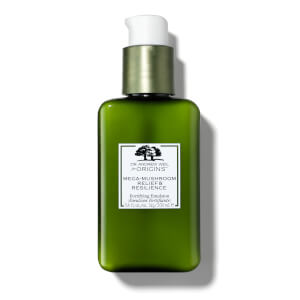
Origins Dr. Andrew for Origins Weil Mega-Mushroom Relief & Resilience Fortifying Emulsion
Works for
2 of 2 advertised claims delivered
Moisturizing21 ingredients credited for this claimStrong support
“What it is A skin-quenching, lightweight moisturizer that supports skin against the visible effects of free-radical damage.”
This product can help improve hydration of the skin with the two types of ingredients.
The first type is called “humectants”:
these ingredients help attract water.
When humectants are on the surface of the skin, they “pull in” the moisture from the outside environment, or from
within deeper layers of the skin. The following ingredients in this product do the job:
algae extract, glycerin.
This product also contains ingredients called “occlusives”. They help reduce the speed with which our skin loses moisture to the outside environment. These ingredients also help soften the upper layer of the skin, so it feels less tight and nicer to the touch. The following ingredients in this product do the job: simmondsia chinensis seed oil, squalane.
The following ingredients in this product are especially good for supporting the skin barrier and helping with the hydration level: ceramide np
Anti-aging3 ingredients credited for this claimModerate support
“Skin Type Normal, Dry, Combination, and Oily Skincare Concerns Dryness, Redness, and Loss of Firmness and Elasticity Formulation Lightweight Gel Highlighted Ingredients , Molecular Mushroom Complex Soothes skin and reduces the look of irritation.”
This product contains glycyrrhetinic acid. This ingredient help neutralize free radicals in skin. By doing so, they might be able to prevent early signs of aging (like fine lines and wrinkles), at least to some extent. These ingredients will not be able to "reverse" signs of aging.
Anti-oxidationNot advertised by the brand · 8 ingredients credited for this claimStrong support
This product contains antioxidants (glycyrrhetinic acid) that can help neutralize free radicals in skin. By doing so, they can lessen the damage the skin gets from the UV light (sun).
Evens skin toneNot advertised by the brand · 2 ingredients credited for this claimModerate support
The following ingredient (ingredients) in this product might be helpful, but there is no evidence to confirm that it actually works: glycine soja seed extract, glycyrrhetinic acid.
Can it cause trouble?
Irritancy11 strong irritants: Zingiber officinale root extract, Boswellia carterii oil + 9 more — patch-test recommendedHigh risk
Comedogenic3 ingredients rated 2 or more on the 0–5 pore-clogging scale3 flagged

User reviews
Be the first — your take helps the next person decide.
Ingredients
Filter by role to see what each ingredient is doing.
Water~45–55%
Squalane~4.7–5.8%
- Irritation risk
- Low
An oil naturally present in skin. Works as an emollient to soften the skin and form a protective layer on its surface without a greasy feeling.
More about SqualaneSimmondsia chinensis seed oil~4.5–5.5%
- Irritation risk
- Medium
Softens the upper layer of skin and helps restore the healthy skin barrier. Has shown to help calm down inflammation in skin. It is a stable oil, meaning that it retains its properties even when exposed to air.
More about Simmondsia chinensis seed oilButylene glycol~3.2–3.9%
- Irritation risk
- Low
Used to create a nice product texture and help delivery of other ingredients. Might be somewhat helpful in attracting water to the upper layer of the skin
More about Butylene glycolGlycerin~2.5–3%
- Irritation risk
- Low
One of the best moisturizing ingredients. Naturally present in skin. It attracts water to the upper layer of the skin working as a humectant
More about GlycerinSaccharomyces ferment filtrate~2–2.4%
- Irritation risk
- Low
A product of yeast fermentation. Helps attract water to the upper layer of the skin
More about Saccharomyces ferment filtratePolyglyceryl-3 methylglucose distearate~1.7–2.1%
- Irritation risk
- Medium
Helps water and oil mix together
More about Polyglyceryl-3 methylglucose distearateCoco-caprylate/caprate~1.5–1.9%
- Irritation risk
- Low
Helps to soften the upper layer of the skin without creating a greasy texture
More about Coco-caprylate/caprateSodium hyaluronate~1.2–1.5%
- Irritation risk
- Low
One of the best moisturizing ingredients. Attracts water into the upper layer of the skin
More about Sodium hyaluronateHippophae rhamnoides extract~1–1.3%
- Irritation risk
- Low
Lactobacillus ferment~0.75–1.15%
- Irritation risk
- Low
A fermentation product created by bacteria Lactobacillus. The fermented product has anti-bacterial properties and might be helpful in calming down inflammation, but studies are lacking. Helps attract water to the upper layer of the skin. Can be used as a preservative
More about Lactobacillus fermentAlgae extract~0.75–1.1%
- Irritation risk
- Low
- Comedogenicity
- 3/5
Plant extract that helps the skin to attract water and make it more smooth for touch. Also shows promise of anti-aging properties, but research is not extensive yet
More about Algae extractOlea europaea fruit oil~0.65–0.95%
- Irritation risk
- Medium
An emollient that helps soften the skin but is not effective for restoring its barrier function. Might be helpful to calm down inflammation
More about Olea europaea fruit oilGlycine soja oil~0.6–0.9%
- Irritation risk
- Medium
- Comedogenicity
- 2/5
A good emollient that helps soften the skin and helps repair its barrier function. It can clog pores if used in high concentrations.
More about Glycine soja oilGlycine soja seed extract~0.6–0.9%
- Irritation risk
- Medium
An emollient that helps soften the skin. Might be somewhat helpful in evening the skin tone.
More about Glycine soja seed extractHypnea musciformis extract~0.55–0.8%
- Irritation risk
- Low
- Comedogenicity
- 3/5
Might help to attract water to the upper layer of the skin
More about Hypnea musciformis extractGanoderma lucidum extract~0.55–0.8%
- Irritation risk
- Medium
Helps attract water to the upper layer of the skin
More about Ganoderma lucidum extractCaffeine~0.5–0.75%
- Irritation risk
- Medium
Might be helpful in neutralizing free radicals. Can have a dehydration effect that might somewhat decrease the look of puffy eyes
More about CaffeineCeramide np~0.5–0.8%
- Irritation risk
- Low
A type of lipid similar to ceramides naturally present in skin. Helps to soften the upper layer of the skin and supports the skin barrier function to keep it hydrated. Can help to prevent inflammation in skin
More about Ceramide npTocopherol~0.45–0.7%
- Irritation risk
- Low
Pure form of vitamin E. Can help moisturise and protect the skin from free radicals. Often used to help stabilise other ingredients or the formula itself
More about TocopherolCaprylyl glycol~0.45–0.7%
- Irritation risk
- Medium
Helps preserve products and creates a nice product texture
More about Caprylyl glycolOryzanol~0.4–0.6%
- Irritation risk
- Low
An anti-oxidant that helps stabilize product formulations. Might help neutralise free radicals in skin
More about OryzanolSodium stearoyl glutamate~0.45–0.7%
- Irritation risk
- Medium
Helps oil and water mix together
More about Sodium stearoyl glutamateSodium pca~0.4–0.6%
- Irritation risk
- Low
Naturally present in skin and helps to attract water to its upper layer
More about Sodium pcaPotassium gluconate~0.4–0.6%
- Irritation risk
- Low
A mineral that might be able to support skin hydration, but convincing research on its effectiveness in topical skincare is lacking
More about Potassium gluconateGlycyrrhetinic acid~0.35–0.65%
- Irritation risk
- Medium
Active compound of licorice root. Works to calm down inflammation, as an anti-oxidant, and might be helpful in lightening the skin and reducing hyperpigmentation
More about Glycyrrhetinic acidAcrylates/c10-30 alkyl acrylate crosspolymer~0.45–0.65%
- Irritation risk
- Medium
Maintains the texture of skincare products. Allows the product to spread evenly. Helps oil and water mix together
More about Acrylates/c10-30 alkyl acrylate crosspolymerPolysorbate 20~0.45–0.65%
Hydrogenated lecithin~0.45–0.65%
- Irritation risk
- Low
Helps to retain moisture by creating a protective barrier on the skin. Rich in fatty acids. Improves product texture and helps with the penetration of other ingredients.
More about Hydrogenated lecithinPalmitic acid~0.45–0.7%
- Irritation risk
- Low
An emollient that is naturally present in skin and helps soften it
More about Palmitic acidHexylene glycol~0.35–0.65%
- Irritation risk
- Medium
Helps create a more spreadable product texture
More about Hexylene glycolSodium hydroxide~0.4–0.6%
Citric acid~0.4–0.6%
- Irritation risk
- Medium
Can work as an exfoliant but is typically used to adjust the product pH
More about Citric acidAmmonium acryloyldimethyltaurate/vp copolymer~0.4–0.6%
- Irritation risk
- Low
Increases thickness of a product. Texture enhancer for oil-in-water emulsions
More about Ammonium acryloyldimethyltaurate/vp copolymerBehenyl alcohol~0.45–0.7%
- Irritation risk
- Low
Non-drying alcohol that helps water and oil mix together. Also serves as an emollient
More about Behenyl alcoholZingiber officinale root extract~0.3–0.55%
- Irritation risk
- High
A plant extract that can contain an irritating essential oil. Might have some anti-oxidant effect, but evidence is lacking
More about Zingiber officinale root extractBoswellia carterii oil~0.35–0.65%
Pogostemon cablin oil~0.3–0.55%
- Irritation risk
- Low
Lavandula angustifolia oil~0.3–0.6%
- Irritation risk
- High
An essential oil. Potential allergen and can be irritating. It has some anti-bacterial properties
More about Lavandula angustifolia oilCitrus nobilis peel oil~0.3–0.55%
- Irritation risk
- High
A plant oil with high content of volatile compounds that, especially when exposed to air, can cause allergic reactions and irritate the skin
More about Citrus nobilis peel oilPelargonium graveolens flower oil~0.3–0.55%
- Irritation risk
- High
An essential oil. Can be irritating. Can become an allergen with oxidation
More about Pelargonium graveolens flower oilCitrus aurantium dulcis oil~0.25–0.5%
- Irritation risk
- High
Used as a fragrance. It can be irritating and cause photosensitivity
More about Citrus aurantium dulcis oilCitronellol~0.2–0.4%
Linalool~0.2–0.35%
Geraniol~0.15–0.25%
Citral~0.15–0.25%
Limonene~0.15–0.3%
- Irritation risk
- High
A common frangrance that can easily irritate skin, especially if exposed to air, light or heat
More about LimonenePhenoxyethanol~0.15–0.3%
- Irritation risk
- Low
A preservative. It helps prevent bacterial growth in cosmetic products
More about PhenoxyethanolPotassium sorbate~0.15–0.25%
Sodium benzoate~0.1–0.25%
Ingredient list view
Water, Squalane, Simmondsia chinensis seed oil, Butylene glycol, Glycerin, Saccharomyces ferment filtrate, Polyglyceryl-3 methylglucose distearate, Coco-caprylate/caprate, Sodium hyaluronate, Hippophae rhamnoides extract, Lactobacillus ferment, Algae extract, Olea europaea fruit oil, Glycine soja oil, Glycine soja seed extract, Hypnea musciformis extract, Ganoderma lucidum extract, Caffeine, Ceramide np, Tocopherol, Caprylyl glycol, Oryzanol, Sodium stearoyl glutamate, Sodium pca, Potassium gluconate, Glycyrrhetinic acid, Acrylates/c10-30 alkyl acrylate crosspolymer, Polysorbate 20, Hydrogenated lecithin, Palmitic acid, Hexylene glycol, Sodium hydroxide, Citric acid, Ammonium acryloyldimethyltaurate/vp copolymer, Behenyl alcohol, Zingiber officinale root extract, Boswellia carterii oil, Pogostemon cablin oil, Lavandula angustifolia oil, Citrus nobilis peel oil, Pelargonium graveolens flower oil, Citrus aurantium dulcis oil, Citronellol, Linalool, Geraniol, Citral, Limonene, Phenoxyethanol, Potassium sorbate, Sodium benzoate
Compare prices
Retailers ranked by price — lowest first.

Worth comparing, line by line.
Match % combines shared ingredients, the first five ingredients, shared actives and hero ingredients, irritancy (lower counts in the alternative's favour), texture and body area. Only products in the same routine step are compared.
| OriginsDr. Andrew for Origins Weil Mega-Mushroom Relief & Resilience Fortifying EmulsionYOUR PRODUCT | Colleen Rothschild BeautyMoisture Veil Silk Emulsion | PrequelAM/PM Modern Moisturizer | CyreneSkin Rescue Moisturiser | |
|---|---|---|---|---|
| Match | — | 57% | 57% | 57% |
| Price | $42.00 | — | $17.99−$24.01 | — |
| Shared key ingredients | — | 7 of 14 | 5 of 14 | 4 of 14 |
| Key difference | — | Ceramide Eop | Linoleic Acid | Niacinamide |
| Irritancy | High | Medium | Medium | Low |
| Drying alcohol | — | — | — | — |
| View product | Shop | Shop | Shop |

Product summary
"Origins - Dr. Andrew for Origins Weil Mega-Mushroom Relief & Resilience Fortifying Emulsion" is a well-rounded moisturizing product. As we expect from a proper moisturizer, the formula includes a combo of effective humectants and emollients. These are the two different types of ingredients that are essential for improving the skin hydration and supporting a healthy skin barrier. Algae extract, glycerin, lactobacillus ferment, saccharomyces ferment filtrate and sodium hyaluronate in this product (humectants) attract water molecules to the upper layer of the skin (the water comes from the outside air or from the deeper layers of the skin if the air is dry). Emollients in this formulation (ceramide np, algae extract, glycine soja oil, simmondsia chinensis seed oil and squalane) help to reduce the moisture loss from the skin. They also soften the skin surface and relieve the feeling of dryness and tightness.
Ingredient callouts
- As a plus, this moisturizer also contains Ceramides (ceramide np 0.50% - 0.80%). Ceramides are a type of lipids that our skin produces itself. They are a building block of the skin's barrier. Ceramides used in skincare are synthetic or extracted from plants. They work well for softening the skin surface and "patch holes" in the skin's barrier.
Irritation risk
There are quite a few common irritants in this product, including ingredients without particular skin benefits. We would not recommend it for sensitive skin. We assess the overall irritancy of this moisturizer to be high. For a detailed overview of all potential irritants: click here
You can see the detailed formula review with the breakdown of all actives in the product and the full ingredient list with estimated concentrations in the tables below.
Price
The product retails for 38.00£ in the United Kingdom, for 53.00CA$ in Canada and for 42.00$ in the United States.
For a detailed price comparison: click here.
Sources cited in this review
Every concentration estimate and effectiveness label is anchored to one of these 23 studies and safety reviews.
- 1
- 2Safety Assessment of Alkyl Esters as Used in Cosmeticscir-safety.org
- 3Hyaluronic acid: A key molecule in skin agingncbi.nlm.nih.gov
- 4
- 5
- 6

Affiliate links · As an Amazon Associate, WIMJ earns from qualifying purchases.