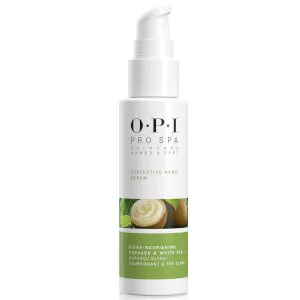
OPI Prospa Protective Hand Serum

OPI Prospa Protective Hand Serum

Efficacy58/100IrritancyHigh

Works for

Moisturizing
Palmitoyl tetrapeptide-7, Palmitoyl tripeptide-1 + 18 more
Works well
What the product description says
“Nourish and repair with the OPI Prospa Protective Hand Serum ; an ultra-hydrating formula that delivers multiple benefits.”
Source: Mankind

This product can help improve hydration of the skin with the two types of ingredients.

The first type is called “humectants”:
these ingredients help attract water. When humectants are on the surface of the skin, they “pull in” the moisture from the outside environment, or from within deeper layers of the skin. The following ingredients in this product do the job: glycerin, sodium lactate.

This product also contains ingredients called “occlusives”. They help reduce the speed with which our skin loses moisture to the outside environment. These ingredients also help soften the upper layer of the skin, so it feels less tight and nicer to the touch. The following ingredients in this product do the job: dimethicone, dimethiconol.

The following ingredients in this product are especially good for supporting the skin barrier and helping with the hydration level: palmitoyl tetrapeptide-7, palmitoyl tripeptide-1

Palmitoyl tetrapeptide-7Hero· EmollientEffect: HighA type of peptide. Peptides are excellent moisturizers and might be able support collagen production reducing fine lines and wrinkles~0.1–0.35%
Palmitoyl tripeptide-1Hero· EmollientEffect: HighA type of peptide. Peptides are excellent moisturizers and might be able support collagen production reducing fine lines and wrinkles~0.1–0.35%
DimethiconeKey active· Emollient, OcclusiveEffect: HighA silicone that helps to reduce water loss from the surface of the skin. Can temporarily "fill in" lines and wrinkles, absorb oil, and create a nice product finish~3.2–4.8%
CyclopentasiloxaneKey active· EmollientEffect: MediumA silicone that helps improve the product texture and spreadability. Can absorb oil creating a short-term mattifying effect on the skin~1.3–2%
GlycerinKey active· HumectantEffect: HighOne of the best moisturizing ingredients. Naturally present in skin. It attracts water to the upper layer of the skin working as a humectant~0.95–1.45%
SqualaneKey active· Emollient, OcclusiveEffect: HighAn oil naturally present in skin. Works as an emollient to soften the skin and form a protective layer on its surface without a greasy feeling.~0.1–0.45%
DimethiconolKey active· Emollient, OcclusiveEffect: HighA silicone that makes products more spreadable and keeps skin smooth. Helps to add gloss to skin and may visually fill in fine lines/wrinkles for short time~0.1–0.45%
Sodium lactateKey active· HumectantEffect: HighHelps attract water to the upper layer of the skin. Is often used to adjust the pH level of the product~0.05–0.2%
Theobroma grandiflorum seed butterKey activeEffect: HighHelps soften the upper layer of the skin and might as well help to attract moisture to its upper layer~0.05–0.15%
Ethylhexyl palmitateKey active· EmollientEffect: MediumAn emollient that helps soften the skin and create a nice product texture~0.05–0.25%
Butylene glycol· HumectantEffect: LowUsed to create a nice product texture and help delivery of other ingredients. Might be somewhat helpful in attracting water to the upper layer of the skin~4.6–6.9%
Bis-peg-18 methyl ether dimethyl silane· Humectant, EmollientEffect: LowA type of silicone that helps soften the upper layer of the skin and create a nice product texture~2.3–3.4%
Caprylyl glycol· Humectant, EmollientEffect: LowHelps preserve products and creates a nice product texture~0.1–0.4%
Glyceryl stearate· EmollientEffect: LowAn emollient that softens the skin and forms a protective layer on its surface. Helps water and oil mix together~0.1–0.4%
Oleic acid· EmollientEffect: LowHelps soften the upper layer of the skin. At the same time, it can weaken the skin's barrier enhancing penetration of other ingredients and increasing the risk of skin dryness~0.1–0.4%
LecithinEffect: Low, below effective doseUsed mostly for creating emulsions - helping oil and water mix together. Helps soften the upper layer of the skin~0.1–0.3%
TocopherolEffect: Low, below effective dosePure form of vitamin E. Can help moisturise and protect the skin from free radicals. Often used to help stabilise other ingredients or the formula itself~0.05–0.2%
Camellia sinensis leaf extractEffect: Low, below effective doseCan contain potent anti-oxidant compounds (abbreviated ECG, GCG, EGC, and EGCG) that might help protect the skin from free radicals. Can help calm down inflammation and has some anti-bacterial properties. Unfortunately, these antioxidants are unstable and lose their effectiveness very quickly in products. The concentration of the antioxidant compounds in the extract also tends to be low to be effective in topical formulation~0.05–0.2%
Caprylic/capric triglycerideUnder-dosedA good mix of fatty acids that forms a protective layer on the skin. Improves the shelf life of products. Derived from coconut and glycerin~0.1–0.35%
Persea gratissima oilUnder-dosedAn emollient that helps soften the skin and could be helpful in repairing its barrier function~0.05–0.3%
Anti-aging
Palmitoyl tetrapeptide-7, Palmitoyl tripeptide-1 + 5 more
May help
What the product description says
“Combines Daisy Flower Extract and skin-brightening Vitamin C with collagen-building Peptides to help fight signs of ageing and unveil firmer, younger-looking skin.”
Source: Mankind

This product contains palmitoyl tetrapeptide-7, palmitoyl tripeptide-1. There is some human evidence that these ingredients help reduce and prevent fine lines and wrinkles and improve skin elasticity and firmness, though it is smaller or less consistent than the evidence for the best anti-aging ingredients.

Palmitoyl tetrapeptide-7Key activeEffect: MediumA type of peptide. Peptides are excellent moisturizers and might be able support collagen production reducing fine lines and wrinkles~0.1–0.35%
Palmitoyl tripeptide-1Key activeEffect: MediumA type of peptide. Peptides are excellent moisturizers and might be able support collagen production reducing fine lines and wrinkles~0.1–0.35%
Camellia sinensis leaf extractEffect: Low, below effective doseCan contain potent anti-oxidant compounds (abbreviated ECG, GCG, EGC, and EGCG) that might help protect the skin from free radicals. Can help calm down inflammation and has some anti-bacterial properties. Unfortunately, these antioxidants are unstable and lose their effectiveness very quickly in products. The concentration of the antioxidant compounds in the extract also tends to be low to be effective in topical formulation~0.05–0.2%
TocopherolEffect: Low, below effective dosePure form of vitamin E. Can help moisturise and protect the skin from free radicals. Often used to help stabilise other ingredients or the formula itself~0.05–0.2%
Ascorbyl palmitateEffect: Low, below effective doseBeing a lipid soluble form of vitamin C, it is more stable and can penetrate the skin better than L-Ascorbic acid. It is effective in protecting the skin from free radicals, as well as evening the skin tone, but is less effective in stimulating collagen production compared to L-Ascorbic acid.~0.05–0.15%
Ascorbyl glucosideUnder-dosedA vitamin C derivative that is more stable but less potent than pure form of vitamin C. Has a potential to boost collagen production, nutralise free radicals and reduce hyperpigmentation, but the required concentration is likely to be much higher than for the pure form of vitamin C, limiting the ingredient's effectiveness in products~0.1–0.4%
Ascorbic acidUnder-dosedThe most well-researched antioxidant that works in skin. Helps neutralize free radicals supporting collagen production, helping to even out the skin tone and preventing early signs of aging~0.05–0.15%
Evens skin tone
Ascorbyl glucoside ~0.1–0.4%, below the ~1% it needs + 1 more
Under-dosed
What the product description says
“Combines Daisy Flower Extract and skin-brightening Vitamin C with collagen-building Peptides to help fight signs of ageing and unveil firmer, younger-looking skin.”
Source: Mankind

Effective ingredients missing or their concentration is too low

Camellia sinensis leaf extractEffect: Low, below effective doseCan contain potent anti-oxidant compounds (abbreviated ECG, GCG, EGC, and EGCG) that might help protect the skin from free radicals. Can help calm down inflammation and has some anti-bacterial properties. Unfortunately, these antioxidants are unstable and lose their effectiveness very quickly in products. The concentration of the antioxidant compounds in the extract also tends to be low to be effective in topical formulation~0.05–0.2%
Ascorbyl glucosideUnder-dosedA vitamin C derivative that is more stable but less potent than pure form of vitamin C. Has a potential to boost collagen production, nutralise free radicals and reduce hyperpigmentation, but the required concentration is likely to be much higher than for the pure form of vitamin C, limiting the ingredient's effectiveness in products~0.1–0.4%
Ascorbic acidUnder-dosedThe most well-researched antioxidant that works in skin. Helps neutralize free radicals supporting collagen production, helping to even out the skin tone and preventing early signs of aging~0.05–0.15%

Can it cause trouble?

Irritancy
8 strong irritants: Alcohol, Parfum + 6 more — patch-test recommended
High risk
We flagged 27 ingredients with irritancy potential. Severity depends on your sensitivity threshold; the table lists the worst offenders first.
IngredientFunctionIrritationEst. amount
AlcoholCan be drying and contribute to skin irritation. Used in formulars to dissolve other ingredients, create a thinner product consistency or for its antibacterial propertiesHigh~1.7–2.5%est.
ParfumAn aromatic blend of unspecified and possibly irritating ingredientsHigh~0.35–0.8%est.
LimoneneA common frangrance that can easily irritate skin, especially if exposed to air, light or heatHigh~0.05–0.3%est.
LinaloolA fragrance. Can be irritatingHigh~0.05–0.1%est.
CitronellolA fragrance. Can be irritatingHigh~0.05–0.1%est.
GeraniolA fragrance. Can be irritatingHigh~0.05–0.15%est.
Ascorbic acidThe most well-researched antioxidant that works in skin. Helps neutralize free radicals supporting collagen production, helping to even out the skin tone and preventing early signs of agingHigh~0.05–0.15%est.
CitralA fragrance with a lemon scent. A likely irritantHigh~0.05–0.15%est.
Bellis perennis flower extractA plant extract. Used as a fragrance. Can be irritatingHigh~0.05–0.15%est.
Ci 19140A yellow dyeHigh~0.05–0.1%est.
Ascorbyl glucosideA vitamin C derivative that is more stable but less potent than pure form of vitamin C. Has a potential to boost collagen production, nutralise free radicals and reduce hyperpigmentation, but the required concentration is likely to be much higher than for the pure form of vitamin C, limiting the ingredient's effectiveness in productsMedium~0.1–0.4%est.
Hydroxyethyl acrylate/sodium acryloyldimethyl taurate copolymerA gelling agent that thickens the product consistency and leaves the skin with a velvety finishMedium~0.1–0.35%est.
1,2-hexanediolA preservativeMedium~0.1–0.35%est.
Caprylyl glycolHelps preserve products and creates a nice product textureMedium~0.1–0.4%est.
Peg-40 hydrogenated castor oilHelps oil and water mix togetherMedium~0.1–0.3%est.
PtfeUsed to create a nice product finishMedium~0.05–0.3%est.
Tocopheryl acetateA more stable but less bio-available form of vitamin E compared to Tocopherol. Might help moisturize and protect the skin from free radicals, but mostly used in low concentrations to stabilize other ingredients.Medium~0.05–0.25%est.
Disodium edtaStabilizes the product formulationMedium~0.05–0.15%est.
Polysorbate 60Helps oil and water mix togetherMedium~0.05–0.25%est.
Theobroma grandiflorum seed butterHelps soften the upper layer of the skin and might as well help to attract moisture to its upper layerMedium~0.05–0.15%est.
Persea gratissima oilAn emollient that helps soften the skin and could be helpful in repairing its barrier functionMedium~0.05–0.3%est.
Ascorbyl palmitateBeing a lipid soluble form of vitamin C, it is more stable and can penetrate the skin better than L-Ascorbic acid. It is effective in protecting the skin from free radicals, as well as evening the skin tone, but is less effective in stimulating collagen production compared to L-Ascorbic acid.Medium~0.05–0.15%est.
Citric acidCan work as an exfoliant but is typically used to adjust the product pHMedium~0.05–0.15%est.
Caprylic/capric triglycerideA good mix of fatty acids that forms a protective layer on the skin. Improves the shelf life of products. Derived from coconut and glycerinMedium~0.1–0.35%est.
Sodium lactateHelps attract water to the upper layer of the skin. Is often used to adjust the pH level of the productMedium~0.05–0.2%est.
Oleic acidHelps soften the upper layer of the skin. At the same time, it can weaken the skin's barrier enhancing penetration of other ingredients and increasing the risk of skin drynessMedium~0.1–0.4%est.
Ci 42090A colorant (dye)Medium~0.05–0.1%est.
Comedogenic
1 ingredient rated 2 or more on the 0–5 pore-clogging scale
1 flagged
These ingredients have a comedogenic rating of 2 or more on a 0–5 scale; the table shows each one's rating. In leave-on products they can clog pores in acne-prone skin.
IngredientFunctionRatingEst. amount
Ethylhexyl palmitateAn emollient that helps soften the skin and create a nice product texture3/5~0.05–0.25%est.

User reviews

Would you recommend?
No community reviews yet.

Be the first — your take helps the next person decide.

Ingredients

Filter by role to see what each ingredient is doing.

Water~40–60%
Formula
Irritation risk
Low

Plain old water

More about Water
Butylene glycol~4.6–6.9%
Formula
Irritation risk
Low
Works for
Moisturizing

Used to create a nice product texture and help delivery of other ingredients. Might be somewhat helpful in attracting water to the upper layer of the skin

More about Butylene glycol
Dimethicone~3.2–4.8%
Key active
Irritation risk
Low
Works for
MoisturizingMattifying

A silicone that helps to reduce water loss from the surface of the skin. Can temporarily "fill in" lines and wrinkles, absorb oil, and create a nice product finish

More about Dimethicone
Bis-peg-18 methyl ether dimethyl silane~2.3–3.4%
Formula
Irritation risk
Low
Works for
CleansingMoisturizing

A type of silicone that helps soften the upper layer of the skin and create a nice product texture

More about Bis-peg-18 methyl ether dimethyl silane
Alcohol~1.7–2.5%
Irritant · high
Irritation risk
High
Works for
Antibacterial

Can be drying and contribute to skin irritation. Used in formulars to dissolve other ingredients, create a thinner product consistency or for its antibacterial properties

More about Alcohol
Cyclopentasiloxane~1.3–2%
Key active
Irritation risk
Low
Works for
MoisturizingMattifying

A silicone that helps improve the product texture and spreadability. Can absorb oil creating a short-term mattifying effect on the skin

More about Cyclopentasiloxane
Peg-400~1.1–1.6%
Formula
Irritation risk
Low
More about Peg-400
Polyethylene~1.4–2.1%
Formula
Irritation risk
Low

Used to thicken the product's texture

More about Polyethylene
Glycerin~0.95–1.45%
Key active
Irritation risk
Low
Works for
Moisturizing

One of the best moisturizing ingredients. Naturally present in skin. It attracts water to the upper layer of the skin working as a humectant

More about Glycerin
Xanthan gum~0.5–1.15%
Formula
Irritation risk
Low
Works for
Cleansing

Used to create a thicker product consistency

More about Xanthan gum
Parfum~0.35–0.8%
Irritant · high
Irritation risk
High

An aromatic blend of unspecified and possibly irritating ingredients

More about Parfum
Phenoxyethanol~0.15–0.65%
Formula
Irritation risk
Low

A preservative. It helps prevent bacterial growth in cosmetic products

More about Phenoxyethanol
Ascorbyl glucoside~0.1–0.4%
Under-dosedIrritant · medium
Irritation risk
Medium
Works for
Anti-oxidationAnti-agingEvens skin tone

A vitamin C derivative that is more stable but less potent than pure form of vitamin C. Has a potential to boost collagen production, nutralise free radicals and reduce hyperpigmentation, but the required concentration is likely to be much higher than for the pure form of vitamin C, limiting the ingredient's effectiveness in products

More about Ascorbyl glucoside
Dimethiconol~0.1–0.45%
Key active
Irritation risk
Low
Works for
Moisturizing

A silicone that makes products more spreadable and keeps skin smooth. Helps to add gloss to skin and may visually fill in fine lines/wrinkles for short time

More about Dimethiconol
Hydroxyethyl acrylate/sodium acryloyldimethyl taurate copolymer~0.1–0.35%
Irritant · medium
Irritation risk
Medium

A gelling agent that thickens the product consistency and leaves the skin with a velvety finish

More about Hydroxyethyl acrylate/sodium acryloyldimethyl taurate copolymer
Squalane~0.1–0.45%
Key active
Irritation risk
Low
Works for
Moisturizing

An oil naturally present in skin. Works as an emollient to soften the skin and form a protective layer on its surface without a greasy feeling.

More about Squalane
1,2-hexanediol~0.1–0.35%
Irritant · medium
Irritation risk
Medium

A preservative

More about 1,2-hexanediol
Caprylyl glycol~0.1–0.4%
Irritant · medium
Irritation risk
Medium
Works for
Moisturizing

Helps preserve products and creates a nice product texture

More about Caprylyl glycol
Limonene~0.05–0.3%
Irritant · high
Irritation risk
High

A common frangrance that can easily irritate skin, especially if exposed to air, light or heat

More about Limonene
Peg-40 hydrogenated castor oil~0.1–0.3%
Irritant · medium
Irritation risk
Medium
Works for
Cleansing

Helps oil and water mix together

More about Peg-40 hydrogenated castor oil
Ptfe~0.05–0.3%
Irritant · medium
Irritation risk
Medium

Used to create a nice product finish

More about Ptfe
Tocopheryl acetate~0.05–0.25%
Irritant · medium
Irritation risk
Medium
Works for
Anti-oxidation

A more stable but less bio-available form of vitamin E compared to Tocopherol. Might help moisturize and protect the skin from free radicals, but mostly used in low concentrations to stabilize other ingredients.

More about Tocopheryl acetate
Disodium edta~0.05–0.15%
Irritant · medium
Irritation risk
Medium

Stabilizes the product formulation

More about Disodium edta
Linalool~0.05–0.1%
Irritant · high
Irritation risk
High

A fragrance. Can be irritating

More about Linalool
Citronellol~0.05–0.1%
Irritant · high
Irritation risk
High

A fragrance. Can be irritating

More about Citronellol
Polysorbate 60~0.05–0.25%
Irritant · medium
Irritation risk
Medium
Works for
Cleansing

Helps oil and water mix together

More about Polysorbate 60
Silica dimethyl silylate~0.05–0.25%
Formula
Irritation risk
Low

Used to create a thicker product consistency

More about Silica dimethyl silylate
Sodium hydroxide~0.05–0.2%
Formula
Irritation risk
Low

Used to adjust the product's pH

More about Sodium hydroxide
Mica~0.05–0.25%
Formula
Irritation risk
Low

Creates an illusion of smoother and more radiant skin tone. Adds shimmer to the skin by reflecting light

More about Mica
Geraniol~0.05–0.15%
Irritant · high
Irritation risk
High

A fragrance. Can be irritating

More about Geraniol
Sorbitan isostearate~0.05–0.2%
Formula
Irritation risk
Low
Works for
Cleansing

Helps oil and water mix together

More about Sorbitan isostearate
Tocopherol~0.05–0.2%
Formula
Irritation risk
Low
Works for
Anti-oxidationMoisturizingAnti-agingAnti-inflammatory

Pure form of vitamin E. Can help moisturise and protect the skin from free radicals. Often used to help stabilise other ingredients or the formula itself

More about Tocopherol
Ascorbic acid~0.05–0.15%
Under-dosedIrritant · high
Irritation risk
High
Works for
Anti-oxidationEvens skin toneAnti-aging

The most well-researched antioxidant that works in skin. Helps neutralize free radicals supporting collagen production, helping to even out the skin tone and preventing early signs of aging

More about Ascorbic acid
Theobroma grandiflorum seed butter~0.05–0.15%
Key activeIrritant · medium
Irritation risk
Medium
Works for
Moisturizing

Helps soften the upper layer of the skin and might as well help to attract moisture to its upper layer

More about Theobroma grandiflorum seed butter
Silica~0.1–0.45%
Formula
Irritation risk
Low

Used to absorb oil and can temporarily mattify skin

More about Silica
N-butyl alcohol~0.05–0.15%
Formula
Persea gratissima oil~0.05–0.3%
Under-dosedIrritant · medium
Irritation risk
Medium
Works for
Moisturizing

An emollient that helps soften the skin and could be helpful in repairing its barrier function

More about Persea gratissima oil
Ethylhexyl palmitate~0.05–0.25%
Key activeComedogenic 3/5
Irritation risk
Low
Comedogenicity
3/5
Works for
Moisturizing

An emollient that helps soften the skin and create a nice product texture

More about Ethylhexyl palmitate
Citral~0.05–0.15%
Irritant · high
Irritation risk
High

A fragrance with a lemon scent. A likely irritant

More about Citral
Ascorbyl palmitate~0.05–0.15%
Irritant · medium
Irritation risk
Medium
Works for
Anti-agingAnti-oxidation

Being a lipid soluble form of vitamin C, it is more stable and can penetrate the skin better than L-Ascorbic acid. It is effective in protecting the skin from free radicals, as well as evening the skin tone, but is less effective in stimulating collagen production compared to L-Ascorbic acid.

More about Ascorbyl palmitate
Bellis perennis flower extract~0.05–0.15%
Irritant · high
Irritation risk
High

A plant extract. Used as a fragrance. Can be irritating

More about Bellis perennis flower extract
Camellia sinensis leaf extract~0.05–0.2%
Formula
Irritation risk
Low
Works for
Anti-oxidationAntibacterialAnti-agingAnti-blemishEvens skin toneMoisturizing

Can contain potent anti-oxidant compounds (abbreviated ECG, GCG, EGC, and EGCG) that might help protect the skin from free radicals. Can help calm down inflammation and has some anti-bacterial properties. Unfortunately, these antioxidants are unstable and lose their effectiveness very quickly in products. The concentration of the antioxidant compounds in the extract also tends to be low to be effective in topical formulation

More about Camellia sinensis leaf extract
Sodium carbonate~0.05–0.2%
Formula
Irritation risk
Low

Helps regulate product's pH

More about Sodium carbonate
Lecithin~0.1–0.3%
Formula
Irritation risk
Low
Works for
CleansingMoisturizing

Used mostly for creating emulsions - helping oil and water mix together. Helps soften the upper layer of the skin

More about Lecithin
Citric acid~0.05–0.15%
Irritant · medium
Irritation risk
Medium

Can work as an exfoliant but is typically used to adjust the product pH

More about Citric acid
Caprylic/capric triglyceride~0.1–0.35%
Under-dosedIrritant · medium
Irritation risk
Medium
Works for
Moisturizing

A good mix of fatty acids that forms a protective layer on the skin. Improves the shelf life of products. Derived from coconut and glycerin

More about Caprylic/capric triglyceride
Carbomer~0.05–0.2%
Formula
Irritation risk
Low
Works for
Cleansing

Helps create a thicker or gel-like product texture. It is not a surfactant but can be used in gentle cleansing formulations

More about Carbomer
Sodium lactate~0.05–0.2%
Key activeIrritant · medium
Irritation risk
Medium
Works for
Moisturizing

Helps attract water to the upper layer of the skin. Is often used to adjust the pH level of the product

More about Sodium lactate
Glyceryl stearate~0.1–0.4%
Formula
Irritation risk
Low
Works for
CleansingMoisturizing

An emollient that softens the skin and forms a protective layer on its surface. Helps water and oil mix together

More about Glyceryl stearate
Polysorbate 20~0.1–0.35%
Formula
Irritation risk
Low
Works for
Cleansing

Helps oil and water mix together

More about Polysorbate 20
Oleic acid~0.1–0.4%
Irritant · medium
Irritation risk
Medium
Works for
CleansingMoisturizingAnti-inflammatory

Helps soften the upper layer of the skin. At the same time, it can weaken the skin's barrier enhancing penetration of other ingredients and increasing the risk of skin dryness

More about Oleic acid
Denatonium benzoate~0.05–0.25%
Formula
Palmitoyl tripeptide-1~0.1–0.35%
Hero · Moisturizing
Irritation risk
Low
Works for
MoisturizingAnti-aging

A type of peptide. Peptides are excellent moisturizers and might be able support collagen production reducing fine lines and wrinkles

More about Palmitoyl tripeptide-1
Palmitoyl tetrapeptide-7~0.1–0.35%
Hero · Moisturizing
Irritation risk
Low
Works for
MoisturizingAnti-aging

A type of peptide. Peptides are excellent moisturizers and might be able support collagen production reducing fine lines and wrinkles

More about Palmitoyl tetrapeptide-7
Ci 77891~0.05–0.25%
Formula
Irritation risk
Low
More about Ci 77891
Ci 19140~0.05–0.1%
Irritant · high
Irritation risk
High

A yellow dye

More about Ci 19140
Ci 42090~0.05–0.1%
Irritant · medium
Irritation risk
Medium

A colorant (dye)

More about Ci 42090
Ingredient list view

Water, Butylene glycol, Dimethicone, Bis-peg-18 methyl ether dimethyl silane, Alcohol, Cyclopentasiloxane, Peg-400, Polyethylene, Glycerin, Xanthan gum, Parfum, Phenoxyethanol, Ascorbyl glucoside, Dimethiconol, Hydroxyethyl acrylate/sodium acryloyldimethyl taurate copolymer, Squalane, 1,2-hexanediol, Caprylyl glycol, Limonene, Peg-40 hydrogenated castor oil, Ptfe, Tocopheryl acetate, Disodium edta, Linalool, Citronellol, Polysorbate 60, Silica dimethyl silylate, Sodium hydroxide, Mica, Geraniol, Sorbitan isostearate, Tocopherol, Ascorbic acid, Theobroma grandiflorum seed butter, Silica, N-butyl alcohol, Persea gratissima oil, Ethylhexyl palmitate, Citral, Ascorbyl palmitate, Bellis perennis flower extract, Camellia sinensis leaf extract, Sodium carbonate, Lecithin, Citric acid, Caprylic/capric triglyceride, Carbomer, Sodium lactate, Glyceryl stearate, Polysorbate 20, Oleic acid, Denatonium benzoate, Palmitoyl tripeptide-1, Palmitoyl tetrapeptide-7, Ci 77891, Ci 19140, Ci 42090

Compare prices

Retailers ranked by price — lowest first.

Amazon US89.02 Grams
Price unavailable Out of stock
Check

Affiliate links · As an Amazon Associate, WIMJ earns from qualifying purchases.

Worth comparing, line by line.

Match % combines shared ingredients, the first five ingredients, shared actives and hero ingredients, irritancy (lower counts in the alternative's favour), texture and body area. Only products in the same routine step are compared.

Side-by-side comparison of this product against its closest alternatives
OPIProspa Protective Hand SerumYOUR PRODUCTLab Series Skincare for MenMax LS Power V Lifting SerumElizabeth GrantRoyale Imperial Honey Concentrated SerumLa ChênaieSupreme Anti-Aging Serum
Match—55%54%53%
Price——$120.00—
Shared key ingredients—6 of 96 of 96 of 9
Key difference—NiacinamideNiacinamideAcetyl Dipeptide-1 Cetyl Ester
Irritancy High Medium Medium Medium
Drying alcohol Contains drying alcohol ———
View product Shop Shop Shop

More alternatives: Clinique Smart Wrinkle Correcting Serum All Skin TypesMedik8 LIQUID PEPTIDES ADVANCED MP

Cheaper alternatives? See how this stacks up against similar formulas.
We compare ingredient profiles across our catalog — pick the closest match for your budget.
Open dupe finder
OPI Prospa Protective Hand Serum
OPIProspa Protective Hand Serum

Affiliate links · As an Amazon Associate, WIMJ earns from qualifying purchases.

As an Amazon Associate, WIMJ earns from qualifying purchases.