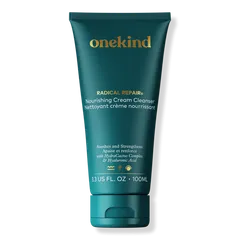
Works for:
based on ingredients and %- Cleansing
Can it cause trouble?
- Irritation risk: high
- Comedogenic risk ingredients: 1
Key actives

Works for
Cleansing
What does the product description say?
Radical Repair Nourishing Cream Cleanser
Source: Ulta
This product works by removing dirt and oil from the surface of the skin. It uses a combination of mild cleansing agents (arachidic acid, cocamidopropyl hydroxysultaine, decyl glucoside, disodium 2-sulfolaurate, disodium laureth sulfosuccinate, glyceryl caprylate, glyceryl undecylenate, glycol distearate, lauryl glucoside, myristic acid, palmitic acid, sodium lauroyl lactylate, sodium lauryl sulfoacetate, sodium methyl 2-sulfolaurate, sodium methyl cocoyl taurate, stearyl alcohol, xanthan gum) and should be able to cleanse the skin gently. Still keep in mind that any cleansing can disrupt the skin barrier, and most people do not need to cleanse their skin more than once per day.
Even though this formulation is mild, the following cleansing agents could trigger an irritation or allergy for some people: decyl glucoside, sodium methyl cocoyl taurate
Used to create a thicker product consistency
Used as a cleansing agent. Helps water and oil mix together
Helps oil and water mix together. Can be irritating
An emollient that can also help water and oil mix together, as well as prevent bacteria growth in products
Helps oil and water mix together and helps preserve the product formulation
Helps water and oil mix together
Helps oil and water mix together
Helps oil and water mix together. Could be comedogenic
An emollient that is naturally present in skin and helps soften it
Helps water and oil mix together
Helps oil and water mix together
Helps oil and water mix together. Can be used as cleansing agent
An emollient that helps soften the skin
Helps oil and water mix together and works as an emollient
How honest is this product?
| Promise | Can it deliver? |
|---|---|
| Cleansing |
Total Promises Fulfilled score: 100/100.
We receive a small commission for purchases made through these links at no cost for you. Thank you for your support! Learn more
Potential irritants
Comedogenic ingredients
User reviews (0)
Averages from community submissions.
No reviews yet for this product.
Be the first to share your experience!
Tried this product?
Help capture what the ingredient list can't—texture, finish, pilling, scent, and more. Answer what you can, skip the rest.
Takes ~30 seconds.
Reviews are shown in aggregate. No personal details.
| Product | Similarity | Price | Irritancy |
|---|---|---|---|
 Onekind Radical Repair Nourishing Cream Cleanser | Current | $34.00 | |
 Veriphy Skincare CTRL-ALT-DEL Facial Cleanser | 37% | $44.00 | |
 Farmacy Beauty Green Clean Gentle Creamy Cleanser | 37% | $14.00 | |
 MALIN + GOETZ Foaming Cream Cleanser | 36% | $32.00 | |
 Kate Somerville DeliKate™ Soothing Cleanser | 36% | ≈ $13.42 | |
 Maelove Sheer Silk Ceramide Cleanser | 35% | $22.95 |
Key Actives
Helps attract water to the upper layer of the skin and can help improve skin barrier function
An emollient that is naturally present in skin and helps soften it
Helps oil and water mix together and works as an emollient
An emollient that can also help water and oil mix together, as well as prevent bacteria growth in products
Helps oil and water mix together and helps preserve the product formulation
One of the best moisturizing ingredients. Naturally present in skin. It attracts water to the upper layer of the skin working as a humectant
Used as a cleansing agent. Helps water and oil mix together
An emollient that helps soften the skin
Helps oil and water mix together. Can be irritating
Helps oil and water mix together. Can be used as cleansing agent
Helps oil and water mix together
Helps water and oil mix together
Used to create a thicker product consistency
Helps attract water to the upper layer of the skin
Helps oil and water mix together. Could be comedogenic
One of the best moisturizing ingredients. Attracts water into the upper layer of the skin. A version of it is naturally present in skin
Potential irritants
Helps oil and water mix together. Can be used as cleansing agent
Can be drying and contribute to skin irritation. Used in formulars to dissolve other ingredients, create a thinner product consistency or for its antibacterial properties
Used as a cleansing agent. Helps water and oil mix together
Helps mask the small of other ingredients and improve the product texture
Helps oil and water mix together and helps preserve the product formulation
Helps oil and water mix together. Could be comedogenic
Helps to control the skin's pH level. Maintains the skin's natural film of amino-lactic acids and oils. Helps to preserve products
Traditionally used to treat sunburns, dermatitis and inflammation, but evidence for its effectiveness is lacking. The extract can contain humectants that help attract water into the skin
A derivative of vitamin C that is more stable, but less bioavailable than the pure form of vitamin C. It does not penetrate the skin well, but has been shown to convert to pure vitamin C once in skin. It can be helpful in stimulating collagen production and lightening the skin tone, but the required concentration is likely to be very high
Can work as an exfoliant but is typically used to adjust the product pH
Comedogenic ingredients
Helps oil and water mix together. Could be comedogenic
All ingredients
One of the best moisturizing ingredients. Naturally present in skin. It attracts water to the upper layer of the skin working as a humectant
Used as a cleansing agent. Helps water and oil mix together
Acts as a solvent for other ingredients. Speeds up the absorption of other ingredients into the skin
Helps oil and water mix together. Can be used as cleansing agent
An emollient that is naturally present in skin and helps soften it
A preservative. It helps prevent bacterial growth in cosmetic products
Used to stabilize mixtures of oil and water, and create thicker, gel-like product textures
Helps mask the small of other ingredients and improve the product texture
An emollient that can also help water and oil mix together, as well as prevent bacteria growth in products
Helps attract water to the upper layer of the skin and can help improve skin barrier function
Helps oil and water mix together and helps preserve the product formulation
Helps oil and water mix together. Could be comedogenic
Helps to control the skin's pH level. Maintains the skin's natural film of amino-lactic acids and oils. Helps to preserve products
Traditionally used to treat sunburns, dermatitis and inflammation, but evidence for its effectiveness is lacking. The extract can contain humectants that help attract water into the skin
One of the best moisturizing ingredients. Attracts water into the upper layer of the skin. A version of it is naturally present in skin
A derivative of vitamin C that is more stable, but less bioavailable than the pure form of vitamin C. It does not penetrate the skin well, but has been shown to convert to pure vitamin C once in skin. It can be helpful in stimulating collagen production and lightening the skin tone, but the required concentration is likely to be very high
Can work as an exfoliant but is typically used to adjust the product pH
Can be drying and contribute to skin irritation. Used in formulars to dissolve other ingredients, create a thinner product consistency or for its antibacterial properties
Ingredient list view
Water, Glycerin, Cocamidopropyl hydroxysultaine, Propanediol, Stearyl alcohol, Glycol distearate, Lauryl glucoside, Sodium methyl 2-sulfolaurate, Decyl glucoside, Sodium methyl cocoyl taurate, Disodium laureth sulfosuccinate, Palmitic acid, Phenoxyethanol, Stearic acid, Sodium lauryl sulfoacetate, Sodium chloride, Sodium lauroyl lactylate, Polyacrylate crosspolymer-6, Acacia senegal gum, Xanthan gum, Disodium 2-sulfolaurate, Glyceryl caprylate, Saccharide isomerate, Panthenol, Mentha viridis leaf oil, Sodium phytate, Lavandula intermedia oil, Linalool, Linalyl acetate, Glyceryl undecylenate, Sodium benzoate, Menthol, Mentha piperita oil, Myristic acid, Sodium citrate, Opuntia ficus-indica stem extract, Aloe barbadensis leaf juice, Arachidic acid, Hydrolyzed hyaluronic acid, Magnesium ascorbyl phosphate, Pentasodium triphosphate, Citric acid, Alcohol
- Glycerol and the skin: holistic approach to its origin and functions
- Ecofriendly surfactant is allergen of the year
- Safety Assessment of Alkyl Taurate Amides and Taurate Salts as Used in Cosmetics
- Skin moisturizing effects of panthenol-based formulations
- Safety Assessment of Panthenol, Pantothenic Acid, and Derivatives as Used in Cosmetics
- The fatty acid profile of the skin surface lipid layer in papulopustular rosacea
- Efficacy of a New Topical Nano-hyaluronic Acid in Humans
- Physiochemical properties and application of hyaluronic acid: a systematic review
- Stability, transdermal penetration, and cutaneous effects of ascorbic acid and its derivatives
- Topical L-ascorbic acid: percutaneous absorption studies