Works for
Anti-agingGlycolic acid, TocopherolWorks well
“A blend of barbary fig, kahai nut and chia seed oils works to boost the integrity of your lipid barrier, while minimising the look of fine lines as raspberry seed oil helps to restore elasticity.”
This product can help reduce and prevent fine lines and wrinkles, improve skin elasticity and firmness because it contains glycolic acid.
Keep in mind that it typically takes at least 6 weeks to notice any results because the changes that are needed to improve fine lines and elasticity happen in the deeper layers of the skin. No topical anti-aging product can “erase” wrinkles or fully reverse signs of aging.
ExfoliationGlycolic acid, Mandelic acidWorks well
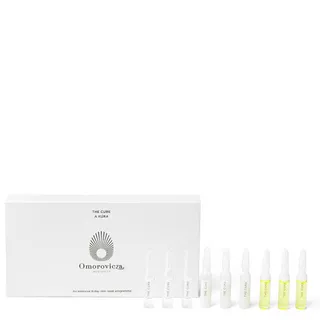
“This carefully crafted course works to exfoliate, revive, nourish and strengthen the skin, revealing a younger-looking and healthier-feeling surface.”
This product can help exfoliate the skin. In other words, it helps break down the bonds between dead cells on the surface of the skin and speed up the skin turnover. Skin often appears softer and brighter after exfoliation, but overdoing it can result in disrupted skin barrier. The following ingredient is doing the exfoliating job in this product: glycolic acid, mandelic acid.
Evens skin toneGlycolic acid, Mandelic acidWorks well
“On days four to six, phase two encourages microcirculations, eases inflammation, eliminates toxin and evens tone and texture with a concoction of sandalwood, ginseng and caffeine.”
This product can help reduce hypepigmentation and even out the skin tone because it contains the following effective ingredients: glycolic acid, mandelic acid
Keep in mind that you would need to apply any topical skincare targetted at hypigmentation consistently for a couple of months to get a result. No topical skincare product can help get rid of hyperpigmentation (including post-acne marks and age spots) instantly.
MoisturizingSodium lactate, Sodium hyaluronate + 8 moreWorks
“Chia Seed and Kahai Nut strengthen the skin’s natural barrier, helping to repair and protect the complexion.”
This product can help improve hydration of the skin with the two types of ingredients.
The first type is called “humectants”:
these ingredients help attract water.
When humectants are on the surface of the skin, they “pull in” the moisture from the outside environment, or from
within deeper layers of the skin. The following ingredients in this product do the job:
sodium hyaluronate, sodium lactate.
This product also contains ingredients called “occlusives”. They help reduce the speed with which our skin loses moisture to the outside environment. These ingredients also help soften the upper layer of the skin, so it feels less tight and nicer to the touch. The following ingredients in this product do the job: plukenetia volubilis seed oil, squalane.
Anti-oxidationSide benefit · Rubus idaeus seed oil, Caffeine + 1 moreMay help
This product contains antioxidants (rubus idaeus seed oil) that can help neutralize free radicals in skin to lessen the damage it gets from the UV light (sun). There is some human evidence for this effect in skin, though it is smaller or less consistent than the evidence for the best antioxidants.
Can it cause trouble?
Irritancy8 strong irritants: Parfum, Linalool + 6 more — patch-test recommendedHigh risk
ComedogenicClean of flagged comedogenic ingredientsNone flagged
User reviews
Be the first — your take helps the next person decide.
Ingredients
Filter by role to see what each ingredient is doing.
Water~45–55%
Sodium lactate~7.1–8.7%
- Irritation risk
- Medium
Helps attract water to the upper layer of the skin. Is often used to adjust the pH level of the product
More about Sodium lactateGlycolic acid~4.5–5.5%
- Irritation risk
- High
An alpha-hydroxy acid (AHA) that helps to remove the dead skin cells on the surface of the skin reveling a more even, smoother complexation. It is also able to stimulate collagen production with long-term use. Could help to reduce pore congestion. It can be irritating to the skin. Apply sunscreen daily if using products with glycolic acid
More about Glycolic acidMaltodextrin~3.3–4%
- Irritation risk
- Low
Used to stabilize the product formulation and can help absorb oil
More about MaltodextrinMandelic acid~2.3–2.9%
- Irritation risk
- High
Helps shed the upper layer of dead cells from the surface of the skin revealing smoother, brighter skin. It can help to reduce hyperpigmentation. It has anti-bacterial properties, and might help to reduce blemishes, as well as fine lines and wrinkles. It is considered to be gentler than glycolic acid
More about Mandelic acidProtease~1.9–2.3%
- Irritation risk
- Low
Sodium hyaluronate~1.6–2%
- Irritation risk
- Low
One of the best moisturizing ingredients. Attracts water into the upper layer of the skin
More about Sodium hyaluronateBenzyl alcohol~0.5–1%
- Irritation risk
- High
A preservative. Can be used to mask unpleasant smell. Can be irritating
More about Benzyl alcoholWater~1.2–1.4%
Saccharomyces/grape ferment extract~0.95–1.15%
- Irritation risk
- Low
Phospholipids~0.7–1.05%
- Irritation risk
- Low
Emollients that are naturaly present in skin. In addition, they help water and oil mix together in the product
More about PhospholipidsEthyl ximenynate~0.6–0.9%
- Irritation risk
- Low
Lecithin~0.6–0.9%
- Irritation risk
- Low
Used mostly for creating emulsions - helping oil and water mix together. Helps soften the upper layer of the skin
More about LecithinCaprylic/capric triglyceride~0.6–0.9%
- Irritation risk
- Medium
A good mix of fatty acids that forms a protective layer on the skin. Improves the shelf life of products. Derived from coconut and glycerin
More about Caprylic/capric triglycerideCaffeine~0.5–0.75%
- Irritation risk
- Medium
Might be helpful in neutralizing free radicals. Can have a dehydration effect that might somewhat decrease the look of puffy eyes
More about CaffeineMaltodextrin~0.5–0.75%
- Irritation risk
- Low
Used to stabilize the product formulation and can help absorb oil
More about MaltodextrinXanthan gum~0.5–0.75%
- Irritation risk
- Low
Used to create a thicker product consistency
More about Xanthan gumHydroxyethylcellulose~0.45–0.7%
- Irritation risk
- Low
Used to thicken product formulations and create gel-like textures
More about HydroxyethylcelluloseEthylhexylglycerin~0.4–0.6%
Phenoxyethanol~0.4–0.6%
- Irritation risk
- Low
A preservative. It helps prevent bacterial growth in cosmetic products
More about PhenoxyethanolSalvia hispanica seed oil~0.35–0.65%
- Irritation risk
- Low
Chia seed oil. Helps to soften the upper layer of the skin and might be helpful in repairing skin barrier
More about Salvia hispanica seed oilCaryodendron orinocense nut oil~0.35–0.65%
- Irritation risk
- Low
Rubus idaeus seed oil~0.3–0.6%
- Irritation risk
- Medium
A plant oil that might be able to help neutralize free radicals in skin
More about Rubus idaeus seed oilPlukenetia volubilis seed oil~0.3–0.6%
- Irritation risk
- Low
A plant oil that works as a good moisturizer by softening the upper layer of the skin. Might be helpful in reducing inflammation in skin and reducing blemishes due to the large content of linoleic acid
More about Plukenetia volubilis seed oilOpuntia ficus-indica seed oil~0.3–0.55%
- Irritation risk
- Medium
A plant oil that helps soften the upper layer of the skin and can support skin's barrier function due to its high content of linoleic acid. It also has anti-microbial properties
More about Opuntia ficus-indica seed oilSqualane~0.3–0.55%
- Irritation risk
- Low
An oil naturally present in skin. Works as an emollient to soften the skin and form a protective layer on its surface without a greasy feeling.
More about SqualaneParfum~0.2–0.4%
- Irritation risk
- High
An aromatic blend of unspecified and possibly irritating ingredients
More about ParfumTocopherol~0.25–0.4%
- Irritation risk
- Low
Pure form of vitamin E. Can help moisturise and protect the skin from free radicals. Often used to help stabilise other ingredients or the formula itself
More about TocopherolLinalool~0.15–0.3%
Limonene~0.15–0.25%
- Irritation risk
- High
A common frangrance that can easily irritate skin, especially if exposed to air, light or heat
More about LimoneneGeraniol~0.1–0.2%
Eugenol~0.1–0.2%
Benzyl benzoate~0.1–0.15%
- Irritation risk
- High
Fragrance with sweet balsamic smell. Help to preserve products and dissolve other ingredients. Could trigger allergic reactions and be irritating
More about Benzyl benzoateFarnesol~0.05–0.15%
Citronellol~0.05–0.1%
Ingredient list view
Water, Sodium lactate, Glycolic acid, Maltodextrin, Mandelic acid, Protease, Sodium hyaluronate, Benzyl alcohol, Water, Saccharomyces/grape ferment extract, Phospholipids, Ethyl ximenynate, Lecithin, Caprylic/capric triglyceride, Caffeine, Maltodextrin, Xanthan gum, Hydroxyethylcellulose, Ethylhexylglycerin, Phenoxyethanol, Salvia hispanica seed oil, Caryodendron orinocense nut oil, Rubus idaeus seed oil, Plukenetia volubilis seed oil, Opuntia ficus-indica seed oil, Squalane, Parfum, Tocopherol, Linalool, Limonene, Geraniol, Eugenol, Benzyl benzoate, Farnesol, Citronellol
Worth comparing, line by line.
Match % combines shared ingredients, the first five ingredients, shared actives and hero ingredients, irritancy (lower counts in the alternative's favour), texture and body area. Only products in the same routine step are compared.
| OmoroviczaThe CureYOUR PRODUCT | Jan MariniMarini Multi-Acid Exfoliating Pads | Paula's choice25% AHA + 2% BHA Exfoliant Peel | BaleaNiacinamide Peeling Concentrate | |
|---|---|---|---|---|
| Match | — | 44% | 43% | 42% |
| Price | $283.00 | — | $44.45−$238.55 | — |
| Shared key ingredients | — | 4 of 12 | 4 of 12 | 3 of 12 |
| Key difference | — | Salicylic Acid | Salicylic Acid | Niacinamide |
| Irritancy | High | Low | Medium | Low |
| Drying alcohol | — | — | — | — |
| View product | Shop | Shop | Shop |


More alternatives: Dr. Levy Radical3 Reboot Pro PeelAllies of Skin Multi Acids & Retinoid Brightening Sleeping Facial
Product summary
"Omorovicza - The Cure" is effective for: Anti-aging, Exfoliation and Evens skin tone
This product could be helpful for: Moisturizing, but its actives are not the most effective or are not well-studied.
Ingredient callouts
- Exfoliating acids (mandelic acid 2.30% - 2.90% and glycolic acid 4.50% - 5.50%). In this concentration, they will have a noticeable exfoliating effect. They can also have an anti-aging effect and stimulate collagen production in a long-run.
- Humectants (sodium hyaluronate 1.60% - 2.00% and sodium lactate 7.10% - 8.70%). These ingredients help attract water to the upper layer of the skin and improve the skin hydration.
About the brand
According to Cruelty-Free Kitty "Omorovicza" is cruelty free and so is its parent company.
Price
The product retails at around 282.95$ in the United States and from 61.50£ up to 205.00£ in the United Kingdom.
For a detailed price comparison: click here.
Sources cited in this review
Every concentration estimate and effectiveness label is anchored to one of these 13 studies and safety reviews.
- 1
- 2Glycolic acid peel therapy – a current reviewncbi.nlm.nih.gov
- 3
- 4
- 5
- 6Hyaluronic acid: A key molecule in skin agingncbi.nlm.nih.gov
