Works for
2 of 2 advertised claims delivered
Moisturizing14 ingredients credited for this claimGood support
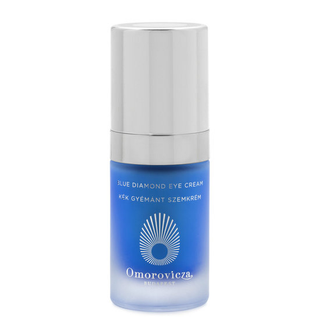
“Blue Diamond Eye Cream”
This product can help improve hydration of the skin with the two types of ingredients.
The first type is called “humectants”:
these ingredients help attract water.
When humectants are on the surface of the skin, they “pull in” the moisture from the outside environment, or from
within deeper layers of the skin. The following ingredients in this product do the job:
arginine, glycerin.
This product also contains ingredients called “occlusives”. They help reduce the speed with which our skin loses moisture to the outside environment. These ingredients also help soften the upper layer of the skin, so it feels less tight and nicer to the touch. The following ingredients in this product do the job: arginine, butyrospermum parkii butter.
Anti-aging5 ingredients credited for this claimModerate support
“Infused with Silicium to lift and firm skin, whilst brightening vitamin C boosts elasticity and stimulates collagen production to reduce sagging that develops with age.”
This product contains lysine. This ingredient might be able to help reduce and prevent fine lines and wrinkles, improve skin elasticity and firmness, but there is not enough evidence that it actually works.
Can it cause trouble?
Irritancy5 strong irritants: Rosa damascena extract, Parfum + 3 more — patch-test recommendedHigh risk
Comedogenic3 ingredients rated 2 or more on the 0–5 pore-clogging scale3 flagged
User reviews
Be the first — your take helps the next person decide.
Ingredients
Filter by role to see what each ingredient is doing.
Water~45–55%
Glycerin~5.1–6.2%
- Irritation risk
- Low
One of the best moisturizing ingredients. Naturally present in skin. It attracts water to the upper layer of the skin working as a humectant
More about GlycerinWater~4.7–5.8%
Ethylhexyl dodecanol~4–4.8%
- Irritation risk
- Low
Squalane~3.1–3.8%
- Irritation risk
- Low
An oil naturally present in skin. Works as an emollient to soften the skin and form a protective layer on its surface without a greasy feeling.
More about SqualaneMethylsilanol mannuronate~2.5–3%
- Irritation risk
- Low
Butyrospermum parkii butter~2.2–2.7%
- Irritation risk
- Low
- Comedogenicity
- 3/5
A great moisturising ingredient that softens the skin and reduces water loss from its upper layer. It also can be helpful in protecting skin from free radicals
More about Butyrospermum parkii butterStearyl heptanoate~2–2.4%
Cetearyl alcohol~1.9–2.3%
- Irritation risk
- Low
- Comedogenicity
- 2/5
A non-drying alcohol. Works as an emollient. Helps water and oil mix together and creates a nice product texture
More about Cetearyl alcoholCetyl phosphate~1.2–1.5%
Arginine~0.9–1.1%
- Irritation risk
- Low
An amino acid that is naturally present in skin and helps keep it hydrated. When used together with AHAs, it can reduce their irritating effect on the skin
More about ArginineRosa damascena extract~0.9–1.1%
- Irritation risk
- High
Oil of a very fragrant pink rose used as fragrance in cosmetics. Extensive research has shown it has mixed benefits. In the pro column, inhaling this flower’s scent seems to have relaxing properties and the plant’s petals contain skin-soothing and antioxidant compounds that can benefit skin. On the flipside, the numerous chemicals that create this rose’s distinctive fragrance pose a risk of causing skin aggravation.
More about Rosa damascena extractPhenoxyethanol~0.5–1%
- Irritation risk
- Low
A preservative. It helps prevent bacterial growth in cosmetic products
More about PhenoxyethanolAlbizia julibrissin bark extract~0.7–1.05%
- Irritation risk
- High
A plant extract that might help to neutralize free radicals in skin. Is claimed to help reduce hyperpigmentation but evidence is missing
More about Albizia julibrissin bark extractPullulan~0.75–1.1%
- Irritation risk
- High
Creates a thin drying film on the skin resulting in a short-term tightening effect
More about PullulanCarbomer~0.7–1.05%
- Irritation risk
- Low
Helps create a thicker or gel-like product texture. It is not a surfactant but can be used in gentle cleansing formulations
More about CarbomerSodium hyaluronate~0.7–1%
- Irritation risk
- Low
One of the best moisturizing ingredients. Attracts water into the upper layer of the skin
More about Sodium hyaluronateHydrolyzed hyaluronic acid~0.6–0.9%
- Irritation risk
- Low
One of the best moisturizing ingredients. Attracts water into the upper layer of the skin. A version of it is naturally present in skin
More about Hydrolyzed hyaluronic acidPrunus domestica seed extract~0.65–0.95%
- Irritation risk
- Low
Ethylhexylglycerin~0.6–0.9%
Ascorbyl tetraisopalmitate~0.55–0.85%
- Irritation risk
- Medium
A vitamin C derivative. Studies show that is might be effective in reducing hyperpigmentation, but there are no studies confirming that it is effectively converted into the bioavailable form of Vitamin C in skin. It is not clear how this derivative compares in effectiveness to the topical application of bioavailable form of vitamin C (L-ascorbic acid)
More about Ascorbyl tetraisopalmitateMethylglucoside phosphate~0.5–0.8%
- Irritation risk
- Low
Proline~0.5–0.8%
Lysine~0.5–0.75%
- Irritation risk
- Low
An amino-acid that helps to attract water to the upper layer of the skin. In combination with other amino-acids, might help to reduce fine lines and wrinkles
More about LysineTocopherol~0.5–0.75%
- Irritation risk
- Low
Pure form of vitamin E. Can help moisturise and protect the skin from free radicals. Often used to help stabilise other ingredients or the formula itself
More about TocopherolDisodium edta~0.45–0.65%
Tropaeolum majus flower/leaf/stem extract~0.35–0.65%
- Irritation risk
- Low
Parfum~0.4–0.65%
- Irritation risk
- High
An aromatic blend of unspecified and possibly irritating ingredients
More about ParfumXanthan gum~0.45–0.65%
- Irritation risk
- Low
Used to create a thicker product consistency
More about Xanthan gumCopper gluconate~0.4–0.6%
- Irritation risk
- Medium
Typically used to stabilize the product formulations. It is a salt of polyhydroxy acid (PHA) and in larger concentrations, can help shed the dead cells from the skin surface revealing smoother skin. It can help attract water to the upper layer of the skin. Might to be helpful against acne and clogged pores. Could be helpful in neutralizing free radicals, but solid research is missing
More about Copper gluconatePhospholipids~0.35–0.65%
- Irritation risk
- Low
Emollients that are naturaly present in skin. In addition, they help water and oil mix together in the product
More about PhospholipidsSorbic acid~0.35–0.6%
Sodium benzoate~0.25–0.5%
Darutoside~0.3–0.55%
- Irritation risk
- Low
Pentapeptide-44~0.25–0.5%
- Irritation risk
- Low
Silica~0.3–0.55%
Linalool~0.15–0.25%
Limonene~0.05–0.1%
- Irritation risk
- High
A common frangrance that can easily irritate skin, especially if exposed to air, light or heat
More about LimoneneGeraniol~0.01–0.05%
Ingredient list view
Water, Glycerin, Water, Ethylhexyl dodecanol, Squalane, Methylsilanol mannuronate, Butyrospermum parkii butter, Stearyl heptanoate, Cetearyl alcohol, Cetyl phosphate, Arginine, Rosa damascena extract, Phenoxyethanol, Albizia julibrissin bark extract, Pullulan, Carbomer, Sodium hyaluronate, Hydrolyzed hyaluronic acid, Prunus domestica seed extract, Ethylhexylglycerin, Ascorbyl tetraisopalmitate, Methylglucoside phosphate, Proline, Lysine, Unknown, Tocopherol, Disodium edta, Tropaeolum majus flower/leaf/stem extract, Parfum, Xanthan gum, Copper gluconate, Phospholipids, Sorbic acid, Sodium benzoate, Darutoside, Unknown, Pentapeptide-44, Unknown, Silica, Linalool, Limonene, Geraniol
Compare prices
Retailers ranked by price — lowest first.


Sources cited in this review
Every concentration estimate and effectiveness label is anchored to one of these 16 studies and safety reviews.
- 1
- 2
- 3Phytopharmacological properties of Albizia species: A reviewresearchgate.net
- 4Hyaluronic acid: A key molecule in skin agingncbi.nlm.nih.gov
- 5
- 6Efficacy of a New Topical Nano-hyaluronic Acid in Humansncbi.nlm.nih.gov

Affiliate links · As an Amazon Associate, WIMJ earns from qualifying purchases.