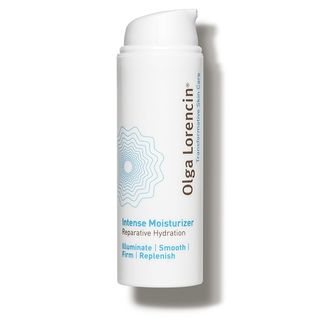
Olga Lorencin Skin Care Intense Moisturizer
Works for
2 of 2 advertised claims delivered
Moisturizing24 ingredients credited for this claimStrong support
“Intense Moisturizer”
This product can help improve hydration of the skin with the two types of ingredients.
The first type is called “humectants”:
these ingredients help attract water.
When humectants are on the surface of the skin, they “pull in” the moisture from the outside environment, or from
within deeper layers of the skin. The following ingredients in this product do the job:
biosaccharide gum-1, sodium hyaluronate.
This product also contains ingredients called “occlusives”. They help reduce the speed with which our skin loses moisture to the outside environment. These ingredients also help soften the upper layer of the skin, so it feels less tight and nicer to the touch. The following ingredients in this product do the job: dimethicone, simmondsia chinensis seed oil.
The following ingredients in this product are especially good for supporting the skin barrier and helping with the hydration level: ceramide 2, palmitoyl oligopeptide
Anti-aging5 ingredients credited for this claimModerate support
“accelerate collagen production to help repair skin damage, increase elasticity and delay the aging process Expertly designed formulations for perfecting your complexion.”
This product contains palmitoyl oligopeptide. This ingredient might be able to help reduce and prevent fine lines and wrinkles, improve skin elasticity and firmness, but there is not enough evidence that it actually works.
Anti-oxidationNot advertised by the brand · 12 ingredients credited for this claimModerate support
This product contains antioxidants (squalene) that might be able to help neutralize free radicals in skin to lessen the damage it gets from the UV light (sun). There is not enough evidence to confirm their effectiveness in skin though.
Can it cause trouble?
Irritancy1 strong irritant: ParfumMedium risk
Comedogenic3 ingredients rated 2 or more on the 0–5 pore-clogging scale3 flagged
User reviews
Be the first — your take helps the next person decide.
Ingredients
Filter by role to see what each ingredient is doing.
Water~45–55%
Macadamia integrifolia seed oil~4.4–5.4%
- Irritation risk
- Low
A plant oil that helps soften the upper layer of the skin
More about Macadamia integrifolia seed oilDiisopropyl dimer dilinoleate~4.1–5%
- Irritation risk
- Low
Squalane~3.1–3.8%
- Irritation risk
- Low
An oil naturally present in skin. Works as an emollient to soften the skin and form a protective layer on its surface without a greasy feeling.
More about SqualaneCetearyl alcohol~2.3–2.8%
- Irritation risk
- Low
- Comedogenicity
- 2/5
A non-drying alcohol. Works as an emollient. Helps water and oil mix together and creates a nice product texture
More about Cetearyl alcoholPolysorbate 60~1.9–2.3%
C12-15 alkyl benzoate~1.6–2%
- Irritation risk
- Low
Enhances the product texture and makes it more spreadable. Helps reduce water loss from the outer layer of skin. Extands the shelf life by preventing bacteria growth
More about C12-15 alkyl benzoateDimethicone~1.5–1.8%
- Irritation risk
- Low
A silicone that helps to reduce water loss from the surface of the skin. Can temporarily "fill in" lines and wrinkles, absorb oil, and create a nice product finish
More about DimethiconeSimmondsia chinensis seed oil~1.2–1.5%
- Irritation risk
- Medium
Softens the upper layer of skin and helps restore the healthy skin barrier. Has shown to help calm down inflammation in skin. It is a stable oil, meaning that it retains its properties even when exposed to air.
More about Simmondsia chinensis seed oilPeg-100 stearate~1–1.2%
- Irritation risk
- Low
Helps oil and water mix togehter and creates a nice product texture
More about Peg-100 stearateButyrospermum parkii butter~0.7–1.1%
- Irritation risk
- Low
- Comedogenicity
- 3/5
A great moisturising ingredient that softens the skin and reduces water loss from its upper layer. It also can be helpful in protecting skin from free radicals
More about Butyrospermum parkii butterPersea gratissima oil~0.65–0.95%
- Irritation risk
- Medium
An emollient that helps soften the skin and could be helpful in repairing its barrier function
More about Persea gratissima oilTocopheryl acetate~0.55–0.8%
- Irritation risk
- Medium
A more stable but less bio-available form of vitamin E compared to Tocopherol. Might help moisturize and protect the skin from free radicals, but mostly used in low concentrations to stabilize other ingredients.
More about Tocopheryl acetateOlea europaea fruit oil~0.5–0.75%
- Irritation risk
- Medium
An emollient that helps soften the skin but is not effective for restoring its barrier function. Might be helpful to calm down inflammation
More about Olea europaea fruit oilBorago officinalis seed oil~0.45–0.7%
- Irritation risk
- Low
A plant oil that is effective in reducing irritation in skin, restore the barrier function and support its hydration
More about Borago officinalis seed oilOenothera biennis oil~0.5–0.75%
- Irritation risk
- Medium
Helps soften the upper layer of the skin and can support skin barrier function
More about Oenothera biennis oilOlive oil decyl esters~0.45–0.65%
- Irritation risk
- Low
Bisabolol~0.3–0.6%
- Irritation risk
- Low
An active component of chamomile plant that historically has been used to calm down irritated skin. A recent study shows that bisabolol indeed can have some anti-inflammatory effect on skin, even though conclusive data is lacking. Bisabolol has a sweet floral scent and can be added to products for its aromatic properties
More about BisabololSodium pca~0.3–0.6%
- Irritation risk
- Low
Naturally present in skin and helps to attract water to its upper layer
More about Sodium pcaSqualene~0.35–0.65%
- Irritation risk
- Low
- Comedogenicity
- 2/5
An oil that is naturally part of skin sebum that helps to soften its upper layer, reduce water loss and neutralize free radicals. It might be comedogenic. Avoid applying large concentrations (or pure oil) before sun exposure as oxidized squalene can clog pores and lead to skin irritation. Today squalene is mostly derived from vegetable oils or synthetized by yeast
More about SqualeneCeramide 2~0.3–0.6%
- Irritation risk
- Low
A type of lipid similar to ceramides naturally present in skin. Helps to soften the upper layer of the skin and supports the skin barrier function to keep it hydrated. Can help to prevent inflammation in skin
More about Ceramide 2Olea europaea leaf extract~0.25–0.5%
- Irritation risk
- Medium
A plant extract that might have some anti-oxidant and anti-inflammatory properties but evidence for effectiveness in skin is missing
More about Olea europaea leaf extractPeg-10~0.25–0.5%
- Irritation risk
- Low
Laureth-7~0.3–0.55%
Tocopherol~0.3–0.5%
- Irritation risk
- Low
Pure form of vitamin E. Can help moisturise and protect the skin from free radicals. Often used to help stabilise other ingredients or the formula itself
More about TocopherolBiosaccharide gum-1~0.25–0.5%
- Irritation risk
- Low
Helps attract water to the upper layer of the skin and is claimed to provide a longer-lasting hydration because of its ability to create a water-binding film on the surface of the skin
More about Biosaccharide gum-1Echinacea purpurea extract~0.25–0.45%
- Irritation risk
- High
Plant extract that might have some anti-oxidant properties. Can be irritating
More about Echinacea purpurea extractAcanthopanax senticosus root extract~0.25–0.45%
- Irritation risk
- High
A plant extract that might have antioxidant properties
More about Acanthopanax senticosus root extractAscorbyl palmitate~0.25–0.5%
- Irritation risk
- Medium
Being a lipid soluble form of vitamin C, it is more stable and can penetrate the skin better than L-Ascorbic acid. It is effective in protecting the skin from free radicals, as well as evening the skin tone, but is less effective in stimulating collagen production compared to L-Ascorbic acid.
More about Ascorbyl palmitateCentella asiatica extract~0.35–0.6%
- Irritation risk
- Medium
A plant extract that has been shown to be able to reduce inflammation in skin, support restoration of skin barrier function, as well as support collagen production. Contains active compounds called centelloids: asiaticoside, madecasosside, asiatic acid and madecassic acid. Might be helpful in preventing stretch marks. It can be itself be irritating though.
More about Centella asiatica extractSodium hyaluronate~0.25–0.5%
- Irritation risk
- Low
One of the best moisturizing ingredients. Attracts water into the upper layer of the skin
More about Sodium hyaluronatePalmitoyl oligopeptide~0.35–0.65%
- Irritation risk
- Low
A type of peptide. Peptides are excellent moisturizers and might be able support collagen production reducing fine lines and wrinkles
More about Palmitoyl oligopeptideGlyceryl stearate~0.3–0.6%
- Irritation risk
- Low
An emollient that softens the skin and forms a protective layer on its surface. Helps water and oil mix together
More about Glyceryl stearateButylene glycol~0.25–0.45%
- Irritation risk
- Low
Used to create a nice product texture and help delivery of other ingredients. Might be somewhat helpful in attracting water to the upper layer of the skin
More about Butylene glycolPhenoxyethanol~0.25–0.5%
- Irritation risk
- Low
A preservative. It helps prevent bacterial growth in cosmetic products
More about PhenoxyethanolPolyacrylamide~0.25–0.5%
- Irritation risk
- Medium
Used to improve product texture and help oil and water mix together
More about PolyacrylamideTribehenin~0.25–0.5%
- Irritation risk
- Low
Used to create a thicker product consistency and soften the upper layer of the skin
More about TribeheninCaprylyl glycol~0.25–0.45%
- Irritation risk
- Medium
Helps preserve products and creates a nice product texture
More about Caprylyl glycolC13-14 isoparaffin~0.25–0.4%
- Irritation risk
- Low
Helps soften the upper layer of the skin, dissolve other ingredients and create a thicker product consistency
More about C13-14 isoparaffinEthylhexylglycerin~0.15–0.3%
Hexylene glycol~0.15–0.25%
- Irritation risk
- Medium
Helps create a more spreadable product texture
More about Hexylene glycolCarbomer~0.1–0.25%
- Irritation risk
- Low
Helps create a thicker or gel-like product texture. It is not a surfactant but can be used in gentle cleansing formulations
More about CarbomerAminomethyl propanol~0.15–0.25%
Disodium edta~0.1–0.2%
Parfum~0.05–0.1%
- Irritation risk
- High
An aromatic blend of unspecified and possibly irritating ingredients
More about ParfumIngredient list view
Water, Macadamia integrifolia seed oil, Diisopropyl dimer dilinoleate, Squalane, Cetearyl alcohol, Polysorbate 60, C12-15 alkyl benzoate, Dimethicone, Simmondsia chinensis seed oil, Peg-100 stearate, Butyrospermum parkii butter, Persea gratissima oil, Tocopheryl acetate, Olea europaea fruit oil, Borago officinalis seed oil, Oenothera biennis oil, Olive oil decyl esters, Bisabolol, Sodium pca, Squalene, Ceramide 2, Olea europaea leaf extract, Peg-10, Unknown, Laureth-7, Tocopherol, Biosaccharide gum-1, Echinacea purpurea extract, Acanthopanax senticosus root extract, Ascorbyl palmitate, Centella asiatica extract, Sodium hyaluronate, Palmitoyl oligopeptide, Glyceryl stearate, Butylene glycol, Phenoxyethanol, Polyacrylamide, Tribehenin, Caprylyl glycol, C13-14 isoparaffin, Ethylhexylglycerin, Hexylene glycol, Carbomer, Aminomethyl propanol, Disodium edta, Parfum
Compare prices
Retailers ranked by price — lowest first.
Worth comparing, line by line.
Match % combines shared ingredients, the first five ingredients, shared actives and hero ingredients, irritancy (lower counts in the alternative's favour), texture and body area. Only products in the same routine step are compared.
| Olga Lorencin Skin CareIntense MoisturizerYOUR PRODUCT | Perricone MDTreatments Neuropeptide Night Cream | |
|---|---|---|
| Match | — | 50% |
| Price | $95.00 | $274.39+$179.39 |
| Shared key ingredients | — | 7 of 16 |
| Key difference | — | Dipeptide-2 |
| Irritancy | Medium | Medium |
| Drying alcohol | — | — |
| View product | Shop |


Sources cited in this review
Every concentration estimate and effectiveness label is anchored to one of these 25 studies and safety reviews.
- 1
- 2
- 3Final Report on the Safety Assessment of Dimethicone Copolyoljournals.sagepub.com
- 4Use of “natural” oils for moisturization: Review of olive, coconut, and sunflower seed oilonlinelibrary.wiley.com
- 5
- 6

Affiliate links · As an Amazon Associate, WIMJ earns from qualifying purchases.