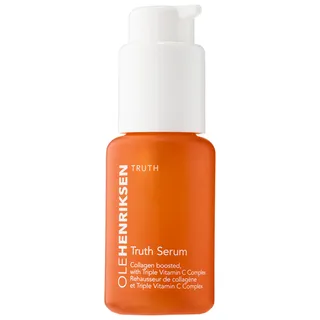
OleHenriksen Truth Serum

OleHenriksen Truth Serum

Efficacy75/100IrritancyHigh·100% recommend (1 review)

Works for

Anti-aging
Thioctic acid, Sodium ascorbyl phosphate + 2 more
May help
What the product description says
“Fights visible signs of aging”
Source: Ole henriksen

This product contains thioctic acid. This ingredient help neutralize free radicals in skin. By doing so, they might be able to prevent early signs of aging (like fine lines and wrinkles), at least to some extent. These ingredients will not be able to "reverse" signs of aging.

Thioctic acidEffect: Low~0.3–0.55%
Sodium ascorbyl phosphateEffect: Low, below effective doseA stable derivative of vitamin C. It is oil-soluble which means it is more likely to penetrate the skin compared to the pure form of vitamin C (which is water-soluble), but it is less bio-available and is way less effective in stimulating collagen and reducing wrinkles compared to the pure form of vitamin C (L-ascorbic acid) and its other derivatives (for example, magnesium ascorbyl phosphate). At the same time, this vitamin C derivative has been shown in studies to be effective in reducing acne, blemishes and clogged pores. It is less irritating then the pure form of vitamin C~3–3.7%
Camellia sinensis leaf extractEffect: Low, below effective doseCan contain potent anti-oxidant compounds (abbreviated ECG, GCG, EGC, and EGCG) that might help protect the skin from free radicals. Can help calm down inflammation and has some anti-bacterial properties. Unfortunately, these antioxidants are unstable and lose their effectiveness very quickly in products. The concentration of the antioxidant compounds in the extract also tends to be low to be effective in topical formulation~0.25–0.45%
Ascorbic acidUnder-dosedThe most well-researched antioxidant that works in skin. Helps neutralize free radicals supporting collagen production, helping to even out the skin tone and preventing early signs of aging~0.25–0.45%
Moisturizing
Glycerin, Peg-12 dimethicone + 6 more
Works
What the product description says
“A cult-favorite vitamin C serum that brightens, boosts elasticity, firms, hydrates and soothes skin for a healthy-looking complexion.”
Source: Ole henriksen

This product contains good ingredients to attract water to the upper layer of the skin. These ingredients are called "humectants": glycerin, sodium hyaluronate.

When humectants are on the surface of the skin, they “pull in” the moisture from the outside environment, or from within deeper layers of the skin. If the air is dry, humectants can speed up the moisture loss from the skin. This is why it is a good idea to use another product on top of this one to help "seal in" the moisture (look for ingredients like dimethicone, squalane, oils and butters).

GlycerinKey active· HumectantEffect: HighOne of the best moisturizing ingredients. Naturally present in skin. It attracts water to the upper layer of the skin working as a humectant~4.7–5.7%
Peg-12 dimethiconeKey activeEffect: MediumHelps soften the upper layer of the skin and create a nice product texture~0.65–1%
Hydrolyzed vegetable proteinKey activeEffect: Medium~0.45–0.65%
Sodium hyaluronateKey active· HumectantEffect: HighOne of the best moisturizing ingredients. Attracts water into the upper layer of the skin~0.3–0.55%
Caprylyl glycol· Humectant, EmollientEffect: LowHelps preserve products and creates a nice product texture~1.6–2%
Sorbitol· HumectantEffect: LowHelps attract water to the upper layer of the skin and improves the product texture~0.25–0.45%
Aloe barbadensis leaf extractEffect: Low, below effective doseTraditionally used to treat sunburns, dermatitis and inflammation, but evidence for its effectiveness is lacking. The extract can contain humectants that help attract water into the skin~0.45–0.7%
Camellia sinensis leaf extractEffect: Low, below effective doseCan contain potent anti-oxidant compounds (abbreviated ECG, GCG, EGC, and EGCG) that might help protect the skin from free radicals. Can help calm down inflammation and has some anti-bacterial properties. Unfortunately, these antioxidants are unstable and lose their effectiveness very quickly in products. The concentration of the antioxidant compounds in the extract also tends to be low to be effective in topical formulation~0.25–0.45%
Anti-oxidation
Not advertised by the brand · Thioctic acid, Rosa canina fruit extract + 4 more
Works well

This product contains antioxidants (thioctic acid) that can help neutralize free radicals in skin. By doing so, they can lessen the damage the skin gets from the UV light (sun).

Thioctic acidKey activeEffect: High~0.3–0.55%
Rosa canina fruit extractEffect: LowA plant extract that might have some anti-oxidant properties, but evidence is lacking~0.25–0.4%
Tocopheryl acetateEffect: Low, below effective doseA more stable but less bio-available form of vitamin E compared to Tocopherol. Might help moisturize and protect the skin from free radicals, but mostly used in low concentrations to stabilize other ingredients.~0.55–0.85%
Sodium ascorbyl phosphateUnder-dosedA stable derivative of vitamin C. It is oil-soluble which means it is more likely to penetrate the skin compared to the pure form of vitamin C (which is water-soluble), but it is less bio-available and is way less effective in stimulating collagen and reducing wrinkles compared to the pure form of vitamin C (L-ascorbic acid) and its other derivatives (for example, magnesium ascorbyl phosphate). At the same time, this vitamin C derivative has been shown in studies to be effective in reducing acne, blemishes and clogged pores. It is less irritating then the pure form of vitamin C~3–3.7%
Ascorbic acidUnder-dosedThe most well-researched antioxidant that works in skin. Helps neutralize free radicals supporting collagen production, helping to even out the skin tone and preventing early signs of aging~0.25–0.45%
Camellia sinensis leaf extractUnder-dosedCan contain potent anti-oxidant compounds (abbreviated ECG, GCG, EGC, and EGCG) that might help protect the skin from free radicals. Can help calm down inflammation and has some anti-bacterial properties. Unfortunately, these antioxidants are unstable and lose their effectiveness very quickly in products. The concentration of the antioxidant compounds in the extract also tends to be low to be effective in topical formulation~0.25–0.45%

Can it cause trouble?

Irritancy
7 strong irritants: Parfum, Aroma + 5 more — patch-test recommended
High risk
We flagged 22 ingredients with irritancy potential. Severity depends on your sensitivity threshold; the table lists the worst offenders first.
IngredientFunctionIrritationEst. amount
ParfumAn aromatic blend of unspecified and possibly irritating ingredientsHigh~0.9–1.1%est.
AromaAn unspecified blend of fragrant irritating ingredientsHigh~0.5–0.75%est.
Citrus aurantium dulcis fruit extractA plant extract that is used as a fragrance. Can be irritating and lead to photosensitivityHigh~0.3–0.6%est.
Citrus grandis seed extract—High~0.2–0.4%est.
Ascorbic acidThe most well-researched antioxidant that works in skin. Helps neutralize free radicals supporting collagen production, helping to even out the skin tone and preventing early signs of agingHigh~0.25–0.45%est.
TriacetinUsed to dissolve other ingredientsHigh~0.2–0.35%est.
Benzyl benzoateFragrance with sweet balsamic smell. Help to preserve products and dissolve other ingredients. Could trigger allergic reactions and be irritatingHigh~0.1–0.2%est.
LimoneneA common frangrance that can easily irritate skin, especially if exposed to air, light or heatHigh~0.1–0.15%est.
LinaloolA fragrance. Can be irritatingHigh~0.05–0.1%est.
Ci 15985A colorantHigh~0.05–0.1%est.
Oleth-20Helps oil and water mix togetherMedium~4.8–5.9%est.
Sodium ascorbyl phosphateA stable derivative of vitamin C. It is oil-soluble which means it is more likely to penetrate the skin compared to the pure form of vitamin C (which is water-soluble), but it is less bio-available and is way less effective in stimulating collagen and reducing wrinkles compared to the pure form of vitamin C (L-ascorbic acid) and its other derivatives (for example, magnesium ascorbyl phosphate). At the same time, this vitamin C derivative has been shown in studies to be effective in reducing acne, blemishes and clogged pores. It is less irritating then the pure form of vitamin CMedium~3–3.7%est.
Caprylyl glycolHelps preserve products and creates a nice product textureMedium~1.6–2%est.
Hexylene glycolHelps create a more spreadable product textureMedium~1.4–1.7%est.
Citric acidCan work as an exfoliant but is typically used to adjust the product pHMedium~1.1–1.4%est.
Tocopheryl acetateA more stable but less bio-available form of vitamin E compared to Tocopherol. Might help moisturize and protect the skin from free radicals, but mostly used in low concentrations to stabilize other ingredients.Medium~0.55–0.85%est.
Polysorbate 60Helps oil and water mix togetherMedium~0.45–0.65%est.
Aloe barbadensis leaf extractTraditionally used to treat sunburns, dermatitis and inflammation, but evidence for its effectiveness is lacking. The extract can contain humectants that help attract water into the skinMedium~0.45–0.7%est.
Rosa canina fruit extractA plant extract that might have some anti-oxidant properties, but evidence is lackingMedium~0.25–0.4%est.
Leuconostoc/radish root ferment filtrateA preservative that comes from radishes fermented by a bacteria. New research suggests that the preservation properties in the ingredient come from an ammonium salt that is not present naturally in radish root but used in its cultivation. Is problematic because the exact amount of the preservative agents is difficult to determineMedium~0.2–0.4%est.
Potassium sorbateA preservativeMedium~0.2–0.35%est.
Sodium benzotriazolyl butylphenol sulfonateHelps protect the ingredients in the formulation against UV lightMedium~0.15–0.25%est.
Comedogenic
Clean of flagged comedogenic ingredients
None flagged

User reviews

Would you recommend?
100%·yes

1 of 1 community members would buy it again.

100% would0% wouldn't
What reviewers noticed
Marker shows the average response

Ingredients

Filter by role to see what each ingredient is doing.

Water~45–55%
Formula
Irritation risk
Low

Plain old water

More about Water
Glycerin~4.7–5.7%
Key active
Irritation risk
Low
Works for
Moisturizing

One of the best moisturizing ingredients. Naturally present in skin. It attracts water to the upper layer of the skin working as a humectant

More about Glycerin
Oleth-20~4.8–5.9%
Irritant · medium
Irritation risk
Medium
Works for
Cleansing

Helps oil and water mix together

More about Oleth-20
Sodium ascorbyl phosphate~3–3.7%
Under-dosedIrritant · medium
Irritation risk
Medium
Works for
Anti-blemishAnti-oxidationAnti-aging

A stable derivative of vitamin C. It is oil-soluble which means it is more likely to penetrate the skin compared to the pure form of vitamin C (which is water-soluble), but it is less bio-available and is way less effective in stimulating collagen and reducing wrinkles compared to the pure form of vitamin C (L-ascorbic acid) and its other derivatives (for example, magnesium ascorbyl phosphate). At the same time, this vitamin C derivative has been shown in studies to be effective in reducing acne, blemishes and clogged pores. It is less irritating then the pure form of vitamin C

More about Sodium ascorbyl phosphate
Hydroxyethylcellulose~2.3–2.8%
Formula
Irritation risk
Low

Used to thicken product formulations and create gel-like textures

More about Hydroxyethylcellulose
Phenoxyethanol~0.5–1%
Formula
Irritation risk
Low

A preservative. It helps prevent bacterial growth in cosmetic products

More about Phenoxyethanol
Caprylyl glycol~1.6–2%
Irritant · medium
Irritation risk
Medium
Works for
Moisturizing

Helps preserve products and creates a nice product texture

More about Caprylyl glycol
Hexylene glycol~1.4–1.7%
Irritant · medium
Irritation risk
Medium
Works for
Cleansing

Helps create a more spreadable product texture

More about Hexylene glycol
Citric acid~1.1–1.4%
Irritant · medium
Irritation risk
Medium

Can work as an exfoliant but is typically used to adjust the product pH

More about Citric acid
Parfum~0.9–1.1%
Irritant · high
Irritation risk
High

An aromatic blend of unspecified and possibly irritating ingredients

More about Parfum
Peg-12 dimethicone~0.65–1%
Key active
Irritation risk
Low
Works for
Moisturizing

Helps soften the upper layer of the skin and create a nice product texture

More about Peg-12 dimethicone
Tocopheryl acetate~0.55–0.85%
Irritant · medium
Irritation risk
Medium
Works for
Anti-oxidation

A more stable but less bio-available form of vitamin E compared to Tocopherol. Might help moisturize and protect the skin from free radicals, but mostly used in low concentrations to stabilize other ingredients.

More about Tocopheryl acetate
Aroma~0.5–0.75%
Irritant · high
Irritation risk
High

An unspecified blend of fragrant irritating ingredients

More about Aroma
Hydrolyzed vegetable protein~0.45–0.65%
Key active
Irritation risk
Low
Works for
Moisturizing
More about Hydrolyzed vegetable protein
Disodium phosphate~0.45–0.65%
Formula
Irritation risk
Low

Helps adjust the product pH and stabilize the formulation

More about Disodium phosphate
Polysorbate 60~0.45–0.65%
Irritant · medium
Irritation risk
Medium
Works for
Cleansing

Helps oil and water mix together

More about Polysorbate 60
Aloe barbadensis leaf extract~0.45–0.7%
Irritant · medium
Irritation risk
Medium
Works for
Moisturizing

Traditionally used to treat sunburns, dermatitis and inflammation, but evidence for its effectiveness is lacking. The extract can contain humectants that help attract water into the skin

More about Aloe barbadensis leaf extract
Citrus aurantium dulcis fruit extract~0.3–0.6%
Irritant · high
Irritation risk
High

A plant extract that is used as a fragrance. Can be irritating and lead to photosensitivity

More about Citrus aurantium dulcis fruit extract
Sodium hyaluronate~0.3–0.55%
Key active
Irritation risk
Low
Works for
Moisturizing

One of the best moisturizing ingredients. Attracts water into the upper layer of the skin

More about Sodium hyaluronate
Thioctic acid~0.3–0.55%
Key active
Irritation risk
Low
Works for
Anti-oxidationAnti-aging
More about Thioctic acid
Calcium ascorbate~0.25–0.5%
Formula
Sodium phosphate~0.25–0.5%
Formula
Irritation risk
Low

Helps stabilize the product formulation

More about Sodium phosphate
Sorbitol~0.25–0.45%
Formula
Irritation risk
Low
Works for
Moisturizing

Helps attract water to the upper layer of the skin and improves the product texture

More about Sorbitol
Citrus grandis seed extract~0.2–0.4%
Irritant · high
Sodium benzoate~0.25–0.45%
Formula
Irritation risk
Low

A preservative

More about Sodium benzoate
Ascorbic acid~0.25–0.45%
Under-dosedIrritant · high
Irritation risk
High
Works for
Anti-oxidationEvens skin toneAnti-aging

The most well-researched antioxidant that works in skin. Helps neutralize free radicals supporting collagen production, helping to even out the skin tone and preventing early signs of aging

More about Ascorbic acid
Camellia sinensis leaf extract~0.25–0.45%
Under-dosed
Irritation risk
Low
Works for
AntibacterialAnti-oxidationAnti-agingAnti-blemishEvens skin toneMoisturizing

Can contain potent anti-oxidant compounds (abbreviated ECG, GCG, EGC, and EGCG) that might help protect the skin from free radicals. Can help calm down inflammation and has some anti-bacterial properties. Unfortunately, these antioxidants are unstable and lose their effectiveness very quickly in products. The concentration of the antioxidant compounds in the extract also tends to be low to be effective in topical formulation

More about Camellia sinensis leaf extract
Euphrasia officinalis extract~0.2–0.4%
Formula
Rosa canina fruit extract~0.25–0.4%
Irritant · medium
Irritation risk
Medium
Works for
Anti-oxidation

A plant extract that might have some anti-oxidant properties, but evidence is lacking

More about Rosa canina fruit extract
Leuconostoc/radish root ferment filtrate~0.2–0.4%
Irritant · medium
Irritation risk
Medium

A preservative that comes from radishes fermented by a bacteria. New research suggests that the preservation properties in the ingredient come from an ammonium salt that is not present naturally in radish root but used in its cultivation. Is problematic because the exact amount of the preservative agents is difficult to determine

More about Leuconostoc/radish root ferment filtrate
Potassium sorbate~0.2–0.35%
Irritant · medium
Irritation risk
Medium

A preservative

More about Potassium sorbate
Triacetin~0.2–0.35%
Irritant · high
Irritation risk
High

Used to dissolve other ingredients

More about Triacetin
Sodium benzotriazolyl butylphenol sulfonate~0.15–0.25%
Irritant · medium
Irritation risk
Medium

Helps protect the ingredients in the formulation against UV light

More about Sodium benzotriazolyl butylphenol sulfonate
Benzyl benzoate~0.1–0.2%
Irritant · high
Irritation risk
High

Fragrance with sweet balsamic smell. Help to preserve products and dissolve other ingredients. Could trigger allergic reactions and be irritating

More about Benzyl benzoate
Limonene~0.1–0.15%
Irritant · high
Irritation risk
High

A common frangrance that can easily irritate skin, especially if exposed to air, light or heat

More about Limonene
Linalool~0.05–0.1%
Irritant · high
Irritation risk
High

A fragrance. Can be irritating

More about Linalool
Ci 15985~0.05–0.1%
Irritant · high
Irritation risk
High

A colorant

More about Ci 15985
Ingredient list view

Water, Glycerin, Oleth-20, Sodium ascorbyl phosphate, Hydroxyethylcellulose, Phenoxyethanol, Caprylyl glycol, Hexylene glycol, Citric acid, Parfum, Peg-12 dimethicone, Tocopheryl acetate, Aroma, Hydrolyzed vegetable protein, Disodium phosphate, Polysorbate 60, Aloe barbadensis leaf extract, Citrus aurantium dulcis fruit extract, Sodium hyaluronate, Thioctic acid, Calcium ascorbate, Sodium phosphate, Sorbitol, Citrus grandis seed extract, Sodium benzoate, Ascorbic acid, Camellia sinensis leaf extract, Euphrasia officinalis extract, Rosa canina fruit extract, Leuconostoc/radish root ferment filtrate, Potassium sorbate, Triacetin, Sodium benzotriazolyl butylphenol sulfonate, Benzyl benzoate, Limonene, Linalool, Ci 15985

Compare prices

Retailers ranked by price — lowest first.

Ole henriksen
$58.00
Buy
Sephora
$72.00 Out of stock
Check

Affiliate links

Worth comparing, line by line.

Match % combines shared ingredients, the first five ingredients, shared actives and hero ingredients, irritancy (lower counts in the alternative's favour), texture and body area. Only products in the same routine step are compared.

Side-by-side comparison of this product against its closest alternatives
OleHenriksenTruth SerumYOUR PRODUCTLive No B.S.Vitamin C + E SerumJune Jacobs SpaJune Jacobs Elastin Collagen SerumEnoughSecret with re-active lifting ampoule
Match—65%63%63%
Price$58.00———
Shared key ingredients—4 of 54 of 53 of 5
Key difference—Ferulic AcidPalmitoyl Tetrapeptide-7Adenosine
Irritancy High Medium Medium Medium
Drying alcohol————
View product Shop Shop Shop

More alternatives: Youn Beauty CE Antioxidant SerumSeoul Ceuticals PDRN + Vitamin C Serum

Cheaper alternatives? See how this stacks up against similar formulas.
We compare ingredient profiles across our catalog — pick the closest match for your budget.
Open dupe finder

Sources cited in this review

Every concentration estimate and effectiveness label is anchored to one of these 13 studies and safety reviews.

  1. 1
  2. 2
  3. 3
  4. 4
  5. 5
  6. 6
OleHenriksen Truth Serum
OleHenriksenTruth Serum

Affiliate links · As an Amazon Associate, WIMJ earns from qualifying purchases.

As an Amazon Associate, WIMJ earns from qualifying purchases.