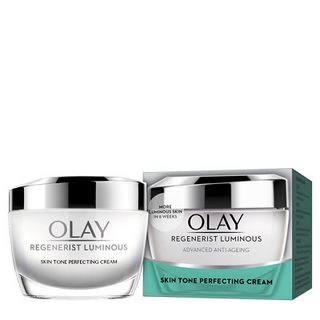
Olay Regenerist Luminous Perfecting Face Cream
Works for
1 of 1 advertised claim delivered
Moisturizing14 ingredients credited for this claimStrong support
“Ultra pigmented for 24 hours of intense colour and hydration”
This product can help improve hydration of the skin with the two types of ingredients.
The first type is called “humectants”:
these ingredients help attract water.
When humectants are on the surface of the skin, they “pull in” the moisture from the outside environment, or from
within deeper layers of the skin. The following ingredients in this product do the job:
allantoin, carnosine.
This product also contains ingredients called “occlusives”. They help reduce the speed with which our skin loses moisture to the outside environment. These ingredients also help soften the upper layer of the skin, so it feels less tight and nicer to the touch. The following ingredients in this product do the job: dimethicone, dimethiconol.
The following ingredients in this product are especially good for supporting the skin barrier and helping with the hydration level: acetyl glucosamine, niacinamide, panthenol
Evens skin toneNot advertised by the brand · 3 ingredients credited for this claimStrong support
This product can help reduce hypepigmentation and even out the skin tone because it contains the following effective ingredients: acetyl glucosamine, niacinamide
Keep in mind that you would need to apply any topical skincare targetted at hypigmentation consistently for a couple of months to get a result. No topical skincare product can help get rid of hyperpigmentation (including post-acne marks and age spots) instantly.
Anti-agingNot advertised by the brand · 5 ingredients credited for this claimStrong support
This product can help reduce and prevent fine lines and wrinkles, improve skin elasticity and firmness because it contains acetyl glucosamine, niacinamide.
These ingredients in the product can also be helpful, even though there is less evidence for their effectiveness: carnosine.
Keep in mind that it typically takes at least 6 weeks to notice any results because the changes that are needed to improve fine lines and elasticity happen in the deeper layers of the skin. No topical anti-aging product can “erase” wrinkles or fully reverse signs of aging.
Anti-oxidationNot advertised by the brand · 4 ingredients credited for this claimStrong support
This product contains antioxidants (carnosine) that can help neutralize free radicals in skin. By doing so, they can lessen the damage the skin gets from the UV light (sun).
The following ingredients - sodium ascorbyl phosphate also can have an antioxidant effect, but there is less evidence to confirm their effectiveness in skin.
Anti-blemishNot advertised by the brand · 4 ingredients credited for this claimGood support
This product might be able to help reduce blemishes and clogged pores because it contains niacinamide.
The following ingredient (ingredients) in this product might be helpful, but there is no evidence to confirm that it actually works: sodium ascorbyl phosphate
Can it cause trouble?
Irritancy10 strong irritants: Dmdm hydantoin, Iodopropynyl butylcarbamate + 8 more — patch-test recommendedHigh risk
Comedogenic2 ingredients rated 2 or more on the 0–5 pore-clogging scale2 flagged


User reviews
Be the first — your take helps the next person decide.
Ingredients
Filter by role to see what each ingredient is doing.
Water~40–60%
Cyclopentasiloxane~4.8–7.2%
- Irritation risk
- Low
A silicone that helps improve the product texture and spreadability. Can absorb oil creating a short-term mattifying effect on the skin
More about CyclopentasiloxaneGlycerin~3.3–5%
- Irritation risk
- Low
One of the best moisturizing ingredients. Naturally present in skin. It attracts water to the upper layer of the skin working as a humectant
More about GlycerinNiacinamide~2.7–4%
- Irritation risk
- Low
Is proven to be effective in reducing blemishes, evening out skin tone and helping to improve lines and wrinkles. It helps the skin to repair sun damage, calm down inflammation and keep maintain good levels of moisture. The concentration of about 2% is effective for supporting the skin barrier and evening out the skin tone. Concentration of 4-6% is better for helping with acne and balancing the sebum production
More about NiacinamideAluminum starch octenylsuccinate~2–3.1%
- Irritation risk
- Medium
Used to thicken the product's consistency
More about Aluminum starch octenylsuccinateAcetyl glucosamine~1.6–2.5%
- Irritation risk
- Low
An effective moisturizing ingredient that also has been shown to be effective in evening out the skin tone and reducing hyperpigmentation. It can help somewhat reduce wrinkles in skin
More about Acetyl glucosamineDimethicone~1.5–2.2%
- Irritation risk
- Low
A silicone that helps to reduce water loss from the surface of the skin. Can temporarily "fill in" lines and wrinkles, absorb oil, and create a nice product finish
More about DimethiconeDimethicone crosspolymer~1.2–1.8%
- Irritation risk
- Low
Used to create a thicker product texture. Helps soften the upper layer of the skin and might be able to prevent moisture loss from its surface
More about Dimethicone crosspolymerPolyethylene~1.2–1.7%
Panthenol~0.5–1.2%
- Irritation risk
- Low
Helps attract water to the upper layer of the skin and can help improve skin barrier function
More about PanthenolTocopheryl acetate~0.4–0.95%
- Irritation risk
- Medium
A more stable but less bio-available form of vitamin E compared to Tocopherol. Might help moisturize and protect the skin from free radicals, but mostly used in low concentrations to stabilize other ingredients.
More about Tocopheryl acetateCamellia sinensis leaf extract~0.2–0.8%
- Irritation risk
- Low
Can contain potent anti-oxidant compounds (abbreviated ECG, GCG, EGC, and EGCG) that might help protect the skin from free radicals. Can help calm down inflammation and has some anti-bacterial properties. Unfortunately, these antioxidants are unstable and lose their effectiveness very quickly in products. The concentration of the antioxidant compounds in the extract also tends to be low to be effective in topical formulation
More about Camellia sinensis leaf extractAloe barbadensis leaf extract~0.15–0.65%
- Irritation risk
- Medium
Traditionally used to treat sunburns, dermatitis and inflammation, but evidence for its effectiveness is lacking. The extract can contain humectants that help attract water into the skin
More about Aloe barbadensis leaf extractCarnosine~0.1–0.45%
- Irritation risk
- Low
A type of peptide. It attracts water to the upper layer of the skin. It can help neutralize free radicals in skin combatting the sun damage
More about CarnosineAllantoin~0.1–0.4%
- Irritation risk
- Low
Helps calm down inflammation in skin and can help reduce itching. Helps to repair the skin barrier and keep skin hydrated
More about AllantoinSodium ascorbyl phosphate~0.1–0.45%
- Irritation risk
- Medium
A stable derivative of vitamin C. It is oil-soluble which means it is more likely to penetrate the skin compared to the pure form of vitamin C (which is water-soluble), but it is less bio-available and is way less effective in stimulating collagen and reducing wrinkles compared to the pure form of vitamin C (L-ascorbic acid) and its other derivatives (for example, magnesium ascorbyl phosphate). At the same time, this vitamin C derivative has been shown in studies to be effective in reducing acne, blemishes and clogged pores. It is less irritating then the pure form of vitamin C
More about Sodium ascorbyl phosphateButylene glycol~0.1–0.45%
- Irritation risk
- Low
Used to create a nice product texture and help delivery of other ingredients. Might be somewhat helpful in attracting water to the upper layer of the skin
More about Butylene glycolPropylene glycol~0.1–0.4%
- Irritation risk
- High
Helps oil and water mix together and can enhance the penetration of other ingredients into the skin. It can be irritating
More about Propylene glycolDimethiconol~0.15–0.55%
- Irritation risk
- Low
A silicone that makes products more spreadable and keeps skin smooth. Helps to add gloss to skin and may visually fill in fine lines/wrinkles for short time
More about DimethiconolLaureth-4~0.1–0.4%
- Irritation risk
- Medium
- Comedogenicity
- 2/5
Helps water and oil mix together
More about Laureth-4Laureth-7~0.1–0.35%
Sodium peg-7 olive oil carboxylate~0.1–0.35%
- Irritation risk
- Medium
Helps oil and water mix together
More about Sodium peg-7 olive oil carboxylatePeg-30 dipolyhydroxystearate~0.05–0.3%
- Irritation risk
- Medium
Helps oil and water mix together
More about Peg-30 dipolyhydroxystearateTrideceth-6~0.05–0.25%
Disodium edta~0.05–0.25%
Polyacrylamide~0.1–0.3%
- Irritation risk
- Medium
Used to improve product texture and help oil and water mix together
More about PolyacrylamideAcrylates/c10-30 alkyl acrylate crosspolymer~0.05–0.3%
- Irritation risk
- Medium
Maintains the texture of skincare products. Allows the product to spread evenly. Helps oil and water mix together
More about Acrylates/c10-30 alkyl acrylate crosspolymerAmmonium polyacrylate~0.05–0.3%
Titanium dioxide~0.1–0.4%
- Irritation risk
- Low
Works as a UV filter when used in high concentrations. It is photostable and is effective mostly against the UVB light, with some protection in the UVA range. In small concentrations, used for its ability to improve the color of cosmetic products. Is usually well tolerated by the skin
More about Titanium dioxideC13-14 alkane~0.05–0.25%
- Irritation risk
- Low
Helps soften the upper layer of the skin
More about C13-14 alkaneDmdm hydantoin~0.05–0.2%
- Irritation risk
- High
A preservative that releases formaldehyde and can be irritating
More about Dmdm hydantoinIodopropynyl butylcarbamate~0.01–0.02%
Methylparaben~0.05–0.25%
Benzyl alcohol~0.05–0.1%
- Irritation risk
- High
A preservative. Can be used to mask unpleasant smell. Can be irritating
More about Benzyl alcoholImidazolidinyl urea~0.05–0.2%
- Irritation risk
- High
A preservative. Is more irritating than many other preservatives available
More about Imidazolidinyl ureaPropylparaben~0.05–0.15%
Parfum~0.05–0.15%
- Irritation risk
- High
An aromatic blend of unspecified and possibly irritating ingredients
More about ParfumLinalool~0.05–0.2%
Benzyl salicylate~0.05–0.2%
Hexyl cinnamal~0.05–0.2%
Limonene~0.05–0.2%
- Irritation risk
- High
A common frangrance that can easily irritate skin, especially if exposed to air, light or heat
More about LimoneneAlpha-isomethyl ionone~0.05–0.15%
- Irritation risk
- High
A fragrance. Potential allergen and can be irritating
More about Alpha-isomethyl iononeCitronellol~0.05–0.2%
Caramel~0.05–0.2%
- Irritation risk
- Low
Ci 19140~0.01–0.1%
Ci 16035~0.01–0.1%
Ingredient list view
Water, Cyclopentasiloxane, Glycerin, Niacinamide, Aluminum starch octenylsuccinate, Acetyl glucosamine, Dimethicone, Dimethicone crosspolymer, Polyethylene, Panthenol, Tocopheryl acetate, Camellia sinensis leaf extract, Aloe barbadensis leaf extract, Carnosine, Allantoin, Sodium ascorbyl phosphate, Butylene glycol, Propylene glycol, Dimethiconol, Laureth-4, Laureth-7, Sodium peg-7 olive oil carboxylate, Peg-30 dipolyhydroxystearate, Trideceth-6, Disodium edta, Polyacrylamide, Acrylates/c10-30 alkyl acrylate crosspolymer, Ammonium polyacrylate, Titanium dioxide, C13-14 alkane, Dmdm hydantoin, Iodopropynyl butylcarbamate, Methylparaben, Benzyl alcohol, Imidazolidinyl urea, Propylparaben, Parfum, Linalool, Benzyl salicylate, Hexyl cinnamal, Limonene, Alpha-isomethyl ionone, Citronellol, Caramel, Ci 19140, Ci 16035
Compare prices
Retailers ranked by price — lowest first.
Affiliate links · prices updated regularly · As an Amazon Associate, WIMJ earns from qualifying purchases.
Worth comparing, line by line.
Match % combines shared ingredients, the first five ingredients, shared actives and hero ingredients, irritancy (lower counts in the alternative's favour), texture and body area. Only products in the same routine step are compared.
| OlayRegenerist Luminous Perfecting Face CreamYOUR PRODUCT | OlayTone Perfecting Cream Face Moisturizer | DdfPro-Retinol Complex 3 Moisturizer | SK-IIR.N.A. POWER Anti-Aging Face Cream | |
|---|---|---|---|---|
| Match | — | 100% | 90% | 83% |
| Price | $39.11 | $34.99−$4.12 | $49.00+$9.89 | $224.75+$185.64 |
| Shared key ingredients | — | 9 of 9 | 6 of 9 | 5 of 9 |
| Key difference | — | Tea Extract | Caprylic/Capric Triglyceride | Pitera |
| Irritancy | High | High | Medium | Medium |
| Drying alcohol | — | — | — | — |
| View product | Shop | Shop | Shop |

Sources cited in this review
Every concentration estimate and effectiveness label is anchored to one of these 27 studies and safety reviews.
- 1
- 2
- 3
- 4
- 5Glucosamine: an ingredient with skin and other benefitsncbi.nlm.nih.gov
- 6

Affiliate links · As an Amazon Associate, WIMJ earns from qualifying purchases.