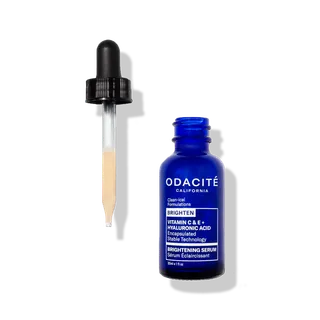
Odacite BRIGHTENING SERUM • VITAMIN C & E + HYALURONIC ACID
Works for
Anti-agingRetinyl palmitate, Ascorbyl palmitate + 2 moreMay help
“A dark spot correcting Clean-ical Vitamin C & E Serum expertly formulated with patented Advanced Encapsulation Technology to visibly brighten and even out skin tone, reduce the appearance of fine lines and wrinkles, and fight oxidative damage from free radicals.”
This product contains retinyl palmitate. There is some human evidence that this ingredient helps reduce and prevent fine lines and wrinkles and improve skin elasticity and firmness, though it is smaller or less consistent than the evidence for the best anti-aging ingredients.
MoisturizingSqualane, Glycerin + 9 moreWorks
“With a hydrating base of Hyaluronic Acid, Squalane, and Orange Blossom Water, plus a nourishing Vitamin Complex boost, Vitamin C & E + Hyaluronic Acid Brightening Serum helps to fight oxidative damage from free radicals and brighten the complexion with its clean, skin-compatible formula.”
This product can help improve hydration of the skin with the two types of ingredients.
The first type is called “humectants”:
these ingredients help attract water.
When humectants are on the surface of the skin, they “pull in” the moisture from the outside environment, or from
within deeper layers of the skin. The following ingredients in this product do the job:
glycerin, sodium hyaluronate.
This product also contains ingredients called “occlusives”. They help reduce the speed with which our skin loses moisture to the outside environment. These ingredients also help soften the upper layer of the skin, so it feels less tight and nicer to the touch. The following ingredients in this product do the job: squalane, aloe barbadensis leaf extract.
Evens skin toneRetinyl palmitate, Ascorbyl tetraisopalmitateMay help
“A dark spot correcting Clean-ical Vitamin C & E Serum expertly formulated with patented Advanced Encapsulation Technology to visibly brighten and even out skin tone, reduce the appearance of fine lines and wrinkles, and fight oxidative damage from free radicals.”
The following ingredient (ingredients) in this product might be helpful, but there is no evidence to confirm that it actually works: retinyl palmitate.
Can it cause trouble?
Irritancy10 strong irritants: Citrus aurantium amara flower water, Retinyl palmitate + 8 more — patch-test recommendedHigh risk
Comedogenic1 ingredient rated 2 or more on the 0–5 pore-clogging scale1 flagged

User reviews
Be the first — your take helps the next person decide.
Ingredients
Filter by role to see what each ingredient is doing.
Citrus aurantium amara flower water~22–33%
- Irritation risk
- High
A citrus plant essential oil (in a less concentrated format). Used as a fragrance and can be irritating
More about Citrus aurantium amara flower waterSqualane~5–7.5%
- Irritation risk
- Low
An oil naturally present in skin. Works as an emollient to soften the skin and form a protective layer on its surface without a greasy feeling.
More about SqualaneGlycerin~4.3–6.4%
- Irritation risk
- Low
One of the best moisturizing ingredients. Naturally present in skin. It attracts water to the upper layer of the skin working as a humectant
More about GlycerinLauryl glucoside~4–6%
Polyglyceryl-2 dipolyhydroxystearate~2.6–3.9%
- Irritation risk
- Low
Helps to soften the upper layer of the skin
More about Polyglyceryl-2 dipolyhydroxystearateAscorbyl tetraisopalmitate~2.1–3.1%
- Irritation risk
- Medium
A vitamin C derivative. Studies show that is might be effective in reducing hyperpigmentation, but there are no studies confirming that it is effectively converted into the bioavailable form of Vitamin C in skin. It is not clear how this derivative compares in effectiveness to the topical application of bioavailable form of vitamin C (L-ascorbic acid)
More about Ascorbyl tetraisopalmitateCellulose acetate butyrate~1.6–2.4%
- Irritation risk
- Low
Pentaerythrityl tetra-di-t-butyl hydroxyhydrocinnamate~1.3–1.9%
- Irritation risk
- Low
Used to increase stability of product formulations
More about Pentaerythrityl tetra-di-t-butyl hydroxyhydrocinnamateLonicera caprifolium flower extract~1–1.5%
- Irritation risk
- High
A plant extract that might help neutralize free radicals in skin. Can contain volalite oils and be irritating
More about Lonicera caprifolium flower extractLonicera japonica flower extract~0.9–1.35%
- Irritation risk
- High
A plant extract that might help neutralize free radicals in skin. Can contain volalite oils and be irritating
More about Lonicera japonica flower extractSodium hyaluronate~0.55–1.3%
- Irritation risk
- Low
One of the best moisturizing ingredients. Attracts water into the upper layer of the skin
More about Sodium hyaluronateAmorphophallus konjac root extract~0.55–1.25%
- Irritation risk
- Low
Water~0.45–1.05%
Aloe barbadensis leaf extract~0.5–1.15%
- Irritation risk
- Medium
Traditionally used to treat sunburns, dermatitis and inflammation, but evidence for its effectiveness is lacking. The extract can contain humectants that help attract water into the skin
More about Aloe barbadensis leaf extractPhospholipids~0.4–0.9%
- Irritation risk
- Low
Emollients that are naturaly present in skin. In addition, they help water and oil mix together in the product
More about PhospholipidsTocopheryl acetate~0.45–1.1%
- Irritation risk
- Medium
A more stable but less bio-available form of vitamin E compared to Tocopherol. Might help moisturize and protect the skin from free radicals, but mostly used in low concentrations to stabilize other ingredients.
More about Tocopheryl acetateRetinyl palmitate~0.35–0.85%
- Irritation risk
- High
Three steps removed from the active form of vitamin A - retinoic acid. To have an effect in the skin, it first needs to be converted twice to become the retinoic acid. This means it is less potent than retinol, but could also be less irritating. Once converted to the retinoic acid in the skin, it helps against all signs of aging, improves skin cell turnover and helps fight blemishes and clogged pores. However, in many cosmetic formulations, it is used in a concentration that is too low to have the full effect
More about Retinyl palmitatePantothenic acid~0.35–0.8%
- Irritation risk
- Low
Helps attract water to the upper layer of the skin and may help reduce inflammation in skin
More about Pantothenic acidAscorbyl palmitate~0.4–0.9%
- Irritation risk
- Medium
Being a lipid soluble form of vitamin C, it is more stable and can penetrate the skin better than L-Ascorbic acid. It is effective in protecting the skin from free radicals, as well as evening the skin tone, but is less effective in stimulating collagen production compared to L-Ascorbic acid.
More about Ascorbyl palmitateCholecalciferol~0.35–0.8%
- Irritation risk
- Low
Citrus aurantium amara flower oil~0.2–0.8%
- Irritation risk
- High
Used as a fragrance. Can be irritating
More about Citrus aurantium amara flower oilPogostemon cablin oil~0.15–0.65%
- Irritation risk
- Low
Cupressus sempervirens leaf oil~0.15–0.7%
- Irritation risk
- Low
Cananga odorata flower oil~0.15–0.7%
Citrus paradisi peel oil~0.15–0.7%
Backhousia citriodora leaf oil~0.15–0.65%
- Irritation risk
- High
A plant oil containing volatile compounds. Used as a fragrance and can be irritating
More about Backhousia citriodora leaf oilCitrus aurantium leaf oil~0.2–0.8%
Rosa damascena flower oil~0.3–0.75%
- Irritation risk
- High
Used as a fragrance. Can be irritating
More about Rosa damascena flower oilBenzyl alcohol~0.2–0.75%
- Irritation risk
- High
A preservative. Can be used to mask unpleasant smell. Can be irritating
More about Benzyl alcoholBenzoic acid~0.25–0.5%
Dehydroacetic acid~0.3–0.6%
Tocopherol~0.2–0.75%
- Irritation risk
- Low
Pure form of vitamin E. Can help moisturise and protect the skin from free radicals. Often used to help stabilise other ingredients or the formula itself
More about TocopherolCurcuma longa root extract~0.1–0.3%
- Irritation risk
- High
A plant extract that can contain an active compound curcumin, that may have some anti-inflammatory properties when applied to the skin, but solid research is lacking and the typical concentration used in skincare products is too low. Can be an irritant
More about Curcuma longa root extractOcimum sanctum leaf extract~0.1–0.4%
- Irritation risk
- High
A plant extract that is rich in a fragrance compound eugenol that is a frequent allergen and can be irritating. It might also contain anti-oxidants to help neutralize free radicals
More about Ocimum sanctum leaf extractOcimum basilicum flower/leaf extract~0.05–0.3%
- Irritation risk
- High
Used as a fragrance. Canbe irritating
More about Ocimum basilicum flower/leaf extractCorallina officinalis extract~0.05–0.3%
- Irritation risk
- Low
- Comedogenicity
- 3/5
Red algae extract that helps attract water to the upper layer of the skin and might contain antioxidants
More about Corallina officinalis extractSodium benzoate~0.05–0.25%
Ingredient list view
Citrus aurantium amara flower water, Squalane, Glycerin, Lauryl glucoside, Polyglyceryl-2 dipolyhydroxystearate, Ascorbyl tetraisopalmitate, Cellulose acetate butyrate, Pentaerythrityl tetra-di-t-butyl hydroxyhydrocinnamate, Lonicera caprifolium flower extract, Lonicera japonica flower extract, Sodium hyaluronate, Amorphophallus konjac root extract, Water, Aloe barbadensis leaf extract, Phospholipids, Tocopheryl acetate, Retinyl palmitate, Pantothenic acid, Ascorbyl palmitate, Cholecalciferol, Citrus aurantium amara flower oil, Pogostemon cablin oil, Cupressus sempervirens leaf oil, Cananga odorata flower oil, Citrus paradisi peel oil, Backhousia citriodora leaf oil, Citrus aurantium leaf oil, Rosa damascena flower oil, Benzyl alcohol, Benzoic acid, Dehydroacetic acid, Tocopherol, Unknown, Curcuma longa root extract, Ocimum sanctum leaf extract, Ocimum basilicum flower/leaf extract, Corallina officinalis extract, Sodium benzoate
Compare prices
Retailers ranked by price — lowest first.


Worth comparing, line by line.
Match % combines shared ingredients, the first five ingredients, shared actives and hero ingredients, irritancy (lower counts in the alternative's favour), texture and body area. Only products in the same routine step are compared.
| OdaciteBRIGHTENING SERUM • VITAMIN C & E + HYALURONIC ACIDYOUR PRODUCT | ZelensPower C Collagen-Boosting and Brightening Serum | MANTLETHE WOW SERUM | EssanoAdvanced Brightening Vitamin C Serum | |
|---|---|---|---|---|
| Match | — | 53% | 52% | 49% |
| Price | $78.00 | $111.10+$33.10 | — | — |
| Shared key ingredients | — | 4 of 9 | 5 of 9 | 4 of 9 |
| Key difference | — | Saccharomyces Ferment Lysate Filtrate | Beta-Sitosterol | Betaine |
| Irritancy | High | Low | Medium | Medium |
| Drying alcohol | — | — | — | — |
| View product | Shop | Shop | Shop |


More alternatives: skin ingredients sk.in marvel | hydro shotsk.in flash | repair shot
Product summary
"Odacite - BRIGHTENING SERUM • VITAMIN C & E + HYALURONIC ACID" is effective for: Moisturizing
Ingredient callouts
- this product includes a form of Retinoids (vitamin A) - retinyl palmitate 0.35% - 0.85%, but this type of vitamin A is not very effective. It could in theory help with fine lines and wrinkles, but the effect is most likely minimal.
- Humectants (panthenol 0.35% - 0.75%, sodium hyaluronate 0.55% - 1.30% and glycerin 4.30% - 6.40%). These ingredients help attract water to the upper layer of the skin and improve the skin hydration.
About the brand
According to Cruelty-Free Kitty "Odacite" is cruelty free and so is its parent company.
Price
The product retails for 68.00$ in the United States, for 62.00£ in the United Kingdom and from 62.00£ up to 434.00£ in the United Kingdom.
For a detailed price comparison: click here.
Sources cited in this review
Every concentration estimate and effectiveness label is anchored to one of these 16 studies and safety reviews.
- 1
- 2
- 3
- 4
- 5
- 6

Affiliate links · As an Amazon Associate, WIMJ earns from qualifying purchases.