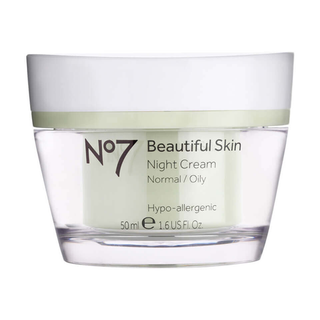
No7 Beautiful Skin Night Cream - Normal to Oily
Works for
1 of 1 advertised claim delivered
MoisturizingMagnesium pca, Manganese pca + 8 moreGood evidence
“Hydrates, balances and mattifies skin.”
This product can help improve hydration of the skin with the two types of ingredients.
The first type is called “humectants”:
these ingredients help attract water.
When humectants are on the surface of the skin, they “pull in” the moisture from the outside environment, or from
within deeper layers of the skin. The following ingredients in this product do the job:
glycerin, magnesium pca.
This product also contains ingredients called “occlusives”. They help reduce the speed with which our skin loses moisture to the outside environment. These ingredients also help soften the upper layer of the skin, so it feels less tight and nicer to the touch. The following ingredients in this product do the job: dimethicone, cetearyl alcohol.
Can it cause trouble?
Irritancy3 strong irritants: Parfum, Alcohol + 1 more — patch-test recommendedHigh risk
Comedogenic1 ingredient rated 2 or more on the 0–5 pore-clogging scale1 flagged
User reviews
Be the first — your take helps the next person decide.
Ingredients
Filter by role to see what each ingredient is doing.
Water~40–60%
Glycerin~4.2–6.3%
- Irritation risk
- Low
One of the best moisturizing ingredients. Naturally present in skin. It attracts water to the upper layer of the skin working as a humectant
More about GlycerinCyclopentasiloxane~3.7–5.5%
- Irritation risk
- Low
A silicone that helps improve the product texture and spreadability. Can absorb oil creating a short-term mattifying effect on the skin
More about CyclopentasiloxaneIsononyl isononanoate~2.8–4.2%
- Irritation risk
- Low
Forms a protective film on the surface of the skin to prevent moisture loss. Gives a velvety feel to products while reducing tackiness
More about Isononyl isononanoateCyclohexasiloxane~2.1–3.1%
- Irritation risk
- Low
A silicone that serves as an emollient. Helps create a nice non-greasy feels
More about CyclohexasiloxaneCetearyl glucoside~1.7–2.5%
- Irritation risk
- Medium
Helps water and oil in the product mix well together and improves product texture
More about Cetearyl glucosideCetearyl alcohol~1.4–2.2%
- Irritation risk
- Low
- Comedogenicity
- 2/5
A non-drying alcohol. Works as an emollient. Helps water and oil mix together and creates a nice product texture
More about Cetearyl alcoholAmmonium acryloyldimethyltaurate/vp copolymer~1.3–1.9%
- Irritation risk
- Low
Increases thickness of a product. Texture enhancer for oil-in-water emulsions
More about Ammonium acryloyldimethyltaurate/vp copolymerSilica~1.3–1.9%
Phenoxyethanol~0.5–1%
- Irritation risk
- Low
A preservative. It helps prevent bacterial growth in cosmetic products
More about PhenoxyethanolTocopheryl acetate~0.5–1.2%
- Irritation risk
- Medium
A more stable but less bio-available form of vitamin E compared to Tocopherol. Might help moisturize and protect the skin from free radicals, but mostly used in low concentrations to stabilize other ingredients.
More about Tocopheryl acetateMethylparaben~0.15–0.3%
Potassium cetyl phosphate~0.4–0.9%
- Irritation risk
- Medium
Helps oil and water mix together
More about Potassium cetyl phosphateParfum~0.35–0.75%
- Irritation risk
- High
An aromatic blend of unspecified and possibly irritating ingredients
More about ParfumSodium pca~0.3–0.75%
- Irritation risk
- Low
Naturally present in skin and helps to attract water to its upper layer
More about Sodium pcaZinc pca~0.35–0.8%
- Irritation risk
- Low
A compound that combines zinc with a hydrating ingredient PCA. Might to be helpful against acne and clogged pores. Can help calm down inflammation in skin. Could be helpful in reducing the formation of free radicals in skin. Might help to reduce fine lines in wrinkles, but solid evidence is missing
More about Zinc pcaXanthan gum~0.3–0.75%
- Irritation risk
- Low
Used to create a thicker product consistency
More about Xanthan gumEthylparaben~0.2–0.4%
Alcohol~0.15–0.65%
- Irritation risk
- High
Can be drying and contribute to skin irritation. Used in formulars to dissolve other ingredients, create a thinner product consistency or for its antibacterial properties
More about AlcoholAscorbyl glucoside~0.15–0.6%
- Irritation risk
- Medium
A vitamin C derivative that is more stable but less potent than pure form of vitamin C. Has a potential to boost collagen production, nutralise free radicals and reduce hyperpigmentation, but the required concentration is likely to be much higher than for the pure form of vitamin C, limiting the ingredient's effectiveness in products
More about Ascorbyl glucosideTetrasodium edta~0.15–0.5%
Magnesium pca~0.1–0.5%
- Irritation risk
- Low
Helps attract water to the upper layer of the skin
More about Magnesium pcaT-butyl alcohol~0.1–0.4%
- Irritation risk
- Medium
Used to dissolve other ingredients and to improve smell of products. It could be irritating
More about T-butyl alcoholHamamelis virginiana extract~0.1–0.45%
- Irritation risk
- High
A plant extract that can help calm down inflammation in skin. Can, however, itself be irritating
More about Hamamelis virginiana extractDimethicone~0.15–0.5%
- Irritation risk
- Low
A silicone that helps to reduce water loss from the surface of the skin. Can temporarily "fill in" lines and wrinkles, absorb oil, and create a nice product finish
More about DimethiconePotassium hydroxide~0.1–0.35%
Dipropylene glycol~0.05–0.25%
- Irritation risk
- Low
Helps to dissolve other ingredients in a formulation. Slows down the rate of product drying
More about Dipropylene glycolManganese pca~0.05–0.25%
- Irritation risk
- Low
Helps attract water to the upper layer of the skin. Often used as a part of an ingredient complex Physiogenyl together with Sodium PCA, Magnesium PCA and Zinc PCA. The manufacturer claims that it does more than attracting water, but there is no evidence or studies supporting this claim
More about Manganese pcaSimethicone~0.05–0.25%
- Irritation risk
- Low
A type of silicone that helps to create nice product texture and is used as an anti-foaming agent
More about SimethiconePotassium sorbate~0.05–0.2%
Ingredient list view
Water, Glycerin, Cyclopentasiloxane, Isononyl isononanoate, Cyclohexasiloxane, Cetearyl glucoside, Cetearyl alcohol, Ammonium acryloyldimethyltaurate/vp copolymer, Silica, Phenoxyethanol, Tocopheryl acetate, Methylparaben, Potassium cetyl phosphate, Parfum, Sodium pca, Zinc pca, Xanthan gum, Ethylparaben, Alcohol, Ascorbyl glucoside, Tetrasodium edta, Magnesium pca, T-butyl alcohol, Hamamelis virginiana extract, Dimethicone, Potassium hydroxide, Dipropylene glycol, Manganese pca, Simethicone, Potassium sorbate
Compare prices
Retailers ranked by price — lowest first.
Sources cited in this review
Every concentration estimate and effectiveness label is anchored to one of these 11 studies and safety reviews.
- 1
- 2
- 3Zinc Therapy in Dermatology: A Review hindawi.com
- 4The Roles of Vitamin C in Skin Healthncbi.nlm.nih.gov
- 5
- 6

Affiliate links · As an Amazon Associate, WIMJ earns from qualifying purchases.