Works for
ExfoliationGlycolic acid, Allantoin + 1 moreWorks well
“exfoliating + 2% glycolic acid”
This product can help exfoliate the skin. In other words, it helps break down the bonds between dead cells on the surface of the skin and speed up the skin turnover. Skin often appears softer and brighter after exfoliation, but overdoing it can result in disrupted skin barrier. The following ingredient is doing the exfoliating job in this product: glycolic acid.
Anti-agingSide benefit · Glycolic acid, Folic acid + 4 moreWorks well
This product can help reduce and prevent fine lines and wrinkles, improve skin elasticity and firmness because it contains glycolic acid.
These ingredients in the product can also be helpful, even though there is less evidence for their effectiveness: folic acid.
Keep in mind that it typically takes at least 6 weeks to notice any results because the changes that are needed to improve fine lines and elasticity happen in the deeper layers of the skin. No topical anti-aging product can “erase” wrinkles or fully reverse signs of aging.
Evens skin toneSide benefit · Glycolic acid, Niacin + 2 moreWorks well
This product can help reduce hypepigmentation and even out the skin tone because it contains the following effective ingredients: glycolic acid
Keep in mind that you would need to apply any topical skincare targetted at hypigmentation consistently for a couple of months to get a result. No topical skincare product can help get rid of hyperpigmentation (including post-acne marks and age spots) instantly.
MoisturizingSide benefit · Glycerin, Sodium hyaluronate + 7 moreWorks
This product contains good ingredients to attract water to the upper layer of the skin. These ingredients are called "humectants": glycerin, sodium hyaluronate.
When humectants are on the surface of the skin, they “pull in” the moisture from the outside environment, or from within deeper layers of the skin. If the air is dry, humectants can speed up the moisture loss from the skin. This is why it is a good idea to use another product on top of this one to help "seal in" the moisture (look for ingredients like dimethicone, squalane, oils and butters).
Can it cause trouble?
Irritancy4 strong irritants: Parfum, Illicium verum fruit extract + 2 more — patch-test recommendedHigh risk
ComedogenicClean of flagged comedogenic ingredientsNone flagged


User reviews
Be the first — your take helps the next person decide.
Ingredients
Filter by role to see what each ingredient is doing.
Water~45–55%
Glycerin~4.4–5.4%
- Irritation risk
- Low
One of the best moisturizing ingredients. Naturally present in skin. It attracts water to the upper layer of the skin working as a humectant
More about GlycerinCocamidopropyl betaine~5.4–6.6%
- Irritation risk
- High
Helps water and oil mix together. Used as a cleansing ingredient. Could be an allergen
More about Cocamidopropyl betaineTromethamine~3.2–3.9%
Glycolic acid~2.5–3%
- Irritation risk
- High
An alpha-hydroxy acid (AHA) that helps to remove the dead skin cells on the surface of the skin reveling a more even, smoother complexation. It is also able to stimulate collagen production with long-term use. Could help to reduce pore congestion. It can be irritating to the skin. Apply sunscreen daily if using products with glycolic acid
More about Glycolic acidDipropylene glycol~2–2.4%
- Irritation risk
- Low
Helps to dissolve other ingredients in a formulation. Slows down the rate of product drying
More about Dipropylene glycolMethyl perfluorobutyl ether~1.7–2.1%
- Irritation risk
- Low
Methyl perfluoroisobutyl ether~1.4–1.8%
- Irritation risk
- Low
Disiloxane~1.2–1.4%
- Irritation risk
- Low
Hydroxyethylcellulose~1–1.2%
- Irritation risk
- Low
Used to thicken product formulations and create gel-like textures
More about HydroxyethylcelluloseDecyl glucoside~0.75–1.1%
- Irritation risk
- High
Helps oil and water mix together. Can be irritating
More about Decyl glucosideAllantoin~0.45–0.7%
- Irritation risk
- Low
Helps calm down inflammation in skin and can help reduce itching. Helps to repair the skin barrier and keep skin hydrated
More about AllantoinPhenoxyethanol~0.5–0.75%
- Irritation risk
- Low
A preservative. It helps prevent bacterial growth in cosmetic products
More about PhenoxyethanolChlorphenesin~0.16–0.32%
Hydroxyacetophenone~0.45–0.65%
Caprylyl glycol~0.45–0.7%
- Irritation risk
- Medium
Helps preserve products and creates a nice product texture
More about Caprylyl glycol1,2-hexanediol~0.45–0.65%
Parfum~0.3–0.55%
- Irritation risk
- High
An aromatic blend of unspecified and possibly irritating ingredients
More about ParfumPropanediol~0.3–0.6%
- Irritation risk
- Low
Acts as a solvent for other ingredients. Speeds up the absorption of other ingredients into the skin
More about PropanediolDisodium edta~0.3–0.55%
Sodium hyaluronate~0.25–0.5%
- Irritation risk
- Low
One of the best moisturizing ingredients. Attracts water into the upper layer of the skin
More about Sodium hyaluronateIllicium verum fruit extract~0.25–0.45%
- Irritation risk
- High
Anise fruit extract. Used as a fragrance. Can be irritating
More about Illicium verum fruit extractRetinyl palmitate~0.25–0.45%
- Irritation risk
- High
Three steps removed from the active form of vitamin A - retinoic acid. To have an effect in the skin, it first needs to be converted twice to become the retinoic acid. This means it is less potent than retinol, but could also be less irritating. Once converted to the retinoic acid in the skin, it helps against all signs of aging, improves skin cell turnover and helps fight blemishes and clogged pores. However, in many cosmetic formulations, it is used in a concentration that is too low to have the full effect
More about Retinyl palmitateThiamine hcl~0.25–0.45%
- Irritation risk
- Medium
Can help attract water to the upper layer of the skin. Is studied as a mosquito repellent
More about Thiamine hclRiboflavin~0.25–0.45%
- Irritation risk
- Low
Niacin~0.25–0.45%
- Irritation risk
- High
A form of vitamin B3. It is similar in action to niacinamide, but is more likely to cause red flashes in skin as the side effect
More about NiacinCarnitine hcl~0.25–0.4%
- Irritation risk
- Low
Might be helpful in decreasing sebum production making the skin less oily. Is claimed to be able to support ceramide production in skin that leads to better hydration, but evidence is lacking. Is able to attract water to the upper layer of the skin
More about Carnitine hclPantothenic acid~0.2–0.35%
- Irritation risk
- Low
Helps attract water to the upper layer of the skin and may help reduce inflammation in skin
More about Pantothenic acidBiotin~0.15–0.3%
- Irritation risk
- Low
Might have some moisturising properties. Is not effective when applied topically beyond some moisturizing effect
More about BiotinFolic acid~0.15–0.3%
- Irritation risk
- Low
Can help stimulate collagen production in skin. While available studies are promising, more research is needed to confirm the efficacy in skin
More about Folic acidAscorbic acid~0.15–0.25%
- Irritation risk
- High
The most well-researched antioxidant that works in skin. Helps neutralize free radicals supporting collagen production, helping to even out the skin tone and preventing early signs of aging
More about Ascorbic acidTocopherol~0.1–0.15%
- Irritation risk
- Low
Pure form of vitamin E. Can help moisturise and protect the skin from free radicals. Often used to help stabilise other ingredients or the formula itself
More about TocopherolLinalool~0.05–0.1%
Ingredient list view
Water, Glycerin, Cocamidopropyl betaine, Tromethamine, Glycolic acid, Dipropylene glycol, Methyl perfluorobutyl ether, Methyl perfluoroisobutyl ether, Disiloxane, Hydroxyethylcellulose, Decyl glucoside, Allantoin, Phenoxyethanol, Chlorphenesin, Hydroxyacetophenone, Caprylyl glycol, 1,2-hexanediol, Parfum, Propanediol, Disodium edta, Sodium hyaluronate, Illicium verum fruit extract, Retinyl palmitate, Thiamine hcl, Riboflavin, Niacin, Carnitine hcl, Pantothenic acid, Biotin, Folic acid, Ascorbic acid, Tocopherol, Linalool
Compare prices
Retailers ranked by price — lowest first.
Affiliate links · As an Amazon Associate, WIMJ earns from qualifying purchases.
Worth comparing, line by line.
Match % combines shared ingredients, the first five ingredients, shared actives and hero ingredients, irritancy (lower counts in the alternative's favour), texture and body area. Only products in the same routine step are compared.
| NIP+FABGlycolic Fix Extreme Bubble MaskYOUR PRODUCT | Elizabeth GrantWonder Effect Glycolic Mask | M-61Hydraboost HA Gel Mask | REVOLUTION SKINCAREx Sali Hughes Better in 5 Express Exfoliating Mask | |
|---|---|---|---|---|
| Match | — | 59% | 59% | 58% |
| Price | — | $10.00 | $48.00 | $13.37 |
| Shared key ingredients | — | 4 of 9 | 3 of 9 | 3 of 9 |
| Key difference | — | Niacinamide | Vitamin C | Gluconolactone |
| Irritancy | High | Medium | Medium | Low |
| Drying alcohol | — | — | — | — |
| View product | Shop | Shop | Shop |


More alternatives: Higher Education Skincare Greek Week Hydrating Probiotic Sleeping MaskAiryday Bright Nights Sleep Mask
Product summary
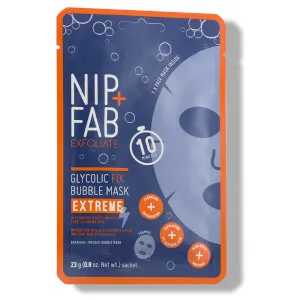
"NIP+FAB - Glycolic Fix Extreme Bubble Mask" is effective for: Exfoliation, Anti-aging and Evens skin tone
This product could be helpful for: Moisturizing, but its actives are not the most effective or are not well-studied.
Ingredient callouts
- This product contains acids (glycolic acid 2.50% - 3.00%). Their concentration is low, and they will not have a strong exfoliating effect. Instead, they work to support the skin natural acid mantle and to attract water (as humectants).
- This product also contains Vitamin C (Ascorbic Acid). It can be an effective active for anti-aging and evening out the skin tone, but in this product it is used for stabilizing other ingredients in the formulation. In this concentration (0.15% - 0.25%) it cannot have a noticeable benefit for the skin.
- This product includes a form of Retinoids (vitamin A) - retinyl palmitate 0.25% - 0.45%, but this type of vitamin A is not very effective. It could in theory help with fine lines and wrinkles, but the effect is most likely minimal.
- Humectants (sodium hyaluronate 0.25% - 0.50% and glycerin 4.40% - 5.40%). These ingredients help attract water to the upper layer of the skin and improve the skin hydration.
About the brand
According to Cruelty-Free Kitty "NIP+FAB" is cruelty free and so is its parent company.
Price
The product retails from 4.90$ up to 9.70$ in the United States, from 9.09A$ up to 12.99A$ in Australia, from 4.20£ up to 7.00£ in the United Kingdom and for 12.30CA$ in Canada.
For a detailed price comparison: click here.
Sources cited in this review
Every concentration estimate and effectiveness label is anchored to one of these 14 studies and safety reviews.
- 1
- 2Safety Assessment of Tromethamine as Used in Cosmeticscir-safety.org
- 3
- 4Glycolic acid peel therapy – a current reviewncbi.nlm.nih.gov
- 5
- 6

Affiliate links · As an Amazon Associate, WIMJ earns from qualifying purchases.