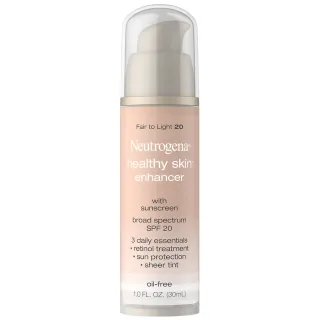
Neutrogena Retinol Enhancer, Fair To Light 20, Fair to Light
Works for
2 of 3 advertised claims delivered
Sun protectionSPF 20 · 3 UV filters · Partial spectrumWeak protectionSPF under 30
This product does not offer good protection against UVA rays.
Anti-agingRetinol, Retinyl palmitateStrong evidence
“The dermatologist-developed formula contains a vitamin-rich retinol treatment to visibly smooth fine lines and reduce signs of aging.”
This product can help reduce and prevent fine lines and wrinkles, improve skin elasticity and firmness because it contains retinol.
These ingredients in the product can also be helpful, even though there is less evidence for their effectiveness: retinyl palmitate.
Keep in mind that it typically takes at least 6 weeks to notice any results because the changes that are needed to improve fine lines and elasticity happen in the deeper layers of the skin. No topical anti-aging product can “erase” wrinkles or fully reverse signs of aging.
MoisturizingDimethicone, Arginine + 9 moreGood evidence
“This lightweight, non-comedogenic enhancer nourishes skin and protects against future sun damage with a weightless, broad spectrum SPF 20 moisturizer.”
This product can help improve hydration of the skin with the two types of ingredients.
The first type is called “humectants”:
these ingredients help attract water.
When humectants are on the surface of the skin, they “pull in” the moisture from the outside environment, or from
within deeper layers of the skin. The following ingredients in this product do the job:
arginine, butylene glycol.
This product also contains ingredients called “occlusives”. They help reduce the speed with which our skin loses moisture to the outside environment. These ingredients also help soften the upper layer of the skin, so it feels less tight and nicer to the touch. The following ingredients in this product do the job: arginine, dimethicone.
ExfoliationNot advertised by the brand · Retinol, Retinyl palmitateStrong evidence
This product can help exfoliate the skin. In other words, it helps break down the bonds between dead cells on the surface of the skin and speed up the skin turnover. Skin often appears softer and brighter after exfoliation, but overdoing it can result in disrupted skin barrier. The following ingredient is doing the exfoliating job in this product: retinol.
Anti-oxidationNot advertised by the brand · Camellia oleifera leaf extract, Retinol + 1 moreStrong evidence
This product contains antioxidants (camellia oleifera leaf extract, retinol) that can help neutralize free radicals in skin. By doing so, they can lessen the damage the skin gets from the UV light (sun).
Anti-blemishNot advertised by the brand · Retinol, Retinyl palmitateStrong evidence
This product can help reduce breakouts and clogged pores because it contains the following ingredient: retinol. This ingredient is used for treating acne and can have a noticeable effect.
The following ingredient (ingredients) in this product might be helpful, but there is no evidence to confirm that it actually works: retinyl palmitate
Evens skin toneNot advertised by the brand · Retinol, Retinyl palmitateStrong evidence
This product can help reduce hypepigmentation and even out the skin tone because it contains the following effective ingredients: retinol.
The following ingredient (ingredients) in this product might be helpful, but there is no evidence to confirm that it actually can help even out the skin tone: retinyl palmitate.
Keep in mind that you would need to apply any topical skincare targetted at hypigmentation consistently for a couple of months to get a result. No topical skincare product can help get rid of hyperpigmentation (including post-acne marks and age spots) instantly.
This product can also help with skin tone because it offers sun protection. Sun damage is the main factor causing age spots, darkening of post-acne marks and other discolorations. This is why sun protection is the best strategy for maintaining an even skin tone. We, however, do not recommend using this product as a sunscreen because the protection it offers is not strong enough).
Can it cause trouble?
Irritancy3 strong irritants: Retinyl palmitate, Retinol + 1 more — patch-test recommendedHigh risk
Comedogenic2 ingredients rated 2 or more on the 0–5 pore-clogging scale2 flagged


User reviews
Be the first — your take helps the next person decide.
Ingredients
Filter by role to see what each ingredient is doing.
Ethylhexyl methoxycinnamate7%
- Irritation risk
- High
Octinoxate. When used in higher concentrations, works as a sunscreen protecting the skin from UVB rays. When used in lower concentration, helps to preserve the product formulation. Is shown to be harmful to coral reefs - consider avoiding bathing in coral reef areas when wearing a product with this ingredient. It can be irritating
More about Ethylhexyl methoxycinnamateEthylhexyl salicylate3%
- Irritation risk
- Low
Octisalate. A UV filter. It offers some protection against the sun rays that cause sunburn (UVB), but does not protect against the most aging sun rays (UVA). It loses its effectiveness quickly when exposed to sunlight. It is an organic, or so called "chemical" sunscreen
More about Ethylhexyl salicylateTitanium dioxide5.1%
- Irritation risk
- Low
Works as a UV filter when used in high concentrations. It is photostable and is effective mostly against the UVB light, with some protection in the UVA range. In small concentrations, used for its ability to improve the color of cosmetic products. Is usually well tolerated by the skin
More about Titanium dioxideWater~45–55%
Isopropyl isostearate~5.2–6.3%
- Irritation risk
- Low
- Comedogenicity
- 3/5
An emollient that helps soften the skin
More about Isopropyl isostearateCyclopentasiloxane~5–6.2%
- Irritation risk
- Low
A silicone that helps improve the product texture and spreadability. Can absorb oil creating a short-term mattifying effect on the skin
More about CyclopentasiloxaneDimethicone~4.3–5.3%
- Irritation risk
- Low
A silicone that helps to reduce water loss from the surface of the skin. Can temporarily "fill in" lines and wrinkles, absorb oil, and create a nice product finish
More about DimethiconeButylene glycol~2.9–3.6%
- Irritation risk
- Low
Used to create a nice product texture and help delivery of other ingredients. Might be somewhat helpful in attracting water to the upper layer of the skin
More about Butylene glycolGlyceryl stearate~2.3–2.8%
- Irritation risk
- Low
An emollient that softens the skin and forms a protective layer on its surface. Helps water and oil mix together
More about Glyceryl stearateCetyl alcohol~1.7–2%
- Irritation risk
- Low
A non-drying alcohol that works to soften the skin and stabilize product formulations helping oil and water mix together
More about Cetyl alcoholCetearyl alcohol~1.5–1.8%
- Irritation risk
- Low
- Comedogenicity
- 2/5
A non-drying alcohol. Works as an emollient. Helps water and oil mix together and creates a nice product texture
More about Cetearyl alcoholTocopheryl acetate~1.1–1.3%
- Irritation risk
- Medium
A more stable but less bio-available form of vitamin E compared to Tocopherol. Might help moisturize and protect the skin from free radicals, but mostly used in low concentrations to stabilize other ingredients.
More about Tocopheryl acetateRetinyl palmitate~0.8–1.2%
- Irritation risk
- High
Three steps removed from the active form of vitamin A - retinoic acid. To have an effect in the skin, it first needs to be converted twice to become the retinoic acid. This means it is less potent than retinol, but could also be less irritating. Once converted to the retinoic acid in the skin, it helps against all signs of aging, improves skin cell turnover and helps fight blemishes and clogged pores. However, in many cosmetic formulations, it is used in a concentration that is too low to have the full effect
More about Retinyl palmitateRetinol~0.75–1.1%
- Irritation risk
- High
Two steps removed from the active form of vitamin A - retinoic acid. Once converted to the retinoic acid in the skin, retinol is proven to be effective against all signs of aging. It improves skin cell turnover, helps fight blemishes and clogged pores, can regulate excess oil production and even skin tone. It can, however, be quite irritating
More about RetinolArginine~0.65–0.95%
- Irritation risk
- Low
An amino acid that is naturally present in skin and helps keep it hydrated. When used together with AHAs, it can reduce their irritating effect on the skin
More about ArginineOlea europaea fruit extract~0.7–1.05%
- Irritation risk
- Low
An emollient that helps soften the skin but is not effective for restoring its barrier function. Might be helpful to calm down inflammation
More about Olea europaea fruit extractCamellia oleifera leaf extract~0.55–0.8%
- Irritation risk
- Low
A plant extract that can help neutralize free radicals and reduce inflammation, even though it is not usually used in sufficient concentration in cosmetics
More about Camellia oleifera leaf extractBht~0.5–0.75%
Silica~0.75–1.1%
Polysorbate 20~0.55–0.8%
Sclerotium gum~0.45–0.7%
- Irritation risk
- Low
Used to create gel-like formulas and stabilize emulsions
More about Sclerotium gumTetrasodium edta~0.3–0.55%
Erythorbic acid~0.25–0.5%
- Irritation risk
- Low
Isostearyl palmitate~0.3–0.6%
- Irritation risk
- Low
Polysilicone-11~0.3–0.6%
- Irritation risk
- Low
A silicone that forms a light film on the skin surface helping to bind water and temporarily absorb oils creating a matt and powdery feel
More about Polysilicone-11Peg-100 stearate~0.3–0.6%
- Irritation risk
- Low
Helps oil and water mix togehter and creates a nice product texture
More about Peg-100 stearateAmmonium polyacryloyldimethyl taurate~0.25–0.5%
- Irritation risk
- Low
Used to create a thicker product consistency
More about Ammonium polyacryloyldimethyl tauratePeg-75 stearate~0.25–0.45%
Ceteth-20~0.4–0.65%
Steareth-20~0.35–0.6%
Iron oxides~0.2–0.35%
- Irritation risk
- Low
An umbrella term for the following three colorants: CI 77491, CI 77492, CI 77499. They might be able to offer some protection against visible light, but the degree of the protection is not clear
More about Iron oxidesLauroyl lysine~0.2–0.35%
- Irritation risk
- Low
Helps soften the upper layer of the skin and creates a nice product texture
More about Lauroyl lysineEthylparaben~0.1–0.2%
Methylparaben~0.1–0.2%
Propylparaben~0.1–0.2%
Phenoxyethanol~0.1–0.2%
- Irritation risk
- Low
A preservative. It helps prevent bacterial growth in cosmetic products
More about PhenoxyethanolParfum~0.05–0.1%
- Irritation risk
- High
An aromatic blend of unspecified and possibly irritating ingredients
More about ParfumIngredient list view
Ethylhexyl methoxycinnamate, Ethylhexyl salicylate, Titanium dioxide, Water, Isopropyl isostearate, Cyclopentasiloxane, Dimethicone, Butylene glycol, Glyceryl stearate, Cetyl alcohol, Cetearyl alcohol, Tocopheryl acetate, Retinyl palmitate, Retinol, Arginine, Olea europaea fruit extract, Camellia oleifera leaf extract, Bht, Silica, Polysorbate 20, Sclerotium gum, Tetrasodium edta, Erythorbic acid, Isostearyl palmitate, Polysilicone-11, Peg-100 stearate, Ammonium polyacryloyldimethyl taurate, Peg-75 stearate, Ceteth-20, Steareth-20, Iron oxides, Lauroyl lysine, Ethylparaben, Methylparaben, Propylparaben, Phenoxyethanol, Parfum
Compare prices
Retailers ranked by price — lowest first.

Worth comparing, line by line.
Match % combines shared ingredients, the first five ingredients, shared actives and hero ingredients, irritancy (lower counts in the alternative's favour), texture and body area. Only products in the same routine step are compared.
| NeutrogenaRetinol Enhancer, Fair To Light 20, Fair to LightYOUR PRODUCT | Exuviance ProfessionalTotal Correct Day SPF 30 | TONYMOLYRetinol Red Radiance Sun Essence | CeraVeSkin Renewing Day Cream SPF 30 | |
|---|---|---|---|---|
| Match | — | 87% | 84% | 83% |
| Price | $9.99 | $84.09+$74.10 | $29.20+$19.21 | $15.22+$5.23 |
| Shared key ingredients | — | 4 of 9 | 5 of 9 | 4 of 9 |
| Key difference | — | Acetyl Glucosamine | Hexapeptide-2 | Ceramide Np |
| Irritancy | High | Medium | High | Medium |
| SPF | SPF 20 | SPF 30 | SPF 50 | SPF 30 |
| Drying alcohol | — | — | — | Contains drying alcohol |
| View product | Shop | Shop | Shop |


Product summary
We do not recommend "Neutrogena - Retinol Enhancer, Fair To Light 20, Fair to Light" because it does not provide good UVA protection. UVA sun rays don't burn the skin, but they still lead to photoaging and hyperpigmentation.
It should also be hydrating enough to use without an additional moisturizer during the day. Like all broad-spectrum sunscreens, this product has an anti-aging benefit.
Sunscreen filters
This is a "mixed" sunscreen in the sense that it uses both mineral and organic (so-called "chemical") sun filters. Here are the organic filters this product uses: octinoxate and octisalate. As for the mineral filters, this sunscreen uses titanium dioxide.
Irritation risk
It contains some common irritants, including those without a benefit for the skin. We assess the overall irritancy of this product to be high. For a detailed overview of all potential irritants: click here
You can see the detailed formula review with the breakdown of all actives in the product and the full ingredient list with estimated concentrations in the tables below.
Price
The product retails for 9.99$ in the United States.
For a detailed price comparison: click here.
Sources cited in this review
Every concentration estimate and effectiveness label is anchored to one of these 6 studies and safety reviews.
- 1
- 2Final Report on the Safety Assessment of Dimethicone Copolyoljournals.sagepub.com
- 3
- 4Improvement of naturally aged skin with vitamin A (retinol)ncbi.nlm.nih.gov
- 5
- 6

Affiliate links · As an Amazon Associate, WIMJ earns from qualifying purchases.