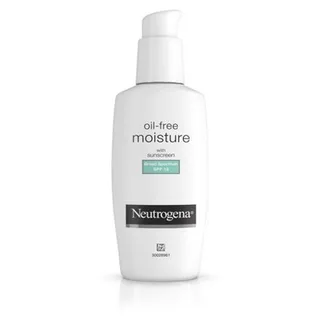
Neutrogena Oil Free Facial Moisturizer SPF 15 Sunscreen Glycerin
Works for
Sun protectionSPF 15 · 3 UV filters · Partial spectrumWeak protectionSPF under 30
This product does not offer good protection against UVA rays.
MoisturizingOctyldodecyl neopentanoate, Glycerin + 2 moreWorks
“Oil Free Facial Moisturizer SPF 15 Sunscreen Glycerin”
This product can help improve hydration of the skin with the two types of ingredients.
The first type is called “humectants”:
these ingredients help attract water.
When humectants are on the surface of the skin, they “pull in” the moisture from the outside environment, or from
within deeper layers of the skin. The following ingredients in this product do the job:
glycerin.
This product also contains ingredients called “occlusives”. They help reduce the speed with which our skin loses moisture to the outside environment. These ingredients also help soften the upper layer of the skin, so it feels less tight and nicer to the touch. The following ingredients in this product do the job: dimethicone, octyldodecyl neopentanoate.
Can it cause trouble?
Irritancy2 strong irritants: Benzophenone-3, Diazolidinyl ureaMedium risk
ComedogenicClean of flagged comedogenic ingredientsNone flagged
User reviews
Be the first — your take helps the next person decide.
Ingredients
Filter by role to see what each ingredient is doing.
Ethylhexyl methoxycinnamate7.5%
- Irritation risk
- High
Octinoxate. When used in higher concentrations, works as a sunscreen protecting the skin from UVB rays. When used in lower concentration, helps to preserve the product formulation. Is shown to be harmful to coral reefs - consider avoiding bathing in coral reef areas when wearing a product with this ingredient. It can be irritating
More about Ethylhexyl methoxycinnamateEthylhexyl salicylate5%
- Irritation risk
- Low
Octisalate. A UV filter. It offers some protection against the sun rays that cause sunburn (UVB), but does not protect against the most aging sun rays (UVA). It loses its effectiveness quickly when exposed to sunlight. It is an organic, or so called "chemical" sunscreen
More about Ethylhexyl salicylateBenzophenone-33%
- Irritation risk
- High
Same as oxybenzone. Protects in the UVB and short UVA range. In small concentrations, used to stabilize product formulation. Can be irritating. Is shown to be harmful to coral reefs - consider avoiding bathing in coral reef areas when wearing a product with this ingredient. It can penetrate the skin and get absorbed into bloodstream faster than other popular filters available in the US. The study that produced this finding did not address any potential health effects of the absorption
More about Benzophenone-3Water~40–60%
Octyldodecyl neopentanoate~7.5–11.2%
- Irritation risk
- Low
An emollient that helps soften the skin. Often used to stabilize other ingredients, for example, sunscreen
More about Octyldodecyl neopentanoateGlycerin~4.6–6.9%
- Irritation risk
- Low
One of the best moisturizing ingredients. Naturally present in skin. It attracts water to the upper layer of the skin working as a humectant
More about GlycerinGlyceryl stearate~3.4–5.1%
- Irritation risk
- Low
An emollient that softens the skin and forms a protective layer on its surface. Helps water and oil mix together
More about Glyceryl stearatePeg-100 stearate~2.7–4%
- Irritation risk
- Low
Helps oil and water mix togehter and creates a nice product texture
More about Peg-100 stearateDimethicone~2.2–3.3%
- Irritation risk
- Low
A silicone that helps to reduce water loss from the surface of the skin. Can temporarily "fill in" lines and wrinkles, absorb oil, and create a nice product finish
More about DimethiconeTriethanolamine~1–1.5%
- Irritation risk
- Medium
Used to adjust pH of the product and can help improve the product's smell
More about TriethanolamineDiazolidinyl urea~0.25–0.5%
- Irritation risk
- High
A preservative. Works by releasing formaldehyde. Can be irritating
More about Diazolidinyl ureaMethylparaben~0.15–0.3%
Propylparaben~0.1–0.35%
Carbomer~0.1–0.45%
- Irritation risk
- Low
Helps create a thicker or gel-like product texture. It is not a surfactant but can be used in gentle cleansing formulations
More about CarbomerIngredient list view
Ethylhexyl methoxycinnamate, Ethylhexyl salicylate, Benzophenone-3, Water, Octyldodecyl neopentanoate, Glycerin, Glyceryl stearate, Peg-100 stearate, Dimethicone, Triethanolamine, Diazolidinyl urea, Methylparaben, Unknown, Propylparaben, Carbomer
Compare prices
Retailers ranked by price — lowest first.
Affiliate links · As an Amazon Associate, WIMJ earns from qualifying purchases.
Worth comparing, line by line.
Match % combines shared ingredients, the first five ingredients, shared actives and hero ingredients, irritancy (lower counts in the alternative's favour), texture and body area. Only products in the same routine step are compared.
| NeutrogenaOil Free Facial Moisturizer SPF 15 Sunscreen GlycerinYOUR PRODUCT | Walgreens BeautyOil-Free Moisturizing Facial Lotion SPF 15 | CetaphilDaily Facial Moisturizer SPF 50 | AvonAnew Platinum Day Cream Broad Spectrum SPF 25 | |
|---|---|---|---|---|
| Match | — | 47% | 44% | 44% |
| Price | — | — | $9.78 | — |
| Shared key ingredients | — | 5 of 5 | 4 of 5 | 4 of 5 |
| Key difference | — | — | Cyclomethicone | Avobenzone |
| Irritancy | Medium | Medium | Medium | Medium |
| SPF | SPF 15 | SPF 15 | SPF 50 | SPF 25 |
| Drying alcohol | — | — | — | — |
| View product | Shop | Shop | Shop |


More alternatives: Trinny London BFF SPF 30 CREAMDr. Denese SPF 30 Defense Day Cream
Product summary
We do not recommend "Neutrogena - Oil Free Facial Moisturizer SPF 15 Sunscreen Glycerin" because it does not provide good UVA protection. UVA sun rays don't burn the skin, but they still lead to photoaging and hyperpigmentation.
It contains good moisturizing ingredients and can double as a hydrating day cream.
Sunscreen filters
This sunscreen uses so-called "chemical", or organic UV filters (organic simply means that their molecules contain atoms of carbon). These filters typically give good sun protection and rarely leave a white cast, but they can be irritating for sensitive skin. The UV filters in this sunscreen are: oxybenzone 3.00% (declared), octinoxate 7.50% (declared) and octisalate 5.00% (declared).
Irritation risk
This formulation includes some common irritants, including ingredients that do not provide a benefit for the skin. We assess the overall irritancy of this moisturizer to be medium. For a detailed overview of all potential irritants: click here
You can see the detailed formula review with the breakdown of all actives in the product and the full ingredient list with estimated concentrations in the tables below.
Price
The product retails for 11.49$ in the United States.
For a detailed price comparison: click here.
Sources cited in this review
Every concentration estimate and effectiveness label is anchored to one of these 7 studies and safety reviews.
- 1
- 2
- 3On Photostability of Oxybenzonecore.ac.uk
- 4
- 5
- 6

Affiliate links · As an Amazon Associate, WIMJ earns from qualifying purchases.