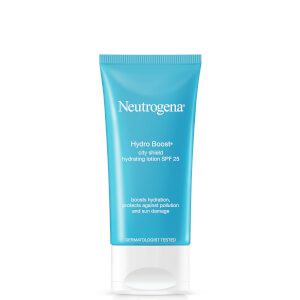
Neutrogena Hydro Boost City Shield SPF25 Moisturiser and Facial Sunscreen
Works for
1 of 3 advertised claims delivered
Sun protectionSPF 25 · 5 UV filters · Broad spectrumWeak protectionSPF under 30
This product offers broad spectrum sun protection, but it is weak. We recommend to use a broad spectrum sunscreen with at least SPF 30.
This product can be considered "reef safe" because it does not contain the UV filters (oxybenzone and octinoxate) that can be harmful to coral reefs when present in the water in high concentrations.
Moisturizing6 ingredients credited for this claimGood support
“Hydro Boost City Shield SPF25 Moisturiser and Facial Sunscreen”
This product contains good ingredients to attract water to the upper layer of the skin. These ingredients are called "humectants": glycerin, sodium hyaluronate.
When humectants are on the surface of the skin, they “pull in” the moisture from the outside environment, or from within deeper layers of the skin. If the air is dry, humectants can speed up the moisture loss from the skin. This is why it is a good idea to use another product on top of this one to help "seal in" the moisture (look for ingredients like dimethicone, squalane, oils and butters).
Anti-aging2 ingredients credited for this claimLimited support
“Skin is left feeling supple with a youthful bounce.”
This product does not contain ingredients that are able to reduce fine lines and wrinkles or help with skin elasticity, but it can improve the look of the skin temporarily through moisturization. Well-moisturized skin might also be able to repair the sun damage better.
The biggest anti-aging effect in this product comes from sun protection. Sun damage is the main factor causing early signs of skin aging. We, however, do not recommend using this product as a sunscreen because the protection it offers is not strong enough).
Can it cause trouble?
Irritancy1 strong irritant: ParfumMedium risk
Comedogenic1 ingredient rated 2 or more on the 0–5 pore-clogging scale1 flagged
User reviews
Be the first — your take helps the next person decide.
Ingredients
Filter by role to see what each ingredient is doing.
Water~45–55%
Glycerin~5–6.1%
- Irritation risk
- Low
One of the best moisturizing ingredients. Naturally present in skin. It attracts water to the upper layer of the skin working as a humectant
More about GlycerinHomosalate~4.5–5.5%
- Irritation risk
- Medium
A weak sunscreen that offers some protection against the sun rays that cause sunburn (UVB), but does not offer meaningful protection against protect against the most aging sun rays (UVA). It loses its effectiveness quickly when exposed to sunlight. It is an organic, or so called "chemical" sunscreen. When used in low concentrations, helps to stabilize the product formulation
More about HomosalateCaprylyl methicone~3.1–3.8%
- Irritation risk
- Low
A type of silicone that helps to soften the upper layer of the skin and create a nice product finish on the skin
More about Caprylyl methiconeEthylhexyl salicylate~3.2–3.9%
- Irritation risk
- Low
Octisalate. A UV filter. It offers some protection against the sun rays that cause sunburn (UVB), but does not protect against the most aging sun rays (UVA). It loses its effectiveness quickly when exposed to sunlight. It is an organic, or so called "chemical" sunscreen
More about Ethylhexyl salicylateButyl methoxydibenzoylmethane~2.5–3.1%
- Irritation risk
- Medium
Avobenzone. An organic, or so-called "chemical" UV filter. Protects against both UVA and UVB rays. Needs to be combined with other filters in a formulation to be stable.
More about Butyl methoxydibenzoylmethanePhenylbenzimidazole sulfonic acid~2.1–2.6%
- Irritation risk
- Medium
Ensulizole. A UV filter that is effective against UVB rays. Does not protect against UVA light. It is photostable and can be used to help stabilize other sunscreen ingredients. It is water-soluble meaning that it can help create lighter sunscreen formulations
More about Phenylbenzimidazole sulfonic acidOctocrylene~2–2.5%
- Irritation risk
- Medium
A weak sunscreen that protects against the sun rays that cause sunburn (UVB) and is somewhat effective against the UVA rays. It is quite stable and can help stabilize other, more vulnerable, sunscreen ingredients like Avobenzone. It is an organic, or so called "chemical" sunscreen
More about OctocryleneSodium acryloyldimethyltaurate/vp crosspolymer~1.2–1.5%
- Irritation risk
- Medium
Used to stabilize the product formulations
More about Sodium acryloyldimethyltaurate/vp crosspolymerSilica~1.3–1.5%
Sodium hyaluronate~0.7–1.05%
- Irritation risk
- Low
One of the best moisturizing ingredients. Attracts water into the upper layer of the skin
More about Sodium hyaluronateTocopheryl acetate~0.6–0.85%
- Irritation risk
- Medium
A more stable but less bio-available form of vitamin E compared to Tocopherol. Might help moisturize and protect the skin from free radicals, but mostly used in low concentrations to stabilize other ingredients.
More about Tocopheryl acetateDicaprylyl carbonate~0.55–0.8%
- Irritation risk
- Low
Helps products spread more easily and works as an emollient to soften skin
More about Dicaprylyl carbonateGlyceryl stearate~0.5–0.75%
- Irritation risk
- Low
An emollient that softens the skin and forms a protective layer on its surface. Helps water and oil mix together
More about Glyceryl stearateSteareth-21~0.5–0.8%
Sodium polyacrylate~0.45–0.7%
- Irritation risk
- Low
Used to create a gel-like product texture, as well as to stabilize emulsions
More about Sodium polyacrylateDisodium edta~0.3–0.55%
Sodium hydroxide~0.25–0.45%
Sodium ascorbyl phosphate~0.25–0.45%
- Irritation risk
- Medium
A stable derivative of vitamin C. It is oil-soluble which means it is more likely to penetrate the skin compared to the pure form of vitamin C (which is water-soluble), but it is less bio-available and is way less effective in stimulating collagen and reducing wrinkles compared to the pure form of vitamin C (L-ascorbic acid) and its other derivatives (for example, magnesium ascorbyl phosphate). At the same time, this vitamin C derivative has been shown in studies to be effective in reducing acne, blemishes and clogged pores. It is less irritating then the pure form of vitamin C
More about Sodium ascorbyl phosphateTocopherol~0.2–0.4%
- Irritation risk
- Low
Pure form of vitamin E. Can help moisturise and protect the skin from free radicals. Often used to help stabilise other ingredients or the formula itself
More about TocopherolBenzyl alcohol~0.15–0.25%
- Irritation risk
- High
A preservative. Can be used to mask unpleasant smell. Can be irritating
More about Benzyl alcoholChlorphenesin~0.1–0.25%
Phenoxyethanol~0.15–0.25%
- Irritation risk
- Low
A preservative. It helps prevent bacterial growth in cosmetic products
More about PhenoxyethanolParfum~0.1–0.2%
- Irritation risk
- High
An aromatic blend of unspecified and possibly irritating ingredients
More about ParfumCi 16035~0.1–0.15%
Ci 42090~0.05–0.15%
Ingredient list view
Water, Glycerin, Homosalate, Caprylyl methicone, Ethylhexyl salicylate, Butyl methoxydibenzoylmethane, Phenylbenzimidazole sulfonic acid, Octocrylene, Sodium acryloyldimethyltaurate/vp crosspolymer, Silica, Sodium hyaluronate, Tocopheryl acetate, Dicaprylyl carbonate, Glyceryl stearate, Steareth-21, Sodium polyacrylate, Disodium edta, Sodium hydroxide, Sodium ascorbyl phosphate, Tocopherol, Benzyl alcohol, Chlorphenesin, Phenoxyethanol, Parfum, Ci 16035, Ci 42090
Compare prices
Retailers ranked by price — lowest first.
Product summary
"Neutrogena - Hydro Boost City Shield SPF25 Moisturiser and Facial Sunscreen" offers broad spectrum protection. It means that it protects from both UVA and UVB rays (you can remember UVB as "burning" sunlight - they cause sunburn. You can remember UVA rays as "aging" - they do not lead to sunburn, but they cause photodamage and contribute to early signs of skin aging and hyperpigmentation). On the negative side, the SPF of this moisturizer is not high enough. We recommend to use a sunscreen with at least SPF 30 daily.
This moisturizer should also be hydrating enough to use without an additional moisturizer during the day.
Sunscreen filters
This is a so-called "chemical" sunscreen. It means that it uses organic UV filters. They typically offer good sun protection and rarely leave a white cast, but they can be irritating for some people with sensitive skin. The UV filters in this sunscreen are: avobenzone 2.50% - 3.10%, octisalate 3.20% - 3.90%, homosalate 4.50% - 5.50%, octocrylene 2.00% - 2.50% and ensulizole 2.10% - 2.60%.
Irritation risk
This formulation includes some common irritants, including ingredients that do not provide a benefit for the skin. We assess the overall irritancy of this moisturizer to be medium. For a detailed overview of all potential irritants: click here
You can see the detailed formula review with the breakdown of all actives in the product and the full ingredient list with estimated concentrations in the tables below.
Price
The product retails for 12.99$ in the United States.
For a detailed price comparison: click here.
Sources cited in this review
Every concentration estimate and effectiveness label is anchored to one of these 14 studies and safety reviews.
- 1
- 2
- 3
- 4Hyaluronic acid: A key molecule in skin agingncbi.nlm.nih.gov
- 5
- 6

Affiliate links · As an Amazon Associate, WIMJ earns from qualifying purchases.