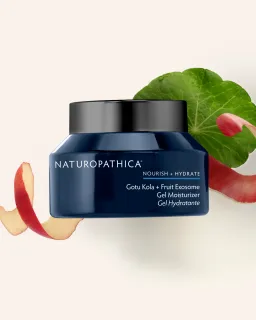
Naturopathica Gotu Kola + Fruit Exosome Gel Moisturizer

Naturopathica Gotu Kola + Fruit Exosome Gel Moisturizer

Efficacy75/100IrritancyMedium
Edit

Works for

2 of 2 advertised claims delivered

Anti-aging
9 ingredients credited for this claim
Moderate evidence
What the product description says
“These Exosomes help support skin cell communication for smoother, firmer, more lifted-looking skin, while the weightless formula absorbs quickly to calm the complexion and deliver lasting moisture.”
Source: Naturopathica

This product contains centella asiatica leaf extract, serine, threonine. These ingredients might be able to help reduce and prevent fine lines and wrinkles, improve skin elasticity and firmness, but there is not enough evidence that it actually works.

Centella asiatica leaf extractKey activeEffect: MediumA plant extract that has been shown to be able to reduce inflammation in skin, support restoration of skin barrier function, as well as support collagen production. It can be irritating to sensitive skin. Might be helpful in preventing stretch marks. It could, however, itself be irritating.~0.6–0.9%
SerineKey activeEffect: MediumAn amino-acid that helps to attract water to the upper layer of the skin. In combination with other amino-acids, might help to reduce fine lines and wrinkles~0.5–0.75%
ThreonineKey activeEffect: MediumAn amino-acid that helps to attract water to the upper layer of the skin. In combination with other amino-acids, might help to reduce fine lines and wrinkles~0.35–0.6%
3-o-ethyl ascorbic acidEffect: LowA vitamin C derivative that is more stable but less potent than pure form of vitamin C. Can help neutralize free radicals and help reduce hyperpigmentation, but the required concentration is likely to be much higher than for the pure form of vitamin C, limiting the ingredient's effectiveness in products~0.5–0.8%
Hyaluronic acidEffect: LowOne of the best moisturizing ingredients. Attracts water into the upper layer of the skin. Naturally present in skin. Typically has large molecule size unless advertised otherwise on the product label. Helps support skin's barrier function and may help to reduce inflammation~0.5–0.75%
Beta-glucanEffect: LowHelps attract water to the upper layer of the skin, calm down inflammation and irritation, restore the barrier function and support wound healing. It can be helpful in reducing fine lines and wrinkles~0.5–0.75%
Aloe barbadensis leaf juiceEffect: LowTraditionally used to treat sunburns, dermatitis and inflammation, but evidence for its effectiveness is lacking. The extract can contain humectants that help attract water into the skin~26–32%
Tetrahexyldecyl ascorbateUnder-dosedEffect: HighBeing a lipid soluble form of vitamin C, it is more stable than ascorbic acid, but still degrades quickly and needs to be stabilized in a formulation with another ingredient. It is claimed to penetrate skin better than pure vitamin C and have the the similar benefits, but solid studies of its effectiveness are lacking. Is likely to require a higher concentration in a product than pure vitamin C to be effective. It might be able to help reduce pore clogging.~0.5–0.8%
TocopherolEffect: Low, below effective dosePure form of vitamin E. Can help moisturise and protect the skin from free radicals. Often used to help stabilise other ingredients or the formula itself~0.5–0.8%
Moisturizing
34 ingredients credited for this claim
Good evidence
What the product description says
“Gotu Kola + Fruit Exosome Gel Moisturizer”
Source: Naturopathica

This product can help improve hydration of the skin with the two types of ingredients.

The first type is called “humectants”:
these ingredients help attract water. When humectants are on the surface of the skin, they “pull in” the moisture from the outside environment, or from within deeper layers of the skin. The following ingredients in this product do the job: alanine, arginine.

This product also contains ingredients called “occlusives”. They help reduce the speed with which our skin loses moisture to the outside environment. These ingredients also help soften the upper layer of the skin, so it feels less tight and nicer to the touch. The following ingredients in this product do the job: arginine, glycine soja oil.

Hydrolyzed glycosaminoglycansKey active· HumectantEffect: HighLong sugars that help attract water to the upper layer of the skin~0.4–0.6%
Hydrolyzed hyaluronic acidKey active· HumectantEffect: HighOne of the best moisturizing ingredients. Attracts water into the upper layer of the skin. A version of it is naturally present in skin~0.25–0.4%
Lactobacillus/arundinaria gigantea leaf ferment filtrateKey activeEffect: HighFermented bamboo. Is used to create a nice product texture. Might have some antioxidant effect~0.55–0.85%
Sodium pcaKey active· HumectantEffect: HighNaturally present in skin and helps to attract water to its upper layer~0.65–1%
ThreonineKey activeEffect: HighAn amino-acid that helps to attract water to the upper layer of the skin. In combination with other amino-acids, might help to reduce fine lines and wrinkles~0.35–0.6%
AlanineKey active· HumectantEffect: HighAn amino-acid that helps to attract water to the upper layer of the skin and might help to lighten the skin, but solid evidence is lacking~0.5–0.75%
ArginineKey active· Humectant, OcclusiveEffect: HighAn amino acid that is naturally present in skin and helps keep it hydrated. When used together with AHAs, it can reduce their irritating effect on the skin~0.3–0.55%
Beta-glucanKey activeEffect: HighHelps attract water to the upper layer of the skin, calm down inflammation and irritation, restore the barrier function and support wound healing. It can be helpful in reducing fine lines and wrinkles~0.5–0.75%
BetaineKey active· HumectantEffect: HighHelps attract water to the upper layer of the skin and improves the product texture~0.7–1.05%
Glutamic acidKey active· HumectantEffect: HighAn amino-acid that helps attract water to the upper layer of the skin~0.4–0.65%
GlycerinKey active· HumectantEffect: HighOne of the best moisturizing ingredients. Naturally present in skin. It attracts water to the upper layer of the skin working as a humectant~5–6.1%
GlycineKey active· HumectantEffect: HighHelps to attract water to the upper layer of the skin and can help restore the skin barrier function~0.45–0.7%
Glycine soja oilKey active· EmollientEffect: HighA good emollient that helps soften the skin and helps repair its barrier function. It can clog pores if used in high concentrations.~0.55–0.8%
Helianthus annuus sprout extractKey activeEffect: HighHelps soften the upper layer of the skin and can help support the skin barrier~0.45–0.7%
Hyaluronic acidKey active· HumectantEffect: HighOne of the best moisturizing ingredients. Attracts water into the upper layer of the skin. Naturally present in skin. Typically has large molecule size unless advertised otherwise on the product label. Helps support skin's barrier function and may help to reduce inflammation~0.5–0.75%
Lysine hclKey activeEffect: High~0.4–0.6%
Malus domestica fruit extractKey activeEffect: HighHelps attract water to the upper layer of the skin~0.55–0.8%
PcaKey active· HumectantEffect: HighNaturally present in skin and helps to attract water to its upper layer~0.5–0.75%
Polyglutamic acidKey active· HumectantEffect: HighHelps attract water to the upper layer of the skin.~0.45–0.7%
SerineKey activeEffect: HighAn amino-acid that helps to attract water to the upper layer of the skin. In combination with other amino-acids, might help to reduce fine lines and wrinkles~0.5–0.75%
Sodium hyaluronateKey active· HumectantEffect: HighOne of the best moisturizing ingredients. Attracts water into the upper layer of the skin~0.4–0.65%
Sodium lactateKey active· HumectantEffect: HighHelps attract water to the upper layer of the skin. Is often used to adjust the pH level of the product~0.6–0.85%
Coco-caprylate/caprateKey active· EmollientEffect: MediumHelps to soften the upper layer of the skin without creating a greasy texture~0.7–1.05%
Coconut alkanesKey active· EmollientEffect: MediumAn emollient that helps soften the skin~1.4–1.8%
ProlineKey activeEffect: Medium~0.2–0.4%
Pentylene glycol· EmollientEffect: LowUsed to preserve products, dissolve other ingredients and create a nice product texture~4–4.9%
Stearic acid· EmollientEffect: LowHelps oil and water mix together and works as an emollient~1.3–1.5%
Aloe barbadensis leaf juice· HumectantEffect: LowTraditionally used to treat sunburns, dermatitis and inflammation, but evidence for its effectiveness is lacking. The extract can contain humectants that help attract water into the skin~26–32%
Caprylyl glycol· Humectant, EmollientEffect: LowHelps preserve products and creates a nice product texture~0.35–0.65%
Moringa oleifera seed oil· EmollientEffect: LowA plant oil that helps soften the upper layer of the skin. Is unlikely to be helpful in restoring skin barrier function due to the low content of linoleic acid~0.3–0.55%
AlginEffect: LowUsed to thicken product formulation. Can help attract water to the upper layer of the skin~0.5–0.8%
Lecithin· EmollientEffect: LowUsed mostly for creating emulsions - helping oil and water mix together. Helps soften the upper layer of the skin~0.75–1.1%
Simmondsia chinensis seed oilUnder-dosedEffect: HighSoftens the upper layer of skin and helps restore the healthy skin barrier. Has shown to help calm down inflammation in skin. It is a stable oil, meaning that it retains its properties even when exposed to air.~0.6–0.85%
TocopherolEffect: Low, below effective dosePure form of vitamin E. Can help moisturise and protect the skin from free radicals. Often used to help stabilise other ingredients or the formula itself~0.5–0.8%
Anti-oxidation
Not advertised by the brand · 7 ingredients credited for this claim
Moderate evidence

This product contains antioxidants (3-o-ethyl ascorbic acid) that might be able to help neutralize free radicals in skin to lessen the damage it gets from the UV light (sun). There is not enough evidence to confirm their effectiveness in skin though.

3-o-ethyl ascorbic acidKey activeEffect: MediumA vitamin C derivative that is more stable but less potent than pure form of vitamin C. Can help neutralize free radicals and help reduce hyperpigmentation, but the required concentration is likely to be much higher than for the pure form of vitamin C, limiting the ingredient's effectiveness in products~0.5–0.8%
Beta-glucanEffect: LowHelps attract water to the upper layer of the skin, calm down inflammation and irritation, restore the barrier function and support wound healing. It can be helpful in reducing fine lines and wrinkles~0.5–0.75%
Eclipta prostrata extractEffect: LowA plant extract that might help neutralize free radicals in skin. It can be irritating~0.5–0.75%
Lactobacillus/arundinaria gigantea leaf ferment filtrateEffect: LowFermented bamboo. Is used to create a nice product texture. Might have some antioxidant effect~0.55–0.85%
Malus domestica fruit extractEffect: LowHelps attract water to the upper layer of the skin~0.55–0.8%
Tetrahexyldecyl ascorbateUnder-dosedEffect: HighBeing a lipid soluble form of vitamin C, it is more stable than ascorbic acid, but still degrades quickly and needs to be stabilized in a formulation with another ingredient. It is claimed to penetrate skin better than pure vitamin C and have the the similar benefits, but solid studies of its effectiveness are lacking. Is likely to require a higher concentration in a product than pure vitamin C to be effective. It might be able to help reduce pore clogging.~0.5–0.8%
TocopherolUnder-dosedEffect: HighPure form of vitamin E. Can help moisturise and protect the skin from free radicals. Often used to help stabilise other ingredients or the formula itself~0.5–0.8%
Evens skin tone
Not advertised by the brand · 3 ingredients credited for this claim
Moderate evidence

The following ingredient (ingredients) in this product might be helpful, but there is no evidence to confirm that it actually works: 3-o-ethyl ascorbic acid, alanine.

3-o-ethyl ascorbic acidKey activeEffect: MediumA vitamin C derivative that is more stable but less potent than pure form of vitamin C. Can help neutralize free radicals and help reduce hyperpigmentation, but the required concentration is likely to be much higher than for the pure form of vitamin C, limiting the ingredient's effectiveness in products~0.5–0.8%
AlanineEffect: LowAn amino-acid that helps to attract water to the upper layer of the skin and might help to lighten the skin, but solid evidence is lacking~0.5–0.75%
Tetrahexyldecyl ascorbateUnder-dosedEffect: HighBeing a lipid soluble form of vitamin C, it is more stable than ascorbic acid, but still degrades quickly and needs to be stabilized in a formulation with another ingredient. It is claimed to penetrate skin better than pure vitamin C and have the the similar benefits, but solid studies of its effectiveness are lacking. Is likely to require a higher concentration in a product than pure vitamin C to be effective. It might be able to help reduce pore clogging.~0.5–0.8%

Can it cause trouble?

Irritancy
2 strong irritants: Citrus reticulata fruit extract, Carica papaya fruit extract
Medium risk
We flagged 20 ingredients with irritancy potential. Severity depends on your sensitivity threshold; the table lists the worst offenders first.
IngredientFunctionIrritationEst. amount
3-o-ethyl ascorbic acidA vitamin C derivative that is more stable but less potent than pure form of vitamin C. Can help neutralize free radicals and help reduce hyperpigmentation, but the required concentration is likely to be much higher than for the pure form of vitamin C, limiting the ingredient's effectiveness in productsHigh~0.5–0.8%est.
Citrus reticulata fruit extract—High~0.5–0.8%est.
Carica papaya fruit extract—High~0.5–0.75%est.
Eclipta prostrata extractA plant extract that might help neutralize free radicals in skin. It can be irritatingHigh~0.5–0.75%est.
Melia azadirachta leaf extractA plant extract that has anti-bacterial properties. Can be used to preserve the product. Can be irritatingHigh~0.2–0.4%est.
Aloe barbadensis leaf juiceTraditionally used to treat sunburns, dermatitis and inflammation, but evidence for its effectiveness is lacking. The extract can contain humectants that help attract water into the skinMedium~26–32%est.
Pentylene glycolUsed to preserve products, dissolve other ingredients and create a nice product textureMedium~4–4.9%est.
Coconut alkanesAn emollient that helps soften the skinMedium~1.4–1.8%est.
Sodium acrylates copolymerUsed to create a thicker product consistencyMedium~1–1.3%est.
Centella asiatica leaf extractA plant extract that has been shown to be able to reduce inflammation in skin, support restoration of skin barrier function, as well as support collagen production. It can be irritating to sensitive skin. Might be helpful in preventing stretch marks. It could, however, itself be irritating.Medium~0.6–0.9%est.
Sodium lactateHelps attract water to the upper layer of the skin. Is often used to adjust the pH level of the productMedium~0.6–0.85%est.
Tetrahexyldecyl ascorbateBeing a lipid soluble form of vitamin C, it is more stable than ascorbic acid, but still degrades quickly and needs to be stabilized in a formulation with another ingredient. It is claimed to penetrate skin better than pure vitamin C and have the the similar benefits, but solid studies of its effectiveness are lacking. Is likely to require a higher concentration in a product than pure vitamin C to be effective. It might be able to help reduce pore clogging.Medium~0.5–0.8%est.
Malus domestica fruit extractHelps attract water to the upper layer of the skinMedium~0.55–0.8%est.
Simmondsia chinensis seed oilSoftens the upper layer of skin and helps restore the healthy skin barrier. Has shown to help calm down inflammation in skin. It is a stable oil, meaning that it retains its properties even when exposed to air.Medium~0.6–0.85%est.
Glycine soja oilA good emollient that helps soften the skin and helps repair its barrier function. It can clog pores if used in high concentrations.Medium~0.55–0.8%est.
1,2-hexanediolA preservativeMedium~0.5–0.75%est.
Leuconostoc/radish root ferment filtrateA preservative that comes from radishes fermented by a bacteria. New research suggests that the preservation properties in the ingredient come from an ammonium salt that is not present naturally in radish root but used in its cultivation. Is problematic because the exact amount of the preservative agents is difficult to determineMedium~0.45–0.65%est.
Caprylyl glycolHelps preserve products and creates a nice product textureMedium~0.35–0.65%est.
EthylhexylglycerinA preservativeMedium~0.2–0.4%est.
Moringa oleifera seed oilA plant oil that helps soften the upper layer of the skin. Is unlikely to be helpful in restoring skin barrier function due to the low content of linoleic acidMedium~0.3–0.55%est.
Comedogenic
3 ingredients rated 2 or more on the 0–5 pore-clogging scale
3 flagged
These ingredients have a comedogenic rating of 2 or more on a 0–5 scale; the table shows each one's rating. In leave-on products they can clog pores in acne-prone skin.
IngredientFunctionRatingEst. amount
AlginUsed to thicken product formulation. Can help attract water to the upper layer of the skin3/5~0.5–0.8%est.
Coconut alkanesAn emollient that helps soften the skin2/5~1.4–1.8%est.
Glycine soja oilA good emollient that helps soften the skin and helps repair its barrier function. It can clog pores if used in high concentrations.2/5~0.55–0.8%est.
Edit
Cheaper Alternatives
Similar formulations, better price
No cheaper similar product found.

User reviews

Would you recommend?
No community reviews yet.

Be the first — your take helps the next person decide.

Write a review · ~30s

Ingredients

Filter by role to see what each ingredient is doing.

Aloe barbadensis leaf juice~26–32%
Irritant · medium
Irritation risk
Medium
Works for
MoisturizingAntibacterialAnti-inflammatoryReduces rednessReduces irritationAnti-blemishAnti-aging

Traditionally used to treat sunburns, dermatitis and inflammation, but evidence for its effectiveness is lacking. The extract can contain humectants that help attract water into the skin

More about Aloe barbadensis leaf juice
Water~12–15%
Formula
Irritation risk
Low

Plain old water

More about Water
Glycerin~5–6.1%
Key active
Irritation risk
Low
Works for
Moisturizing

One of the best moisturizing ingredients. Naturally present in skin. It attracts water to the upper layer of the skin working as a humectant

More about Glycerin
Pentylene glycol~4–4.9%
Irritant · medium
Irritation risk
Medium
Works for
Moisturizing

Used to preserve products, dissolve other ingredients and create a nice product texture

More about Pentylene glycol
Methylheptyl isostearate~2.8–3.5%
Formula
Cetearyl olivate~2–2.4%
Formula
Irritation risk
Low
Works for
Cleansing

Helps oil and water mix together

More about Cetearyl olivate
Maltodextrin~1.7–2.1%
Formula
Irritation risk
Low
Works for
Mattifying

Used to stabilize the product formulation and can help absorb oil

More about Maltodextrin
Coconut alkanes~1.4–1.8%
Key activeComedogenic 2/5Irritant · medium
Irritation risk
Medium
Comedogenicity
2/5
Works for
Moisturizing

An emollient that helps soften the skin

More about Coconut alkanes
Sorbitan olivate~1.3–1.6%
Formula
Irritation risk
Low
Works for
Cleansing

Helps oil and water mix together

More about Sorbitan olivate
Stearic acid~1.3–1.5%
Formula
Irritation risk
Low
Works for
CleansingMoisturizing

Helps oil and water mix together and works as an emollient

More about Stearic acid
Methylheptylglycerin~1–1.3%
Formula
Sodium acrylates copolymer~1–1.3%
Irritant · medium
Irritation risk
Medium

Used to create a thicker product consistency

More about Sodium acrylates copolymer
Betaine~0.7–1.05%
Key active
Irritation risk
Low
Works for
Moisturizing

Helps attract water to the upper layer of the skin and improves the product texture

More about Betaine
Lecithin~0.75–1.1%
Formula
Irritation risk
Low
Works for
CleansingMoisturizing

Used mostly for creating emulsions - helping oil and water mix together. Helps soften the upper layer of the skin

More about Lecithin
Sodium pca~0.65–1%
Key active
Irritation risk
Low
Works for
Moisturizing

Naturally present in skin and helps to attract water to its upper layer

More about Sodium pca
Coco-caprylate/caprate~0.7–1.05%
Key active
Irritation risk
Low
Works for
Moisturizing

Helps to soften the upper layer of the skin without creating a greasy texture

More about Coco-caprylate/caprate
Propanediol~0.65–1%
Formula
Irritation risk
Low

Acts as a solvent for other ingredients. Speeds up the absorption of other ingredients into the skin

More about Propanediol
Centella asiatica leaf vesicles
Not recognized
Centella asiatica leaf extract~0.6–0.9%
Key activeIrritant · medium
Irritation risk
Medium
Works for
Anti-inflammatoryReduces irritationReduces rednessAnti-agingAnti-blemish

A plant extract that has been shown to be able to reduce inflammation in skin, support restoration of skin barrier function, as well as support collagen production. It can be irritating to sensitive skin. Might be helpful in preventing stretch marks. It could, however, itself be irritating.

More about Centella asiatica leaf extract
Sodium lactate~0.6–0.85%
Key activeIrritant · medium
Irritation risk
Medium
Works for
Moisturizing

Helps attract water to the upper layer of the skin. Is often used to adjust the pH level of the product

More about Sodium lactate
Lactobacillus/arundinaria gigantea leaf ferment filtrate~0.55–0.85%
Key active
Irritation risk
Low
Works for
MoisturizingAnti-oxidation

Fermented bamboo. Is used to create a nice product texture. Might have some antioxidant effect

More about Lactobacillus/arundinaria gigantea leaf ferment filtrate
Tremella fuciformis polysaccharide~0.6–0.95%
Formula
3-o-ethyl ascorbic acid~0.5–0.8%
Key activeIrritant · high
Irritation risk
High
Works for
Anti-oxidationEvens skin toneAnti-aging

A vitamin C derivative that is more stable but less potent than pure form of vitamin C. Can help neutralize free radicals and help reduce hyperpigmentation, but the required concentration is likely to be much higher than for the pure form of vitamin C, limiting the ingredient's effectiveness in products

More about 3-o-ethyl ascorbic acid
Tetrahexyldecyl ascorbate~0.5–0.8%
Under-dosedIrritant · medium
Irritation risk
Medium
Works for
Anti-agingEvens skin toneAnti-oxidation

Being a lipid soluble form of vitamin C, it is more stable than ascorbic acid, but still degrades quickly and needs to be stabilized in a formulation with another ingredient. It is claimed to penetrate skin better than pure vitamin C and have the the similar benefits, but solid studies of its effectiveness are lacking. Is likely to require a higher concentration in a product than pure vitamin C to be effective. It might be able to help reduce pore clogging.

More about Tetrahexyldecyl ascorbate
Beta-glucan~0.5–0.75%
Key active
Irritation risk
Low
Works for
MoisturizingReduces irritationAnti-inflammatoryAnti-oxidationAnti-blemishAnti-aging

Helps attract water to the upper layer of the skin, calm down inflammation and irritation, restore the barrier function and support wound healing. It can be helpful in reducing fine lines and wrinkles

More about Beta-glucan
Pca~0.5–0.75%
Key active
Irritation risk
Low
Works for
Moisturizing

Naturally present in skin and helps to attract water to its upper layer

More about Pca
Tocopherol~0.5–0.8%
Under-dosed
Irritation risk
Low
Works for
Anti-oxidationMoisturizingAnti-inflammatoryAnti-aging

Pure form of vitamin E. Can help moisturise and protect the skin from free radicals. Often used to help stabilise other ingredients or the formula itself

More about Tocopherol
Malus domestica fruit extract~0.55–0.8%
Key activeIrritant · medium
Irritation risk
Medium
Works for
MoisturizingAnti-oxidation

Helps attract water to the upper layer of the skin

More about Malus domestica fruit extract
Citrus reticulata fruit extract~0.5–0.8%
Irritant · high
Hyaluronic acid~0.5–0.75%
Key active
Irritation risk
Low
Works for
MoisturizingAnti-inflammatoryAnti-aging

One of the best moisturizing ingredients. Attracts water into the upper layer of the skin. Naturally present in skin. Typically has large molecule size unless advertised otherwise on the product label. Helps support skin's barrier function and may help to reduce inflammation

More about Hyaluronic acid
Carica papaya fruit extract~0.5–0.75%
Irritant · high
Simmondsia chinensis seed oil~0.6–0.85%
Under-dosedIrritant · medium
Irritation risk
Medium
Works for
Moisturizing

Softens the upper layer of skin and helps restore the healthy skin barrier. Has shown to help calm down inflammation in skin. It is a stable oil, meaning that it retains its properties even when exposed to air.

More about Simmondsia chinensis seed oil
Algin~0.5–0.8%
Comedogenic 3/5
Irritation risk
Low
Comedogenicity
3/5
Works for
Moisturizing

Used to thicken product formulation. Can help attract water to the upper layer of the skin

More about Algin
Xanthan gum~0.55–0.8%
Formula
Irritation risk
Low
Works for
Cleansing

Used to create a thicker product consistency

More about Xanthan gum
Glycine soja oil~0.55–0.8%
Key activeComedogenic 2/5Irritant · medium
Irritation risk
Medium
Comedogenicity
2/5
Works for
Moisturizing

A good emollient that helps soften the skin and helps repair its barrier function. It can clog pores if used in high concentrations.

More about Glycine soja oil
Eclipta prostrata extract~0.5–0.75%
Irritant · high
Irritation risk
High
Works for
Anti-inflammatoryAnti-oxidation

A plant extract that might help neutralize free radicals in skin. It can be irritating

More about Eclipta prostrata extract
Serine~0.5–0.75%
Key active
Irritation risk
Low
Works for
MoisturizingAnti-aging

An amino-acid that helps to attract water to the upper layer of the skin. In combination with other amino-acids, might help to reduce fine lines and wrinkles

More about Serine
1,2-hexanediol~0.5–0.75%
Irritant · medium
Irritation risk
Medium

A preservative

More about 1,2-hexanediol
Alanine~0.5–0.75%
Key active
Irritation risk
Low
Works for
MoisturizingEvens skin tone

An amino-acid that helps to attract water to the upper layer of the skin and might help to lighten the skin, but solid evidence is lacking

More about Alanine
Glycine~0.45–0.7%
Key active
Irritation risk
Low
Works for
Moisturizing

Helps to attract water to the upper layer of the skin and can help restore the skin barrier function

More about Glycine
Helianthus annuus sprout extract~0.45–0.7%
Key active
Irritation risk
Low
Works for
Moisturizing

Helps soften the upper layer of the skin and can help support the skin barrier

More about Helianthus annuus sprout extract
Polyglutamic acid~0.45–0.7%
Key active
Irritation risk
Low
Works for
Moisturizing

Helps attract water to the upper layer of the skin.

More about Polyglutamic acid
Biosaccharide gum
Not recognized
Leuconostoc/radish root ferment filtrate~0.45–0.65%
Irritant · medium
Irritation risk
Medium

A preservative that comes from radishes fermented by a bacteria. New research suggests that the preservation properties in the ingredient come from an ammonium salt that is not present naturally in radish root but used in its cultivation. Is problematic because the exact amount of the preservative agents is difficult to determine

More about Leuconostoc/radish root ferment filtrate
Bentonite~0.45–0.7%
Formula
Irritation risk
Low
Works for
Anti-blemish

Helps stabilize the product formulation

More about Bentonite
Glutamic acid~0.4–0.65%
Key active
Irritation risk
Low
Works for
Moisturizing

An amino-acid that helps attract water to the upper layer of the skin

More about Glutamic acid
Sodium hyaluronate~0.4–0.65%
Key active
Irritation risk
Low
Works for
Moisturizing

One of the best moisturizing ingredients. Attracts water into the upper layer of the skin

More about Sodium hyaluronate
Hydrolyzed glycosaminoglycans~0.4–0.6%
Key active
Irritation risk
Low
Works for
Moisturizing

Long sugars that help attract water to the upper layer of the skin

More about Hydrolyzed glycosaminoglycans
Lysine hcl~0.4–0.6%
Key active
Irritation risk
Low
Works for
Moisturizing
More about Lysine hcl
Threonine~0.35–0.6%
Key active
Irritation risk
Low
Works for
MoisturizingAnti-aging

An amino-acid that helps to attract water to the upper layer of the skin. In combination with other amino-acids, might help to reduce fine lines and wrinkles

More about Threonine
Arginine~0.3–0.55%
Key active
Irritation risk
Low
Works for
Moisturizing

An amino acid that is naturally present in skin and helps keep it hydrated. When used together with AHAs, it can reduce their irritating effect on the skin

More about Arginine
Caprylyl glycol~0.35–0.65%
Irritant · medium
Irritation risk
Medium
Works for
Moisturizing

Helps preserve products and creates a nice product texture

More about Caprylyl glycol
Hydrolyzed hyaluronic acid~0.25–0.4%
Key active
Irritation risk
Low
Works for
Moisturizing

One of the best moisturizing ingredients. Attracts water into the upper layer of the skin. A version of it is naturally present in skin

More about Hydrolyzed hyaluronic acid
Melia azadirachta leaf extract~0.2–0.4%
Irritant · high
Irritation risk
High
Works for
AntibacterialAnti-blemish

A plant extract that has anti-bacterial properties. Can be used to preserve the product. Can be irritating

More about Melia azadirachta leaf extract
Ethylhexylglycerin~0.2–0.4%
Irritant · medium
Irritation risk
Medium

A preservative

More about Ethylhexylglycerin
Moringa oleifera seed oil~0.3–0.55%
Irritant · medium
Irritation risk
Medium
Works for
Moisturizing

A plant oil that helps soften the upper layer of the skin. Is unlikely to be helpful in restoring skin barrier function due to the low content of linoleic acid

More about Moringa oleifera seed oil
Proline~0.2–0.4%
Key active
Irritation risk
Low
Works for
Moisturizing
More about Proline
Quartz~0.25–0.45%
Formula
Irritation risk
Low

A mineral. It does not have any confirmed benefit for the skin

More about Quartz
Ingredient list view

Aloe barbadensis leaf juice, Water, Glycerin, Pentylene glycol, Methylheptyl isostearate, Cetearyl olivate, Maltodextrin, Coconut alkanes, Sorbitan olivate, Stearic acid, Methylheptylglycerin, Sodium acrylates copolymer, Betaine, Lecithin, Sodium pca, Coco-caprylate/caprate, Propanediol, Unknown, Centella asiatica leaf extract, Sodium lactate, Lactobacillus/arundinaria gigantea leaf ferment filtrate, Tremella fuciformis polysaccharide, 3-o-ethyl ascorbic acid, Tetrahexyldecyl ascorbate, Beta-glucan, Pca, Tocopherol, Malus domestica fruit extract, Citrus reticulata fruit extract, Hyaluronic acid, Carica papaya fruit extract, Simmondsia chinensis seed oil, Algin, Xanthan gum, Glycine soja oil, Eclipta prostrata extract, Serine, 1,2-hexanediol, Alanine, Glycine, Helianthus annuus sprout extract, Polyglutamic acid, Unknown, Leuconostoc/radish root ferment filtrate, Bentonite, Glutamic acid, Sodium hyaluronate, Hydrolyzed glycosaminoglycans, Lysine hcl, Threonine, Arginine, Caprylyl glycol, Hydrolyzed hyaluronic acid, Melia azadirachta leaf extract, Ethylhexylglycerin, Moringa oleifera seed oil, Proline, Quartz

Compare prices

Retailers ranked by price — lowest first.

Naturopathica
$126.00
Buy

Affiliate links · prices updated regularly

Cheaper alternatives? See how this stacks up against similar formulas.
We compare ingredient profiles across our catalog — pick the closest match for your budget.
Open dupe finder

Sources cited in this review

Every concentration estimate and effectiveness label is anchored to one of these 34 studies and safety reviews.

  1. 1
  2. 2
  3. 3
  4. 4
  5. 5
  6. 6
Naturopathica Gotu Kola + Fruit Exosome Gel Moisturizer
NaturopathicaGotu Kola + Fruit Exosome Gel Moisturizer

Affiliate links · As an Amazon Associate, WIMJ earns from qualifying purchases.

As an Amazon Associate, WIMJ earns from qualifying purchases.