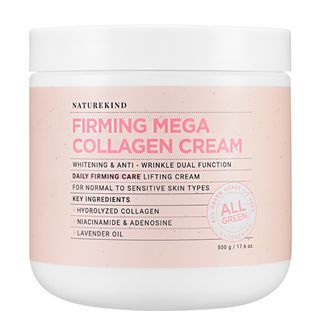
NATUREKIND Firming Mega Collagen Cream
Works for
3 of 3 advertised claims delivered
Anti-aging7 ingredients credited for this claimStrong support
“Niacinamide and adenosine rejuvenate skin by improving skin elasticity and skin tone.”
This product can help reduce and prevent fine lines and wrinkles, improve skin elasticity and firmness because it contains adenosine, niacinamide.
These ingredients in the product can also be helpful, even though there is less evidence for their effectiveness: aspartic acid, astaxanthin, lysine, serine, threonine.
Keep in mind that it typically takes at least 6 weeks to notice any results because the changes that are needed to improve fine lines and elasticity happen in the deeper layers of the skin. No topical anti-aging product can “erase” wrinkles or fully reverse signs of aging.
Moisturizing27 ingredients credited for this claimStrong support
“Firming Mega Collagen Cream”
This product can help improve hydration of the skin with the two types of ingredients.
The first type is called “humectants”:
these ingredients help attract water.
When humectants are on the surface of the skin, they “pull in” the moisture from the outside environment, or from
within deeper layers of the skin. The following ingredients in this product do the job:
alanine, arginine.
This product also contains ingredients called “occlusives”. They help reduce the speed with which our skin loses moisture to the outside environment. These ingredients also help soften the upper layer of the skin, so it feels less tight and nicer to the touch. The following ingredients in this product do the job: arginine, hydrolyzed collagen.
The following ingredients in this product are especially good for supporting the skin barrier and helping with the hydration level: niacinamide
Evens skin tone3 ingredients credited for this claimStrong support
“Niacinamide and adenosine rejuvenate skin by improving skin elasticity and skin tone.”
This product can help reduce hypepigmentation and even out the skin tone because it contains the following effective ingredients: niacinamide
The following ingredient (ingredients) in this product might be helpful, but there is no evidence to confirm that it actually can help even out the skin tone: alanine, cysteine.
Keep in mind that you would need to apply any topical skincare targetted at hypigmentation consistently for a couple of months to get a result. No topical skincare product can help get rid of hyperpigmentation (including post-acne marks and age spots) instantly.
Anti-blemishNot advertised by the brand · 2 ingredients credited for this claimStrong support
This product can help reduce breakouts and clogged pores because it contains the following ingredient: niacinamide. This ingredient is used for treating acne and can have a noticeable effect.
Anti-oxidationNot advertised by the brand · 4 ingredients credited for this claimStrong support
This product contains antioxidants (astaxanthin) that can help neutralize free radicals in skin. By doing so, they can lessen the damage the skin gets from the UV light (sun).
The following ingredients - cysteine also can have an antioxidant effect, but there is less evidence to confirm their effectiveness in skin.
Can it cause trouble?
Irritancy1 strong irritant: Lavandula angustifolia oilMedium risk
ComedogenicClean of flagged comedogenic ingredientsNone flagged


User reviews
Be the first — your take helps the next person decide.
Ingredients
Filter by role to see what each ingredient is doing.
Water~45–55%
Hydrolyzed collagen~4.6–5.6%
- Irritation risk
- Low
A typically plant-derived compound that is supposed mimic human collagen. Cannot penetrate the skin barrier so is not particularly useful in skincare products beyond attracting water to the upper layer of the skin
More about Hydrolyzed collagenDipropylene glycol~4.1–5%
- Irritation risk
- Low
Helps to dissolve other ingredients in a formulation. Slows down the rate of product drying
More about Dipropylene glycolButylene glycol~3.1–3.7%
- Irritation risk
- Low
Used to create a nice product texture and help delivery of other ingredients. Might be somewhat helpful in attracting water to the upper layer of the skin
More about Butylene glycolCetyl ethylhexanoate~2.4–2.9%
- Irritation risk
- Medium
An emollient that helps soften the skin and creates a thicker product texture
More about Cetyl ethylhexanoateHydrogenated polyisobutene~2–2.5%
- Irritation risk
- Low
Used to improve the product consistency and soften the upper layer of the skin
More about Hydrogenated polyisobuteneNiacinamide~1.7–2%
- Irritation risk
- Low
Is proven to be effective in reducing blemishes, evening out skin tone and helping to improve lines and wrinkles. It helps the skin to repair sun damage, calm down inflammation and keep maintain good levels of moisture. The concentration of about 2% is effective for supporting the skin barrier and evening out the skin tone. Concentration of 4-6% is better for helping with acne and balancing the sebum production
More about NiacinamideGlycerin~1.5–1.9%
- Irritation risk
- Low
One of the best moisturizing ingredients. Naturally present in skin. It attracts water to the upper layer of the skin working as a humectant
More about GlycerinLithospermum erythrorhizon root extract~1.2–1.4%
- Irritation risk
- High
A plant extract that might help neutralize free radicals in skin. Can be used for its fragrance
More about Lithospermum erythrorhizon root extractCamellia sinensis callus culture extract~0.95–1.15%
- Irritation risk
- Low
Snail secretion filtrate~0.7–1%
- Irritation risk
- Medium
Typically contains hyaluronic acid that helps attract water to the upper layer of the skin. Might contain allantoin that is helpful in calming down inflammation. There is no evidence that it can have any further benefits for the skin, especially when used in skincare products
More about Snail secretion filtratePolyglyceryl-10 diisostearate~0.6–0.9%
Hydrogenated lecithin~0.55–0.8%
- Irritation risk
- Low
Helps to retain moisture by creating a protective barrier on the skin. Rich in fatty acids. Improves product texture and helps with the penetration of other ingredients.
More about Hydrogenated lecithinCaprylic/capric triglyceride~0.55–0.8%
- Irritation risk
- Medium
A good mix of fatty acids that forms a protective layer on the skin. Improves the shelf life of products. Derived from coconut and glycerin
More about Caprylic/capric triglycerideAstaxanthin~0.45–0.65%
- Irritation risk
- Medium
Helps neutralize free radicals in skin and might help to calm down inflammation
More about AstaxanthinLysine~0.45–0.65%
- Irritation risk
- Low
An amino-acid that helps to attract water to the upper layer of the skin. In combination with other amino-acids, might help to reduce fine lines and wrinkles
More about LysineHistidine~0.4–0.6%
Arginine~0.35–0.6%
- Irritation risk
- Low
An amino acid that is naturally present in skin and helps keep it hydrated. When used together with AHAs, it can reduce their irritating effect on the skin
More about ArginineAspartic acid~0.3–0.55%
- Irritation risk
- Low
An amino-acid that helps increase skin hydration and might help to slightly improve skin firmness, potentially reducing lines and wrinkles
More about Aspartic acidThreonine~0.3–0.55%
- Irritation risk
- Low
An amino-acid that helps to attract water to the upper layer of the skin. In combination with other amino-acids, might help to reduce fine lines and wrinkles
More about ThreonineSerine~0.25–0.5%
- Irritation risk
- Low
An amino-acid that helps to attract water to the upper layer of the skin. In combination with other amino-acids, might help to reduce fine lines and wrinkles
More about SerineGlutamic acid~0.25–0.5%
- Irritation risk
- Low
An amino-acid that helps attract water to the upper layer of the skin
More about Glutamic acidProline~0.25–0.45%
Glycine~0.25–0.45%
- Irritation risk
- Low
Helps to attract water to the upper layer of the skin and can help restore the skin barrier function
More about GlycineAlanine~0.25–0.45%
- Irritation risk
- Low
An amino-acid that helps to attract water to the upper layer of the skin and might help to lighten the skin, but solid evidence is lacking
More about AlanineValine~0.25–0.45%
- Irritation risk
- Low
Methionine~0.25–0.45%
- Irritation risk
- Low
Isoleucine~0.25–0.45%
- Irritation risk
- Low
An amino acid that can help attract water to the upper layer of the skin and support skin's barrier function
More about IsoleucineLeucine~0.25–0.45%
- Irritation risk
- Low
Tyrosine~0.25–0.45%
Phenylalanine~0.25–0.45%
- Irritation risk
- Low
Cysteine~0.25–0.45%
- Irritation risk
- Low
Might help neutralize free radicals in skin and might be helpful against hyperpigmentation
More about CysteineAdenosine~0.25–0.4%
- Irritation risk
- Low
Might help improve cell turnover and reduce inflammation in skin. One study shows that the ingredients might be able to help reduce dynamic wrinkles (for example, in the corners of the eyes or on the forehead)
More about AdenosineGlyceryl acrylate/acrylic acid copolymer~0.25–0.45%
- Irritation risk
- Medium
Helps attract water to the upper layer of the skin and provide a longer-lasting hydration. Can create a thicker product consistency
More about Glyceryl acrylate/acrylic acid copolymer1,2-hexanediol~0.2–0.4%
Acrylates/c10-30 alkyl acrylate crosspolymer~0.25–0.45%
- Irritation risk
- Medium
Maintains the texture of skincare products. Allows the product to spread evenly. Helps oil and water mix together
More about Acrylates/c10-30 alkyl acrylate crosspolymerTromethamine~0.2–0.4%
Trehalose~0.2–0.4%
- Irritation risk
- Low
A sugar that attracts water to the upper layer of the skin
More about TrehalosePanthenol~0.2–0.4%
- Irritation risk
- Low
Helps attract water to the upper layer of the skin and can help improve skin barrier function
More about PanthenolAllantoin~0.15–0.3%
- Irritation risk
- Low
Helps calm down inflammation in skin and can help reduce itching. Helps to repair the skin barrier and keep skin hydrated
More about AllantoinHydroxyacetophenone~0.2–0.35%
Hydroxyethyl acrylate/sodium acryloyldimethyl taurate copolymer~0.15–0.3%
- Irritation risk
- Medium
A gelling agent that thickens the product consistency and leaves the skin with a velvety finish
More about Hydroxyethyl acrylate/sodium acryloyldimethyl taurate copolymerAmmonium acryloyldimethyltaurate/vp copolymer~0.15–0.3%
- Irritation risk
- Low
Increases thickness of a product. Texture enhancer for oil-in-water emulsions
More about Ammonium acryloyldimethyltaurate/vp copolymerPolyglutamic acid~0.15–0.3%
- Irritation risk
- Low
Helps attract water to the upper layer of the skin.
More about Polyglutamic acidEthylhexylglycerin~0.15–0.25%
Disodium edta~0.05–0.1%
Lavandula angustifolia oil~0.1–0.15%
- Irritation risk
- High
An essential oil. Potential allergen and can be irritating. It has some anti-bacterial properties
More about Lavandula angustifolia oilIngredient list view
Water, Hydrolyzed collagen, Dipropylene glycol, Butylene glycol, Cetyl ethylhexanoate, Hydrogenated polyisobutene, Niacinamide, Glycerin, Lithospermum erythrorhizon root extract, Camellia sinensis callus culture extract, Snail secretion filtrate, Polyglyceryl-10 diisostearate, Hydrogenated lecithin, Caprylic/capric triglyceride, Astaxanthin, Lysine, Histidine, Arginine, Aspartic acid, Threonine, Serine, Glutamic acid, Proline, Glycine, Alanine, Valine, Methionine, Isoleucine, Leucine, Tyrosine, Phenylalanine, Cysteine, Adenosine, Glyceryl acrylate/acrylic acid copolymer, 1,2-hexanediol, Acrylates/c10-30 alkyl acrylate crosspolymer, Tromethamine, Trehalose, Panthenol, Allantoin, Hydroxyacetophenone, Hydroxyethyl acrylate/sodium acryloyldimethyl taurate copolymer, Ammonium acryloyldimethyltaurate/vp copolymer, Polyglutamic acid, Ethylhexylglycerin, Disodium edta, Lavandula angustifolia oil
Compare prices
Retailers ranked by price — lowest first.

Affiliate links · prices updated regularly
Worth comparing, line by line.
Match % combines shared ingredients, the first five ingredients, shared actives and hero ingredients, irritancy (lower counts in the alternative's favour), texture and body area. Only products in the same routine step are compared.
| NATUREKINDFirming Mega Collagen CreamYOUR PRODUCT | MISSHAActibarrier Strong Moist Cream INTENSIVE | BARULABBarusol Expert Repair Salve Cream | COSNORIPanthenol Barrier Cream | |
|---|---|---|---|---|
| Match | — | 90% | 86% | 85% |
| Price | $44.01 | $28.11−$15.90 | $17.10−$26.91 | $16.74−$27.27 |
| Shared key ingredients | — | 18 of 24 | 13 of 24 | 6 of 24 |
| Key difference | — | Copper Tripeptide-1 | Betaine Salicylate | Madecassoside |
| Irritancy | Medium | Medium | Low | Low |
| Drying alcohol | — | — | — | — |
| View product | Shop | Shop | Shop |


Product summary
Based on the ingredients included, "NATUREKIND - Firming Mega Collagen Cream" works well for moisturizing the skin. To work well, any moisturizer needs to include a combination of water-binding and emollient ingredients. NATUREKIND - Firming Mega Collagen Cream ticks this box. Humectants in this product (alanine, arginine, aspartic acid, glutamic acid and glycerin) help to increase the water content in the upper layer of the skin. (These ingredients do so by "capturing" water molecules from the outside air or from within the deeper layers of the skin). Hydrolyzed collagen, arginine, cetyl ethylhexanoate and hydrogenated polyisobutene in this product help decrease the water evoporation from the skin, so that it stays hydrated for longer. These ingredients also soften the skin and take away the feeling of tightness and dryness.
Ingredient callouts
- We particularly like that there is a good concentration of Niacinamide (1.70% - 2.00%) in this moisturizer. Niacinamide is a well-studied multi-tasking active. It is a great ingredient to have in a moisturizer. It is stable, and can work well in almost any hydrating formulation. There is solid evidence that Niacinamide can help support skin barrier, regulate oil production and reduce acne and clogged pores. It also helps to fight photodamage and help improve the skin tone, reducing pigmentation marks.
- Adenosine 0.25% - 0.40%. It is a chemical present inside our skin cells. A clinical trial confirmed that topical application of Adenosine in a low concentration can reduce dynamic wrinkles (these are the wrinkles that appear with age in a places where our mimic is the most active, for example, in the corners of the eyes or on the forehead).
Irritation risk
This moisturizer contains some common irritants, including those without a benefit for the skin. We assess the overall irritancy of this moisturizer to be medium. For a detailed overview of all potential irritants: click here
You can see the detailed formula review with the breakdown of all actives in the product and the full ingredient list with estimated concentrations in the tables below.
Price
The product retails for 44.01$ in the United States.
For a detailed price comparison: click here.
Sources cited in this review
Every concentration estimate and effectiveness label is anchored to one of these 27 studies and safety reviews.
- 1
- 2
- 3
- 4
- 5
- 6

Affiliate links · As an Amazon Associate, WIMJ earns from qualifying purchases.