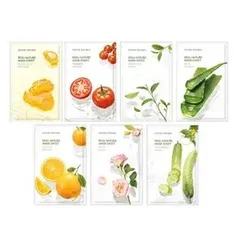
Works for:
based on ingredients and %- Moisturizing
- Anti-aging
- Anti-oxidation
Can it cause trouble?
- Irritation risk: high
- Comedogenic risk ingredients: 1
Key actives


Product Summary
"NATURE REPUBLIC - Real Nature Mask Sheet - 9 Types" is effective for: Anti-aging
This product could be helpful for: Moisturizing, but its actives are not the most effective or are not well-studied.
Ingredient callouts
- Adenosine 0.15% - 0.30%. It is a compound that in involved in many biological processes inside the skin cells. According one high-quality clinical trial, topical Adenosine in low concentrations can somewhat help improve "deep wrinkles" - the wrinkles that appear with age in places where our faces are most dynamic (for example, on the forehead or in the corners of the eyes).
- Humectants (glycerin 0.20% - 0.40%, glyceryl acrylate/acrylic acid copolymer 0.20% - 0.35%, sodium hyaluronate 0.20% - 0.35%, arginine 0.15% - 0.30%, trehalose 0.20% - 0.35%, glycerin 0.20% - 0.35%, glyceryl acrylate/acrylic acid copolymer 0.15% - 0.30%, sodium hyaluronate 0.15% - 0.25%, arginine 0.15% - 0.25%, trehalose 0.15% - 0.25%, glycerin 0.20% - 0.35%, glyceryl acrylate/acrylic acid copolymer 0.15% - 0.30%, sodium hyaluronate 0.15% - 0.25%, arginine 0.15% - 0.25%, trehalose 0.15% - 0.25%, glycerin 0.20% - 0.35%, glycerin 0.20% - 0.35%, glyceryl acrylate/acrylic acid copolymer 0.15% - 0.30%, sodium hyaluronate 0.15% - 0.25%, arginine 0.15% - 0.25%, trehalose 0.15% - 0.25%, glycerin 0.20% - 0.35%, glyceryl acrylate/acrylic acid copolymer 0.15% - 0.30%, sodium hyaluronate 0.15% - 0.25%, arginine 0.15% - 0.25%, trehalose 0.15% - 0.25%, glycerin 0.20% - 0.35%, glyceryl acrylate/acrylic acid copolymer 0.15% - 0.30%, sodium hyaluronate 0.15% - 0.25%, arginine 0.15% - 0.25%, trehalose 0.15% - 0.25%, glycerin 0.20% - 0.35%, glyceryl acrylate/acrylic acid copolymer 0.20% - 0.40%, sodium hyaluronate 0.25% - 0.45%, arginine 0.30% - 0.55%, trehalose 0.70% - 1.05% and glycerin 5.20% - 6.40%). These ingredients help attract water to the upper layer of the skin and improve the skin hydration.
Price
The product retails for 2.63$ in the United States.
For a detailed price comparison: click here.
Works for
Anti-aging
What does the product description say?
Acai Berry Helps reduce wrinkles and improve skin elasticity. How to use 1.
Source: Yesstyle
This product can help reduce and prevent fine lines and wrinkles, improve skin elasticity and firmness because it contains adenosine.
These ingredients in the product can also be helpful, even though there is less evidence for their effectiveness: centella asiatica extract.
Keep in mind that it typically takes at least 6 weeks to notice any results because the changes that are needed to improve fine lines and elasticity happen in the deeper layers of the skin. No topical anti-aging product can “erase” wrinkles or fully reverse signs of aging.
Might help improve cell turnover and reduce inflammation in skin. One study shows that the ingredients might be able to help reduce dynamic wrinkles (for example, in the corners of the eyes or on the forehead)
A plant extract that has been shown to be able to reduce inflammation in skin, support restoration of skin barrier function, as well as support collagen production. Contains active compounds called centelloids: asiaticoside, madecasosside, asiatic acid and madecassic acid. Might be helpful in preventing stretch marks. It can be itself be irritating though.
Is proven to be effective in reducing blemishes, evening out skin tone and helping to improve lines and wrinkles. It helps the skin to repair sun damage, calm down inflammation and keep maintain good levels of moisture. The concentration of about 2% is effective for supporting the skin barrier and evening out the skin tone. Concentration of 4-6% is better for helping with acne and balancing the sebum production
Can contain potent anti-oxidant compounds (abbreviated ECG, GCG, EGC, and EGCG) that might help protect the skin from free radicals. Can help calm down inflammation and has some anti-bacterial properties. Unfortunately, these antioxidants are unstable and lose their effectiveness very quickly in products. The concentration of the antioxidant compounds in the extract also tends to be low to be effective in topical formulation
Might be helpful in supporting collagen and ellastin production but solid research is lacking. Could be irritating
A great moisturising ingredient that softens the skin and reduces water loss from its upper layer. It also can be helpful in protecting skin from free radicals
Anti-oxidation
This product contains antioxidants (centella asiatica extract, ginkgo biloba leaf extract) that might be able to help neutralize free radicals in skin to lessen the damage it gets from the UV light (sun). There is not enough evidence to confirm their effectiveness in skin though.
A plant extract that has been shown to be able to reduce inflammation in skin, support restoration of skin barrier function, as well as support collagen production. Contains active compounds called centelloids: asiaticoside, madecasosside, asiatic acid and madecassic acid. Might be helpful in preventing stretch marks. It can be itself be irritating though.
A plant extract that might help neutralize free radicals and reduce inflammation in skin. It can be irritating
A plant extract. Can have an anti-oxidant effect, but can also contain irritants
A plant extract that might help neutralize free radicals and reduce hyperpigmentation, but the research on its effectiveness in skin is lacking
A plant extract that might contain a compound baicalin that could be helpful in neutralizing free radicals and reducing inflammation in skin. The baicalin concentration in skincare products is often too low for an effective action. Can be used for its fragrant properties
A plant extract that might help neutralize free radicals in skin. Can contain volalite oils and be irritating
Plant extract that can help neutralize free radicals in skin. Can be used as a fragrance. Can be irritating
Might help improve cell turnover and reduce inflammation in skin. One study shows that the ingredients might be able to help reduce dynamic wrinkles (for example, in the corners of the eyes or on the forehead)
Helps attract water to the upper layer of the skin
A plant extract that can have some anti-oxidant effect in skin
A plant extract that helps attract water to the upper layer of the skin. It might be helpful in neutralizing free radicals in skin, but is less potent than the extract from the seeds
Can contain potent anti-oxidant compounds (abbreviated ECG, GCG, EGC, and EGCG) that might help protect the skin from free radicals. Can help calm down inflammation and has some anti-bacterial properties. Unfortunately, these antioxidants are unstable and lose their effectiveness very quickly in products. The concentration of the antioxidant compounds in the extract also tends to be low to be effective in topical formulation
A great moisturising ingredient that softens the skin and reduces water loss from its upper layer. It also can be helpful in protecting skin from free radicals
Might be somewhat helpful in reducing hyperpigmentation and neutralizing free radicals but its typical concentration in a product is too low for having an effect
Moisturizing
What does the product description say?
These sheet masks come in different options to nourish your skin with natural ingredients.
Source: Yesstyle
This product can help improve hydration of the skin with the two types of ingredients.
The first type is called “humectants”:
these ingredients help attract water.
When humectants are on the surface of the skin, they “pull in” the moisture from the outside environment, or from
within deeper layers of the skin. The following ingredients in this product do the job:
arginine, glycerin.
This product also contains ingredients called “occlusives”. They help reduce the speed with which our skin loses moisture to the outside environment. These ingredients also help soften the upper layer of the skin, so it feels less tight and nicer to the touch. The following ingredients in this product do the job: arginine, dimethiconol.
One of the best moisturizing ingredients. Attracts water into the upper layer of the skin
An amino acid that is naturally present in skin and helps keep it hydrated. When used together with AHAs, it can reduce their irritating effect on the skin
A plant extract that has been shown to be able to reduce inflammation in skin, support restoration of skin barrier function, as well as support collagen production. Contains active compounds called centelloids: asiaticoside, madecasosside, asiatic acid and madecassic acid. Might be helpful in preventing stretch marks. It can be itself be irritating though.
A silicone that makes products more spreadable and keeps skin smooth. Helps to add gloss to skin and may visually fill in fine lines/wrinkles for short time
One of the best moisturizing ingredients. Naturally present in skin. It attracts water to the upper layer of the skin working as a humectant
Helps attract water to the upper layer of the skin and provide a longer-lasting hydration. Can create a thicker product consistency
Helps attract water to the upper layer of the skin
A sugar that attracts water to the upper layer of the skin
Might help improve cell turnover and reduce inflammation in skin. One study shows that the ingredients might be able to help reduce dynamic wrinkles (for example, in the corners of the eyes or on the forehead)
A plant extract that helps attract water to the upper layer of the skin. It might be helpful in neutralizing free radicals in skin, but is less potent than the extract from the seeds
A compound secreted by bees. Might be able to attract water to the top layer of the skin. Avoid if sensitive to honey and bee products
An emollient that softens the skin and forms a protective layer on its surface. Helps water and oil mix together
An emollient that helps soften the skin and creates a thicker product texture
A plant extract that might contain a compound baicalin that could be helpful in neutralizing free radicals and reducing inflammation in skin. The baicalin concentration in skincare products is often too low for an effective action. Can be used for its fragrant properties
An emollient that can also help water and oil mix together, as well as prevent bacteria growth in products
Used to create a nice product texture and help delivery of other ingredients. Might be somewhat helpful in attracting water to the upper layer of the skin
A great moisturising ingredient that softens the skin and reduces water loss from its upper layer. It also can be helpful in protecting skin from free radicals
Is proven to be effective in reducing blemishes, evening out skin tone and helping to improve lines and wrinkles. It helps the skin to repair sun damage, calm down inflammation and keep maintain good levels of moisture. The concentration of about 2% is effective for supporting the skin barrier and evening out the skin tone. Concentration of 4-6% is better for helping with acne and balancing the sebum production
Might be somewhat helpful in reducing hyperpigmentation and neutralizing free radicals but its typical concentration in a product is too low for having an effect
Traditionally used to treat sunburns, dermatitis and inflammation, but evidence for its effectiveness is lacking. The extract can contain humectants that help attract water into the skin
A plant extract that can help strengthen the skin barrier function and improve skin moisture levels
Can contain potent anti-oxidant compounds (abbreviated ECG, GCG, EGC, and EGCG) that might help protect the skin from free radicals. Can help calm down inflammation and has some anti-bacterial properties. Unfortunately, these antioxidants are unstable and lose their effectiveness very quickly in products. The concentration of the antioxidant compounds in the extract also tends to be low to be effective in topical formulation
How honest is this product?
| Promise | Can it deliver? |
|---|---|
| Moisturizing |
Total Promises Fulfilled score: 75/100.
We receive a small commission for purchases made through these links at no cost for you. Thank you for your support! Learn more
Potential irritants
Comedogenic ingredients
User reviews (0)
Averages from community submissions.
No reviews yet for this product.
Be the first to share your experience!
Tried this product?
Help capture what the ingredient list can't—texture, finish, pilling, scent, and more. Answer what you can, skip the rest.
Takes ~30 seconds.
Reviews are shown in aggregate. No personal details.
| Product | Similarity | Price | Irritancy |
|---|---|---|---|
 NATURE REPUBLIC Real Nature Mask Sheet - 9 Types | Current | $3.33 | |
 The Crème Shop x KAKAO FRIENDS APEACH CALL ME SMOOTH Printed Essence Sheet Mask | 60% | $4.00 | |
 Etude House Moistfull Collagen Intense Sheet Mask | 60% | $4.90 | |
 VT Cosmetics Tx-toning Daily Mask | 59% | ≈ $20.84 | |
 Muldream Vegan Green Mild All In One Mask | 58% | $3.82 | |
 NIP+FAB Retinol Fix Sheet Mask | 58% | ≈ $7.38 |
Key Actives
A plant extract that has been shown to be able to reduce inflammation in skin, support restoration of skin barrier function, as well as support collagen production. Contains active compounds called centelloids: asiaticoside, madecasosside, asiatic acid and madecassic acid. Might be helpful in preventing stretch marks. It can be itself be irritating though.
A plant extract that has been shown to be able to reduce inflammation in skin, support restoration of skin barrier function, as well as support collagen production. Contains active compounds called centelloids: asiaticoside, madecasosside, asiatic acid and madecassic acid. Might be helpful in preventing stretch marks. It can be itself be irritating though.
A plant extract that has been shown to be able to reduce inflammation in skin, support restoration of skin barrier function, as well as support collagen production. Contains active compounds called centelloids: asiaticoside, madecasosside, asiatic acid and madecassic acid. Might be helpful in preventing stretch marks. It can be itself be irritating though.
A plant extract that has been shown to be able to reduce inflammation in skin, support restoration of skin barrier function, as well as support collagen production. Contains active compounds called centelloids: asiaticoside, madecasosside, asiatic acid and madecassic acid. Might be helpful in preventing stretch marks. It can be itself be irritating though.
A plant extract that has been shown to be able to reduce inflammation in skin, support restoration of skin barrier function, as well as support collagen production. Contains active compounds called centelloids: asiaticoside, madecasosside, asiatic acid and madecassic acid. Might be helpful in preventing stretch marks. It can be itself be irritating though.
A plant extract that has been shown to be able to reduce inflammation in skin, support restoration of skin barrier function, as well as support collagen production. Contains active compounds called centelloids: asiaticoside, madecasosside, asiatic acid and madecassic acid. Might be helpful in preventing stretch marks. It can be itself be irritating though.
A plant extract that has been shown to be able to reduce inflammation in skin, support restoration of skin barrier function, as well as support collagen production. Contains active compounds called centelloids: asiaticoside, madecasosside, asiatic acid and madecassic acid. Might be helpful in preventing stretch marks. It can be itself be irritating though.
A plant extract that has been shown to be able to reduce inflammation in skin, support restoration of skin barrier function, as well as support collagen production. Contains active compounds called centelloids: asiaticoside, madecasosside, asiatic acid and madecassic acid. Might be helpful in preventing stretch marks. It can be itself be irritating though.
A plant extract that has been shown to be able to reduce inflammation in skin, support restoration of skin barrier function, as well as support collagen production. Contains active compounds called centelloids: asiaticoside, madecasosside, asiatic acid and madecassic acid. Might be helpful in preventing stretch marks. It can be itself be irritating though.
Can contain potent anti-oxidant compounds (abbreviated ECG, GCG, EGC, and EGCG) that might help protect the skin from free radicals. Can help calm down inflammation and has some anti-bacterial properties. Unfortunately, these antioxidants are unstable and lose their effectiveness very quickly in products. The concentration of the antioxidant compounds in the extract also tends to be low to be effective in topical formulation
Can contain potent anti-oxidant compounds (abbreviated ECG, GCG, EGC, and EGCG) that might help protect the skin from free radicals. Can help calm down inflammation and has some anti-bacterial properties. Unfortunately, these antioxidants are unstable and lose their effectiveness very quickly in products. The concentration of the antioxidant compounds in the extract also tends to be low to be effective in topical formulation
A plant extract that might help neutralize free radicals and reduce inflammation in skin. It can be irritating
A plant extract that might help neutralize free radicals and reduce inflammation in skin. It can be irritating
Might help improve cell turnover and reduce inflammation in skin. One study shows that the ingredients might be able to help reduce dynamic wrinkles (for example, in the corners of the eyes or on the forehead)
Might help improve cell turnover and reduce inflammation in skin. One study shows that the ingredients might be able to help reduce dynamic wrinkles (for example, in the corners of the eyes or on the forehead)
A great moisturising ingredient that softens the skin and reduces water loss from its upper layer. It also can be helpful in protecting skin from free radicals
Helps attract water to the upper layer of the skin
Helps attract water to the upper layer of the skin
Helps attract water to the upper layer of the skin
One of the best moisturizing ingredients. Naturally present in skin. It attracts water to the upper layer of the skin working as a humectant
A sugar that attracts water to the upper layer of the skin
An amino acid that is naturally present in skin and helps keep it hydrated. When used together with AHAs, it can reduce their irritating effect on the skin
One of the best moisturizing ingredients. Attracts water into the upper layer of the skin
Helps attract water to the upper layer of the skin and provide a longer-lasting hydration. Can create a thicker product consistency
One of the best moisturizing ingredients. Naturally present in skin. It attracts water to the upper layer of the skin working as a humectant
A sugar that attracts water to the upper layer of the skin
An amino acid that is naturally present in skin and helps keep it hydrated. When used together with AHAs, it can reduce their irritating effect on the skin
One of the best moisturizing ingredients. Attracts water into the upper layer of the skin
Helps attract water to the upper layer of the skin and provide a longer-lasting hydration. Can create a thicker product consistency
One of the best moisturizing ingredients. Naturally present in skin. It attracts water to the upper layer of the skin working as a humectant
A sugar that attracts water to the upper layer of the skin
An amino acid that is naturally present in skin and helps keep it hydrated. When used together with AHAs, it can reduce their irritating effect on the skin
One of the best moisturizing ingredients. Attracts water into the upper layer of the skin
Helps attract water to the upper layer of the skin and provide a longer-lasting hydration. Can create a thicker product consistency
One of the best moisturizing ingredients. Naturally present in skin. It attracts water to the upper layer of the skin working as a humectant
A sugar that attracts water to the upper layer of the skin
An amino acid that is naturally present in skin and helps keep it hydrated. When used together with AHAs, it can reduce their irritating effect on the skin
One of the best moisturizing ingredients. Attracts water into the upper layer of the skin
Helps attract water to the upper layer of the skin and provide a longer-lasting hydration. Can create a thicker product consistency
One of the best moisturizing ingredients. Naturally present in skin. It attracts water to the upper layer of the skin working as a humectant
A silicone that makes products more spreadable and keeps skin smooth. Helps to add gloss to skin and may visually fill in fine lines/wrinkles for short time
One of the best moisturizing ingredients. Naturally present in skin. It attracts water to the upper layer of the skin working as a humectant
A sugar that attracts water to the upper layer of the skin
An amino acid that is naturally present in skin and helps keep it hydrated. When used together with AHAs, it can reduce their irritating effect on the skin
One of the best moisturizing ingredients. Attracts water into the upper layer of the skin
Helps attract water to the upper layer of the skin and provide a longer-lasting hydration. Can create a thicker product consistency
One of the best moisturizing ingredients. Naturally present in skin. It attracts water to the upper layer of the skin working as a humectant
A sugar that attracts water to the upper layer of the skin
An amino acid that is naturally present in skin and helps keep it hydrated. When used together with AHAs, it can reduce their irritating effect on the skin
One of the best moisturizing ingredients. Attracts water into the upper layer of the skin
Helps attract water to the upper layer of the skin and provide a longer-lasting hydration. Can create a thicker product consistency
One of the best moisturizing ingredients. Naturally present in skin. It attracts water to the upper layer of the skin working as a humectant
A sugar that attracts water to the upper layer of the skin
An amino acid that is naturally present in skin and helps keep it hydrated. When used together with AHAs, it can reduce their irritating effect on the skin
One of the best moisturizing ingredients. Attracts water into the upper layer of the skin
Helps attract water to the upper layer of the skin and provide a longer-lasting hydration. Can create a thicker product consistency
One of the best moisturizing ingredients. Naturally present in skin. It attracts water to the upper layer of the skin working as a humectant
A silicone that makes products more spreadable and keeps skin smooth. Helps to add gloss to skin and may visually fill in fine lines/wrinkles for short time
Potential irritants
Can be drying and contribute to skin irritation. Used in formulars to dissolve other ingredients, create a thinner product consistency or for its antibacterial properties
Plant extract that can have healing and anti-inflammatory properties. It is a potential allergen and can be irritating
Used as a fragrance. Can be irritating and cause photosensitivity
A plant extract that is used as a fragrance. Can be irritating and lead to photosensitivity
An aromatic blend of unspecified and possibly irritating ingredients
Plant extract that can help neutralize free radicals in skin. Can be used as a fragrance. Can be irritating
A plant extract that can be irritating. It can have some anti-bacterial properties, but there are no evidence of a beneficial effect for skin
A common frangrance that can easily irritate skin, especially if exposed to air, light or heat
Essential oil that can be irritating
A plant extract that is added for its fragrance. Can be irritating
A plant extract. Can have an anti-oxidant effect, but can also contain irritants
An essential oil that can be irritating. Has some anti-bacterial properties
Fragrance with sweet balsamic smell. Help to preserve products and dissolve other ingredients. Could trigger allergic reactions and be irritating
A plant extract that might help neutralize free radicals in skin. Can contain volalite oils and be irritating
Might be helpful in supporting collagen and ellastin production but solid research is lacking. Could be irritating
A plant extract that might help neutralize free radicals and reduce inflammation in skin. It can be irritating
A plant extract that might contain a compound baicalin that could be helpful in neutralizing free radicals and reducing inflammation in skin. The baicalin concentration in skincare products is often too low for an effective action. Can be used for its fragrant properties
A fragrance. Potential allergen and can be irritating
A fragrance. Can trigger allergic reactions and be irritating
A preservative. Can be used to mask unpleasant smell. Can be irritating
A plant extract that has been shown to be able to reduce inflammation in skin, support restoration of skin barrier function, as well as support collagen production. Contains active compounds called centelloids: asiaticoside, madecasosside, asiatic acid and madecassic acid. Might be helpful in preventing stretch marks. It can be itself be irritating though.
Helps attract water to the upper layer of the skin and provide a longer-lasting hydration. Can create a thicker product consistency
A compound secreted by bees. Might be able to attract water to the top layer of the skin. Avoid if sensitive to honey and bee products
Helps attract water to the upper layer of the skin
A plant extract that helps attract water to the upper layer of the skin. It might be helpful in neutralizing free radicals in skin, but is less potent than the extract from the seeds
Traditionally used to treat sunburns, dermatitis and inflammation, but evidence for its effectiveness is lacking. The extract can contain humectants that help attract water into the skin
An emollient that helps soften the skin and creates a thicker product texture
A plant extract that can have some anti-oxidant effect in skin
A plant extract that can help strengthen the skin barrier function and improve skin moisture levels
Might be somewhat helpful in reducing hyperpigmentation and neutralizing free radicals but its typical concentration in a product is too low for having an effect
A plant extract that might help neutralize free radicals and reduce hyperpigmentation, but the research on its effectiveness in skin is lacking
Comedogenic ingredients
A great moisturising ingredient that softens the skin and reduces water loss from its upper layer. It also can be helpful in protecting skin from free radicals
All ingredients
One of the best moisturizing ingredients. Naturally present in skin. It attracts water to the upper layer of the skin working as a humectant
Helps to dissolve other ingredients in a formulation. Slows down the rate of product drying
Can be drying and contribute to skin irritation. Used in formulars to dissolve other ingredients, create a thinner product consistency or for its antibacterial properties
Used to thicken product formulations and create gel-like textures
Used to create a nice product texture and help delivery of other ingredients. Might be somewhat helpful in attracting water to the upper layer of the skin
A plant extract that has been shown to be able to reduce inflammation in skin, support restoration of skin barrier function, as well as support collagen production. Contains active compounds called centelloids: asiaticoside, madecasosside, asiatic acid and madecassic acid. Might be helpful in preventing stretch marks. It can be itself be irritating though.
Plant extract that can have healing and anti-inflammatory properties. It is a potential allergen and can be irritating
An emollient that can also help water and oil mix together, as well as prevent bacteria growth in products
An amino acid that is naturally present in skin and helps keep it hydrated. When used together with AHAs, it can reduce their irritating effect on the skin
Helps create a thicker or gel-like product texture. It is not a surfactant but can be used in gentle cleansing formulations
Might help improve cell turnover and reduce inflammation in skin. One study shows that the ingredients might be able to help reduce dynamic wrinkles (for example, in the corners of the eyes or on the forehead)
One of the best moisturizing ingredients. Attracts water into the upper layer of the skin
Helps attract water to the upper layer of the skin and provide a longer-lasting hydration. Can create a thicker product consistency
A compound secreted by bees. Might be able to attract water to the top layer of the skin. Avoid if sensitive to honey and bee products
Used as a fragrance. Can be irritating and cause photosensitivity
Helps attract water to the upper layer of the skin
A plant extract that is used as a fragrance. Can be irritating and lead to photosensitivity
A plant extract that helps attract water to the upper layer of the skin. It might be helpful in neutralizing free radicals in skin, but is less potent than the extract from the seeds
An aromatic blend of unspecified and possibly irritating ingredients
One of the best moisturizing ingredients. Naturally present in skin. It attracts water to the upper layer of the skin working as a humectant
Helps to dissolve other ingredients in a formulation. Slows down the rate of product drying
Can be drying and contribute to skin irritation. Used in formulars to dissolve other ingredients, create a thinner product consistency or for its antibacterial properties
Used to thicken product formulations and create gel-like textures
Used to create a nice product texture and help delivery of other ingredients. Might be somewhat helpful in attracting water to the upper layer of the skin
A plant extract that has been shown to be able to reduce inflammation in skin, support restoration of skin barrier function, as well as support collagen production. Contains active compounds called centelloids: asiaticoside, madecasosside, asiatic acid and madecassic acid. Might be helpful in preventing stretch marks. It can be itself be irritating though.
A plant extract that is used as a fragrance. Can be irritating and lead to photosensitivity
Plant extract that can have healing and anti-inflammatory properties. It is a potential allergen and can be irritating
An emollient that can also help water and oil mix together, as well as prevent bacteria growth in products
An amino acid that is naturally present in skin and helps keep it hydrated. When used together with AHAs, it can reduce their irritating effect on the skin
Helps create a thicker or gel-like product texture. It is not a surfactant but can be used in gentle cleansing formulations
One of the best moisturizing ingredients. Attracts water into the upper layer of the skin
Helps attract water to the upper layer of the skin and provide a longer-lasting hydration. Can create a thicker product consistency
Used as a fragrance. Can be irritating and cause photosensitivity
Helps attract water to the upper layer of the skin
A plant extract that helps attract water to the upper layer of the skin. It might be helpful in neutralizing free radicals in skin, but is less potent than the extract from the seeds
An aromatic blend of unspecified and possibly irritating ingredients
One of the best moisturizing ingredients. Naturally present in skin. It attracts water to the upper layer of the skin working as a humectant
Helps to dissolve other ingredients in a formulation. Slows down the rate of product drying
Can be drying and contribute to skin irritation. Used in formulars to dissolve other ingredients, create a thinner product consistency or for its antibacterial properties
Used to thicken product formulations and create gel-like textures
Used to create a nice product texture and help delivery of other ingredients. Might be somewhat helpful in attracting water to the upper layer of the skin
A plant extract that has been shown to be able to reduce inflammation in skin, support restoration of skin barrier function, as well as support collagen production. Contains active compounds called centelloids: asiaticoside, madecasosside, asiatic acid and madecassic acid. Might be helpful in preventing stretch marks. It can be itself be irritating though.
Plant extract that can have healing and anti-inflammatory properties. It is a potential allergen and can be irritating
An emollient that can also help water and oil mix together, as well as prevent bacteria growth in products
An amino acid that is naturally present in skin and helps keep it hydrated. When used together with AHAs, it can reduce their irritating effect on the skin
Helps create a thicker or gel-like product texture. It is not a surfactant but can be used in gentle cleansing formulations
One of the best moisturizing ingredients. Attracts water into the upper layer of the skin
Helps attract water to the upper layer of the skin and provide a longer-lasting hydration. Can create a thicker product consistency
An aromatic blend of unspecified and possibly irritating ingredients
One of the best moisturizing ingredients. Naturally present in skin. It attracts water to the upper layer of the skin working as a humectant
Helps to dissolve other ingredients in a formulation. Slows down the rate of product drying
Can be drying and contribute to skin irritation. Used in formulars to dissolve other ingredients, create a thinner product consistency or for its antibacterial properties
Used to thicken product formulations and create gel-like textures
Used to create a nice product texture and help delivery of other ingredients. Might be somewhat helpful in attracting water to the upper layer of the skin
A plant extract that has been shown to be able to reduce inflammation in skin, support restoration of skin barrier function, as well as support collagen production. Contains active compounds called centelloids: asiaticoside, madecasosside, asiatic acid and madecassic acid. Might be helpful in preventing stretch marks. It can be itself be irritating though.
Plant extract that can have healing and anti-inflammatory properties. It is a potential allergen and can be irritating
Traditionally used to treat sunburns, dermatitis and inflammation, but evidence for its effectiveness is lacking. The extract can contain humectants that help attract water into the skin
An emollient that can also help water and oil mix together, as well as prevent bacteria growth in products
An amino acid that is naturally present in skin and helps keep it hydrated. When used together with AHAs, it can reduce their irritating effect on the skin
Helps create a thicker or gel-like product texture. It is not a surfactant but can be used in gentle cleansing formulations
One of the best moisturizing ingredients. Attracts water into the upper layer of the skin
Helps attract water to the upper layer of the skin and provide a longer-lasting hydration. Can create a thicker product consistency
An aromatic blend of unspecified and possibly irritating ingredients
Helps to dissolve other ingredients in a formulation. Slows down the rate of product drying
An emollient that helps soften the skin and creates a thicker product texture
One of the best moisturizing ingredients. Naturally present in skin. It attracts water to the upper layer of the skin working as a humectant
A silicone that makes products more spreadable and keeps skin smooth. Helps to add gloss to skin and may visually fill in fine lines/wrinkles for short time
An emollient that softens the skin and forms a protective layer on its surface. Helps water and oil mix together
Helps oil and water mix togehter and creates a nice product texture
Used to create a nice product texture and help delivery of other ingredients. Might be somewhat helpful in attracting water to the upper layer of the skin
A plant extract that has been shown to be able to reduce inflammation in skin, support restoration of skin barrier function, as well as support collagen production. Contains active compounds called centelloids: asiaticoside, madecasosside, asiatic acid and madecassic acid. Might be helpful in preventing stretch marks. It can be itself be irritating though.
Helps create a thicker or gel-like product texture. It is not a surfactant but can be used in gentle cleansing formulations
Used to thicken product formulations and create gel-like textures
A plant extract that can have some anti-oxidant effect in skin
Plant extract that can have healing and anti-inflammatory properties. It is a potential allergen and can be irritating
An emollient that can also help water and oil mix together, as well as prevent bacteria growth in products
Might help improve cell turnover and reduce inflammation in skin. One study shows that the ingredients might be able to help reduce dynamic wrinkles (for example, in the corners of the eyes or on the forehead)
A plant extract that can help strengthen the skin barrier function and improve skin moisture levels
Plant extract that can help neutralize free radicals in skin. Can be used as a fragrance. Can be irritating
A plant extract that can be irritating. It can have some anti-bacterial properties, but there are no evidence of a beneficial effect for skin
An aromatic blend of unspecified and possibly irritating ingredients
A common frangrance that can easily irritate skin, especially if exposed to air, light or heat
One of the best moisturizing ingredients. Naturally present in skin. It attracts water to the upper layer of the skin working as a humectant
Helps to dissolve other ingredients in a formulation. Slows down the rate of product drying
Can be drying and contribute to skin irritation. Used in formulars to dissolve other ingredients, create a thinner product consistency or for its antibacterial properties
Used to thicken product formulations and create gel-like textures
Used to create a nice product texture and help delivery of other ingredients. Might be somewhat helpful in attracting water to the upper layer of the skin
A plant extract that has been shown to be able to reduce inflammation in skin, support restoration of skin barrier function, as well as support collagen production. Contains active compounds called centelloids: asiaticoside, madecasosside, asiatic acid and madecassic acid. Might be helpful in preventing stretch marks. It can be itself be irritating though.
Plant extract that can have healing and anti-inflammatory properties. It is a potential allergen and can be irritating
Might be somewhat helpful in reducing hyperpigmentation and neutralizing free radicals but its typical concentration in a product is too low for having an effect
An emollient that can also help water and oil mix together, as well as prevent bacteria growth in products
An amino acid that is naturally present in skin and helps keep it hydrated. When used together with AHAs, it can reduce their irritating effect on the skin
Helps create a thicker or gel-like product texture. It is not a surfactant but can be used in gentle cleansing formulations
One of the best moisturizing ingredients. Attracts water into the upper layer of the skin
Helps attract water to the upper layer of the skin and provide a longer-lasting hydration. Can create a thicker product consistency
Essential oil that can be irritating
A plant extract that is added for its fragrance. Can be irritating
A plant extract. Can have an anti-oxidant effect, but can also contain irritants
An essential oil that can be irritating. Has some anti-bacterial properties
An aromatic blend of unspecified and possibly irritating ingredients
Fragrance with sweet balsamic smell. Help to preserve products and dissolve other ingredients. Could trigger allergic reactions and be irritating
One of the best moisturizing ingredients. Naturally present in skin. It attracts water to the upper layer of the skin working as a humectant
Helps to dissolve other ingredients in a formulation. Slows down the rate of product drying
Can be drying and contribute to skin irritation. Used in formulars to dissolve other ingredients, create a thinner product consistency or for its antibacterial properties
Used to thicken product formulations and create gel-like textures
Used to create a nice product texture and help delivery of other ingredients. Might be somewhat helpful in attracting water to the upper layer of the skin
A plant extract that has been shown to be able to reduce inflammation in skin, support restoration of skin barrier function, as well as support collagen production. Contains active compounds called centelloids: asiaticoside, madecasosside, asiatic acid and madecassic acid. Might be helpful in preventing stretch marks. It can be itself be irritating though.
Plant extract that can have healing and anti-inflammatory properties. It is a potential allergen and can be irritating
An emollient that can also help water and oil mix together, as well as prevent bacteria growth in products
An amino acid that is naturally present in skin and helps keep it hydrated. When used together with AHAs, it can reduce their irritating effect on the skin
Helps create a thicker or gel-like product texture. It is not a surfactant but can be used in gentle cleansing formulations
One of the best moisturizing ingredients. Attracts water into the upper layer of the skin
Helps attract water to the upper layer of the skin and provide a longer-lasting hydration. Can create a thicker product consistency
Can contain potent anti-oxidant compounds (abbreviated ECG, GCG, EGC, and EGCG) that might help protect the skin from free radicals. Can help calm down inflammation and has some anti-bacterial properties. Unfortunately, these antioxidants are unstable and lose their effectiveness very quickly in products. The concentration of the antioxidant compounds in the extract also tends to be low to be effective in topical formulation
A plant extract that might help neutralize free radicals in skin. Can contain volalite oils and be irritating
Might be helpful in supporting collagen and ellastin production but solid research is lacking. Could be irritating
A plant extract that might help neutralize free radicals and reduce hyperpigmentation, but the research on its effectiveness in skin is lacking
A plant extract that might help neutralize free radicals and reduce inflammation in skin. It can be irritating
A plant extract that might contain a compound baicalin that could be helpful in neutralizing free radicals and reducing inflammation in skin. The baicalin concentration in skincare products is often too low for an effective action. Can be used for its fragrant properties
An aromatic blend of unspecified and possibly irritating ingredients
One of the best moisturizing ingredients. Naturally present in skin. It attracts water to the upper layer of the skin working as a humectant
Helps to dissolve other ingredients in a formulation. Slows down the rate of product drying
Is proven to be effective in reducing blemishes, evening out skin tone and helping to improve lines and wrinkles. It helps the skin to repair sun damage, calm down inflammation and keep maintain good levels of moisture. The concentration of about 2% is effective for supporting the skin barrier and evening out the skin tone. Concentration of 4-6% is better for helping with acne and balancing the sebum production
Can be drying and contribute to skin irritation. Used in formulars to dissolve other ingredients, create a thinner product consistency or for its antibacterial properties
Used to thicken product formulations and create gel-like textures
Used to create a nice product texture and help delivery of other ingredients. Might be somewhat helpful in attracting water to the upper layer of the skin
A plant extract that has been shown to be able to reduce inflammation in skin, support restoration of skin barrier function, as well as support collagen production. Contains active compounds called centelloids: asiaticoside, madecasosside, asiatic acid and madecassic acid. Might be helpful in preventing stretch marks. It can be itself be irritating though.
Plant extract that can have healing and anti-inflammatory properties. It is a potential allergen and can be irritating
An emollient that can also help water and oil mix together, as well as prevent bacteria growth in products
An amino acid that is naturally present in skin and helps keep it hydrated. When used together with AHAs, it can reduce their irritating effect on the skin
Helps create a thicker or gel-like product texture. It is not a surfactant but can be used in gentle cleansing formulations
One of the best moisturizing ingredients. Attracts water into the upper layer of the skin
Helps attract water to the upper layer of the skin and provide a longer-lasting hydration. Can create a thicker product consistency
Used as a fragrance. Can be irritating and cause photosensitivity
Helps attract water to the upper layer of the skin
A plant extract that is used as a fragrance. Can be irritating and lead to photosensitivity
A plant extract that helps attract water to the upper layer of the skin. It might be helpful in neutralizing free radicals in skin, but is less potent than the extract from the seeds
An aromatic blend of unspecified and possibly irritating ingredients
Helps to dissolve other ingredients in a formulation. Slows down the rate of product drying
An emollient that helps soften the skin and creates a thicker product texture
One of the best moisturizing ingredients. Naturally present in skin. It attracts water to the upper layer of the skin working as a humectant
A silicone that makes products more spreadable and keeps skin smooth. Helps to add gloss to skin and may visually fill in fine lines/wrinkles for short time
An emollient that softens the skin and forms a protective layer on its surface. Helps water and oil mix together
Helps oil and water mix togehter and creates a nice product texture
Used to create a nice product texture and help delivery of other ingredients. Might be somewhat helpful in attracting water to the upper layer of the skin
A plant extract that has been shown to be able to reduce inflammation in skin, support restoration of skin barrier function, as well as support collagen production. Contains active compounds called centelloids: asiaticoside, madecasosside, asiatic acid and madecassic acid. Might be helpful in preventing stretch marks. It can be itself be irritating though.
Helps create a thicker or gel-like product texture. It is not a surfactant but can be used in gentle cleansing formulations
Used to thicken product formulations and create gel-like textures
A great moisturising ingredient that softens the skin and reduces water loss from its upper layer. It also can be helpful in protecting skin from free radicals
Plant extract that can have healing and anti-inflammatory properties. It is a potential allergen and can be irritating
An emollient that can also help water and oil mix together, as well as prevent bacteria growth in products
A plant extract that might help neutralize free radicals in skin. Can contain volalite oils and be irritating
Can contain potent anti-oxidant compounds (abbreviated ECG, GCG, EGC, and EGCG) that might help protect the skin from free radicals. Can help calm down inflammation and has some anti-bacterial properties. Unfortunately, these antioxidants are unstable and lose their effectiveness very quickly in products. The concentration of the antioxidant compounds in the extract also tends to be low to be effective in topical formulation
Might be helpful in supporting collagen and ellastin production but solid research is lacking. Could be irritating
A plant extract that might help neutralize free radicals and reduce inflammation in skin. It can be irritating
A plant extract that might contain a compound baicalin that could be helpful in neutralizing free radicals and reducing inflammation in skin. The baicalin concentration in skincare products is often too low for an effective action. Can be used for its fragrant properties
An aromatic blend of unspecified and possibly irritating ingredients
A fragrance. Potential allergen and can be irritating
A fragrance. Can trigger allergic reactions and be irritating
A preservative. Can be used to mask unpleasant smell. Can be irritating
Ingredient list view
Water, Glycerin, Dipropylene glycol, Alcohol, Hydroxyethylcellulose, Butylene glycol, 1,2-hexanediol, Paeonia suffruticosa root extract, Centella asiatica extract, Trehalose, Peg-60 hydrogenated castor oil, Chamomilla recutita flower extract, Glyceryl caprylate, Arginine, Carbomer, Adenosine, Ethylhexylglycerin, Sodium hyaluronate, Glyceryl acrylate/acrylic acid copolymer, Pvm/ma copolymer, Royal jelly extract, Citrus aurantifolia fruit extract, Citrus limon fruit extract, Malus domestica fruit extract, Citrus aurantium dulcis fruit extract, Vitis vinifera fruit extract, Disodium edta, Parfum, Water, Glycerin, Dipropylene glycol, Alcohol, Hydroxyethylcellulose, Butylene glycol, 1,2-hexanediol, Paeonia suffruticosa root extract, Centella asiatica extract, Trehalose, Citrus aurantium dulcis fruit extract, Peg-60 hydrogenated castor oil, Chamomilla recutita flower extract, Glyceryl caprylate, Arginine, Carbomer, Ethylhexylglycerin, Sodium hyaluronate, Glyceryl acrylate/acrylic acid copolymer, Pvm/ma copolymer, Citrus aurantifolia fruit extract, Citrus limon fruit extract, Malus domestica fruit extract, Vitis vinifera fruit extract, Disodium edta, Parfum, Water, Glycerin, Dipropylene glycol, Alcohol, Hydroxyethylcellulose, Butylene glycol, 1,2-hexanediol, Paeonia suffruticosa root extract, Centella asiatica extract, Trehalose, Chamomilla recutita flower extract, Peg-60 hydrogenated castor oil, Glyceryl caprylate, Arginine, Carbomer, Ethylhexylglycerin, Sodium hyaluronate, Glyceryl acrylate/acrylic acid copolymer, Pvm/ma copolymer, Disodium edta, Parfum, Hexyl cinnamal, Water, Glycerin, Dipropylene glycol, Alcohol, Hydroxyethylcellulose, Butylene glycol, 1,2-hexanediol, Paeonia suffruticosa root extract, Centella asiatica extract, Trehalose, Peg-60 hydrogenated castor oil, Chamomilla recutita flower extract, Aloe barbadensis leaf extract, Maris aqua, Glyceryl caprylate, Arginine, Carbomer, Ethylhexylglycerin, Sodium hyaluronate, Glyceryl acrylate/acrylic acid copolymer, Pvm/ma copolymer, Disodium edta, Parfum, Water, Dipropylene glycol, Cetyl ethylhexanoate, Glycerin, Polyglyceryl-3 methylglucose distearate, Dimethiconol, Glyceryl stearate, Peg-100 stearate, Butylene glycol, Paeonia suffruticosa root extract, Centella asiatica extract, 1,2-hexanediol, Carbomer, Hydroxyethylcellulose, Euterpe oleracea fruit extract, Chamomilla recutita flower extract, Glyceryl caprylate, Potassium hydroxide, Adenosine, Ethylhexylglycerin, Gentiana lutea root extract, Achillea millefolium extract, Artemisia absinthium extract, Arnica montana flower extract, Disodium edta, Parfum, Limonene, Water, Glycerin, Dipropylene glycol, Alcohol, Hydroxyethylcellulose, Butylene glycol, 1,2-hexanediol, Paeonia suffruticosa root extract, Centella asiatica extract, Peg-60 hydrogenated castor oil, Trehalose, Chamomilla recutita flower extract, Cucumis sativus fruit extract, Glyceryl caprylate, Arginine, Carbomer, Ethylhexylglycerin, Sodium hyaluronate, Glyceryl acrylate/acrylic acid copolymer, Pvm/ma copolymer, Lavandula angustifolia flower extract, Melissa officinalis leaf extract, Origanum vulgare leaf extract, Pelargonium graveolens extract, Eucalyptus globulus leaf extract, Melaleuca alternifolia leaf extract, Mentha piperita leaf extract, Disodium edta, Parfum, Benzyl benzoate, Water, Glycerin, Dipropylene glycol, Alcohol, Hydroxyethylcellulose, Butylene glycol, 1,2-hexanediol, Paeonia suffruticosa root extract, Centella asiatica extract, Trehalose, Rosa damascena flower extract, Chamomilla recutita flower extract, Peg-60 hydrogenated castor oil, Glyceryl caprylate, Arginine, Carbomer, Ethylhexylglycerin, Sodium hyaluronate, Glyceryl acrylate/acrylic acid copolymer, Pvm/ma copolymer, Camellia sinensis leaf extract, Sophora angustifolia root extract, Lonicera japonica flower extract, Prunus persica leaf extract, Paeonia lactiflora root extract, Ginkgo biloba leaf extract, Scutellaria baicalensis root extract, Disodium edta, Parfum, Citronellol, Water, Glycerin, Dipropylene glycol, Niacinamide, Alcohol, Hydroxyethylcellulose, Butylene glycol, 1,2-hexanediol, Paeonia suffruticosa root extract, Centella asiatica extract, Peg-60 hydrogenated castor oil, Trehalose, Chamomilla recutita flower extract, Solanum lycopersicum fruit extract, Glyceryl caprylate, Arginine, Carbomer, Ethylhexylglycerin, Sodium hyaluronate, Glyceryl acrylate/acrylic acid copolymer, Pvm/ma copolymer, Citrus aurantifolia fruit extract, Citrus limon fruit extract, Malus domestica fruit extract, Citrus aurantium dulcis fruit extract, Vitis vinifera fruit extract, Disodium edta, Parfum, Water, Dipropylene glycol, Cetyl ethylhexanoate, Glycerin, Polyglyceryl-3 methylglucose distearate, Dimethiconol, Glyceryl stearate, Peg-100 stearate, Butylene glycol, Paeonia suffruticosa root extract, Centella asiatica extract, 1,2-hexanediol, Carbomer, Hydroxyethylcellulose, Butyrospermum parkii butter, Chamomilla recutita flower extract, Glyceryl caprylate, Potassium hydroxide, Ethylhexylglycerin, Sophora angustifolia root extract, Lonicera japonica flower extract, Camellia sinensis leaf extract, Prunus persica leaf extract, Ginkgo biloba leaf extract, Scutellaria baicalensis root extract, Disodium edta, Parfum, Alpha-isomethyl ionone, Linalool, Citronellol, Butylphenyl methylpropional, Benzyl alcohol, Coumarin
- Glycerol and the skin: holistic approach to its origin and functions
- The influence of alkane chain length on the skin irritation potential of 1,2-alkanediols
- Anti-Inflammatory Effect of Titrated Extract of Centella asiatica in Phthalic Anhydride-Induced Allergic Dermatitis Animal Model
- Centella asiatica in cosmetology
- Triterpene Composition and Bioactivities of Centella asiatica
- Asiaticoside induction for cell-cycle progression, proliferation and collagen synthesis in human dermal fibroblasts
- Assessment report on Centella asiatica (L.) Urban, herba
- Contact dermatitis due to Madecassol
- The Effects of a Standardized Extract of Centella asiatica on Postlaser Resurfacing Wound Healing on the Face: A Split-Face, Double-Blind, Randomized, Placebo-Controlled Trial
- Evaluation of anti-wrinkle efficacy of adenosine-containing products using the FOITS technique
- Hyaluronic acid: A key molecule in skin aging
- Hyaluronan (Hyaluronic Acid): a natural moisturizer for skin care
- Safety Assessment of Citrus-Derived Peel Oils as Used in Cosmetics
- Safety Assessment of Citrus Fruit-Derived Ingredients as Used in Cosmetics
- Photosensitivity in children: An approach to diagnosis and management
- Safety Assessment of Vitis Vinifera (Grape)-Derived Ingredients as Used in Cosmetics
- Total Oxidant Scavenging Capacity of Euterpe oleracea Mart. (Açaí) Seeds and Identification of Their Polyphenolic Compounds
- Euterpe oleracea, Matricaria chamomilla, and Camellia sinensis as promising ingredients for development of skin care formulations
- The Herbal Bitter Drug Gentiana lutea Modulates Lipid Synthesis in Human Keratinocytes In Vitro and In Vivo
- Contact dermatitis as an adverse reaction to some topically used European herbal medicinal products – part 1: Achillea millefolium–Curcuma longa
- Effects of Topical Arnica Gel on Post-Laser Treatment Bruises
- Effects of microcurrent application alone or in combination with topical Hypericum perforatum L. and Arnica montana L. on surgically induced wound healing in Wistar rats
- The seamy side of natural medicines: contact sensitization to arnica (Arnica montana L.) and marigold (Calendula officinalis L.)
- Accelerated resolution of laser‐induced bruising with topical 20% arnica: a rater‐blinded randomized controlled trial
- Evaluation of Skin Irritation and Acute and Subacute Oral Toxicity of Lavandula angustifolia Essential Oils in Rabbit and Mice
- Assessment report on Lavandula angustifolia Mill., aetheroleum and Lavandula angustifolia Mill., flos
- VOLATILE CONSTITUENTS FROM THE FLOWERS OF TWO SPECIES OF HONEYSUCKLE ( LONICERA JAPONICA AND LONICERA CAPRIFOLIUM )
- Chemical composition of the essential oils from the flower, leaf and stem of Lonicera japonica
- The skin-depigmenting potential of Paeonia lactiflora root extract and paeoniflorin: in vitro evaluation using reconstructed pigmented human epidermis
- Safety Assessment of Ginkgo biloba-Derived Ingredients as Used in Cosmetics
- Cosmeceutical Critique: Ginkgo Biloba
- Scutellaria baicalensis, the golden herb from the garden of Chinese medicinal plants
- Flavonoids in Treating Psoriasis
- Improvement of skin barrier dysfunction by Scutellaria baicalensis GEOGI extracts through lactic acid fermentation
- Safety Assessment of Scutellaria baicalensis-Derived Ingredients as Used in Cosmetics
- Niacinamide - mechanisms of action and its topical use in dermatology
- Gehring, W. (2004). Nicotinic acid/niacinamide and the skin. Journal of Cosmetic Dermatology, 3(2), 88–93. doi:10.1111/j.1473-2130.2004.00115.x