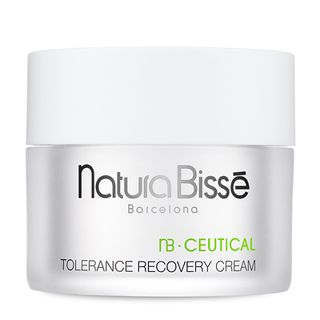
Natura Bissé NB-Ceutical Tolerance Recovery Cream
Works for
2 of 2 advertised claims delivered
MoisturizingAcetyl dipeptide-1 cetyl ester, Tripeptide-1 + 21 moreStrong evidence
“NB-Ceutical Tolerance Recovery Cream”
This product can help improve hydration of the skin with the two types of ingredients.
The first type is called “humectants”:
these ingredients help attract water.
When humectants are on the surface of the skin, they “pull in” the moisture from the outside environment, or from
within deeper layers of the skin. The following ingredients in this product do the job:
betaine, glycerin.
This product also contains ingredients called “occlusives”. They help reduce the speed with which our skin loses moisture to the outside environment. These ingredients also help soften the upper layer of the skin, so it feels less tight and nicer to the touch. The following ingredients in this product do the job: butyrospermum parkii butter, dimethicone.
The following ingredients in this product are especially good for supporting the skin barrier and helping with the hydration level: acetyl dipeptide-1 cetyl ester, tripeptide-1, tripeptide-10 citrulline
Anti-agingAcetyl dipeptide-1 cetyl ester, Tripeptide-1 + 4 moreModerate evidence
“Hypoallergenic formula. . Sensorphine, an exclusive neuropeptide that helps increase the level of beta-endorphins (happiness molecules), thereby increasing your skin’s sensation of comfort and wellbeing. . Tripeptides combined with Fermentus Glaciarum extract, capable of providing a high degree of hydration, promoting production of young collagen (types I and III) and elastin, increasing skin density and effectively preventing premature ageing. .”
This product contains acetyl dipeptide-1 cetyl ester, tripeptide-1, tripeptide-10 citrulline. These ingredients might be able to help reduce and prevent fine lines and wrinkles, improve skin elasticity and firmness, but there is not enough evidence that it actually works.
Can it cause trouble?
Irritancy2 strong irritants: Parfum, Aroma — patch-test recommendedHigh risk
Comedogenic1 ingredient rated 2 or more on the 0–5 pore-clogging scale1 flagged


User reviews
Be the first — your take helps the next person decide.
Ingredients
Filter by role to see what each ingredient is doing.
Water~45–55%
Coco-caprylate~4.1–5%
- Irritation risk
- Medium
An emollient that softens skin and creates a nice product texture
More about Coco-caprylateBetaine~3.8–4.6%
- Irritation risk
- Low
Helps attract water to the upper layer of the skin and improves the product texture
More about BetaineButyrospermum parkii butter~3.1–3.8%
- Irritation risk
- Low
- Comedogenicity
- 3/5
A great moisturising ingredient that softens the skin and reduces water loss from its upper layer. It also can be helpful in protecting skin from free radicals
More about Butyrospermum parkii butterAmaranthus caudatus seed extract~2.3–2.8%
- Irritation risk
- Low
Mangifera indica seed butter~1.9–2.3%
- Irritation risk
- Low
Helps to soften the upper layer of the skin and might have some anti-oxidant effect
More about Mangifera indica seed butterRosa canina fruit oil~1.7–2%
- Irritation risk
- Medium
A great emollient. Contains vitamin E (tocopherol) which may give it some anti-oxidant properties. Can contain volatile compounds and can be irritating
More about Rosa canina fruit oilPropanediol~1.4–1.7%
- Irritation risk
- Low
Acts as a solvent for other ingredients. Speeds up the absorption of other ingredients into the skin
More about PropanediolGlycerin~1.2–1.4%
- Irritation risk
- Low
One of the best moisturizing ingredients. Naturally present in skin. It attracts water to the upper layer of the skin working as a humectant
More about GlycerinGlyceryl stearate~0.9–1.1%
- Irritation risk
- Low
An emollient that softens the skin and forms a protective layer on its surface. Helps water and oil mix together
More about Glyceryl stearateCetyl alcohol~0.7–1.05%
- Irritation risk
- Low
A non-drying alcohol that works to soften the skin and stabilize product formulations helping oil and water mix together
More about Cetyl alcoholTribehenin~0.45–0.7%
- Irritation risk
- Low
Used to create a thicker product consistency and soften the upper layer of the skin
More about TribeheninDimethicone~0.35–0.65%
- Irritation risk
- Low
A silicone that helps to reduce water loss from the surface of the skin. Can temporarily "fill in" lines and wrinkles, absorb oil, and create a nice product finish
More about DimethiconePersea gratissima oil~0.3–0.55%
- Irritation risk
- Medium
An emollient that helps soften the skin and could be helpful in repairing its barrier function
More about Persea gratissima oilPikea robusta extract~0.25–0.45%
- Irritation risk
- Low
Pseudoalteromonas ferment extract~0.2–0.4%
- Irritation risk
- Low
Acetyl dipeptide-1 cetyl ester~0.25–0.4%
- Irritation risk
- Low
A type of peptide. Peptides are excellent moisturizers and might be able support collagen production reducing fine lines and wrinkles
More about Acetyl dipeptide-1 cetyl esterTripeptide-10 citrulline~0.2–0.4%
- Irritation risk
- Low
A type of peptide. Peptides are excellent moisturizers and might be able support collagen production reducing fine lines and wrinkles
More about Tripeptide-10 citrullineTripeptide-1~0.25–0.45%
- Irritation risk
- Low
A type of peptide. Peptides are excellent moisturizers and might be able support collagen production reducing fine lines and wrinkles
More about Tripeptide-1Hydrolyzed collagen~0.25–0.4%
- Irritation risk
- Low
A typically plant-derived compound that is supposed mimic human collagen. Cannot penetrate the skin barrier so is not particularly useful in skincare products beyond attracting water to the upper layer of the skin
More about Hydrolyzed collagenHydrolyzed wheat protein~0.15–0.3%
- Irritation risk
- Medium
Can help attract water to the upper layer of the skin. Avoid if sensitive to gluten
More about Hydrolyzed wheat proteinHydrolyzed soy protein~0.15–0.3%
- Irritation risk
- Low
Helps attract water to the upper layer of the skin. Might have some anti-aging, anti-oxidant, and skin lightening properties, but solid evidence is missing
More about Hydrolyzed soy proteinTocopheryl acetate~0.15–0.3%
- Irritation risk
- Medium
A more stable but less bio-available form of vitamin E compared to Tocopherol. Might help moisturize and protect the skin from free radicals, but mostly used in low concentrations to stabilize other ingredients.
More about Tocopheryl acetateButylene glycol~0.15–0.3%
- Irritation risk
- Low
Used to create a nice product texture and help delivery of other ingredients. Might be somewhat helpful in attracting water to the upper layer of the skin
More about Butylene glycolAllantoin~0.15–0.25%
- Irritation risk
- Low
Helps calm down inflammation in skin and can help reduce itching. Helps to repair the skin barrier and keep skin hydrated
More about AllantoinGlyceryl linoleate~0.2–0.4%
- Irritation risk
- Medium
Helps oil and water mix together
More about Glyceryl linoleateGlyceryl linolenate~0.2–0.35%
- Irritation risk
- Low
Helps soften the upper layer of the skin
More about Glyceryl linolenatePeg-75 stearate~0.15–0.3%
Sodium polyacrylate~0.2–0.35%
- Irritation risk
- Low
Used to create a gel-like product texture, as well as to stabilize emulsions
More about Sodium polyacrylateCeteth-20~0.3–0.55%
Steareth-20~0.35–0.6%
Bisabolol~0.1–0.2%
- Irritation risk
- Low
An active component of chamomile plant that historically has been used to calm down irritated skin. A recent study shows that bisabolol indeed can have some anti-inflammatory effect on skin, even though conclusive data is lacking. Bisabolol has a sweet floral scent and can be added to products for its aromatic properties
More about BisabololEthylhexylglycerin~0.15–0.3%
Acrylamide/ammonium acrylate copolymer~0.2–0.35%
- Irritation risk
- Low
Helps to improve product texture
More about Acrylamide/ammonium acrylate copolymerPolyisobutene~0.2–0.35%
Carbomer~0.15–0.3%
- Irritation risk
- Low
Helps create a thicker or gel-like product texture. It is not a surfactant but can be used in gentle cleansing formulations
More about CarbomerTriethanolamine~0.2–0.35%
- Irritation risk
- Medium
Used to adjust pH of the product and can help improve the product's smell
More about TriethanolamineTocopherol~0.15–0.3%
- Irritation risk
- Low
Pure form of vitamin E. Can help moisturise and protect the skin from free radicals. Often used to help stabilise other ingredients or the formula itself
More about TocopherolLecithin~0.2–0.35%
- Irritation risk
- Low
Used mostly for creating emulsions - helping oil and water mix together. Helps soften the upper layer of the skin
More about LecithinAscorbyl palmitate~0.15–0.3%
- Irritation risk
- Medium
Being a lipid soluble form of vitamin C, it is more stable and can penetrate the skin better than L-Ascorbic acid. It is effective in protecting the skin from free radicals, as well as evening the skin tone, but is less effective in stimulating collagen production compared to L-Ascorbic acid.
More about Ascorbyl palmitateSorbitan isostearate~0.15–0.3%
- Irritation risk
- Low
Helps oil and water mix together
More about Sorbitan isostearateHydroxyethylcellulose~0.15–0.3%
- Irritation risk
- Low
Used to thicken product formulations and create gel-like textures
More about HydroxyethylcelluloseGlyceryl oleate~0.2–0.35%
- Irritation risk
- High
Helps oil and water mix together. Can be irritating
More about Glyceryl oleateLaureth-3~0.15–0.3%
Polysorbate 20~0.2–0.35%
Caprylyl glycol~0.2–0.35%
- Irritation risk
- Medium
Helps preserve products and creates a nice product texture
More about Caprylyl glycolCitric acid~0.15–0.3%
- Irritation risk
- Medium
Can work as an exfoliant but is typically used to adjust the product pH
More about Citric acidXanthan gum~0.2–0.35%
- Irritation risk
- Low
Used to create a thicker product consistency
More about Xanthan gumDisodium edta~0.15–0.3%
Potassium sorbate~0.15–0.25%
Phenoxyethanol~0.15–0.25%
- Irritation risk
- Low
A preservative. It helps prevent bacterial growth in cosmetic products
More about PhenoxyethanolParfum~0.1–0.2%
- Irritation risk
- High
An aromatic blend of unspecified and possibly irritating ingredients
More about ParfumAroma~0.15–0.3%
Parfum~0.1–0.25%
- Irritation risk
- High
An aromatic blend of unspecified and possibly irritating ingredients
More about ParfumCi 19140~0.1–0.15%
Ci 14700~0.1–0.15%
Ingredient list view
Water, Coco-caprylate, Betaine, Butyrospermum parkii butter, Amaranthus caudatus seed extract, Mangifera indica seed butter, Rosa canina fruit oil, Propanediol, Glycerin, Glyceryl stearate, Cetyl alcohol, Tribehenin, Dimethicone, Persea gratissima oil, Pikea robusta extract, Pseudoalteromonas ferment extract, Acetyl dipeptide-1 cetyl ester, Tripeptide-10 citrulline, Tripeptide-1, Hydrolyzed collagen, Hydrolyzed wheat protein, Hydrolyzed soy protein, Tocopheryl acetate, Butylene glycol, Allantoin, Glyceryl linoleate, Glyceryl linolenate, Peg-75 stearate, Sodium polyacrylate, Ceteth-20, Steareth-20, Bisabolol, Ethylhexylglycerin, Acrylamide/ammonium acrylate copolymer, Polyisobutene, Carbomer, Triethanolamine, Tocopherol, Lecithin, Ascorbyl palmitate, Sorbitan isostearate, Hydroxyethylcellulose, Glyceryl oleate, Laureth-3, Polysorbate 20, Caprylyl glycol, Citric acid, Xanthan gum, Disodium edta, Potassium sorbate, Phenoxyethanol, Parfum, Aroma, Parfum, Ci 19140, Ci 14700
Compare prices
Retailers ranked by price — lowest first.
Affiliate links · prices updated regularly · As an Amazon Associate, WIMJ earns from qualifying purchases.
Worth comparing, line by line.
Match % combines shared ingredients, the first five ingredients, shared actives and hero ingredients, irritancy (lower counts in the alternative's favour), texture and body area. Only products in the same routine step are compared.
| Natura BisséNB-Ceutical Tolerance Recovery CreamYOUR PRODUCT | One Ocean BeautyReplenishing Deep Sea Moisturiser | Panthenol extraFace and Eye Cream | |
|---|---|---|---|
| Match | — | 53% | 50% |
| Price | $153.51 | $85.93−$67.58 | $37.51−$116.00 |
| Shared key ingredients | — | 4 of 13 | 5 of 13 |
| Key difference | — | Chondrus Crispus Extract | Panthenol |
| Irritancy | High | Low | Medium |
| Drying alcohol | — | — | — |
| View product | Shop | Shop |
Product summary
Judging from the ingredient list, "Natura Bissé - NB-Ceutical Tolerance Recovery Cream" works well for improving skin hydration This moisturizer uses a good combo of humectants and emollients. These both types of ingredients are essentials for improving the skin hydration and keeping the skin barrier healthy. Betaine, glycerin, hydrolyzed collagen, hydrolyzed soy protein and hydrolyzed wheat protein in this product (humectants) attract water molecules to the upper layer of the skin (the water comes from the outside air or from the deeper layers of the skin if the air is dry). Emollients in this formulation (tripeptide-1, hydrolyzed collagen, butyrospermum parkii butter, dimethicone and cetyl alcohol) help to reduce the moisture loss from the skin. They also soften the skin surface and relieve the feeling of dryness and tightness.
Ingredient callouts
- This moisturizer also contains Peptides (tripeptide-10 citrulline 0.20% - 0.40%, tripeptide-1 0.25% - 0.45% and acetyl dipeptide-1 cetyl ester 0.25% - 0.40%). Peptides are a very big group of ingredients. They all consist of a different combination of aminoacids. Our skin produces Peptides naturally. Some of them work as natural antibiotics, promote wound-healing and production of collagen. The scientists are still studying how effective the topical application of Peptides is, but it is very likely that they are helpful. Peptides might be able to support skin barrier restoration and even have an anti-aging benefit. At the very least, they certainly help attract water to the skin and support the hydration in this way.
Irritation risk
We assess the overall irritancy of this moisturizer to be high. For a detailed overview of all potential irritants: click here
You can see the detailed formula review with the breakdown of all actives in the product and the full ingredient list with estimated concentrations in the tables below.
Sources cited in this review
Every concentration estimate and effectiveness label is anchored to one of these 17 studies and safety reviews.
- 1Extraction and Characteristics of Seed Kernel Oil from Mangopdfs.semanticscholar.org
- 2
- 3
- 4
- 5
- 6Final Report on the Safety Assessment of Dimethicone Copolyoljournals.sagepub.com

Affiliate links · As an Amazon Associate, WIMJ earns from qualifying purchases.