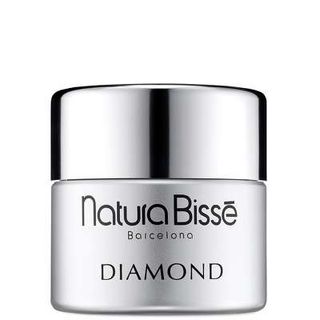
Natura Bissé Diamond Age-Defying: Gel-Cream
Works for
1 of 2 advertised claims delivered
Anti-aging9 ingredients credited for this claimModerate support
“With a cocktail of minerals, hydrolysed collagen, ursolic acid and pea extract, this gel creates elasticity and firmness while softening your skin and restoring its shine.”
This product contains vitis vinifera seed extract. This ingredient might be able to help reduce and prevent fine lines and wrinkles, improve skin elasticity and firmness, but there is not enough evidence that it actually works.
Evens skin tone7 ingredients credited for this claimWeak support
“Pay special attention to the areas with dark spots on face, neck and décolleté.”
Effective ingredients missing or their concentration is too low
MoisturizingNot advertised by the brand · 24 ingredients credited for this claimStrong support
This product can help improve hydration of the skin with the two types of ingredients.
The first type is called “humectants”:
these ingredients help attract water.
When humectants are on the surface of the skin, they “pull in” the moisture from the outside environment, or from
within deeper layers of the skin. The following ingredients in this product do the job:
glycerin, saccharomyces/copper ferment.
This product also contains ingredients called “occlusives”. They help reduce the speed with which our skin loses moisture to the outside environment. These ingredients also help soften the upper layer of the skin, so it feels less tight and nicer to the touch. The following ingredients in this product do the job: butyrospermum parkii butter, dimethiconol.
The following ingredients in this product are especially good for supporting the skin barrier and helping with the hydration level: panthenol
Anti-oxidationNot advertised by the brand · 11 ingredients credited for this claimStrong support
This product contains antioxidants (vitis vinifera seed extract) that can help neutralize free radicals in skin. By doing so, they can lessen the damage the skin gets from the UV light (sun).
Can it cause trouble?
Irritancy9 strong irritants: Alcohol denat., Salvia officinalis leaf extract + 7 more — patch-test recommendedHigh risk
Comedogenic1 ingredient rated 2 or more on the 0–5 pore-clogging scale1 flagged


User reviews
Be the first — your take helps the next person decide.
Ingredients
Filter by role to see what each ingredient is doing.
Water~45–55%
Propylene glycol~4.5–5.4%
- Irritation risk
- High
Helps oil and water mix together and can enhance the penetration of other ingredients into the skin. It can be irritating
More about Propylene glycolCyclopentasiloxane~4–4.8%
- Irritation risk
- Low
A silicone that helps improve the product texture and spreadability. Can absorb oil creating a short-term mattifying effect on the skin
More about CyclopentasiloxaneAlcohol denat.~3–3.7%
- Irritation risk
- High
Produces temporary toning effect. Can help dissolve other ingredients or preserve products
More about Alcohol denat.Glycerin~2.4–2.9%
- Irritation risk
- Low
One of the best moisturizing ingredients. Naturally present in skin. It attracts water to the upper layer of the skin working as a humectant
More about GlycerinPisum sativum extract~1.9–2.3%
- Irritation risk
- Medium
Might be helpful in protecting skin collagen and elastin from breaking down but solid research is lacking
More about Pisum sativum extractPolyacrylamide~1.6–2%
- Irritation risk
- Medium
Used to improve product texture and help oil and water mix together
More about PolyacrylamideButyrospermum parkii butter~1.5–1.8%
- Irritation risk
- Low
- Comedogenicity
- 3/5
A great moisturising ingredient that softens the skin and reduces water loss from its upper layer. It also can be helpful in protecting skin from free radicals
More about Butyrospermum parkii butterHydrolyzed soy protein~1.1–1.4%
- Irritation risk
- Low
Helps attract water to the upper layer of the skin. Might have some anti-aging, anti-oxidant, and skin lightening properties, but solid evidence is missing
More about Hydrolyzed soy proteinHydrolyzed collagen extract~0.9–1.1%
- Irritation risk
- Low
Vitis vinifera seed extract~0.8–1.2%
- Irritation risk
- Low
A plant extract that contains resveratrol and other anti-oxidant compounds that can help neutralize free radicals, reduce inflammation in skin and even out its tone. Can be also used to stabilize the product formulation
More about Vitis vinifera seed extractAesculus hippocastanum seed extract~0.55–0.8%
- Irritation risk
- High
Plant extract. Might have some anti-oxidant properties. Can be irritating
More about Aesculus hippocastanum seed extractPanthenol~0.5–0.75%
- Irritation risk
- Low
Helps attract water to the upper layer of the skin and can help improve skin barrier function
More about PanthenolUrsolic acid~0.45–0.65%
- Irritation risk
- Low
Salvia officinalis leaf extract~0.55–0.8%
- Irritation risk
- High
Sage leaf extract. It can be irritating
More about Salvia officinalis leaf extractOleanolic acid~0.45–0.7%
- Irritation risk
- Low
Might be helpful against blemishes, work as an anti-oxidant, reduce inflammation and improve skin's ability to hold on to moisture, but more research is needed to confirm its effectiveness when applied topically to human skin
More about Oleanolic acidYeast extract~0.45–0.7%
- Irritation risk
- Low
Helps attract water to the upper layer of the skin and might have some anti-oxidant and skin lightening properties. It can help calm down inflammation in skin
More about Yeast extractPentylene glycol~0.5–0.7%
- Irritation risk
- Medium
Used to preserve products, dissolve other ingredients and create a nice product texture
More about Pentylene glycolSodium carboxymethyl beta-glucan~0.75–1.15%
- Irritation risk
- Low
Helps thicken the product formulation and create a gel-like texture
More about Sodium carboxymethyl beta-glucanSaccharomyces/magnesium ferment~0.35–0.6%
- Irritation risk
- Low
Yeast extract that contains magnesium. Can help to attract water to the upper layer of the skin. Evidence of effectiveness for other benefits is missing
More about Saccharomyces/magnesium fermentSaccharomyces/iron ferment~0.3–0.55%
- Irritation risk
- Low
Yeast extract that contains iron. Can help to attract water to the upper layer of the skin. Evidence of effectiveness for other benefits is missing
More about Saccharomyces/iron fermentSaccharomyces/copper ferment~0.3–0.55%
- Irritation risk
- Low
Yeast extract that contains copper. Can help to attract water to the upper layer of the skin and can help in skin wound healing
More about Saccharomyces/copper fermentSaccharomyces/silicon ferment~0.3–0.5%
- Irritation risk
- Low
Yeast extract that contains silicon. Can help to attract water to the upper layer of the skin. Evidence of effectiveness for other benefits is missing
More about Saccharomyces/silicon fermentSaccharomyces/zinc ferment~0.3–0.5%
- Irritation risk
- Low
Yeast extract that contains zinc. Can help to attract water to the upper layer of the skin. Evidence of effectiveness for other benefits is missing
More about Saccharomyces/zinc fermentPalmitoyl hydroxypropyltrimonium amylopectin/glycerin crosspolymer~0.3–0.5%
Hydrogenated lecithin~0.3–0.6%
- Irritation risk
- Low
Helps to retain moisture by creating a protective barrier on the skin. Rich in fatty acids. Improves product texture and helps with the penetration of other ingredients.
More about Hydrogenated lecithinAmmonium glycyrrhizate~0.3–0.5%
- Irritation risk
- Low
Zinc gluconate~0.3–0.5%
- Irritation risk
- Medium
Typically used to stabilize the product formulations. It is a salt of a polyhydroxy acid (PHA) and in larger concentrations, can help shed the dead cells from the skin surface revealing smoother skin. It can help attract water to the upper layer of the skin. Might to be helpful against acne and clogged pores. Could be helpful in neutralizing free radicals, but solid research is missing. Due to the zinc content, might help calm down inflammation in skin
More about Zinc gluconateCaffeine~0.3–0.55%
- Irritation risk
- Medium
Might be helpful in neutralizing free radicals. Can have a dehydration effect that might somewhat decrease the look of puffy eyes
More about CaffeineAscorbic acid~0.3–0.55%
- Irritation risk
- High
The most well-researched antioxidant that works in skin. Helps neutralize free radicals supporting collagen production, helping to even out the skin tone and preventing early signs of aging
More about Ascorbic acidTocopherol~0.3–0.55%
- Irritation risk
- Low
Pure form of vitamin E. Can help moisturise and protect the skin from free radicals. Often used to help stabilise other ingredients or the formula itself
More about TocopherolDimethiconol~0.35–0.6%
- Irritation risk
- Low
A silicone that makes products more spreadable and keeps skin smooth. Helps to add gloss to skin and may visually fill in fine lines/wrinkles for short time
More about DimethiconolTriethanolamine~0.3–0.55%
- Irritation risk
- Medium
Used to adjust pH of the product and can help improve the product's smell
More about TriethanolamineAcrylates/c10-30 alkyl acrylate crosspolymer~0.3–0.55%
- Irritation risk
- Medium
Maintains the texture of skincare products. Allows the product to spread evenly. Helps oil and water mix together
More about Acrylates/c10-30 alkyl acrylate crosspolymerLaureth-7~0.3–0.55%
Disodium edta~0.3–0.55%
C13-14 isoparaffin~0.3–0.6%
- Irritation risk
- Low
Helps soften the upper layer of the skin, dissolve other ingredients and create a thicker product consistency
More about C13-14 isoparaffinSodium hydroxide~0.3–0.55%
Lactic acid~0.3–0.5%
- Irritation risk
- Medium
An exfoliating and moisturizing alpha-hydroxy acid (AHA). Typically causes less irritation than other AHAs, for example, glycolic acid. At high concentrations (about 15%), lactic acid can help reduce lines and wrinkles. Recent studies show that lactic acid can support the "good" bacteria living on skin's surface (healthy skin microbiome)
More about Lactic acidHexanediol~0.3–0.55%
Caprylyl glycol~0.3–0.6%
- Irritation risk
- Medium
Helps preserve products and creates a nice product texture
More about Caprylyl glycolSodium citrate~0.3–0.55%
- Irritation risk
- Medium
Helps to control the skin's pH level. Maintains the skin's natural film of amino-lactic acids and oils. Helps to preserve products
More about Sodium citrateCitric acid~0.3–0.55%
- Irritation risk
- Medium
Can work as an exfoliant but is typically used to adjust the product pH
More about Citric acidBiotin~0.3–0.5%
- Irritation risk
- Low
Might have some moisturising properties. Is not effective when applied topically beyond some moisturizing effect
More about BiotinCyclohexasiloxane~0.3–0.6%
- Irritation risk
- Low
A silicone that serves as an emollient. Helps create a nice non-greasy feels
More about CyclohexasiloxaneLauryl peg/ppg-18/18 methicone~0.3–0.55%
- Irritation risk
- Medium
Helps oil and water mix together. It might be irritating for some people
More about Lauryl peg/ppg-18/18 methiconeChlorphenesin~0.16–0.32%
Niacinamide~0.3–0.55%
- Irritation risk
- Low
Is proven to be effective in reducing blemishes, evening out skin tone and helping to improve lines and wrinkles. It helps the skin to repair sun damage, calm down inflammation and keep maintain good levels of moisture. The concentration of about 2% is effective for supporting the skin barrier and evening out the skin tone. Concentration of 4-6% is better for helping with acne and balancing the sebum production
More about NiacinamidePotassium sorbate~0.3–0.55%
Sorbic acid~0.3–0.55%
Phenoxyethanol~0.3–0.55%
- Irritation risk
- Low
A preservative. It helps prevent bacterial growth in cosmetic products
More about PhenoxyethanolMethylparaben~0.15–0.3%
Ethylparaben~0.2–0.4%
Butylparaben~0.2–0.4%
Propylparaben~0.25–0.4%
Parfum~0.2–0.4%
- Irritation risk
- High
An aromatic blend of unspecified and possibly irritating ingredients
More about ParfumLinalool~0.2–0.35%
Coumarin~0.15–0.3%
Geraniol~0.15–0.25%
Alpha-isomethyl ionone~0.1–0.2%
- Irritation risk
- High
A fragrance. Potential allergen and can be irritating
More about Alpha-isomethyl iononeCitronellol~0.1–0.2%
Limonene~0.1–0.25%
- Irritation risk
- High
A common frangrance that can easily irritate skin, especially if exposed to air, light or heat
More about LimoneneCaramel~0.1–0.2%
- Irritation risk
- Low
Ci 14700~0.05–0.15%
Ingredient list view
Water, Propylene glycol, Cyclopentasiloxane, Alcohol denat., Glycerin, Pisum sativum extract, Polyacrylamide, Butyrospermum parkii butter, Hydrolyzed soy protein, Hydrolyzed collagen extract, Vitis vinifera seed extract, Aesculus hippocastanum seed extract, Panthenol, Ursolic acid, Salvia officinalis leaf extract, Oleanolic acid, Yeast extract, Pentylene glycol, Sodium carboxymethyl beta-glucan, Saccharomyces/magnesium ferment, Saccharomyces/iron ferment, Saccharomyces/copper ferment, Saccharomyces/silicon ferment, Saccharomyces/zinc ferment, Palmitoyl hydroxypropyltrimonium amylopectin/glycerin crosspolymer, Hydrogenated lecithin, Ammonium glycyrrhizate, Zinc gluconate, Caffeine, Ascorbic acid, Tocopherol, Dimethiconol, Triethanolamine, Acrylates/c10-30 alkyl acrylate crosspolymer, Laureth-7, Disodium edta, C13-14 isoparaffin, Sodium hydroxide, Lactic acid, Hexanediol, Caprylyl glycol, Sodium citrate, Citric acid, Biotin, Cyclohexasiloxane, Lauryl peg/ppg-18/18 methicone, Chlorphenesin, Niacinamide, Potassium sorbate, Sorbic acid, Phenoxyethanol, Methylparaben, Ethylparaben, Butylparaben, Propylparaben, Parfum, Linalool, Coumarin, Geraniol, Alpha-isomethyl ionone, Citronellol, Limonene, Caramel, Ci 14700
Compare prices
Retailers ranked by price — lowest first.

Affiliate links · prices updated regularly
Worth comparing, line by line.
Match % combines shared ingredients, the first five ingredients, shared actives and hero ingredients, irritancy (lower counts in the alternative's favour), texture and body area. Only products in the same routine step are compared.
| Natura BisséDiamond Age-Defying: Gel-CreamYOUR PRODUCT | Paula's choiceRESIST Anti-Aging Eye Gel | OlayAnti-Wrinkle Firm & Lift Eye Renewal Gel | MDC DermatologicsPlump, Boost Firm Eye Hydro Gel | |
|---|---|---|---|---|
| Match | — | 68% | 68% | 67% |
| Price | $370.17 | $35.96−$334.21 | $16.51−$353.66 | $64.00−$306.17 |
| Shared key ingredients | — | 5 of 19 | 3 of 19 | 4 of 19 |
| Key difference | — | Caprooyl Tetrapeptide-3 | Tea Extract | Sh-Polypeptide-9 |
| Irritancy | High | Medium | Medium | Medium |
| Drying alcohol | Contains drying alcohol | — | Contains drying alcohol | — |
| View product | Shop | Shop | Shop |


Product summary
Judging from the ingredient list, "Natura Bissé - Diamond Age-Defying: Gel-Cream" works well for improving skin hydration The formulation is based on a combination of good humectants and emollients. Both are needed to increase the skin hydration level. Humectants in this product (panthenol, glycerin, saccharomyces/copper ferment, saccharomyces/iron ferment and saccharomyces/magnesium ferment) help to increase the water content in the upper layer of the skin. (These ingredients do so by "capturing" water molecules from the outside air or from within the deeper layers of the skin). Emollients in this formulation (butyrospermum parkii butter, dimethiconol, cyclopentasiloxane, c13-14 isoparaffin and caprylyl glycol) help to reduce the moisture loss from the skin. They also soften the skin surface and relieve the feeling of dryness and tightness.
Ingredient callouts
- This product also contains Vitamin C (Ascorbic Acid). It can be an effective active for anti-aging and evening out the skin tone, but in this moisturizer it is used for stabilizing other ingredients in the formulation. In this concentration (0.30% - 0.55%) it cannot have a noticeable benefit for the skin.
Irritation risk
This moisturizer contains a bunch of common irritants, including ingredients that do not provide any known benefit for the skin. It might not be the best choice if your skin is sensitive. We assess the overall irritancy of this moisturizer to be high. For a detailed overview of all potential irritants: click here
You can see the detailed formula review with the breakdown of all actives in the product and the full ingredient list with estimated concentrations in the tables below.
Price
The product retails for 280.00£ in the United Kingdom.
For a detailed price comparison: click here.
Sources cited in this review
Every concentration estimate and effectiveness label is anchored to one of these 36 studies and safety reviews.
- 1Surfactants and experimental irritant contact dermatitisncbi.nlm.nih.gov
- 2Propylene Glycolpubmed.ncbi.nlm.nih.gov
- 3Skin-sensitizing and irritant properties of propylene glycolonlinelibrary.wiley.com
- 4
- 5Extracts from Glycine max (soybean) induce elastin synthesis and inhibit elastase activityonlinelibrary.wiley.com
- 6

Affiliate links · As an Amazon Associate, WIMJ earns from qualifying purchases.