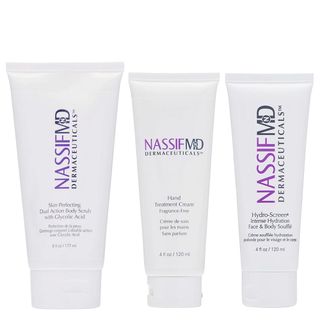
NassifMD Dermaceuticals Anti-Aging Hand & Body Must-Haves
Works for
3 of 3 advertised claims delivered
Anti-aging7 ingredients credited for this claimStrong support
“Anti-Aging Hand & Body Must-Haves”
This product can help reduce and prevent fine lines and wrinkles, improve skin elasticity and firmness because it contains bakuchiol, glycolic acid.
Keep in mind that it typically takes at least 6 weeks to notice any results because the changes that are needed to improve fine lines and elasticity happen in the deeper layers of the skin. No topical anti-aging product can “erase” wrinkles or fully reverse signs of aging.
Exfoliation3 ingredients credited for this claimStrong support
“The gentle exfoliating scrub, deeply hydrating & moisturizing cream, and intensive moisturizing hand cream help keep skin looking youthful and radiant, from head to toe.”
This product can help exfoliate the skin. In other words, it helps break down the bonds between dead cells on the surface of the skin and speed up the skin turnover. Skin often appears softer and brighter after exfoliation, but overdoing it can result in disrupted skin barrier. The following ingredient is doing the exfoliating job in this product: glycolic acid.
Moisturizing22 ingredients credited for this claimGood support
“The gentle exfoliating scrub, deeply hydrating & moisturizing cream, and intensive moisturizing hand cream help keep skin looking youthful and radiant, from head to toe.”
This product can help improve hydration of the skin with the two types of ingredients.
The first type is called “humectants”:
these ingredients help attract water.
When humectants are on the surface of the skin, they “pull in” the moisture from the outside environment, or from
within deeper layers of the skin. The following ingredients in this product do the job:
glycerin, sodium hyaluronate.
This product also contains ingredients called “occlusives”. They help reduce the speed with which our skin loses moisture to the outside environment. These ingredients also help soften the upper layer of the skin, so it feels less tight and nicer to the touch. The following ingredients in this product do the job: caprylic/capric triglyceride, dimethicone.
Anti-oxidationNot advertised by the brand · 5 ingredients credited for this claimStrong support
This product contains antioxidants (bakuchiol) that can help neutralize free radicals in skin. By doing so, they can lessen the damage the skin gets from the UV light (sun).
Evens skin toneNot advertised by the brand · 5 ingredients credited for this claimStrong support
This product can help reduce hypepigmentation and even out the skin tone because it contains the following effective ingredients: bakuchiol, glycolic acid
Keep in mind that you would need to apply any topical skincare targetted at hypigmentation consistently for a couple of months to get a result. No topical skincare product can help get rid of hyperpigmentation (including post-acne marks and age spots) instantly.
Can it cause trouble?
Irritancy6 strong irritants: Parfum, Linalool + 4 more — patch-test recommendedHigh risk
Comedogenic2 ingredients rated 2 or more on the 0–5 pore-clogging scale2 flagged


User reviews
Be the first — your take helps the next person decide.
Ingredients
Filter by role to see what each ingredient is doing.
Water~45–55%
Glycolic acid~5.1–6.2%
- Irritation risk
- High
An alpha-hydroxy acid (AHA) that helps to remove the dead skin cells on the surface of the skin reveling a more even, smoother complexation. It is also able to stimulate collagen production with long-term use. Could help to reduce pore congestion. It can be irritating to the skin. Apply sunscreen daily if using products with glycolic acid
More about Glycolic acidIsopropyl palmitate~4.1–5%
- Irritation risk
- Medium
- Comedogenicity
- 3/5
Helps soften the upper layer of the skin and create a thicker product consistency
More about Isopropyl palmitateCetyl alcohol~2.5–3%
- Irritation risk
- Low
A non-drying alcohol that works to soften the skin and stabilize product formulations helping oil and water mix together
More about Cetyl alcoholCaprylic/capric triglyceride~2.4–2.9%
- Irritation risk
- Medium
A good mix of fatty acids that forms a protective layer on the skin. Improves the shelf life of products. Derived from coconut and glycerin
More about Caprylic/capric triglyceridePhytelephas aequatorialis seed powder~1.9–2.3%
- Irritation risk
- Low
Vegetable oil~1.6–2%
- Irritation risk
- Low
An oil from a mixture of different vegetables. Helps soften the upper layer of the skin
More about Vegetable oilGlycerin~1.5–1.8%
- Irritation risk
- Low
One of the best moisturizing ingredients. Naturally present in skin. It attracts water to the upper layer of the skin working as a humectant
More about GlycerinSodium hydroxide~1.1–1.4%
Polyacrylamide~1–1.2%
- Irritation risk
- Medium
Used to improve product texture and help oil and water mix together
More about PolyacrylamideGlyceryl stearate~0.7–1.05%
- Irritation risk
- Low
An emollient that softens the skin and forms a protective layer on its surface. Helps water and oil mix together
More about Glyceryl stearatePeg-2 stearate se~0.55–0.8%
Phenyl trimethicone~0.5–0.7%
- Irritation risk
- Low
A type of silicone that can decrease loss of moisture from the skin surface. It helps create a nice product texture
More about Phenyl trimethiconeC13-14 isoparaffin~0.45–0.7%
- Irritation risk
- Low
Helps soften the upper layer of the skin, dissolve other ingredients and create a thicker product consistency
More about C13-14 isoparaffinLaureth-7~0.35–0.65%
Hydrogenated vegetable oil~0.4–0.6%
- Irritation risk
- Low
- Comedogenicity
- 2/5
An oil from a mixture of different vegetables. Helps soften the upper layer of the skin
More about Hydrogenated vegetable oilEuphorbia cerifera wax~0.45–0.65%
- Irritation risk
- Low
Phenoxyethanol~0.3–0.55%
- Irritation risk
- Low
A preservative. It helps prevent bacterial growth in cosmetic products
More about PhenoxyethanolMagnesium aluminum silicate~0.25–0.5%
- Irritation risk
- Low
Might be helpful in restoring skin barrier function and, when combined with zinc carbonate and malonic acid, reducing fine lines and wrinkles by stimulating elastin production. Also helps stabilize the product formulation
More about Magnesium aluminum silicateXanthan gum~0.25–0.45%
- Irritation risk
- Low
Used to create a thicker product consistency
More about Xanthan gumLaneth-16~0.25–0.45%
Ceteth-16~0.2–0.4%
Oleth-16~0.2–0.35%
Steareth-16~0.25–0.45%
Parfum~0.15–0.3%
- Irritation risk
- High
An aromatic blend of unspecified and possibly irritating ingredients
More about ParfumEctoin~0.15–0.3%
- Irritation risk
- Low
Softens the upper layer of the skin and can support skin barrier function
More about Ectoin3-o-ethyl ascorbic acid~0.15–0.3%
- Irritation risk
- High
A vitamin C derivative that is more stable but less potent than pure form of vitamin C. Can help neutralize free radicals and help reduce hyperpigmentation, but the required concentration is likely to be much higher than for the pure form of vitamin C, limiting the ingredient's effectiveness in products
More about 3-o-ethyl ascorbic acidTocopherol~0.2–0.35%
- Irritation risk
- Low
Pure form of vitamin E. Can help moisturise and protect the skin from free radicals. Often used to help stabilise other ingredients or the formula itself
More about TocopherolEthylhexylglycerin~0.2–0.35%
Sorbitol~0.15–0.3%
- Irritation risk
- Low
Helps attract water to the upper layer of the skin and improves the product texture
More about SorbitolDihydroxy methylchromone~0.15–0.3%
- Irritation risk
- Low
Acrylamide~0.25–0.45%
- Irritation risk
- High
Used to stabilize formulations and increase water resistance of sunscreen ingredients. In cosmetics, the polymer form of this compound is used. The polymer's molecules cannot penetrate the skin making the compound safe for use in skin care as long as the monomer residue (which, unlike polyacrylamide, is toxic) in the final product is below 0.2%. It can be irritating for skin
More about AcrylamideLinalool~0.15–0.3%
Ci 19140~0.2–0.35%
Ci 42090~0.2–0.35%
Water~0.2–0.35%
Butylene glycol~0.15–0.3%
- Irritation risk
- Low
Used to create a nice product texture and help delivery of other ingredients. Might be somewhat helpful in attracting water to the upper layer of the skin
More about Butylene glycolDimethicone~0.25–0.45%
- Irritation risk
- Low
A silicone that helps to reduce water loss from the surface of the skin. Can temporarily "fill in" lines and wrinkles, absorb oil, and create a nice product finish
More about DimethiconeGlycerin~0.2–0.4%
- Irritation risk
- Low
One of the best moisturizing ingredients. Naturally present in skin. It attracts water to the upper layer of the skin working as a humectant
More about GlycerinCaprylic/capric triglyceride~0.25–0.45%
- Irritation risk
- Medium
A good mix of fatty acids that forms a protective layer on the skin. Improves the shelf life of products. Derived from coconut and glycerin
More about Caprylic/capric triglycerideIsostearyl alcohol~0.2–0.35%
- Irritation risk
- Low
Helps soften the upper layer of the skin
More about Isostearyl alcoholButylene glycol cocoate~0.2–0.35%
- Irritation risk
- Medium
Helps oil and water mix together
More about Butylene glycol cocoateCetyl alcohol~0.2–0.4%
- Irritation risk
- Low
A non-drying alcohol that works to soften the skin and stabilize product formulations helping oil and water mix together
More about Cetyl alcoholGlyceryl stearate~0.2–0.4%
- Irritation risk
- Low
An emollient that softens the skin and forms a protective layer on its surface. Helps water and oil mix together
More about Glyceryl stearatePeg-75 stearate~0.2–0.35%
Ceteth-20~0.3–0.5%
Steareth-20~0.25–0.45%
Ethylcellulose~0.2–0.35%
- Irritation risk
- Low
Phenoxyethanol~0.2–0.35%
- Irritation risk
- Low
A preservative. It helps prevent bacterial growth in cosmetic products
More about PhenoxyethanolEthylhexylglycerin~0.2–0.35%
Ammonium acryloyldimethyltaurate/vp copolymer~0.2–0.4%
- Irritation risk
- Low
Increases thickness of a product. Texture enhancer for oil-in-water emulsions
More about Ammonium acryloyldimethyltaurate/vp copolymerBakuchiol~0.25–0.4%
- Irritation risk
- Medium
A plant extract that is, though different in chemical structure, acts similar to retinoids. First studies show that it can help reduce fine lines and wrinkles, improve skin tone, reduce clogged pores and blemishes, and reduce inflammation. There is no conclusive evidence that bakuchiol is as effective as retinol however. The study that directly compared retinol with bakuchiol used bakuchiol applied twice daily compared to once per day for the retinol. According to this study, bakuchiol is less irritating than retinol. Bakuchiol is extracted from seeds of Babchi plant. Other parts of the plant contain coumarins that could cause allergic and irritant reactions. These compounds should be removed in the extraction process when bakuchiol is produced, but it is a good idea to be cautious and stay away from products that include the Babchi plant extracts other than purified bakuchiol to avoid irritation
More about BakuchiolParfum~0.2–0.35%
- Irritation risk
- High
An aromatic blend of unspecified and possibly irritating ingredients
More about ParfumAcrylates/c10-30 alkyl acrylate crosspolymer~0.25–0.45%
- Irritation risk
- Medium
Maintains the texture of skincare products. Allows the product to spread evenly. Helps oil and water mix together
More about Acrylates/c10-30 alkyl acrylate crosspolymerXanthan gum~0.2–0.4%
- Irritation risk
- Low
Used to create a thicker product consistency
More about Xanthan gumGlycosphingolipids~0.25–0.45%
- Irritation risk
- Low
A type of lipids naturally present in skin. They can be converted to ceramides in skin
More about GlycosphingolipidsGlycolipids~0.2–0.35%
- Irritation risk
- Low
Sodium hyaluronate~0.2–0.4%
- Irritation risk
- Low
One of the best moisturizing ingredients. Attracts water into the upper layer of the skin
More about Sodium hyaluronateDisodium edta~0.2–0.4%
Tocopheryl acetate~0.2–0.4%
- Irritation risk
- Medium
A more stable but less bio-available form of vitamin E compared to Tocopherol. Might help moisturize and protect the skin from free radicals, but mostly used in low concentrations to stabilize other ingredients.
More about Tocopheryl acetateSodium hydroxide~0.2–0.4%
Alcohol~0.2–0.4%
- Irritation risk
- High
Can be drying and contribute to skin irritation. Used in formulars to dissolve other ingredients, create a thinner product consistency or for its antibacterial properties
More about AlcoholLinalool~0.2–0.35%
Citronellol~0.2–0.35%
Amyl cinnamal~0.2–0.35%
- Irritation risk
- High
Benzyl salicylate~0.2–0.35%
Water~0.2–0.4%
Caprylic/capric triglyceride~0.25–0.5%
- Irritation risk
- Medium
A good mix of fatty acids that forms a protective layer on the skin. Improves the shelf life of products. Derived from coconut and glycerin
More about Caprylic/capric triglycerideIsoamyl laurate~0.25–0.45%
- Irritation risk
- Medium
Helps stabilize emulsions and create a nice product texture
More about Isoamyl lauratePropanediol~0.25–0.4%
- Irritation risk
- Low
Acts as a solvent for other ingredients. Speeds up the absorption of other ingredients into the skin
More about PropanediolTribehenin peg-20 esters~0.25–0.45%
- Irritation risk
- Medium
Helps oil and water mix together
More about Tribehenin peg-20 estersNiacinamide~0.2–0.4%
- Irritation risk
- Low
Is proven to be effective in reducing blemishes, evening out skin tone and helping to improve lines and wrinkles. It helps the skin to repair sun damage, calm down inflammation and keep maintain good levels of moisture. The concentration of about 2% is effective for supporting the skin barrier and evening out the skin tone. Concentration of 4-6% is better for helping with acne and balancing the sebum production
More about NiacinamideGlycerin~0.25–0.45%
- Irritation risk
- Low
One of the best moisturizing ingredients. Naturally present in skin. It attracts water to the upper layer of the skin working as a humectant
More about GlycerinCetyl alcohol~0.25–0.45%
- Irritation risk
- Low
A non-drying alcohol that works to soften the skin and stabilize product formulations helping oil and water mix together
More about Cetyl alcoholGlyceryl stearate~0.25–0.5%
- Irritation risk
- Low
An emollient that softens the skin and forms a protective layer on its surface. Helps water and oil mix together
More about Glyceryl stearatePeg-100 stearate~0.3–0.55%
- Irritation risk
- Low
Helps oil and water mix togehter and creates a nice product texture
More about Peg-100 stearateOrobanche rapum extract~0.2–0.4%
- Irritation risk
- Low
Tetrahexyldecyl ascorbate~0.2–0.4%
- Irritation risk
- Medium
Being a lipid soluble form of vitamin C, it is more stable than ascorbic acid, but still degrades quickly and needs to be stabilized in a formulation with another ingredient. It is claimed to penetrate skin better than pure vitamin C and have the the similar benefits, but solid studies of its effectiveness are lacking. Is likely to require a higher concentration in a product than pure vitamin C to be effective. It might be able to help reduce pore clogging.
More about Tetrahexyldecyl ascorbateSodium carrageenan~0.25–0.4%
Sea salt~0.2–0.35%
- Irritation risk
- Medium
Used to thicken the product formulation and might help to add minerals to the surface of the skin. It is used in scrubs as a physical exfoliant. Can increase sensitivity to other ingredients if left on the skin or used in high concentration
More about Sea saltAllantoin~0.2–0.35%
- Irritation risk
- Low
Helps calm down inflammation in skin and can help reduce itching. Helps to repair the skin barrier and keep skin hydrated
More about AllantoinTocopheryl acetate~0.2–0.4%
- Irritation risk
- Medium
A more stable but less bio-available form of vitamin E compared to Tocopherol. Might help moisturize and protect the skin from free radicals, but mostly used in low concentrations to stabilize other ingredients.
More about Tocopheryl acetateSodium hyaluronate~0.2–0.4%
- Irritation risk
- Low
One of the best moisturizing ingredients. Attracts water into the upper layer of the skin
More about Sodium hyaluronateSodium acrylates copolymer~0.2–0.35%
- Irritation risk
- Medium
Used to create a thicker product consistency
More about Sodium acrylates copolymerLecithin~0.25–0.45%
- Irritation risk
- Low
Used mostly for creating emulsions - helping oil and water mix together. Helps soften the upper layer of the skin
More about LecithinPolyacrylate-13~0.25–0.4%
- Irritation risk
- Low
Used to create a thicker product consistency and stabilize the product formulation
More about Polyacrylate-13Polyisobutene~0.25–0.45%
Polysorbate 20~0.2–0.4%
Sorbitan isostearate~0.2–0.4%
- Irritation risk
- Low
Helps oil and water mix together
More about Sorbitan isostearateXanthan gum~0.2–0.35%
- Irritation risk
- Low
Used to create a thicker product consistency
More about Xanthan gumCitric acid~0.2–0.35%
- Irritation risk
- Medium
Can work as an exfoliant but is typically used to adjust the product pH
More about Citric acidPanthenol~0.2–0.35%
- Irritation risk
- Low
Helps attract water to the upper layer of the skin and can help improve skin barrier function
More about PanthenolSodium phytate~0.15–0.3%
Alcohol~0.15–0.3%
- Irritation risk
- High
Can be drying and contribute to skin irritation. Used in formulars to dissolve other ingredients, create a thinner product consistency or for its antibacterial properties
More about AlcoholPhenoxyethanol~0.15–0.25%
- Irritation risk
- Low
A preservative. It helps prevent bacterial growth in cosmetic products
More about PhenoxyethanolEthylhexylglycerin~0.15–0.25%
Sodium potassium aluminum silicate~0.15–0.3%
- Irritation risk
- Low
Silica~0.25–0.45%
Ci 77891~0.1–0.15%
- Irritation risk
- Low
Titanium dioxide~0.1–0.2%
- Irritation risk
- Low
Works as a UV filter when used in high concentrations. It is photostable and is effective mostly against the UVB light, with some protection in the UVA range. In small concentrations, used for its ability to improve the color of cosmetic products. Is usually well tolerated by the skin
More about Titanium dioxideIngredient list view
Water, Glycolic acid, Isopropyl palmitate, Cetyl alcohol, Caprylic/capric triglyceride, Phytelephas aequatorialis seed powder, Vegetable oil, Glycerin, Sodium hydroxide, Polyacrylamide, Glyceryl stearate, Peg-2 stearate se, Phenyl trimethicone, C13-14 isoparaffin, Laureth-7, Hydrogenated vegetable oil, Euphorbia cerifera wax, Phenoxyethanol, Magnesium aluminum silicate, Xanthan gum, Laneth-16, Ceteth-16, Oleth-16, Steareth-16, Parfum, Ectoin, 3-o-ethyl ascorbic acid, Tocopherol, Ethylhexylglycerin, Sorbitol, Dihydroxy methylchromone, Acrylamide, Linalool, Ci 19140, Ci 42090, Water, Butylene glycol, Dimethicone, Glycerin, Caprylic/capric triglyceride, Isostearyl alcohol, Butylene glycol cocoate, Cetyl alcohol, Glyceryl stearate, Peg-75 stearate, Ceteth-20, Steareth-20, Ethylcellulose, Phenoxyethanol, Ethylhexylglycerin, Ammonium acryloyldimethyltaurate/vp copolymer, Bakuchiol, Parfum, Acrylates/c10-30 alkyl acrylate crosspolymer, Xanthan gum, Glycosphingolipids, Glycolipids, Sodium hyaluronate, Disodium edta, Tocopheryl acetate, Sodium hydroxide, Alcohol, Linalool, Citronellol, Amyl cinnamal, Benzyl salicylate, Water, Caprylic/capric triglyceride, Isoamyl laurate, Propanediol, Tribehenin peg-20 esters, Niacinamide, Glycerin, Cetyl alcohol, Glyceryl stearate, Peg-100 stearate, Orobanche rapum extract, Tetrahexyldecyl ascorbate, Sodium carrageenan, Sea salt, Allantoin, Tocopheryl acetate, Sodium hyaluronate, Sodium acrylates copolymer, Lecithin, Polyacrylate-13, Polyisobutene, Polysorbate 20, Sorbitan isostearate, Xanthan gum, Citric acid, Panthenol, Sodium phytate, Alcohol, Phenoxyethanol, Ethylhexylglycerin, Sodium potassium aluminum silicate, Silica, Ci 77891, Titanium dioxide
Compare prices
Retailers ranked by price — lowest first.

Affiliate links · prices updated regularly
Worth comparing, line by line.
Match % combines shared ingredients, the first five ingredients, shared actives and hero ingredients, irritancy (lower counts in the alternative's favour), texture and body area. Only products in the same routine step are compared.
| NassifMD DermaceuticalsAnti-Aging Hand & Body Must-HavesYOUR PRODUCT | AbibCollagen Eye Creme Jericho Rose Tube | 23 years oldBakuchiol A Cream | MIGUHARACica Bakuchiol Erasing Cream | |
|---|---|---|---|---|
| Match | — | 63% | 63% | 62% |
| Price | $69.00 | $16.39−$52.61 | $24.71−$44.29 | $27.04−$41.96 |
| Shared key ingredients | — | 8 of 14 | 6 of 14 | 6 of 14 |
| Key difference | — | Adenosine | Adenosine | Madecassoside |
| Irritancy | High | Medium | Medium | Medium |
| Drying alcohol | Contains drying alcohol | — | — | — |
| View product | Shop | Shop | Shop |


Sources cited in this review
Every concentration estimate and effectiveness label is anchored to one of these 29 studies and safety reviews.
- 1
- 2Glycolic acid peel therapy – a current reviewncbi.nlm.nih.gov
- 3
- 4Final Report on the Safety Assessment of Isopropyl Isostearatejournals.sagepub.com
- 5
- 6Safety Assessment of Isoparaffins as Used in Cosmeticsjournals.sagepub.com

Affiliate links · As an Amazon Associate, WIMJ earns from qualifying purchases.