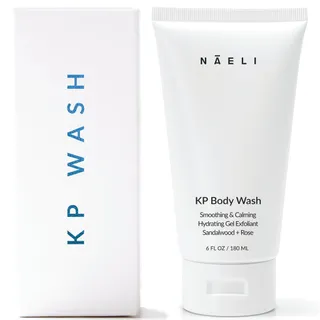
N Ā E L I Sandalwood/Rose KP & Acne Exfoliating Body Wash
Works for
ExfoliationGlycolic acid, Urea + 3 moreWorks well
“Sandalwood/Rose KP & Acne Exfoliating Body Wash”
This product can help exfoliate the skin. In other words, it helps break down the bonds between dead cells on the surface of the skin and speed up the skin turnover. Skin often appears softer and brighter after exfoliation, but overdoing it can result in disrupted skin barrier. The following ingredient is doing the exfoliating job in this product: glycolic acid, salicylic acid.
CleansingCocamidopropyl betaine, Sodium c14-16 olefin sulfonate + 2 moreCleanses gently
“Sandalwood/Rose KP & Acne Exfoliating Body Wash”
This product works by removing dirt and oil from the surface of the skin. It uses a combination of mild cleansing agents (cocamidopropyl betaine, glyceryl caprylate, glyceryl undecylenate, sodium c14-16 olefin sulfonate) and should be able to cleanse the skin gently. Still keep in mind that any cleansing can disrupt the skin barrier, and most people do not need to cleanse their skin more than once per day.
Even though this formulation is mild, the following cleansing agents could trigger an irritation or allergy for some people: cocamidopropyl betaine, sodium c14-16 olefin sulfonate
Anti-blemishSalicylic acid, Glycolic acid + 2 moreWorks well
“Sandalwood/Rose KP & Acne Exfoliating Body Wash”
This product can help reduce breakouts and clogged pores because it contains the following ingredient: salicylic acid. This ingredient is used for treating acne and can have a noticeable effect.
The following ingredient (ingredients) in this product might be helpful, but there is no evidence to confirm that it actually works: glycolic acid
Can it cause trouble?
Irritancy2 strong irritants: Rosa damascena extract, ParfumMedium risk
Comedogenic1 ingredient rated 2 or more on the 0–5 pore-clogging scale1 flagged

User reviews
Be the first — your take helps the next person decide.
Ingredients
Filter by role to see what each ingredient is doing.
Water~45–55%
Aloe barbadensis leaf juice~7.1–8.7%
- Irritation risk
- Medium
Traditionally used to treat sunburns, dermatitis and inflammation, but evidence for its effectiveness is lacking. The extract can contain humectants that help attract water into the skin
More about Aloe barbadensis leaf juiceCocamidopropyl betaine~5.6–6.8%
- Irritation risk
- High
Helps water and oil mix together. Used as a cleansing ingredient. Could be an allergen
More about Cocamidopropyl betaineSodium c14-16 olefin sulfonate~4–4.9%
- Irritation risk
- High
Helps oil and water mix together and used as a cleansing agent. Can be irritating and is better avoided for sensitive skin
More about Sodium c14-16 olefin sulfonateGlycolic acid~2.3–2.8%
- Irritation risk
- High
An alpha-hydroxy acid (AHA) that helps to remove the dead skin cells on the surface of the skin reveling a more even, smoother complexation. It is also able to stimulate collagen production with long-term use. Could help to reduce pore congestion. It can be irritating to the skin. Apply sunscreen daily if using products with glycolic acid
More about Glycolic acidAcrylates copolymer~1.9–2.3%
- Irritation risk
- Medium
Used to stabilize product formulation, help create an even product layer over skin (for example, in sunscreen) and create a thicker product consistency
More about Acrylates copolymerSodium hydroxide~1.6–1.9%
Salicylic acid~0.95–1.2%
- Irritation risk
- High
Used for skin exfoliation. It has an anti-inflammatory and anti-bacterial effect, helps to unclog pores, prevent blemishes and speed up healing of the existing ones. Sometimes referred to as a BHA (beta-hydroxy acid)
More about Salicylic acidUrea~1.1–1.3%
- Irritation risk
- Low
Naturally present in skin (urea makes up about 7% of natural moisturizing factors in skin). Attracts water to the upper layer of the skin. Also has a positive effect on the skin barrier beyond the humectant action. Can enhance penetration of other ingredients. Is an exfoliating ingredient when used in high concentrations
More about UreaAllantoin~0.65–1%
- Irritation risk
- Low
Helps calm down inflammation in skin and can help reduce itching. Helps to repair the skin barrier and keep skin hydrated
More about AllantoinButylene glycol~0.6–0.9%
- Irritation risk
- Low
Used to create a nice product texture and help delivery of other ingredients. Might be somewhat helpful in attracting water to the upper layer of the skin
More about Butylene glycolTocopheryl acetate~0.5–0.8%
- Irritation risk
- Medium
A more stable but less bio-available form of vitamin E compared to Tocopherol. Might help moisturize and protect the skin from free radicals, but mostly used in low concentrations to stabilize other ingredients.
More about Tocopheryl acetateTocopherol~0.45–0.7%
- Irritation risk
- Low
Pure form of vitamin E. Can help moisturise and protect the skin from free radicals. Often used to help stabilise other ingredients or the formula itself
More about TocopherolPassiflora edulis seed powder~0.55–0.8%
- Irritation risk
- Low
Passiflora incarnata seed powder~0.5–0.75%
- Irritation risk
- Low
Hyaluronic acid~0.35–0.6%
- Irritation risk
- Low
One of the best moisturizing ingredients. Attracts water into the upper layer of the skin. Naturally present in skin. Typically has large molecule size unless advertised otherwise on the product label. Helps support skin's barrier function and may help to reduce inflammation
More about Hyaluronic acidAscorbic acid~0.3–0.55%
- Irritation risk
- High
The most well-researched antioxidant that works in skin. Helps neutralize free radicals supporting collagen production, helping to even out the skin tone and preventing early signs of aging
More about Ascorbic acidPersea gratissima oil~0.35–0.6%
- Irritation risk
- Medium
An emollient that helps soften the skin and could be helpful in repairing its barrier function
More about Persea gratissima oilCalendula officinalis extract~0.25–0.45%
- Irritation risk
- High
A plant extract that might help neutralize free radicals in skin
More about Calendula officinalis extractCamellia sinensis extract~0.25–0.45%
- Irritation risk
- Low
Tea extract. Might be helpful in neutralizing free radicals in skin
More about Camellia sinensis extractLactic acid~0.25–0.4%
- Irritation risk
- Medium
An exfoliating and moisturizing alpha-hydroxy acid (AHA). Typically causes less irritation than other AHAs, for example, glycolic acid. At high concentrations (about 15%), lactic acid can help reduce lines and wrinkles. Recent studies show that lactic acid can support the "good" bacteria living on skin's surface (healthy skin microbiome)
More about Lactic acidPunica granatum extract~0.25–0.45%
- Irritation risk
- Medium
A plant extract that can help neutralize free radicals in skin and even out the skin tone, but is typically used in products in a concentration that is too low to be effective
More about Punica granatum extractChamomilla recutita extract~0.25–0.45%
- Irritation risk
- High
Plant extract that can have healing and anti-inflammatory properties. It is a potential allergen and can be irritating
More about Chamomilla recutita extractRosa damascena extract~0.25–0.4%
- Irritation risk
- High
Oil of a very fragrant pink rose used as fragrance in cosmetics. Extensive research has shown it has mixed benefits. In the pro column, inhaling this flower’s scent seems to have relaxing properties and the plant’s petals contain skin-soothing and antioxidant compounds that can benefit skin. On the flipside, the numerous chemicals that create this rose’s distinctive fragrance pose a risk of causing skin aggravation.
More about Rosa damascena extractColloidal oatmeal~0.3–0.55%
- Irritation risk
- Low
Helps to restore skin barrier function, soften the upper layer of the skin and calm down inflammation
More about Colloidal oatmealGlycerin~0.25–0.45%
- Irritation risk
- Low
One of the best moisturizing ingredients. Naturally present in skin. It attracts water to the upper layer of the skin working as a humectant
More about GlycerinSaccharide isomerate~0.2–0.35%
- Irritation risk
- Low
Helps attract water to the upper layer of the skin
More about Saccharide isomerateFucus vesiculosus extract~0.15–0.3%
- Irritation risk
- Low
- Comedogenicity
- 3/5
Arctostaphylos uva-ursi leaf extract~0.15–0.25%
- Irritation risk
- Low
Parfum~0.1–0.15%
- Irritation risk
- High
An aromatic blend of unspecified and possibly irritating ingredients
More about ParfumGlyceryl caprylate~0.15–0.25%
- Irritation risk
- Low
An emollient that can also help water and oil mix together, as well as prevent bacteria growth in products
More about Glyceryl caprylateGlyceryl undecylenate~0.1–0.2%
- Irritation risk
- Medium
Helps oil and water mix together and helps preserve the product formulation
More about Glyceryl undecylenateIngredient list view
Water, Aloe barbadensis leaf juice, Cocamidopropyl betaine, Sodium c14-16 olefin sulfonate, Glycolic acid, Acrylates copolymer, Sodium hydroxide, Salicylic acid, Urea, Allantoin, Butylene glycol, Tocopheryl acetate, Tocopherol, Passiflora edulis seed powder, Passiflora incarnata seed powder, Hyaluronic acid, Ascorbic acid, Persea gratissima oil, Calendula officinalis extract, Camellia sinensis extract, Lactic acid, Punica granatum extract, Unknown, Chamomilla recutita extract, Rosa damascena extract, Colloidal oatmeal, Glycerin, Saccharide isomerate, Fucus vesiculosus extract, Arctostaphylos uva-ursi leaf extract, Parfum, Glyceryl caprylate, Glyceryl undecylenate
Compare prices
Retailers ranked by price — lowest first.
Worth comparing, line by line.
Match % combines shared ingredients, the first five ingredients, shared actives and hero ingredients, irritancy (lower counts in the alternative's favour), texture and body area. Only products in the same routine step are compared.
| N Ā E L ISandalwood/Rose KP & Acne Exfoliating Body WashYOUR PRODUCT | cocokindKP Smoothing Body Stick | Peach SlicesBreakout Banisher Body Wash | CeraVeGel Moussant Anti-Imperfections | |
|---|---|---|---|---|
| Match | — | 72% | 65% | 64% |
| Price | $22.00 | $18.99−$3.01 | $17.99−$4.01 | — |
| Shared key ingredients | — | 4 of 17 | 4 of 17 | 4 of 17 |
| Key difference | — | Niacinamide | Niacinamide | Niacinamide |
| Irritancy | Medium | Low | Medium | Low |
| Drying alcohol | — | — | — | — |
| View product | Shop | Shop | Shop |

More alternatives: Prequel TRAVEL GLEANSER + SANeutrogena Body Clear Scrub With Salicylic Acid
Sources cited in this review
Every concentration estimate and effectiveness label is anchored to one of these 24 studies and safety reviews.
- 1Final Report On the Safety Assessment of Sodium Alpha-Olefin Sulfonatesjournals.sagepub.com
- 2
- 3Glycolic acid peel therapy – a current reviewncbi.nlm.nih.gov
- 4
- 5
- 6

Affiliate links · As an Amazon Associate, WIMJ earns from qualifying purchases.