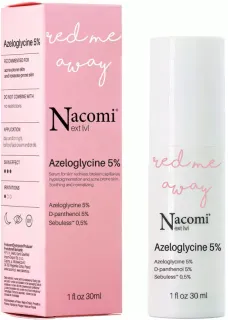
Nacomi Next Level Azeloglycine 5% - Soothing serum for couperose and rosacea skin
Works for
Evens skin tonePotassium azeloyl diglycinate, Hydrolyzed yeast extractWorks well
“Its action is based on the combination of a 5% concentration of azeloglycine with the multifunctional SEBULESS ingredient, which is responsible for lightening discoloration, fighting rosacea and regulating sebum secretion.”
This product can help reduce hypepigmentation and even out the skin tone because it contains the following effective ingredients: potassium azeloyl diglycinate
Keep in mind that you would need to apply any topical skincare targetted at hypigmentation consistently for a couple of months to get a result. No topical skincare product can help get rid of hyperpigmentation (including post-acne marks and age spots) instantly.
Anti-blemishPotassium azeloyl diglycinateMay help
“It normalizes the secretion of sebum and soothes acne.”
This product might be able to help reduce blemishes and clogged pores because it contains potassium azeloyl diglycinate.
MoisturizingSide benefit · Panthenol, Glycerin + 17 moreWorks well
This product can help improve hydration of the skin with the two types of ingredients.
The first type is called “humectants”:
these ingredients help attract water.
When humectants are on the surface of the skin, they “pull in” the moisture from the outside environment, or from
within deeper layers of the skin. The following ingredients in this product do the job:
glycerin, hyaluronic acid.
This product also contains ingredients called “occlusives”. They help reduce the speed with which our skin loses moisture to the outside environment. These ingredients also help soften the upper layer of the skin, so it feels less tight and nicer to the touch. The following ingredients in this product do the job: butyrospermum parkii butter, cetearyl alcohol.
The following ingredients in this product are especially good for supporting the skin barrier and helping with the hydration level: panthenol
Can it cause trouble?
Irritancy1 strong irritant: Passiflora incarnata seed oilMedium risk
Comedogenic2 ingredients rated 2 or more on the 0–5 pore-clogging scale2 flagged

User reviews
Be the first — your take helps the next person decide.
Ingredients
Filter by role to see what each ingredient is doing.
Water~40–60%
Glycerin~4–6.1%
- Irritation risk
- Low
One of the best moisturizing ingredients. Naturally present in skin. It attracts water to the upper layer of the skin working as a humectant
More about GlycerinCoco-caprylate/caprate~3.6–5.4%
- Irritation risk
- Low
Helps to soften the upper layer of the skin without creating a greasy texture
More about Coco-caprylate/capratePanthenol~2.6–3.9%
- Irritation risk
- Low
Helps attract water to the upper layer of the skin and can help improve skin barrier function
More about PanthenolButyrospermum parkii butter~2.1–3.1%
- Irritation risk
- Low
- Comedogenicity
- 3/5
A great moisturising ingredient that softens the skin and reduces water loss from its upper layer. It also can be helpful in protecting skin from free radicals
More about Butyrospermum parkii butterPassiflora incarnata seed oil~1.6–2.4%
- Irritation risk
- High
A plant oil that can help soften the upper layer of the skin. Contains essential oil that can be irritating
More about Passiflora incarnata seed oilCetearyl alcohol~1.4–2.1%
- Irritation risk
- Low
- Comedogenicity
- 2/5
A non-drying alcohol. Works as an emollient. Helps water and oil mix together and creates a nice product texture
More about Cetearyl alcoholGlyceryl stearate~1.2–1.8%
- Irritation risk
- Low
An emollient that softens the skin and forms a protective layer on its surface. Helps water and oil mix together
More about Glyceryl stearateHydrolyzed yeast extract~0.95–1.4%
- Irritation risk
- Low
Helps attract water to the upper layer of the skin and might have some anti-oxidant and skin lightening properties
More about Hydrolyzed yeast extractPotassium azeloyl diglycinate~0.55–1.3%
- Irritation risk
- Low
A derivative of azelaic acid. It is obtained by reacting the chloride of azelaic acid with two molecules of glycine (an amino acid) and potassium hydroxide. It is less studied than azelaic acid, but the available research suggests that it also can be effective in reducing skin redness, hyperpigmentation and blemishes. There are claims that it is more bio-available and more effective than azelaic acid, but no comparison study is available. Potassium azeloyl diglycinate is better soluble in water compared with azelaic acid. Because of this property, products with potassium azeloyl digclycinate can have a nicer texture
More about Potassium azeloyl diglycinatePotato starch modified~0.45–1.05%
- Irritation risk
- Low
Prunus amygdalus dulcis oil~0.4–0.9%
- Irritation risk
- Low
An emollient that softens the skin
More about Prunus amygdalus dulcis oilRosa canina seed oil~0.35–0.85%
- Irritation risk
- Medium
A plant oil that helps soften the upper layer of the skin. It might have anti-oxidant properties. Might help reduce inflammation in skin and help against blemishes
More about Rosa canina seed oilTrehalose~0.2–0.75%
- Irritation risk
- Low
A sugar that attracts water to the upper layer of the skin
More about TrehaloseStearic acid~0.35–0.8%
- Irritation risk
- Low
Helps oil and water mix together and works as an emollient
More about Stearic acidTocopheryl acetate~0.2–0.7%
- Irritation risk
- Medium
A more stable but less bio-available form of vitamin E compared to Tocopherol. Might help moisturize and protect the skin from free radicals, but mostly used in low concentrations to stabilize other ingredients.
More about Tocopheryl acetateSodium hyaluronate~0.15–0.65%
- Irritation risk
- Low
One of the best moisturizing ingredients. Attracts water into the upper layer of the skin
More about Sodium hyaluronateHyaluronic acid~0.15–0.6%
- Irritation risk
- Low
One of the best moisturizing ingredients. Attracts water into the upper layer of the skin. Naturally present in skin. Typically has large molecule size unless advertised otherwise on the product label. Helps support skin's barrier function and may help to reduce inflammation
More about Hyaluronic acidHydrolyzed hyaluronic acid~0.15–0.5%
- Irritation risk
- Low
One of the best moisturizing ingredients. Attracts water into the upper layer of the skin. A version of it is naturally present in skin
More about Hydrolyzed hyaluronic acidSodium hyaluronate crosspolymer~0.1–0.45%
- Irritation risk
- Medium
Attracts water into the upper layer of the skin
More about Sodium hyaluronate crosspolymerHydrolyzed glycosaminoglycans~0.1–0.4%
- Irritation risk
- Low
Long sugars that help attract water to the upper layer of the skin
More about Hydrolyzed glycosaminoglycansSyringa vulgaris extract~0.1–0.35%
- Irritation risk
- Low
Polyglucuronic acid~0.1–0.4%
- Irritation risk
- Low
Often used to support the moisturization effect of polysaccharides (contained, for example, in yeast extract)
More about Polyglucuronic acidSodium lauroyl glutamate~0.1–0.35%
- Irritation risk
- Medium
Used as a cleansing agent. It creates foam
More about Sodium lauroyl glutamateCitric acid~0.1–0.35%
- Irritation risk
- Medium
Can work as an exfoliant but is typically used to adjust the product pH
More about Citric acidDehydroacetic acid~0.1–0.35%
Cetyl hydroxyethylcellulose~0.1–0.4%
- Irritation risk
- Low
Used to create a thicker product consistency and stabilize formulations
More about Cetyl hydroxyethylcelluloseLecithin~0.1–0.45%
- Irritation risk
- Low
Used mostly for creating emulsions - helping oil and water mix together. Helps soften the upper layer of the skin
More about LecithinPropanediol~0.1–0.35%
- Irritation risk
- Low
Acts as a solvent for other ingredients. Speeds up the absorption of other ingredients into the skin
More about PropanediolBenzyl glycol~0.1–0.3%
- Irritation risk
- Medium
Helps dissolve other ingredients and preserve products
More about Benzyl glycolEthylhexylglycerin~0.05–0.3%
Raspberry ketone~0.05–0.25%
- Irritation risk
- High
Used as a fragrance. It can reduce skin pigmentation, but it is not safe to use for these purposes in high concentrations as use of raspberry ketone and its derivative is linked to causing loss of skin pigmentation in people (leukoderma)
More about Raspberry ketoneMaltodextrin~0.05–0.25%
- Irritation risk
- Low
Used to stabilize the product formulation and can help absorb oil
More about MaltodextrinPotassium sorbate~0.05–0.2%
Sodium benzoate~0.05–0.15%
Benzyl alcohol~0.01–0.1%
- Irritation risk
- High
A preservative. Can be used to mask unpleasant smell. Can be irritating
More about Benzyl alcoholIngredient list view
Water, Glycerin, Coco-caprylate/caprate, Panthenol, Butyrospermum parkii butter, Passiflora incarnata seed oil, Cetearyl alcohol, Glyceryl stearate, Hydrolyzed yeast extract, Potassium azeloyl diglycinate, Potato starch modified, Prunus amygdalus dulcis oil, Rosa canina seed oil, Trehalose, Stearic acid, Tocopheryl acetate, Sodium hyaluronate, Hyaluronic acid, Hydrolyzed hyaluronic acid, Sodium hyaluronate crosspolymer, Hydrolyzed glycosaminoglycans, Syringa vulgaris extract, Polyglucuronic acid, Sodium lauroyl glutamate, Citric acid, Dehydroacetic acid, Cetyl hydroxyethylcellulose, Lecithin, Propanediol, Benzyl glycol, Ethylhexylglycerin, Raspberry ketone, Maltodextrin, Potassium sorbate, Sodium benzoate, Benzyl alcohol
Compare prices
Retailers ranked by price — lowest first.

Worth comparing, line by line.
Match % combines shared ingredients, the first five ingredients, shared actives and hero ingredients, irritancy (lower counts in the alternative's favour), texture and body area. Only products in the same routine step are compared.
| Nacomi Next LevelAzeloglycine 5% - Soothing serum for couperose and rosacea skinYOUR PRODUCT | SKIN 1004.Azelaic Acid 10 Ampoule | Osea MalibuAnti-Aging Sea Serum | Paula's choiceAntioxidant Pore Purifier | |
|---|---|---|---|---|
| Match | — | 80% | 77% | 76% |
| Price | — | $21.60 | $88.00 | — |
| Shared key ingredients | — | 4 of 12 | 4 of 12 | 4 of 12 |
| Key difference | — | Azelaic Acid | Niacinamide | Salicylic Acid |
| Irritancy | Medium | Low | Medium | Medium |
| Drying alcohol | — | — | — | — |
| View product | Shop | Shop | Shop |

More alternatives: The Constant Multi-Active Complex 12 Modern Actives Face SerumZelens Lumino - Brightening Serum
Product summary
"Nacomi Next Level - Azeloglycine 5% - Soothing serum for couperose and rosacea skin" is effective for: Moisturizing
Ingredient callouts
- An effective concentration of Panthenol (pro-vitamin B5) - about 2.60% - 3.90%. Panthenol helps strengthen the skin barrier, improve hydration and reduce inflammation in skin.
- Humectants (panthenol 2.60% - 3.90% and glycerin 4.50% - 6.70%). These ingredients help attract water to the upper layer of the skin and improve the skin hydration.
Sources cited in this review
Every concentration estimate and effectiveness label is anchored to one of these 22 studies and safety reviews.
- 1
- 2Safety Assessment of Alkyl Esters as Used in Cosmeticscir-safety.org
- 3Skin moisturizing effects of panthenol-based formulationspdfs.semanticscholar.org
- 4
- 5
- 6

Affiliate links · As an Amazon Associate, WIMJ earns from qualifying purchases.