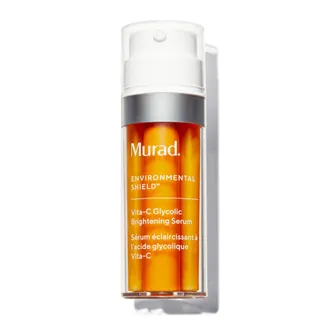
Murad Environmental Shield Vita-C Glycolic Brightening Serum

Murad Environmental Shield Vita-C Glycolic Brightening Serum

Efficacy100/100IrritancyMedium

Works for

Anti-aging
Glycolic acid, Ascorbic acid + 1 more
Works well
What the product description says
“Vitamin C is a potent antioxidant that supports healthier-looking skin and can help prevent visible skin damage like hyperpigmentation, dullness and uneven tone.”
Source: Feelunique

This product can help reduce and prevent fine lines and wrinkles, improve skin elasticity and firmness because it contains glycolic acid.

Keep in mind that it typically takes at least 6 weeks to notice any results because the changes that are needed to improve fine lines and elasticity happen in the deeper layers of the skin. No topical anti-aging product can “erase” wrinkles or fully reverse signs of aging.

Glycolic acidKey activeEffect: HighAn alpha-hydroxy acid (AHA) that helps to remove the dead skin cells on the surface of the skin reveling a more even, smoother complexation. It is also able to stimulate collagen production with long-term use. Could help to reduce pore congestion. It can be irritating to the skin. Apply sunscreen daily if using products with glycolic acid~5.2–6.4%
Ascorbic acidUnder-dosedThe most well-researched antioxidant that works in skin. Helps neutralize free radicals supporting collagen production, helping to even out the skin tone and preventing early signs of aging~0.55–0.85%
Tetrahexyldecyl ascorbateUnder-dosedBeing a lipid soluble form of vitamin C, it is more stable than ascorbic acid, but still degrades quickly and needs to be stabilized in a formulation with another ingredient. It is claimed to penetrate skin better than pure vitamin C and have the the similar benefits, but solid studies of its effectiveness are lacking. Is likely to require a higher concentration in a product than pure vitamin C to be effective. It might be able to help reduce pore clogging.~0.3–0.55%
Moisturizing
Urea, Glycerin + 14 more
Works well
What the product description says
“Pat dry.”
Source: Feelunique

This product can help improve hydration of the skin with the two types of ingredients.

The first type is called “humectants”:
these ingredients help attract water. When humectants are on the surface of the skin, they “pull in” the moisture from the outside environment, or from within deeper layers of the skin. The following ingredients in this product do the job: betaine, glycerin.

This product also contains ingredients called “occlusives”. They help reduce the speed with which our skin loses moisture to the outside environment. These ingredients also help soften the upper layer of the skin, so it feels less tight and nicer to the touch. The following ingredients in this product do the job: caprylic/capric triglyceride, dimethicone.

The following ingredients in this product are especially good for supporting the skin barrier and helping with the hydration level: urea

UreaHero· HumectantEffect: HighNaturally present in skin (urea makes up about 7% of natural moisturizing factors in skin). Attracts water to the upper layer of the skin. Also has a positive effect on the skin barrier beyond the humectant action. Can enhance penetration of other ingredients. Is an exfoliating ingredient when used in high concentrations~0.5–0.75%
GlycerinKey active· HumectantEffect: HighOne of the best moisturizing ingredients. Naturally present in skin. It attracts water to the upper layer of the skin working as a humectant~4–4.8%
Caprylic/capric triglycerideKey active· Emollient, OcclusiveEffect: HighA good mix of fatty acids that forms a protective layer on the skin. Improves the shelf life of products. Derived from coconut and glycerin~3.2–3.9%
DimethiconeKey active· Emollient, OcclusiveEffect: HighA silicone that helps to reduce water loss from the surface of the skin. Can temporarily "fill in" lines and wrinkles, absorb oil, and create a nice product finish~2.4–3%
Diisopropyl sebacateKey active· EmollientEffect: MediumHelps soften the upper layer of the skin without creatng a greasy finish~1.5–1.8%
C13-16 isoparaffinKey active· EmollientEffect: HighIs mostly used to dissolve other ingredients. Helps soften the upper layer of the skin. It might be comedogenic when used in high concentrations~1.2–1.5%
InositolKey active· HumectantEffect: High~0.45–0.65%
TrehaloseKey active· HumectantEffect: HighA sugar that attracts water to the upper layer of the skin~0.45–0.65%
BetaineKey active· HumectantEffect: HighHelps attract water to the upper layer of the skin and improves the product texture~0.35–0.6%
GlutathioneKey activeEffect: HighA peptide that can help neutralize free radicals in skin and reduce melanin production resulting in skin lightening effect and reduction in hyperpigmentation. It can also help attract moisture to the upper layer of the skin~0.3–0.6%
TriheptanoinKey activeEffect: HighA synthetic triglyceride. Helps soften the upper layer of the skin~0.25–0.45%
Chlorella vulgaris extractKey activeEffect: MediumA plant extract that can help to attract water to the upper layer of the skin and might have some anti-oxidant and anti-inflammatory properties~0.25–0.4%
Polysilicone-11Effect: LowA silicone that forms a light film on the skin surface helping to bind water and temporarily absorb oils creating a matt and powdery feel~0.3–0.55%
Caprylyl glycol· Humectant, EmollientEffect: LowHelps preserve products and creates a nice product texture~0.25–0.45%
Butylene glycol· HumectantEffect: LowUsed to create a nice product texture and help delivery of other ingredients. Might be somewhat helpful in attracting water to the upper layer of the skin~0.25–0.45%
Sorbitol· HumectantEffect: LowHelps attract water to the upper layer of the skin and improves the product texture~0.25–0.45%
Evens skin tone
Glycolic acid, Glutathione + 4 more
Works well
What the product description says
“Vitamin C is a potent antioxidant that supports healthier-looking skin and can help prevent visible skin damage like hyperpigmentation, dullness and uneven tone.”
Source: Feelunique

This product can help reduce hypepigmentation and even out the skin tone because it contains the following effective ingredients: glutathione, glycolic acid

The following ingredient (ingredients) in this product might be helpful, but there is no evidence to confirm that it actually can help even out the skin tone: hexylresorcinol.

Keep in mind that you would need to apply any topical skincare targetted at hypigmentation consistently for a couple of months to get a result. No topical skincare product can help get rid of hyperpigmentation (including post-acne marks and age spots) instantly.

Glycolic acidKey activeEffect: HighAn alpha-hydroxy acid (AHA) that helps to remove the dead skin cells on the surface of the skin reveling a more even, smoother complexation. It is also able to stimulate collagen production with long-term use. Could help to reduce pore congestion. It can be irritating to the skin. Apply sunscreen daily if using products with glycolic acid~5.2–6.4%
GlutathioneKey activeEffect: HighA peptide that can help neutralize free radicals in skin and reduce melanin production resulting in skin lightening effect and reduction in hyperpigmentation. It can also help attract moisture to the upper layer of the skin~0.3–0.6%
TaurineEffect: LowCould be helpful in reducing inflammation in skin, evening out the skin tone and neutralizing free radicals, but more research is needed to confirm its effectiveness~0.4–0.65%
HexylresorcinolEffect: LowMight be helpful in reducing hyperpigmentation and neutralizing free radicals in skin~0.25–0.5%
Ascorbic acidUnder-dosedThe most well-researched antioxidant that works in skin. Helps neutralize free radicals supporting collagen production, helping to even out the skin tone and preventing early signs of aging~0.55–0.85%
Tetrahexyldecyl ascorbateUnder-dosedBeing a lipid soluble form of vitamin C, it is more stable than ascorbic acid, but still degrades quickly and needs to be stabilized in a formulation with another ingredient. It is claimed to penetrate skin better than pure vitamin C and have the the similar benefits, but solid studies of its effectiveness are lacking. Is likely to require a higher concentration in a product than pure vitamin C to be effective. It might be able to help reduce pore clogging.~0.3–0.55%
Exfoliation
Glycolic acid, Urea
Works well
What the product description says
“Glycolic acid rapidly resurfaces and removes dead, dulling surface cells to reveal more radiant skin, and clears the way for vitamin C to penetrate skin more effectively.”
Source: Feelunique

This product can help exfoliate the skin. In other words, it helps break down the bonds between dead cells on the surface of the skin and speed up the skin turnover. Skin often appears softer and brighter after exfoliation, but overdoing it can result in disrupted skin barrier. The following ingredient is doing the exfoliating job in this product: glycolic acid.

Glycolic acidKey activeEffect: HighAn alpha-hydroxy acid (AHA) that helps to remove the dead skin cells on the surface of the skin reveling a more even, smoother complexation. It is also able to stimulate collagen production with long-term use. Could help to reduce pore congestion. It can be irritating to the skin. Apply sunscreen daily if using products with glycolic acid~5.2–6.4%
UreaKey activeEffect: MediumNaturally present in skin (urea makes up about 7% of natural moisturizing factors in skin). Attracts water to the upper layer of the skin. Also has a positive effect on the skin barrier beyond the humectant action. Can enhance penetration of other ingredients. Is an exfoliating ingredient when used in high concentrations~0.5–0.75%
Anti-oxidation
Side benefit · Glutathione, Hexylresorcinol + 7 more
Works well

This product contains antioxidants (glutathione) that can help neutralize free radicals in skin. By doing so, they can lessen the damage the skin gets from the UV light (sun).

The following ingredients - hexylresorcinol also can have an antioxidant effect, but there is less evidence to confirm their effectiveness in skin.

GlutathioneKey activeEffect: HighA peptide that can help neutralize free radicals in skin and reduce melanin production resulting in skin lightening effect and reduction in hyperpigmentation. It can also help attract moisture to the upper layer of the skin~0.3–0.6%
HexylresorcinolKey activeEffect: MediumMight be helpful in reducing hyperpigmentation and neutralizing free radicals in skin~0.25–0.5%
TaurineEffect: LowCould be helpful in reducing inflammation in skin, evening out the skin tone and neutralizing free radicals, but more research is needed to confirm its effectiveness~0.4–0.65%
Zanthoxylum bungeanum fruit extractEffect: LowPepper extract. Might help neutralize free radicals in skin~0.25–0.45%
Chlorella vulgaris extractEffect: LowA plant extract that can help to attract water to the upper layer of the skin and might have some anti-oxidant and anti-inflammatory properties~0.25–0.4%
Terminalia ferdinandiana fruit extractEffect: LowA plant extract that might have some anti-oxidant effect in skin, but evidence is lacking~0.25–0.5%
Tocopheryl acetateEffect: Low, below effective doseA more stable but less bio-available form of vitamin E compared to Tocopherol. Might help moisturize and protect the skin from free radicals, but mostly used in low concentrations to stabilize other ingredients.~0.25–0.5%
Ascorbic acidUnder-dosedThe most well-researched antioxidant that works in skin. Helps neutralize free radicals supporting collagen production, helping to even out the skin tone and preventing early signs of aging~0.55–0.85%
Tetrahexyldecyl ascorbateUnder-dosedBeing a lipid soluble form of vitamin C, it is more stable than ascorbic acid, but still degrades quickly and needs to be stabilized in a formulation with another ingredient. It is claimed to penetrate skin better than pure vitamin C and have the the similar benefits, but solid studies of its effectiveness are lacking. Is likely to require a higher concentration in a product than pure vitamin C to be effective. It might be able to help reduce pore clogging.~0.3–0.55%

Can it cause trouble?

Irritancy
21 flagged ingredients
Medium risk
We flagged 21 ingredients with irritancy potential. Severity depends on your sensitivity threshold; the table lists the worst offenders first.
IngredientFunctionIrritationEst. amount
Glycolic acidAn alpha-hydroxy acid (AHA) that helps to remove the dead skin cells on the surface of the skin reveling a more even, smoother complexation. It is also able to stimulate collagen production with long-term use. Could help to reduce pore congestion. It can be irritating to the skin. Apply sunscreen daily if using products with glycolic acidHigh~5.2–6.4%est.
Ascorbic acidThe most well-researched antioxidant that works in skin. Helps neutralize free radicals supporting collagen production, helping to even out the skin tone and preventing early signs of agingHigh~0.55–0.85%est.
Oleyl alcoholUsed as a fragranceHigh~0.25–0.5%est.
Zanthoxylum bungeanum fruit extractPepper extract. Might help neutralize free radicals in skinHigh~0.25–0.45%est.
Decyl glucosideHelps oil and water mix together. Can be irritatingHigh~0.3–0.55%est.
Caprylic/capric triglycerideA good mix of fatty acids that forms a protective layer on the skin. Improves the shelf life of products. Derived from coconut and glycerinMedium~3.2–3.9%est.
TaurineCould be helpful in reducing inflammation in skin, evening out the skin tone and neutralizing free radicals, but more research is needed to confirm its effectivenessMedium~0.4–0.65%est.
GlutathioneA peptide that can help neutralize free radicals in skin and reduce melanin production resulting in skin lightening effect and reduction in hyperpigmentation. It can also help attract moisture to the upper layer of the skinMedium~0.3–0.6%est.
Tetrahexyldecyl ascorbateBeing a lipid soluble form of vitamin C, it is more stable than ascorbic acid, but still degrades quickly and needs to be stabilized in a formulation with another ingredient. It is claimed to penetrate skin better than pure vitamin C and have the the similar benefits, but solid studies of its effectiveness are lacking. Is likely to require a higher concentration in a product than pure vitamin C to be effective. It might be able to help reduce pore clogging.Medium~0.3–0.55%est.
Hydroxyethyl acrylate/sodium acryloyldimethyl taurate copolymerA gelling agent that thickens the product consistency and leaves the skin with a velvety finishMedium~0.25–0.5%est.
HexylresorcinolMight be helpful in reducing hyperpigmentation and neutralizing free radicals in skinMedium~0.25–0.5%est.
Hexylene glycolHelps create a more spreadable product textureMedium~0.25–0.45%est.
Tocopheryl acetateA more stable but less bio-available form of vitamin E compared to Tocopherol. Might help moisturize and protect the skin from free radicals, but mostly used in low concentrations to stabilize other ingredients.Medium~0.25–0.5%est.
Terminalia ferdinandiana fruit extractA plant extract that might have some anti-oxidant effect in skin, but evidence is lackingMedium~0.25–0.5%est.
T-butyl alcoholUsed to dissolve other ingredients and to improve smell of products. It could be irritatingMedium~0.2–0.4%est.
Chlorella vulgaris extractA plant extract that can help to attract water to the upper layer of the skin and might have some anti-oxidant and anti-inflammatory propertiesMedium~0.25–0.4%est.
GoldA colorant. Does not have any proven benefits in skinMedium~0.2–0.4%est.
Citric acidCan work as an exfoliant but is typically used to adjust the product pHMedium~0.2–0.35%est.
Caprylyl glycolHelps preserve products and creates a nice product textureMedium~0.25–0.45%est.
EthylhexylglycerinA preservativeMedium~0.15–0.3%est.
Potassium sorbateA preservativeMedium~0.15–0.3%est.
Comedogenic
2 ingredients rated 2 or more on the 0–5 pore-clogging scale
2 flagged
These ingredients have a comedogenic rating of 2 or more on a 0–5 scale; the table shows each one's rating. In leave-on products they can clog pores in acne-prone skin.
IngredientFunctionRatingEst. amount
Oleyl alcoholUsed as a fragrance3/5~0.25–0.5%est.
Chlorella vulgaris extractA plant extract that can help to attract water to the upper layer of the skin and might have some anti-oxidant and anti-inflammatory properties3/5~0.25–0.4%est.
Did this help you decide?

User reviews

Would you recommend?
No community reviews yet.

Be the first — your take helps the next person decide.

Ingredients

Filter by role to see what each ingredient is doing.

Water~45–55%
Formula
Irritation risk
Low

Plain old water

More about Water
Glycolic acid~5.2–6.4%
Key activeIrritant · high
Irritation risk
High
Works for
Evens skin toneExfoliationAnti-agingAnti-blemish

An alpha-hydroxy acid (AHA) that helps to remove the dead skin cells on the surface of the skin reveling a more even, smoother complexation. It is also able to stimulate collagen production with long-term use. Could help to reduce pore congestion. It can be irritating to the skin. Apply sunscreen daily if using products with glycolic acid

More about Glycolic acid
Glycerin~4–4.8%
Key active
Irritation risk
Low
Works for
Moisturizing

One of the best moisturizing ingredients. Naturally present in skin. It attracts water to the upper layer of the skin working as a humectant

More about Glycerin
Caprylic/capric triglyceride~3.2–3.9%
Key activeIrritant · medium
Irritation risk
Medium
Works for
Moisturizing

A good mix of fatty acids that forms a protective layer on the skin. Improves the shelf life of products. Derived from coconut and glycerin

More about Caprylic/capric triglyceride
Dimethicone~2.4–3%
Key active
Irritation risk
Low
Works for
MoisturizingMattifying

A silicone that helps to reduce water loss from the surface of the skin. Can temporarily "fill in" lines and wrinkles, absorb oil, and create a nice product finish

More about Dimethicone
Sodium hydroxide~1.9–2.3%
Formula
Irritation risk
Low

Used to adjust the product's pH

More about Sodium hydroxide
Hdi/trimethylol hexyllactone crosspolymer~1.6–2%
Formula
Irritation risk
Low

Used to create a silky product texture and add volume to products

More about Hdi/trimethylol hexyllactone crosspolymer
Diisopropyl sebacate~1.5–1.8%
Key active
Irritation risk
Low
Works for
Moisturizing

Helps soften the upper layer of the skin without creatng a greasy finish

More about Diisopropyl sebacate
C13-16 isoparaffin~1.2–1.5%
Key active
Irritation risk
Low
Works for
Moisturizing

Is mostly used to dissolve other ingredients. Helps soften the upper layer of the skin. It might be comedogenic when used in high concentrations

More about C13-16 isoparaffin
Polyacrylate crosspolymer-6~1–1.2%
Formula
Dimethyl isosorbide~0.7–1.05%
Formula
Irritation risk
Low

Used to dissolve other ingredients in a product and can enhance their ability to penetrate the skin

More about Dimethyl isosorbide
Ascorbic acid~0.55–0.85%
Under-dosedIrritant · high
Irritation risk
High
Works for
Anti-oxidationEvens skin toneAnti-aging

The most well-researched antioxidant that works in skin. Helps neutralize free radicals supporting collagen production, helping to even out the skin tone and preventing early signs of aging

More about Ascorbic acid
Urea~0.5–0.75%
Hero · Moisturizing
Irritation risk
Low
Works for
MoisturizingExfoliation

Naturally present in skin (urea makes up about 7% of natural moisturizing factors in skin). Attracts water to the upper layer of the skin. Also has a positive effect on the skin barrier beyond the humectant action. Can enhance penetration of other ingredients. Is an exfoliating ingredient when used in high concentrations

More about Urea
Yeast amino acids~0.45–0.7%
Formula
Trehalose~0.45–0.65%
Key active
Irritation risk
Low
Works for
Moisturizing

A sugar that attracts water to the upper layer of the skin

More about Trehalose
Inositol~0.45–0.65%
Key active
Irritation risk
Low
Works for
Moisturizing
More about Inositol
Taurine~0.4–0.65%
Irritant · medium
Irritation risk
Medium
Works for
Anti-blemishAnti-inflammatoryAnti-oxidationEvens skin tone

Could be helpful in reducing inflammation in skin, evening out the skin tone and neutralizing free radicals, but more research is needed to confirm its effectiveness

More about Taurine
Betaine~0.35–0.6%
Key active
Irritation risk
Low
Works for
Moisturizing

Helps attract water to the upper layer of the skin and improves the product texture

More about Betaine
Glutathione~0.3–0.6%
Key activeIrritant · medium
Irritation risk
Medium
Works for
MoisturizingAnti-oxidationEvens skin tone

A peptide that can help neutralize free radicals in skin and reduce melanin production resulting in skin lightening effect and reduction in hyperpigmentation. It can also help attract moisture to the upper layer of the skin

More about Glutathione
Tetrahexyldecyl ascorbate~0.3–0.55%
Under-dosedIrritant · medium
Irritation risk
Medium
Works for
Evens skin toneAnti-agingAnti-oxidation

Being a lipid soluble form of vitamin C, it is more stable than ascorbic acid, but still degrades quickly and needs to be stabilized in a formulation with another ingredient. It is claimed to penetrate skin better than pure vitamin C and have the the similar benefits, but solid studies of its effectiveness are lacking. Is likely to require a higher concentration in a product than pure vitamin C to be effective. It might be able to help reduce pore clogging.

More about Tetrahexyldecyl ascorbate
Cetearyl isononanoate~0.3–0.55%
Formula
Irritation risk
Low

An emollient that softens the skin and helps prevent moisture loss.

More about Cetearyl isononanoate
Hydroxyethyl acrylate/sodium acryloyldimethyl taurate copolymer~0.25–0.5%
Irritant · medium
Irritation risk
Medium

A gelling agent that thickens the product consistency and leaves the skin with a velvety finish

More about Hydroxyethyl acrylate/sodium acryloyldimethyl taurate copolymer
Oleyl alcohol~0.25–0.5%
Comedogenic 3/5Irritant · high
Irritation risk
High
Comedogenicity
3/5

Used as a fragrance

More about Oleyl alcohol
Silica~0.4–0.65%
Formula
Irritation risk
Low

Used to absorb oil and can temporarily mattify skin

More about Silica
Hexylresorcinol~0.25–0.5%
Key activeIrritant · medium
Irritation risk
Medium
Works for
Anti-oxidationEvens skin tone

Might be helpful in reducing hyperpigmentation and neutralizing free radicals in skin

More about Hexylresorcinol
Polysilicone-11~0.3–0.55%
Formula
Irritation risk
Low
Works for
MattifyingMoisturizing

A silicone that forms a light film on the skin surface helping to bind water and temporarily absorb oils creating a matt and powdery feel

More about Polysilicone-11
Triheptanoin~0.25–0.45%
Key active
Irritation risk
Low
Works for
CleansingMoisturizing

A synthetic triglyceride. Helps soften the upper layer of the skin

More about Triheptanoin
Polyisobutene~0.3–0.55%
Formula
Irritation risk
Low

Used to improve the product consistency

More about Polyisobutene
Marrubium vulgare meristem cell culture~0.25–0.5%
Formula
Zanthoxylum bungeanum fruit extract~0.25–0.45%
Irritant · high
Irritation risk
High
Works for
Anti-oxidation

Pepper extract. Might help neutralize free radicals in skin

More about Zanthoxylum bungeanum fruit extract
Hydrolyzed verbascum thapsus flower~0.25–0.5%
Formula
Butylene glycol~0.25–0.45%
Formula
Irritation risk
Low
Works for
Moisturizing

Used to create a nice product texture and help delivery of other ingredients. Might be somewhat helpful in attracting water to the upper layer of the skin

More about Butylene glycol
Mica~0.3–0.55%
Formula
Irritation risk
Low

Creates an illusion of smoother and more radiant skin tone. Adds shimmer to the skin by reflecting light

More about Mica
Hexylene glycol~0.25–0.45%
Irritant · medium
Irritation risk
Medium
Works for
Cleansing

Helps create a more spreadable product texture

More about Hexylene glycol
Sodium surfactin~0.35–0.6%
Formula
Irritation risk
Low
Works for
Cleansing
More about Sodium surfactin
Xymenynic acid~0.3–0.5%
Formula
Irritation risk
Low
More about Xymenynic acid
Tocopheryl acetate~0.25–0.5%
Irritant · medium
Irritation risk
Medium
Works for
Anti-oxidation

A more stable but less bio-available form of vitamin E compared to Tocopherol. Might help moisturize and protect the skin from free radicals, but mostly used in low concentrations to stabilize other ingredients.

More about Tocopheryl acetate
Peg-7 trimethylolpropane coconut ether~0.3–0.5%
Formula
Irritation risk
Low
Works for
Cleansing
More about Peg-7 trimethylolpropane coconut ether
Terminalia ferdinandiana fruit extract~0.25–0.5%
Irritant · medium
Irritation risk
Medium
Works for
Anti-oxidation

A plant extract that might have some anti-oxidant effect in skin, but evidence is lacking

More about Terminalia ferdinandiana fruit extract
Sorbitol~0.25–0.45%
Formula
Irritation risk
Low
Works for
Moisturizing

Helps attract water to the upper layer of the skin and improves the product texture

More about Sorbitol
Tin oxide~0.4–0.6%
Formula
Irritation risk
Low

A colorant that can add a pearl-like appearance to the formulation

More about Tin oxide
Xanthan gum~0.25–0.45%
Formula
Irritation risk
Low
Works for
Cleansing

Used to create a thicker product consistency

More about Xanthan gum
T-butyl alcohol~0.2–0.4%
Irritant · medium
Irritation risk
Medium

Used to dissolve other ingredients and to improve smell of products. It could be irritating

More about T-butyl alcohol
Chlorella vulgaris extract~0.25–0.4%
Key activeComedogenic 3/5Irritant · medium
Irritation risk
Medium
Comedogenicity
3/5
Works for
MoisturizingAnti-inflammatoryAnti-oxidation

A plant extract that can help to attract water to the upper layer of the skin and might have some anti-oxidant and anti-inflammatory properties

More about Chlorella vulgaris extract
Decyl glucoside~0.3–0.55%
Irritant · high
Irritation risk
High
Works for
Cleansing

Helps oil and water mix together. Can be irritating

More about Decyl glucoside
Gold~0.2–0.4%
Irritant · medium
Irritation risk
Medium

A colorant. Does not have any proven benefits in skin

More about Gold
Citric acid~0.2–0.35%
Irritant · medium
Irritation risk
Medium

Can work as an exfoliant but is typically used to adjust the product pH

More about Citric acid
Caprylyl glycol~0.25–0.45%
Irritant · medium
Irritation risk
Medium
Works for
Moisturizing

Helps preserve products and creates a nice product texture

More about Caprylyl glycol
Phenoxyethanol~0.15–0.3%
Formula
Irritation risk
Low

A preservative. It helps prevent bacterial growth in cosmetic products

More about Phenoxyethanol
Ethylhexylglycerin~0.15–0.3%
Irritant · medium
Irritation risk
Medium

A preservative

More about Ethylhexylglycerin
Sodium benzoate~0.15–0.3%
Formula
Irritation risk
Low

A preservative

More about Sodium benzoate
Potassium sorbate~0.15–0.3%
Irritant · medium
Irritation risk
Medium

A preservative

More about Potassium sorbate
Titanium dioxide~0.1–0.2%
Formula
Irritation risk
Low
Works for
Sun protection

Works as a UV filter when used in high concentrations. It is photostable and is effective mostly against the UVB light, with some protection in the UVA range. In small concentrations, used for its ability to improve the color of cosmetic products. Is usually well tolerated by the skin

More about Titanium dioxide
Ci 77891~0.1–0.15%
Formula
Irritation risk
Low
More about Ci 77891
Ingredient list view

Water, Glycolic acid, Glycerin, Caprylic/capric triglyceride, Dimethicone, Sodium hydroxide, Hdi/trimethylol hexyllactone crosspolymer, Diisopropyl sebacate, C13-16 isoparaffin, Polyacrylate crosspolymer-6, Dimethyl isosorbide, Ascorbic acid, Urea, Yeast amino acids, Trehalose, Inositol, Taurine, Betaine, Glutathione, Tetrahexyldecyl ascorbate, Cetearyl isononanoate, Hydroxyethyl acrylate/sodium acryloyldimethyl taurate copolymer, Oleyl alcohol, Silica, Hexylresorcinol, Polysilicone-11, Triheptanoin, Polyisobutene, Marrubium vulgare meristem cell culture, Zanthoxylum bungeanum fruit extract, Hydrolyzed verbascum thapsus flower, Butylene glycol, Mica, Hexylene glycol, Sodium surfactin, Xymenynic acid, Tocopheryl acetate, Peg-7 trimethylolpropane coconut ether, Terminalia ferdinandiana fruit extract, Sorbitol, Tin oxide, Xanthan gum, T-butyl alcohol, Chlorella vulgaris extract, Decyl glucoside, Gold, Citric acid, Caprylyl glycol, Phenoxyethanol, Ethylhexylglycerin, Sodium benzoate, Potassium sorbate, Titanium dioxide, Ci 77891

Compare prices

Retailers ranked by price — lowest first.

Amazon USPrice as of 11/21 09:22 GMT
$65.33
Buy

Affiliate links · As an Amazon Associate, WIMJ earns from qualifying purchases.

Worth comparing, line by line.

Match % combines shared ingredients, the first five ingredients, shared actives and hero ingredients, irritancy (lower counts in the alternative's favour), texture and body area. Only products in the same routine step are compared.

Side-by-side comparison of this product against its closest alternatives
MuradEnvironmental Shield Vita-C Glycolic Brightening SerumYOUR PRODUCTNuFaceLifter Vitamin C and Hyaluronic Acid Serum S3pureclinicaTriple Strength Vitamin C, E & Ferulic Acid SerumTarteYouth or Dare Multi-Acid & C-Serum
Match—79%78%78%
Price$65.33—$27.88−$37.45—
Shared key ingredients—4 of 144 of 143 of 14
Key difference—Hydrolyzed GlycosaminoglycansSalicylic AcidAminopropyl Ascorbyl Phosphate
Irritancy Medium Low Medium Low
Drying alcohol————
View product Shop Shop Shop

More alternatives: Laboratoire ACM Duolys.Hyal Intensive Anti-Ageing SerumDr Dennis Gross VITAMIN C AND LACTIC 15% FIRM AND BRIGHT SERUM

Cheaper alternatives? See how this stacks up against similar formulas.
We compare ingredient profiles across our catalog — pick the closest match for your budget.
Open dupe finder

Sources cited in this review

Every concentration estimate and effectiveness label is anchored to one of these 22 studies and safety reviews.

  1. 1
  2. 2
  3. 3
  4. 4
  5. 5
  6. 6
Murad Environmental Shield Vita-C Glycolic Brightening Serum
MuradEnvironmental Shield Vita-C Glycolic Brightening Serum

Affiliate links · As an Amazon Associate, WIMJ earns from qualifying purchases.

As an Amazon Associate, WIMJ earns from qualifying purchases.