Works for
1 of 1 advertised claim delivered
MoisturizingGlycerin, Dimethicone + 8 moreGood evidence
“Contains olive fruit oil and lipidure (R) (polyquaternium-51) to provide moisture to dry skin.”
This product can help improve hydration of the skin with the two types of ingredients.
The first type is called “humectants”:
these ingredients help attract water.
When humectants are on the surface of the skin, they “pull in” the moisture from the outside environment, or from
within deeper layers of the skin. The following ingredients in this product do the job:
glycerin, sodium hyaluronate.
This product also contains ingredients called “occlusives”. They help reduce the speed with which our skin loses moisture to the outside environment. These ingredients also help soften the upper layer of the skin, so it feels less tight and nicer to the touch. The following ingredients in this product do the job: dimethicone, olea europaea fruit oil.
Can it cause trouble?
Irritancy9 strong irritants: Rosa damascena flower extract, Cananga odorata flower oil + 7 more — patch-test recommendedHigh risk
Comedogenic1 ingredient rated 2 or more on the 0–5 pore-clogging scale1 flagged
User reviews
Be the first — your take helps the next person decide.
Ingredients
Filter by role to see what each ingredient is doing.
Water~45–55%
Propanediol~5–6.1%
- Irritation risk
- Low
Acts as a solvent for other ingredients. Speeds up the absorption of other ingredients into the skin
More about PropanediolDipropylene glycol~4.1–5%
- Irritation risk
- Low
Helps to dissolve other ingredients in a formulation. Slows down the rate of product drying
More about Dipropylene glycolOlea europaea fruit oil~3–3.7%
- Irritation risk
- Medium
An emollient that helps soften the skin but is not effective for restoring its barrier function. Might be helpful to calm down inflammation
More about Olea europaea fruit oilHydrogenated polyisobutene~2.4–3%
- Irritation risk
- Low
Used to improve the product consistency and soften the upper layer of the skin
More about Hydrogenated polyisobuteneDimethicone~2–2.5%
- Irritation risk
- Low
A silicone that helps to reduce water loss from the surface of the skin. Can temporarily "fill in" lines and wrinkles, absorb oil, and create a nice product finish
More about DimethiconeDipentaerythrityl hexahydroxystearate~1.6–2%
Cetyl ethylhexanoate~1.5–1.8%
- Irritation risk
- Medium
An emollient that helps soften the skin and creates a thicker product texture
More about Cetyl ethylhexanoatePolyquaternium-51~1.2–1.5%
- Irritation risk
- Low
An emollient that helps create a nice silky finish on the skin
More about Polyquaternium-51Verbena officinalis extract~1–1.2%
- Irritation risk
- Low
Rosa damascena flower extract~0.7–1%
Sodium hyaluronate~0.6–0.9%
- Irritation risk
- Low
One of the best moisturizing ingredients. Attracts water into the upper layer of the skin
More about Sodium hyaluronateGlycerin~0.6–0.9%
- Irritation risk
- Low
One of the best moisturizing ingredients. Naturally present in skin. It attracts water to the upper layer of the skin working as a humectant
More about GlycerinButylene glycol~0.5–0.75%
- Irritation risk
- Low
Used to create a nice product texture and help delivery of other ingredients. Might be somewhat helpful in attracting water to the upper layer of the skin
More about Butylene glycolEthylhexylglycerin~0.5–0.75%
Glyceryl stearate~0.55–0.8%
- Irritation risk
- Low
An emollient that softens the skin and forms a protective layer on its surface. Helps water and oil mix together
More about Glyceryl stearatePeg-75 stearate~0.5–0.7%
Polysorbate 80~0.45–0.7%
Sodium laureth sulfate~0.7–1.05%
- Irritation risk
- High
- Comedogenicity
- 2/5
Works as a foaming cleansing agent
More about Sodium laureth sulfateAcrylates/beheneth-25 methacrylate copolymer~0.35–0.65%
- Irritation risk
- Low
Tocopherol~0.3–0.6%
- Irritation risk
- Low
Pure form of vitamin E. Can help moisturise and protect the skin from free radicals. Often used to help stabilise other ingredients or the formula itself
More about TocopherolPotassium hydroxide~0.3–0.6%
Citric acid~0.3–0.55%
- Irritation risk
- Medium
Can work as an exfoliant but is typically used to adjust the product pH
More about Citric acidPhenoxyethanol~0.3–0.55%
- Irritation risk
- Low
A preservative. It helps prevent bacterial growth in cosmetic products
More about PhenoxyethanolAmyris balsamifera bark oil~0.25–0.45%
- Irritation risk
- Low
Artemisia pallens flower/leaf/stem oil~0.25–0.5%
- Irritation risk
- Low
Cananga odorata flower oil~0.25–0.45%
Citrus paradisi peel oil~0.2–0.4%
Coriandrum sativum fruit oil~0.2–0.35%
- Irritation risk
- High
A plant oil that is used as a fragrance. Can be irritating
More about Coriandrum sativum fruit oilJuniperus mexicana oil~0.2–0.4%
- Irritation risk
- Low
Eugenia caryophyllus leaf oil~0.15–0.3%
- Irritation risk
- High
An essential oil. Used as a fragrance. Can be irritating and sensitizing
More about Eugenia caryophyllus leaf oilMyristica fragrans kernel oil~0.15–0.25%
Daucus carota sativa seed oil~0.15–0.3%
- Irritation risk
- Low
A plant oil that might help neutralize free radicals and have an anti-bacterial effect
More about Daucus carota sativa seed oilCymbopogon martini oil~0.1–0.15%
- Irritation risk
- High
Aromatic plant oil used in cosmetics as a fragrance. A likely irritant
More about Cymbopogon martini oilCitrus aurantium bergamia fruit oil~0.05–0.1%
- Irritation risk
- High
A plant oil with a high content of volatile compounds that can irritate the skin and lead to allergic reactions. Can lead to photosensitivity
More about Citrus aurantium bergamia fruit oilCitrus limon fruit oil~0.05–0.1%
- Irritation risk
- High
Ingredient list view
Water, Propanediol, Dipropylene glycol, Olea europaea fruit oil, Hydrogenated polyisobutene, Dimethicone, Dipentaerythrityl hexahydroxystearate, Cetyl ethylhexanoate, Polyquaternium-51, Verbena officinalis extract, Rosa damascena flower extract, Sodium hyaluronate, Glycerin, Butylene glycol, Ethylhexylglycerin, Glyceryl stearate, Peg-75 stearate, Polysorbate 80, Sodium laureth sulfate, Acrylates/beheneth-25 methacrylate copolymer, Tocopherol, Potassium hydroxide, Citric acid, Phenoxyethanol, Amyris balsamifera bark oil, Artemisia pallens flower/leaf/stem oil, Cananga odorata flower oil, Citrus paradisi peel oil, Coriandrum sativum fruit oil, Juniperus mexicana oil, Eugenia caryophyllus leaf oil, Unknown, Myristica fragrans kernel oil, Daucus carota sativa seed oil, Cymbopogon martini oil, Citrus aurantium bergamia fruit oil, Citrus limon fruit oil
Compare prices
Retailers ranked by price — lowest first.

Affiliate links · prices updated regularly
Product summary
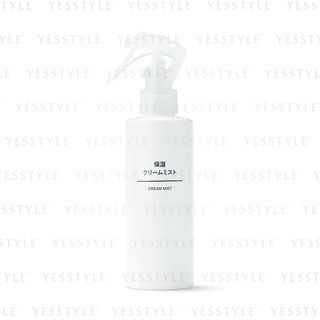
"MUJI - Cream Mist" could be helpful for: Moisturizing, but its actives are not the most effective or are not well-studied.
Ingredient callouts
- Humectants (sodium hyaluronate 0.70% - 1.05% and glycerin 0.65% - 0.95%). These ingredients help attract water to the upper layer of the skin and improve the skin hydration.
Price
The product retails for 21.80$ in the United States.
For a detailed price comparison: click here.
Sources cited in this review
Every concentration estimate and effectiveness label is anchored to one of these 15 studies and safety reviews.
- 1Use of “natural” oils for moisturization: Review of olive, coconut, and sunflower seed oilonlinelibrary.wiley.com
- 2
- 3
- 4Final Report on the Safety Assessment of Dimethicone Copolyoljournals.sagepub.com
- 5Hyaluronic acid: A key molecule in skin agingncbi.nlm.nih.gov
- 6

Affiliate links · As an Amazon Associate, WIMJ earns from qualifying purchases.