Works for
1 of 2 advertised claims delivered
Sun protectionSPF 50 · 1 UV filter · Partial spectrumWeak protectionLow filter dose
This product does not offer good protection against UVA rays.
This product can be considered "reef safe" because it does not contain the UV filters (oxybenzone and octinoxate) that can be harmful to coral reefs when present in the water in high concentrations.
Moisturizing21 ingredients credited for this claimStrong support
“Infused with green tea, broccoli and wheat extracts, the formula soothes and hydrates sun-irritated skin.”
This product can help improve hydration of the skin with the two types of ingredients.
The first type is called “humectants”:
these ingredients help attract water.
When humectants are on the surface of the skin, they “pull in” the moisture from the outside environment, or from
within deeper layers of the skin. The following ingredients in this product do the job:
glycerin, sodium hyaluronate.
This product also contains ingredients called “occlusives”. They help reduce the speed with which our skin loses moisture to the outside environment. These ingredients also help soften the upper layer of the skin, so it feels less tight and nicer to the touch. The following ingredients in this product do the job: persea gratissima oil, vinyl dimethicone.
The following ingredients in this product are especially good for supporting the skin barrier and helping with the hydration level: ceramide np
Anti-oxidationNot advertised by the brand · 6 ingredients credited for this claimModerate support
This product contains antioxidants (camellia sinensis leaf extract) that might be able to help neutralize free radicals in skin to lessen the damage it gets from the UV light (sun). There is not enough evidence to confirm their effectiveness in skin though.
Can it cause trouble?
Irritancy2 strong irritants: Pelargonium graveolens flower oil, Oenothera biennis flower extractMedium risk
ComedogenicClean of flagged comedogenic ingredientsNone flagged
User reviews
Be the first — your take helps the next person decide.
Ingredients
Filter by role to see what each ingredient is doing.
Octyldodecanol~25–31%
- Irritation risk
- Low
An emollient that helps to soften the skin and create a pleasant product texture and stabilize the formulation
More about OctyldodecanolPropylheptyl caprylate~4.4–5.4%
- Irritation risk
- Low
Helps soften the upper layer of the skin
More about Propylheptyl caprylateButylene glycol dicaprylate/dicaprate~5.2–6.3%
- Irritation risk
- Low
Helps soften the upper layer of the skin
More about Butylene glycol dicaprylate/dicaprateC12-15 alkyl benzoate~4.4–5.4%
- Irritation risk
- Low
Enhances the product texture and makes it more spreadable. Helps reduce water loss from the outer layer of skin. Extands the shelf life by preventing bacteria growth
More about C12-15 alkyl benzoatePolyamide-8~3.4–4.1%
- Irritation risk
- Low
Titanium dioxide~2.9–3.5%
- Irritation risk
- Low
Works as a UV filter when used in high concentrations. It is photostable and is effective mostly against the UVB light, with some protection in the UVA range. In small concentrations, used for its ability to improve the color of cosmetic products. Is usually well tolerated by the skin
More about Titanium dioxideDibutyl lauroyl glutamide~2.1–2.6%
- Irritation risk
- Medium
Helps improve the product texture and soften the upper layer of the skin
More about Dibutyl lauroyl glutamideDibutyl ethylhexanoyl glutamide~1.6–2%
- Irritation risk
- Medium
Helps improve the product texture and soften the upper layer of the skin
More about Dibutyl ethylhexanoyl glutamideSilica silylate~1.5–1.8%
Vinyl dimethicone~1.2–1.5%
- Irritation risk
- Low
A type of silicone that helps to create a nice product texture and soften the upper layer of the skin
More about Vinyl dimethiconeAluminum stearate~0.95–1.2%
- Irritation risk
- Medium
Used to help evenly disperse other ingredients (for example, pigment) in a formulation
More about Aluminum stearatePolyhydroxystearic acid~0.8–1.15%
- Irritation risk
- Medium
Used to create a thicker product consistency and stabilize the formulation
More about Polyhydroxystearic acidPelargonium graveolens flower oil~0.7–1.1%
- Irritation risk
- High
An essential oil. Can be irritating. Can become an allergen with oxidation
More about Pelargonium graveolens flower oilGlycine soja seed extract~0.75–1.1%
- Irritation risk
- Medium
An emollient that helps soften the skin. Might be somewhat helpful in evening the skin tone.
More about Glycine soja seed extractCamellia sinensis leaf extract~0.65–0.95%
- Irritation risk
- Low
Can contain potent anti-oxidant compounds (abbreviated ECG, GCG, EGC, and EGCG) that might help protect the skin from free radicals. Can help calm down inflammation and has some anti-bacterial properties. Unfortunately, these antioxidants are unstable and lose their effectiveness very quickly in products. The concentration of the antioxidant compounds in the extract also tends to be low to be effective in topical formulation
More about Camellia sinensis leaf extractOenothera biennis flower extract~0.65–0.95%
Chamomilla recutita flower extract~0.6–0.9%
- Irritation risk
- High
Plant extract that can have healing and anti-inflammatory properties. It is a potential allergen and can be irritating
More about Chamomilla recutita flower extractGlycyrrhiza glabra root extract~0.55–0.85%
- Irritation risk
- Medium
A plant extract that can help lighten the skin and calm down inflammation. Might be helpful in neutralizing free radicals
More about Glycyrrhiza glabra root extractPersea gratissima oil~0.65–0.95%
- Irritation risk
- Medium
An emollient that helps soften the skin and could be helpful in repairing its barrier function
More about Persea gratissima oilSea water~0.5–0.8%
- Irritation risk
- Low
Dissolves other ingredients. It does not have additional skin benefits compared to plain water
More about Sea waterBrassica oleracea italica sprout extract~0.6–0.9%
- Irritation risk
- Low
Phaseolus radiatus sprout extract~0.5–0.75%
- Irritation risk
- Low
Triticum vulgare sprout extract~0.5–0.75%
- Irritation risk
- Low
Beta vulgaris sprout extract~0.5–0.75%
- Irritation risk
- Low
Brassica napus sprout extract~0.5–0.7%
- Irritation risk
- Low
Brassica oleracea capitata sprout extract~0.5–0.75%
- Irritation risk
- Low
Medicago sativa sprout extract~0.5–0.75%
- Irritation risk
- Low
Helianthus annuus sprout extract~0.5–0.75%
- Irritation risk
- Low
Helps soften the upper layer of the skin and can help support the skin barrier
More about Helianthus annuus sprout extractBrassica juncea sprout extract~0.5–0.75%
- Irritation risk
- Low
Glycine soja sprout extract~0.55–0.85%
- Irritation risk
- Low
Carthamus tinctorius bud extract~0.5–0.75%
- Irritation risk
- Low
Trifolium repens sprout extract~0.5–0.7%
- Irritation risk
- Low
Oenothera biennis sprout extract~0.5–0.75%
- Irritation risk
- Low
Arachis hypogaea sprout extract~0.5–0.7%
- Irritation risk
- Low
Bambusa vulgaris shoot extract~0.5–0.75%
- Irritation risk
- Low
Chrysanthemum zawadskii sprout extract~0.5–0.75%
- Irritation risk
- Low
Sesamum indicum sprout extract~0.5–0.7%
- Irritation risk
- Low
Caprylic/capric triglyceride~0.55–0.85%
- Irritation risk
- Medium
A good mix of fatty acids that forms a protective layer on the skin. Improves the shelf life of products. Derived from coconut and glycerin
More about Caprylic/capric triglycerideAlumina~0.6–0.95%
- Irritation risk
- Low
The same compound that is used safely in dental implants and bone cements. In cosmetics, it is used to improve the consistency of products
More about AluminaDehydroacetic acid~0.3–0.6%
Pentaerythrityl tetra-di-t-butyl hydroxyhydrocinnamate~0.45–0.7%
- Irritation risk
- Low
Used to increase stability of product formulations
More about Pentaerythrityl tetra-di-t-butyl hydroxyhydrocinnamateStearic acid~0.6–0.9%
- Irritation risk
- Low
Helps oil and water mix together and works as an emollient
More about Stearic acidGlycerin~0.45–0.7%
- Irritation risk
- Low
One of the best moisturizing ingredients. Naturally present in skin. It attracts water to the upper layer of the skin working as a humectant
More about GlycerinBeta-glucan~0.4–0.65%
- Irritation risk
- Low
Helps attract water to the upper layer of the skin, calm down inflammation and irritation, restore the barrier function and support wound healing. It can be helpful in reducing fine lines and wrinkles
More about Beta-glucanCeramide np~0.4–0.65%
- Irritation risk
- Low
A type of lipid similar to ceramides naturally present in skin. Helps to soften the upper layer of the skin and supports the skin barrier function to keep it hydrated. Can help to prevent inflammation in skin
More about Ceramide npSodium pca~0.25–0.5%
- Irritation risk
- Low
Naturally present in skin and helps to attract water to its upper layer
More about Sodium pcaSodium hyaluronate~0.2–0.4%
- Irritation risk
- Low
One of the best moisturizing ingredients. Attracts water into the upper layer of the skin
More about Sodium hyaluronateAllantoin~0.15–0.3%
- Irritation risk
- Low
Helps calm down inflammation in skin and can help reduce itching. Helps to repair the skin barrier and keep skin hydrated
More about AllantoinTocopherol~0.2–0.4%
- Irritation risk
- Low
Pure form of vitamin E. Can help moisturise and protect the skin from free radicals. Often used to help stabilise other ingredients or the formula itself
More about TocopherolPanthenol~0.2–0.35%
- Irritation risk
- Low
Helps attract water to the upper layer of the skin and can help improve skin barrier function
More about PanthenolButylene glycol~0.15–0.25%
- Irritation risk
- Low
Used to create a nice product texture and help delivery of other ingredients. Might be somewhat helpful in attracting water to the upper layer of the skin
More about Butylene glycolWater~0.15–0.25%
Ingredient list view
Octyldodecanol, Propylheptyl caprylate, Butylene glycol dicaprylate/dicaprate, C12-15 alkyl benzoate, Polyamide-8, Titanium dioxide, Dibutyl lauroyl glutamide, Dibutyl ethylhexanoyl glutamide, Silica silylate, Vinyl dimethicone, Aluminum stearate, Polyhydroxystearic acid, Pelargonium graveolens flower oil, Glycine soja seed extract, Camellia sinensis leaf extract, Oenothera biennis flower extract, Chamomilla recutita flower extract, Glycyrrhiza glabra root extract, Persea gratissima oil, Sea water, Brassica oleracea italica sprout extract, Phaseolus radiatus sprout extract, Triticum vulgare sprout extract, Beta vulgaris sprout extract, Brassica napus sprout extract, Brassica oleracea capitata sprout extract, Medicago sativa sprout extract, Helianthus annuus sprout extract, Brassica juncea sprout extract, Glycine soja sprout extract, Carthamus tinctorius bud extract, Trifolium repens sprout extract, Oenothera biennis sprout extract, Arachis hypogaea sprout extract, Bambusa vulgaris shoot extract, Chrysanthemum zawadskii sprout extract, Sesamum indicum sprout extract, Caprylic/capric triglyceride, Alumina, Dehydroacetic acid, Pentaerythrityl tetra-di-t-butyl hydroxyhydrocinnamate, Stearic acid, Glycerin, Beta-glucan, Ceramide np, Sodium pca, Sodium hyaluronate, Allantoin, Tocopherol, Panthenol, Butylene glycol, Water
Compare prices
Retailers ranked by price — lowest first.

Product summary
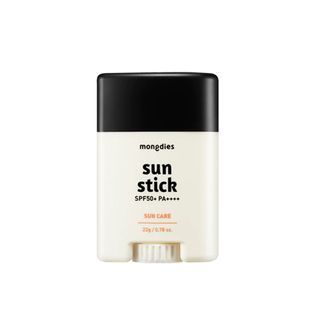
We do not recommend "Mongdies - Sun Stick" because it does not provide good UVA protection. UVA sun rays don't burn the skin, but they still lead to photoaging and hyperpigmentation.
This sunscreen should also be hydrating enough to use without an additional moisturizer during the day.
Sunscreen filters
This product is a mineral sunscreen. It uses titanium dioxide for sun protection. Titanium dioxide almost never irritates the skin or stings eyes, but it can leave a white cast.
Irritation risk
There are some common irritants in this product, including ingredients that do not have benefits for the skin. We assess the overall irritancy of this sunscreen to be medium. For a detailed overview of all potential irritants: click here
You can see the detailed formula review with the breakdown of all actives in the product and the full ingredient list with estimated concentrations in the tables below.
Price
The product retails from 15.50$ up to 28.00$ in the United States.
For a detailed price comparison: click here.
Sources cited in this review
Every concentration estimate and effectiveness label is anchored to one of these 22 studies and safety reviews.
- 1
- 2
- 3
- 4
- 5
- 6β-Glucans: Multi-Functional Modulator of Wound Healingncbi.nlm.nih.gov

Affiliate links · As an Amazon Associate, WIMJ earns from qualifying purchases.