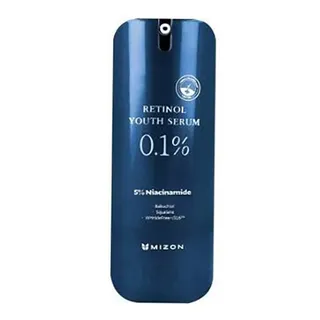
Mizon Retinol Youth Serum 0.1%

Mizon Retinol Youth Serum 0.1%

Efficacy100/100IrritancyHigh

Works for

Anti-aging
Retinol, Niacinamide + 6 more
Works well
What the product description says
“Mizon Retinol Youth Serum 0.1% helps improve wrinkles and skin elasticity.”
Source: Lila Beauty

This product can help reduce and prevent fine lines and wrinkles, improve skin elasticity and firmness because it contains retinol, adenosine, bakuchiol, niacinamide.

These ingredients in the product can also be helpful, even though there is less evidence for their effectiveness: acetyl tetrapeptide-15, copper tripeptide-1.

Keep in mind that it typically takes at least 6 weeks to notice any results because the changes that are needed to improve fine lines and elasticity happen in the deeper layers of the skin. No topical anti-aging product can “erase” wrinkles or fully reverse signs of aging.

RetinolHeroEffect: HighTwo steps removed from the active form of vitamin A - retinoic acid. Once converted to the retinoic acid in the skin, retinol is proven to be effective against all signs of aging. It improves skin cell turnover, helps fight blemishes and clogged pores, can regulate excess oil production and even skin tone. It can, however, be quite irritating~0.3–0.55%
NiacinamideKey activeEffect: HighIs proven to be effective in reducing blemishes, evening out skin tone and helping to improve lines and wrinkles. It helps the skin to repair sun damage, calm down inflammation and keep maintain good levels of moisture. The concentration of about 2% is effective for supporting the skin barrier and evening out the skin tone. Concentration of 4-6% is better for helping with acne and balancing the sebum production~4.2–5.1%
BakuchiolKey activeEffect: HighA plant extract that is, though different in chemical structure, acts similar to retinoids. First studies show that it can help reduce fine lines and wrinkles, improve skin tone, reduce clogged pores and blemishes, and reduce inflammation. There is no conclusive evidence that bakuchiol is as effective as retinol however. The study that directly compared retinol with bakuchiol used bakuchiol applied twice daily compared to once per day for the retinol. According to this study, bakuchiol is less irritating than retinol. Bakuchiol is extracted from seeds of Babchi plant. Other parts of the plant contain coumarins that could cause allergic and irritant reactions. These compounds should be removed in the extraction process when bakuchiol is produced, but it is a good idea to be cautious and stay away from products that include the Babchi plant extracts other than purified bakuchiol to avoid irritation~0.55–0.85%
AdenosineKey activeEffect: HighMight help improve cell turnover and reduce inflammation in skin. One study shows that the ingredients might be able to help reduce dynamic wrinkles (for example, in the corners of the eyes or on the forehead)~0.3–0.55%
Copper tripeptide-1Key activeEffect: MediumA naturally occurring peptide. One of the most studied peptides in dermatology. It is sometimes abbreviated GHK-Cu. Belongs to the class of carrier peptides. It stimulates both synthesis and breakdown of collagen in skin. It is released in skin wounds and inflammation to support healing. It accelerates wound-healing of the skin and can stimulate hair growth. There are preliminary studies that confirm that copper tripeptide can help support collagen production reducing fine lines and wrinkles and decrease inflammation in skin.~0.3–0.5%
Acetyl tetrapeptide-15Key activeEffect: MediumA type of peptide. Peptides are excellent moisturizers and might be able support collagen production reducing fine lines and wrinkles~0.25–0.5%
Hyaluronic acidEffect: LowOne of the best moisturizing ingredients. Attracts water into the upper layer of the skin. Naturally present in skin. Typically has large molecule size unless advertised otherwise on the product label. Helps support skin's barrier function and may help to reduce inflammation~0.2–0.4%
Butyrospermum parkii butterEffect: Low, below effective doseA great moisturising ingredient that softens the skin and reduces water loss from its upper layer. It also can be helpful in protecting skin from free radicals~0.55–0.8%
Anti-oxidation
Side benefit · Bakuchiol, Retinol + 5 more
Works well

This product contains antioxidants (bakuchiol, retinol) that can help neutralize free radicals in skin. By doing so, they can lessen the damage the skin gets from the UV light (sun).

BakuchiolKey activeEffect: HighA plant extract that is, though different in chemical structure, acts similar to retinoids. First studies show that it can help reduce fine lines and wrinkles, improve skin tone, reduce clogged pores and blemishes, and reduce inflammation. There is no conclusive evidence that bakuchiol is as effective as retinol however. The study that directly compared retinol with bakuchiol used bakuchiol applied twice daily compared to once per day for the retinol. According to this study, bakuchiol is less irritating than retinol. Bakuchiol is extracted from seeds of Babchi plant. Other parts of the plant contain coumarins that could cause allergic and irritant reactions. These compounds should be removed in the extraction process when bakuchiol is produced, but it is a good idea to be cautious and stay away from products that include the Babchi plant extracts other than purified bakuchiol to avoid irritation~0.55–0.85%
RetinolKey activeEffect: HighTwo steps removed from the active form of vitamin A - retinoic acid. Once converted to the retinoic acid in the skin, retinol is proven to be effective against all signs of aging. It improves skin cell turnover, helps fight blemishes and clogged pores, can regulate excess oil production and even skin tone. It can, however, be quite irritating~0.3–0.55%
AdenosineEffect: LowMight help improve cell turnover and reduce inflammation in skin. One study shows that the ingredients might be able to help reduce dynamic wrinkles (for example, in the corners of the eyes or on the forehead)~0.3–0.55%
Porphyridium cruentum extractEffect: LowA red algae extract. Can help attract water to the upper layer of the skin and might have an antioxidant effect~0.3–0.55%
Crithmum maritimum extractEffect: LowAn algae extract that might have anti-oxidant properties~0.3–0.55%
Citrus reticulata peel extractEffect: LowA likely irritant. Might have some anti-oxidant activity, but is mostly used as a fragrance in cosmetic products~0.3–0.55%
Butyrospermum parkii butterEffect: Low, below effective doseA great moisturising ingredient that softens the skin and reduces water loss from its upper layer. It also can be helpful in protecting skin from free radicals~0.55–0.8%
Exfoliation
Side benefit · Retinol
Works well

This product can help exfoliate the skin. In other words, it helps break down the bonds between dead cells on the surface of the skin and speed up the skin turnover. Skin often appears softer and brighter after exfoliation, but overdoing it can result in disrupted skin barrier. The following ingredient is doing the exfoliating job in this product: retinol.

RetinolKey activeEffect: HighTwo steps removed from the active form of vitamin A - retinoic acid. Once converted to the retinoic acid in the skin, retinol is proven to be effective against all signs of aging. It improves skin cell turnover, helps fight blemishes and clogged pores, can regulate excess oil production and even skin tone. It can, however, be quite irritating~0.3–0.55%
Evens skin tone
Side benefit · Retinol, Niacinamide + 2 more
Works well

This product can help reduce hypepigmentation and even out the skin tone because it contains the following effective ingredients: retinol.

In addition, this product contains bakuchiol, niacinamide. This ingredient (ingredients) might help reduce hyperpigmentation, but the effect, if any, is likely to be small.

Keep in mind that you would need to apply any topical skincare targetted at hypigmentation consistently for a couple of months to get a result. No topical skincare product can help get rid of hyperpigmentation (including post-acne marks and age spots) instantly.

RetinolHeroEffect: HighTwo steps removed from the active form of vitamin A - retinoic acid. Once converted to the retinoic acid in the skin, retinol is proven to be effective against all signs of aging. It improves skin cell turnover, helps fight blemishes and clogged pores, can regulate excess oil production and even skin tone. It can, however, be quite irritating~0.3–0.55%
NiacinamideKey activeEffect: HighIs proven to be effective in reducing blemishes, evening out skin tone and helping to improve lines and wrinkles. It helps the skin to repair sun damage, calm down inflammation and keep maintain good levels of moisture. The concentration of about 2% is effective for supporting the skin barrier and evening out the skin tone. Concentration of 4-6% is better for helping with acne and balancing the sebum production~4.2–5.1%
BakuchiolKey activeEffect: HighA plant extract that is, though different in chemical structure, acts similar to retinoids. First studies show that it can help reduce fine lines and wrinkles, improve skin tone, reduce clogged pores and blemishes, and reduce inflammation. There is no conclusive evidence that bakuchiol is as effective as retinol however. The study that directly compared retinol with bakuchiol used bakuchiol applied twice daily compared to once per day for the retinol. According to this study, bakuchiol is less irritating than retinol. Bakuchiol is extracted from seeds of Babchi plant. Other parts of the plant contain coumarins that could cause allergic and irritant reactions. These compounds should be removed in the extraction process when bakuchiol is produced, but it is a good idea to be cautious and stay away from products that include the Babchi plant extracts other than purified bakuchiol to avoid irritation~0.55–0.85%
Dipotassium glycyrrhizateEffect: Low, below effective doseA salt derived from licorice. Works as an emollient to soften the upper layer of the skin and can help calm down inflammation. Might be helpful for skin lightening~0.3–0.55%
Anti-blemish
Side benefit · Niacinamide, Retinol + 1 more
Works well

This product can help reduce breakouts and clogged pores because it contains the following ingredient: niacinamide, retinol. These ingredients is used for treating acne and can have a noticeable effect.

In addition, this product contains bakuchiol. It can help in reducing blemishes, even though it is less effective.

NiacinamideHeroEffect: HighIs proven to be effective in reducing blemishes, evening out skin tone and helping to improve lines and wrinkles. It helps the skin to repair sun damage, calm down inflammation and keep maintain good levels of moisture. The concentration of about 2% is effective for supporting the skin barrier and evening out the skin tone. Concentration of 4-6% is better for helping with acne and balancing the sebum production~4.2–5.1%
RetinolHeroEffect: HighTwo steps removed from the active form of vitamin A - retinoic acid. Once converted to the retinoic acid in the skin, retinol is proven to be effective against all signs of aging. It improves skin cell turnover, helps fight blemishes and clogged pores, can regulate excess oil production and even skin tone. It can, however, be quite irritating~0.3–0.55%
BakuchiolKey activeEffect: HighA plant extract that is, though different in chemical structure, acts similar to retinoids. First studies show that it can help reduce fine lines and wrinkles, improve skin tone, reduce clogged pores and blemishes, and reduce inflammation. There is no conclusive evidence that bakuchiol is as effective as retinol however. The study that directly compared retinol with bakuchiol used bakuchiol applied twice daily compared to once per day for the retinol. According to this study, bakuchiol is less irritating than retinol. Bakuchiol is extracted from seeds of Babchi plant. Other parts of the plant contain coumarins that could cause allergic and irritant reactions. These compounds should be removed in the extraction process when bakuchiol is produced, but it is a good idea to be cautious and stay away from products that include the Babchi plant extracts other than purified bakuchiol to avoid irritation~0.55–0.85%
Moisturizing
Side benefit · Niacinamide, Panthenol + 26 more
Works well

This product can help improve hydration of the skin with the two types of ingredients.

The first type is called “humectants”:
these ingredients help attract water. When humectants are on the surface of the skin, they “pull in” the moisture from the outside environment, or from within deeper layers of the skin. The following ingredients in this product do the job: glycerin, hyaluronic acid.

This product also contains ingredients called “occlusives”. They help reduce the speed with which our skin loses moisture to the outside environment. These ingredients also help soften the upper layer of the skin, so it feels less tight and nicer to the touch. The following ingredients in this product do the job: caprylic/capric triglyceride, squalane.

The following ingredients in this product are especially good for supporting the skin barrier and helping with the hydration level: acetyl tetrapeptide-15, ceramide np, copper tripeptide-1, niacinamide, panthenol

NiacinamideHeroEffect: HighIs proven to be effective in reducing blemishes, evening out skin tone and helping to improve lines and wrinkles. It helps the skin to repair sun damage, calm down inflammation and keep maintain good levels of moisture. The concentration of about 2% is effective for supporting the skin barrier and evening out the skin tone. Concentration of 4-6% is better for helping with acne and balancing the sebum production~4.2–5.1%
PanthenolHero· HumectantEffect: HighHelps attract water to the upper layer of the skin and can help improve skin barrier function~0.4–0.65%
Ceramide npHero· EmollientEffect: HighA type of lipid similar to ceramides naturally present in skin. Helps to soften the upper layer of the skin and supports the skin barrier function to keep it hydrated. Can help to prevent inflammation in skin~0.3–0.55%
Copper tripeptide-1HeroEffect: HighA naturally occurring peptide. One of the most studied peptides in dermatology. It is sometimes abbreviated GHK-Cu. Belongs to the class of carrier peptides. It stimulates both synthesis and breakdown of collagen in skin. It is released in skin wounds and inflammation to support healing. It accelerates wound-healing of the skin and can stimulate hair growth. There are preliminary studies that confirm that copper tripeptide can help support collagen production reducing fine lines and wrinkles and decrease inflammation in skin.~0.3–0.5%
Acetyl tetrapeptide-15HeroEffect: HighA type of peptide. Peptides are excellent moisturizers and might be able support collagen production reducing fine lines and wrinkles~0.25–0.5%
GlycerinKey active· HumectantEffect: HighOne of the best moisturizing ingredients. Naturally present in skin. It attracts water to the upper layer of the skin working as a humectant~3–3.7%
Neopentyl glycol dicaprateKey active· EmollientEffect: MediumHelps soften the upper layer of the skin~2.4–2.9%
Caprylic/capric triglycerideKey active· Emollient, OcclusiveEffect: HighA good mix of fatty acids that forms a protective layer on the skin. Improves the shelf life of products. Derived from coconut and glycerin~0.75–1.15%
Macadamia ternifolia seed oilKey active· EmollientEffect: MediumPlant oil from nuts that helps soften the upper layer of the skin. Contains a high concentration of oleic acid that can weaken skin's barrier function and increase water-loss while enhancing penetration of other ingredients~0.45–0.65%
CholesterolKey active· EmollientEffect: HighAn emollient that is naturally found in skin~0.4–0.6%
SqualaneKey active· Emollient, OcclusiveEffect: HighAn oil naturally present in skin. Works as an emollient to soften the skin and form a protective layer on its surface without a greasy feeling.~0.4–0.6%
Brassica campestris sterolsKey active· EmollientEffect: MediumHelp soften the upper layer of the skin~0.35–0.6%
Sodium hyaluronateKey active· HumectantEffect: HighOne of the best moisturizing ingredients. Attracts water into the upper layer of the skin~0.3–0.55%
Porphyridium cruentum extractKey activeEffect: MediumA red algae extract. Can help attract water to the upper layer of the skin and might have an antioxidant effect~0.3–0.55%
AdenosineKey activeEffect: MediumMight help improve cell turnover and reduce inflammation in skin. One study shows that the ingredients might be able to help reduce dynamic wrinkles (for example, in the corners of the eyes or on the forehead)~0.3–0.55%
Crithmum maritimum extractKey activeEffect: MediumAn algae extract that might have anti-oxidant properties~0.3–0.55%
GlucoseKey active· HumectantEffect: MediumHelps attract water to the upper layer of the skin. Could be helpful in restoring the skin barrier function~0.3–0.55%
Hydrolyzed hyaluronic acidKey active· HumectantEffect: HighOne of the best moisturizing ingredients. Attracts water into the upper layer of the skin. A version of it is naturally present in skin~0.2–0.35%
Hyaluronic acidKey active· HumectantEffect: HighOne of the best moisturizing ingredients. Attracts water into the upper layer of the skin. Naturally present in skin. Typically has large molecule size unless advertised otherwise on the product label. Helps support skin's barrier function and may help to reduce inflammation~0.2–0.4%
Hydrolyzed sodium hyaluronateKey activeEffect: HighAttracts water into the upper layer of the skin~0.15–0.3%
Sodium acetylated hyaluronateKey active· HumectantEffect: HighA type of hyaluronic acid that works as an excellent moisturizer by attracting water into the upper layer of the skin. Is typically feels less sticky on the skin compared to the usual hyaluronic acid~0.1–0.2%
Sodium hyaluronate crosspolymerKey active· HumectantEffect: HighAttracts water into the upper layer of the skin~0.1–0.2%
Glyceryl stearate· EmollientEffect: LowAn emollient that softens the skin and forms a protective layer on its surface. Helps water and oil mix together~0.55–0.85%
Caprylyl glycol· Humectant, EmollientEffect: LowHelps preserve products and creates a nice product texture~0.35–0.6%
Pentylene glycol· EmollientEffect: LowUsed to preserve products, dissolve other ingredients and create a nice product texture~0.2–0.35%
Aloe barbadensis leaf extractEffect: Low, below effective doseTraditionally used to treat sunburns, dermatitis and inflammation, but evidence for its effectiveness is lacking. The extract can contain humectants that help attract water into the skin~0.4–0.6%
Butyrospermum parkii butterUnder-dosedA great moisturising ingredient that softens the skin and reduces water loss from its upper layer. It also can be helpful in protecting skin from free radicals~0.55–0.8%
Dipotassium glycyrrhizateUnder-dosedA salt derived from licorice. Works as an emollient to soften the upper layer of the skin and can help calm down inflammation. Might be helpful for skin lightening~0.3–0.55%

Can it cause trouble?

Irritancy
4 strong irritants: Alcohol, Retinol + 2 more — patch-test recommended
High risk
We flagged 24 ingredients with irritancy potential. Severity depends on your sensitivity threshold; the table lists the worst offenders first.
IngredientFunctionIrritationEst. amount
PullulanCreates a thin drying film on the skin resulting in a short-term tightening effectHigh~0.35–0.6%est.
AlcoholCan be drying and contribute to skin irritation. Used in formulars to dissolve other ingredients, create a thinner product consistency or for its antibacterial propertiesHigh~0.3–0.6%est.
RetinolTwo steps removed from the active form of vitamin A - retinoic acid. Once converted to the retinoic acid in the skin, retinol is proven to be effective against all signs of aging. It improves skin cell turnover, helps fight blemishes and clogged pores, can regulate excess oil production and even skin tone. It can, however, be quite irritatingHigh~0.3–0.55%est.
Citrus reticulata peel extractA likely irritant. Might have some anti-oxidant activity, but is mostly used as a fragrance in cosmetic productsHigh~0.3–0.55%est.
Citrus nobilis peel extract—High~0.25–0.5%est.
MethylpropanediolHelps dissolve other ingredients in a formulationMedium~5.6–6.9%est.
1,2-hexanediolA preservativeMedium~0.75–1.1%est.
Polyglyceryl-10 laurateHelps water and oil mix togetherMedium~0.95–1.15%est.
Caprylic/capric triglycerideA good mix of fatty acids that forms a protective layer on the skin. Improves the shelf life of products. Derived from coconut and glycerinMedium~0.75–1.15%est.
HydroxyacetophenoneUsed to increase effectiveness of preservativesMedium~0.6–0.85%est.
BakuchiolA plant extract that is, though different in chemical structure, acts similar to retinoids. First studies show that it can help reduce fine lines and wrinkles, improve skin tone, reduce clogged pores and blemishes, and reduce inflammation. There is no conclusive evidence that bakuchiol is as effective as retinol however. The study that directly compared retinol with bakuchiol used bakuchiol applied twice daily compared to once per day for the retinol. According to this study, bakuchiol is less irritating than retinol. Bakuchiol is extracted from seeds of Babchi plant. Other parts of the plant contain coumarins that could cause allergic and irritant reactions. These compounds should be removed in the extraction process when bakuchiol is produced, but it is a good idea to be cautious and stay away from products that include the Babchi plant extracts other than purified bakuchiol to avoid irritationMedium~0.55–0.85%est.
Macadamia ternifolia seed oilPlant oil from nuts that helps soften the upper layer of the skin. Contains a high concentration of oleic acid that can weaken skin's barrier function and increase water-loss while enhancing penetration of other ingredientsMedium~0.45–0.65%est.
Hydrogenated phosphatidylcholineHelps oil and water mix togetherMedium~0.35–0.6%est.
Hydroxypropyl methylcelluloseUsed to create a thicker product consistency and stabilize the formulationMedium~0.35–0.65%est.
BhtA preservativeMedium~0.3–0.55%est.
Citric acidCan work as an exfoliant but is typically used to adjust the product pHMedium~0.3–0.55%est.
Caprylyl/capryl glucosideHelps oil and water mix together. Can be used as a cleansing agentMedium~0.45–0.7%est.
Sorbitan oleateHelps oil and water mix togetherMedium~0.3–0.6%est.
Aloe barbadensis leaf extractTraditionally used to treat sunburns, dermatitis and inflammation, but evidence for its effectiveness is lacking. The extract can contain humectants that help attract water into the skinMedium~0.4–0.6%est.
Potassium cetyl phosphateHelps oil and water mix togetherMedium~0.35–0.6%est.
Caprylyl glycolHelps preserve products and creates a nice product textureMedium~0.35–0.6%est.
Disodium edtaStabilizes the product formulationMedium~0.25–0.45%est.
Pentylene glycolUsed to preserve products, dissolve other ingredients and create a nice product textureMedium~0.2–0.35%est.
Sodium hyaluronate crosspolymerAttracts water into the upper layer of the skinMedium~0.1–0.2%est.
Comedogenic
4 ingredients rated 2 or more on the 0–5 pore-clogging scale
4 flagged
These ingredients have a comedogenic rating of 2 or more on a 0–5 scale; the table shows each one's rating. In leave-on products they can clog pores in acne-prone skin.
IngredientFunctionRatingEst. amount
Butyrospermum parkii butterA great moisturising ingredient that softens the skin and reduces water loss from its upper layer. It also can be helpful in protecting skin from free radicals3/5~0.55–0.8%est.
Crithmum maritimum extractAn algae extract that might have anti-oxidant properties3/5~0.3–0.55%est.
Porphyridium cruentum extractA red algae extract. Can help attract water to the upper layer of the skin and might have an antioxidant effect3/5~0.3–0.55%est.
Sorbitan oleateHelps oil and water mix together2/5~0.3–0.6%est.

User reviews

Would you recommend?
No community reviews yet.

Be the first — your take helps the next person decide.

Ingredients

Filter by role to see what each ingredient is doing.

Water~45–55%
Formula
Irritation risk
Low

Plain old water

More about Water
Methylpropanediol~5.6–6.9%
Irritant · medium
Irritation risk
Medium

Helps dissolve other ingredients in a formulation

More about Methylpropanediol
Niacinamide~4.2–5.1%
Hero · Moisturizing, Anti-blemish
Irritation risk
Low
Works for
Anti-agingAnti-blemishEvens skin toneMoisturizingReduces irritationAnti-inflammatoryAntibacterialReduces redness

Is proven to be effective in reducing blemishes, evening out skin tone and helping to improve lines and wrinkles. It helps the skin to repair sun damage, calm down inflammation and keep maintain good levels of moisture. The concentration of about 2% is effective for supporting the skin barrier and evening out the skin tone. Concentration of 4-6% is better for helping with acne and balancing the sebum production

More about Niacinamide
Glycerin~3–3.7%
Key active
Irritation risk
Low
Works for
Moisturizing

One of the best moisturizing ingredients. Naturally present in skin. It attracts water to the upper layer of the skin working as a humectant

More about Glycerin
Neopentyl glycol dicaprate~2.4–2.9%
Key active
Irritation risk
Low
Works for
Moisturizing

Helps soften the upper layer of the skin

More about Neopentyl glycol dicaprate
Cyclodextrin~1.9–2.3%
Formula
Irritation risk
Low

A type of sugar that is used to support delivery of active ingredients and can enhance their penetration into the skin without disrupting the skin's barrier

More about Cyclodextrin
1,2-hexanediol~0.75–1.1%
Irritant · medium
Irritation risk
Medium

A preservative

More about 1,2-hexanediol
Hydrogenated lecithin~1.4–1.7%
Formula
Irritation risk
Low
Works for
Cleansing

Helps to retain moisture by creating a protective barrier on the skin. Rich in fatty acids. Improves product texture and helps with the penetration of other ingredients.

More about Hydrogenated lecithin
Propanediol~1.2–1.4%
Formula
Irritation risk
Low

Acts as a solvent for other ingredients. Speeds up the absorption of other ingredients into the skin

More about Propanediol
Polyglyceryl-10 laurate~0.95–1.15%
Irritant · medium
Irritation risk
Medium
Works for
Cleansing

Helps water and oil mix together

More about Polyglyceryl-10 laurate
Caprylic/capric triglyceride~0.75–1.15%
Key activeIrritant · medium
Irritation risk
Medium
Works for
Moisturizing

A good mix of fatty acids that forms a protective layer on the skin. Improves the shelf life of products. Derived from coconut and glycerin

More about Caprylic/capric triglyceride
Hydroxyacetophenone~0.6–0.85%
Irritant · medium
Irritation risk
Medium

Used to increase effectiveness of preservatives

More about Hydroxyacetophenone
Bakuchiol~0.55–0.85%
Key activeIrritant · medium
Irritation risk
Medium
Works for
Evens skin toneAnti-inflammatoryAnti-blemishAnti-oxidationAnti-aging

A plant extract that is, though different in chemical structure, acts similar to retinoids. First studies show that it can help reduce fine lines and wrinkles, improve skin tone, reduce clogged pores and blemishes, and reduce inflammation. There is no conclusive evidence that bakuchiol is as effective as retinol however. The study that directly compared retinol with bakuchiol used bakuchiol applied twice daily compared to once per day for the retinol. According to this study, bakuchiol is less irritating than retinol. Bakuchiol is extracted from seeds of Babchi plant. Other parts of the plant contain coumarins that could cause allergic and irritant reactions. These compounds should be removed in the extraction process when bakuchiol is produced, but it is a good idea to be cautious and stay away from products that include the Babchi plant extracts other than purified bakuchiol to avoid irritation

More about Bakuchiol
Butyrospermum parkii butter~0.55–0.8%
Under-dosedComedogenic 3/5
Irritation risk
Low
Comedogenicity
3/5
Works for
MoisturizingAnti-oxidationAnti-aging

A great moisturising ingredient that softens the skin and reduces water loss from its upper layer. It also can be helpful in protecting skin from free radicals

More about Butyrospermum parkii butter
Sodium acrylate/sodium acryloyldimethyl taurate copolymer~0.45–0.7%
Formula
Irritation risk
Low

Used to create a thicker product consistency

More about Sodium acrylate/sodium acryloyldimethyl taurate copolymer
Glyceryl stearate~0.55–0.85%
Formula
Irritation risk
Low
Works for
CleansingMoisturizing

An emollient that softens the skin and forms a protective layer on its surface. Helps water and oil mix together

More about Glyceryl stearate
Polyisobutene~0.5–0.75%
Formula
Irritation risk
Low

Used to improve the product consistency

More about Polyisobutene
Sodium polyacrylate~0.5–0.75%
Formula
Irritation risk
Low
Works for
Mattifying

Used to create a gel-like product texture, as well as to stabilize emulsions

More about Sodium polyacrylate
Panthenol~0.4–0.65%
Hero · Moisturizing
Irritation risk
Low
Works for
Reduces rednessMoisturizingReduces irritation

Helps attract water to the upper layer of the skin and can help improve skin barrier function

More about Panthenol
Macadamia ternifolia seed oil~0.45–0.65%
Key activeIrritant · medium
Irritation risk
Medium
Works for
Moisturizing

Plant oil from nuts that helps soften the upper layer of the skin. Contains a high concentration of oleic acid that can weaken skin's barrier function and increase water-loss while enhancing penetration of other ingredients

More about Macadamia ternifolia seed oil
Hydrogenated phosphatidylcholine~0.35–0.6%
Irritant · medium
Irritation risk
Medium
Works for
Cleansing

Helps oil and water mix together

More about Hydrogenated phosphatidylcholine
Hydroxypropyl methylcellulose~0.35–0.65%
Irritant · medium
Irritation risk
Medium
Works for
Cleansing

Used to create a thicker product consistency and stabilize the formulation

More about Hydroxypropyl methylcellulose
Squalane~0.4–0.6%
Key active
Irritation risk
Low
Works for
Moisturizing

An oil naturally present in skin. Works as an emollient to soften the skin and form a protective layer on its surface without a greasy feeling.

More about Squalane
Pullulan~0.35–0.6%
Irritant · high
Irritation risk
High
Works for
Mattifying

Creates a thin drying film on the skin resulting in a short-term tightening effect

More about Pullulan
Bht~0.3–0.55%
Irritant · medium
Irritation risk
Medium

A preservative

More about Bht
Dipropylene glycol~0.3–0.55%
Formula
Irritation risk
Low

Helps to dissolve other ingredients in a formulation. Slows down the rate of product drying

More about Dipropylene glycol
Polysorbate 20~0.35–0.6%
Formula
Irritation risk
Low
Works for
Cleansing

Helps oil and water mix together

More about Polysorbate 20
Alcohol~0.3–0.6%
Irritant · high
Irritation risk
High
Works for
Antibacterial

Can be drying and contribute to skin irritation. Used in formulars to dissolve other ingredients, create a thinner product consistency or for its antibacterial properties

More about Alcohol
Retinol~0.3–0.55%
Hero · Anti-aging, Evens skin tone, Anti-blemishIrritant · high
Irritation risk
High
Works for
Anti-agingAnti-oxidationExfoliationMattifyingAnti-blemishEvens skin tone

Two steps removed from the active form of vitamin A - retinoic acid. Once converted to the retinoic acid in the skin, retinol is proven to be effective against all signs of aging. It improves skin cell turnover, helps fight blemishes and clogged pores, can regulate excess oil production and even skin tone. It can, however, be quite irritating

More about Retinol
Citric acid~0.3–0.55%
Irritant · medium
Irritation risk
Medium

Can work as an exfoliant but is typically used to adjust the product pH

More about Citric acid
Citrus reticulata peel extract~0.3–0.55%
Irritant · high
Irritation risk
High
Works for
Anti-oxidation

A likely irritant. Might have some anti-oxidant activity, but is mostly used as a fragrance in cosmetic products

More about Citrus reticulata peel extract
Gleditsia australis fruit extract~0.3–0.55%
Formula
Sophora flavescens root extract~0.3–0.55%
Formula
Peg-5 rapeseed sterol~0.45–0.65%
Formula
Irritation risk
Low
Works for
Cleansing
More about Peg-5 rapeseed sterol
Brassica campestris sterols~0.35–0.6%
Key active
Irritation risk
Low
Works for
Moisturizing

Help soften the upper layer of the skin

More about Brassica campestris sterols
Adenosine~0.3–0.55%
Key active
Irritation risk
Low
Works for
Anti-agingMoisturizingAnti-oxidation

Might help improve cell turnover and reduce inflammation in skin. One study shows that the ingredients might be able to help reduce dynamic wrinkles (for example, in the corners of the eyes or on the forehead)

More about Adenosine
Caprylyl/capryl glucoside~0.45–0.7%
Irritant · medium
Irritation risk
Medium
Works for
Cleansing

Helps oil and water mix together. Can be used as a cleansing agent

More about Caprylyl/capryl glucoside
Sorbitan oleate~0.3–0.6%
Comedogenic 2/5Irritant · medium
Irritation risk
Medium
Comedogenicity
2/5
Works for
Cleansing

Helps oil and water mix together

More about Sorbitan oleate
Xanthan gum~0.3–0.6%
Formula
Irritation risk
Low
Works for
Cleansing

Used to create a thicker product consistency

More about Xanthan gum
Citrus nobilis peel extract~0.25–0.5%
Irritant · high
Dipotassium glycyrrhizate~0.3–0.55%
Under-dosed
Irritation risk
Low
Works for
MoisturizingAnti-inflammatoryEvens skin tone

A salt derived from licorice. Works as an emollient to soften the upper layer of the skin and can help calm down inflammation. Might be helpful for skin lightening

More about Dipotassium glycyrrhizate
Ceteth-5~0.3–0.6%
Formula
Irritation risk
Low
Works for
Cleansing
More about Ceteth-5
Ceteth-3~0.3–0.6%
Formula
Irritation risk
Low
Works for
Cleansing
More about Ceteth-3
Larix leptolepis bark extract~0.3–0.55%
Formula
Poterium officinale root extract~0.3–0.55%
Formula
Aloe barbadensis leaf extract~0.4–0.6%
Irritant · medium
Irritation risk
Medium
Works for
Moisturizing

Traditionally used to treat sunburns, dermatitis and inflammation, but evidence for its effectiveness is lacking. The extract can contain humectants that help attract water into the skin

More about Aloe barbadensis leaf extract
Sodium hyaluronate~0.3–0.55%
Key active
Irritation risk
Low
Works for
Moisturizing

One of the best moisturizing ingredients. Attracts water into the upper layer of the skin

More about Sodium hyaluronate
Cholesterol~0.4–0.6%
Key active
Irritation risk
Low
Works for
CleansingMoisturizing

An emollient that is naturally found in skin

More about Cholesterol
Crithmum maritimum extract~0.3–0.55%
Key activeComedogenic 3/5
Irritation risk
Low
Comedogenicity
3/5
Works for
MoisturizingAnti-oxidation

An algae extract that might have anti-oxidant properties

More about Crithmum maritimum extract
Porphyridium cruentum extract~0.3–0.55%
Key activeComedogenic 3/5
Irritation risk
Low
Comedogenicity
3/5
Works for
MoisturizingAnti-oxidation

A red algae extract. Can help attract water to the upper layer of the skin and might have an antioxidant effect

More about Porphyridium cruentum extract
Hexapeptide-61 dimer~0.3–0.55%
Formula
Potassium cetyl phosphate~0.35–0.6%
Irritant · medium
Irritation risk
Medium
Works for
Cleansing

Helps oil and water mix together

More about Potassium cetyl phosphate
Caprylyl glycol~0.35–0.6%
Irritant · medium
Irritation risk
Medium
Works for
Moisturizing

Helps preserve products and creates a nice product texture

More about Caprylyl glycol
Glucose~0.3–0.55%
Key active
Irritation risk
Low
Works for
Moisturizing

Helps attract water to the upper layer of the skin. Could be helpful in restoring the skin barrier function

More about Glucose
Copper tripeptide-1~0.3–0.5%
Hero · Moisturizing
Irritation risk
Low
Works for
MoisturizingAnti-aging

A naturally occurring peptide. One of the most studied peptides in dermatology. It is sometimes abbreviated GHK-Cu. Belongs to the class of carrier peptides. It stimulates both synthesis and breakdown of collagen in skin. It is released in skin wounds and inflammation to support healing. It accelerates wound-healing of the skin and can stimulate hair growth. There are preliminary studies that confirm that copper tripeptide can help support collagen production reducing fine lines and wrinkles and decrease inflammation in skin.

More about Copper tripeptide-1
Ceramide np~0.3–0.55%
Hero · Moisturizing
Irritation risk
Low
Works for
MoisturizingReduces irritationAnti-inflammatory

A type of lipid similar to ceramides naturally present in skin. Helps to soften the upper layer of the skin and supports the skin barrier function to keep it hydrated. Can help to prevent inflammation in skin

More about Ceramide np
Acetyl tetrapeptide-15~0.25–0.5%
Hero · Moisturizing
Irritation risk
Low
Works for
MoisturizingAnti-aging

A type of peptide. Peptides are excellent moisturizers and might be able support collagen production reducing fine lines and wrinkles

More about Acetyl tetrapeptide-15
Disodium edta~0.25–0.45%
Irritant · medium
Irritation risk
Medium

Stabilizes the product formulation

More about Disodium edta
Hyaluronic acid~0.2–0.4%
Key active
Irritation risk
Low
Works for
MoisturizingAnti-inflammatoryAnti-aging

One of the best moisturizing ingredients. Attracts water into the upper layer of the skin. Naturally present in skin. Typically has large molecule size unless advertised otherwise on the product label. Helps support skin's barrier function and may help to reduce inflammation

More about Hyaluronic acid
Hydrolyzed hyaluronic acid~0.2–0.35%
Key active
Irritation risk
Low
Works for
Moisturizing

One of the best moisturizing ingredients. Attracts water into the upper layer of the skin. A version of it is naturally present in skin

More about Hydrolyzed hyaluronic acid
Hydrolyzed sodium hyaluronate~0.15–0.3%
Key active
Irritation risk
Low
Works for
Moisturizing

Attracts water into the upper layer of the skin

More about Hydrolyzed sodium hyaluronate
Hydroxypropyltrimonium hyaluronate~0.15–0.3%
Formula
Potassium hyaluronate~0.2–0.35%
Formula
Pentylene glycol~0.2–0.35%
Irritant · medium
Irritation risk
Medium
Works for
Moisturizing

Used to preserve products, dissolve other ingredients and create a nice product texture

More about Pentylene glycol
Sodium hyaluronate crosspolymer~0.1–0.2%
Key activeIrritant · medium
Irritation risk
Medium
Works for
Moisturizing

Attracts water into the upper layer of the skin

More about Sodium hyaluronate crosspolymer
Sodium acetylated hyaluronate~0.1–0.2%
Key active
Irritation risk
Low
Works for
Moisturizing

A type of hyaluronic acid that works as an excellent moisturizer by attracting water into the upper layer of the skin. Is typically feels less sticky on the skin compared to the usual hyaluronic acid

More about Sodium acetylated hyaluronate
Ingredient list view

Water, Methylpropanediol, Niacinamide, Glycerin, Neopentyl glycol dicaprate, Cyclodextrin, 1,2-hexanediol, Hydrogenated lecithin, Propanediol, Polyglyceryl-10 laurate, Caprylic/capric triglyceride, Hydroxyacetophenone, Bakuchiol, Butyrospermum parkii butter, Sodium acrylate/sodium acryloyldimethyl taurate copolymer, Glyceryl stearate, Polyisobutene, Sodium polyacrylate, Panthenol, Macadamia ternifolia seed oil, Hydrogenated phosphatidylcholine, Hydroxypropyl methylcellulose, Squalane, Pullulan, Bht, Dipropylene glycol, Polysorbate 20, Alcohol, Retinol, Citric acid, Citrus reticulata peel extract, Gleditsia australis fruit extract, Sophora flavescens root extract, Peg-5 rapeseed sterol, Brassica campestris sterols, Adenosine, Caprylyl/capryl glucoside, Sorbitan oleate, Xanthan gum, Citrus nobilis peel extract, Dipotassium glycyrrhizate, Ceteth-5, Ceteth-3, Larix leptolepis bark extract, Poterium officinale root extract, Aloe barbadensis leaf extract, Sodium hyaluronate, Cholesterol, Crithmum maritimum extract, Porphyridium cruentum extract, Hexapeptide-61 dimer, Potassium cetyl phosphate, Caprylyl glycol, Glucose, Copper tripeptide-1, Ceramide np, Acetyl tetrapeptide-15, Disodium edta, Hyaluronic acid, Hydrolyzed hyaluronic acid, Hydrolyzed sodium hyaluronate, Hydroxypropyltrimonium hyaluronate, Potassium hyaluronate, Pentylene glycol, Sodium hyaluronate crosspolymer, Sodium acetylated hyaluronate

Compare prices

Retailers ranked by price — lowest first.

🇦🇺 Lila Beauty (AU)28 g
≈ $31.71
Buy
🇦🇺 Amazon Australia (AU)Price as of 11/4 12:02 GMT
≈ $42.92
Buy
🇬🇧 Amazon UK (UK)Price as of 11/3 12:39 GMT
≈ $46.02
Buy

Affiliate links · As an Amazon Associate, WIMJ earns from qualifying purchases.

Worth comparing, line by line.

Match % combines shared ingredients, the first five ingredients, shared actives and hero ingredients, irritancy (lower counts in the alternative's favour), texture and body area. Only products in the same routine step are compared.

Side-by-side comparison of this product against its closest alternatives
MizonRetinol Youth Serum 0.1%YOUR PRODUCTISNTREEHyper Retinol EX 1.0 SerumStandard SeoulFirming Bouncy Boost SerumDr Dennis GrossDRx BioRejuvenation Serum
Match—84%84%83%
Price—$13.71$22.21$89.00
Shared key ingredients—10 of 2213 of 2214 of 22
Key difference—Madecassic AcidMelia Azadirachta Leaf ExtractLactobionic Acid
Irritancy High Medium Medium High
Drying alcohol Contains drying alcohol ———
View product Shop Shop Shop

More alternatives: Some By Mi Retinol Intense Reactivating Serum Large Size 50mlMedicube Deep Reviving Bakuchiol Retinol Serum

Cheaper alternatives? See how this stacks up against similar formulas.
We compare ingredient profiles across our catalog — pick the closest match for your budget.
Open dupe finder

Product summary

"Mizon - Buy Mizon Retinol Youth Serum 0.1% Australia - Korean Beauty Skincare and Makeup" is effective for: Exfoliation, Anti-aging, Anti-blemish, Evens skin tone and Moisturizing

Ingredient callouts

  • A good concentration of Niacinamide (4.20% - 5.10%). Niacinamide is a well-studied multi-tasking active. It is stable, and can work well in almost any hydrating formulation. There is solid evidence that Niacinamide can help support skin barrier, regulate oil production and reduce acne and clogged pores. It also helps to fight photodamage and improve the skin tone, reducing pigmentation marks.
  • Bakuchiol in this product (the concentration is about 0.55% - 0.85%). Helps fight photodamage (wrinkles, elasticity loss and pigmentation) and can reduce clogged pores and blemishes. Bakuchiol is a compound extracted from a plant Babchi. It acts similar to retinoids, but with less irritation risk.
  • This product contains an effective form of Retinoids (vitamin A): retinol 0.30% - 0.55%. Retinoids are potent multitasking actives. They work to improve and prevent early signs of aging, reduce hyperpigmentation (age spots and post-acne marks), and prevent inflamed blemishes and clogged pores. The downside of Retinoids is that they can be irritating. If you are not already using a Retinoid in your routine, it is best to start slowly and apply the Retinoid product only a few times per week. If your skin tolerates it well, you can gradually increase the frequency to daily.
  • Ceramides (ceramide np 0.30% - 0.55%). Ceramides are an important part of our natural skin barrier. The Ceramides used in skincare are synthetic or come from plants. They help soften the skin and can help "fill the gaps" in the skin barrier, keeping the skin hydrated and resilient for longer.
  • Peptides (acetyl tetrapeptide-15 0.25% - 0.50% and copper tripeptide-1 0.30% - 0.50%). There are many different kind of Peptides and they are naturally present in our skin. They all are a combination of aminoacids. Some of them work as natural antibiotics, promote wound-healing and production of collagen. The science is still not settled on how effective Peptides are in skincare, but it is very likely that they have a benefit. They might help restore the skin barrier and fight the signs of aging. At the very least, Peptides work as humectants: they attract water to the upper layer of the skin and improve its hydration.
  • Adenosine 0.30% - 0.55%. It is a compound that in involved in many biological processes inside the skin cells. According one high-quality clinical trial, topical Adenosine in low concentrations can somewhat help improve "deep wrinkles" - the wrinkles that appear with age in places where our faces are most dynamic (for example, on the forehead or in the corners of the eyes).
  • Humectants (sodium acetylated hyaluronate 0.10% - 0.20%, sodium hyaluronate crosspolymer 0.10% - 0.20%, hydrolyzed hyaluronic acid 0.20% - 0.35%, hyaluronic acid 0.20% - 0.40%, sodium hyaluronate 0.30% - 0.55%, panthenol 0.40% - 0.65% and glycerin 3.00% - 3.70%). These ingredients help attract water to the upper layer of the skin and improve the skin hydration.

Price

The product retails for 46.00A$ in Australia.

For a detailed price comparison: click here.

Sources cited in this review

Every concentration estimate and effectiveness label is anchored to one of these 32 studies and safety reviews.

  1. 1
  2. 2
  3. 3
  4. 4
  5. 5
  6. 6
Mizon Retinol Youth Serum 0.1%
MizonRetinol Youth Serum 0.1%

Affiliate links · As an Amazon Associate, WIMJ earns from qualifying purchases.

As an Amazon Associate, WIMJ earns from qualifying purchases.