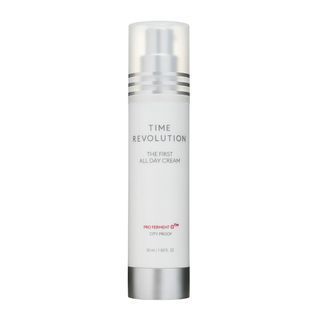
MISSHA Time Revolution The First All Day Cream
Works for
1 of 2 advertised claims delivered
Moisturizing27 ingredients credited for this claimStrong support
“A city-proof cream designed to protect your skin from external environment (UV rays, fine dust, blue light) by replenishing hydration and nourishment, restoring a healthier skin.”
This product can help improve hydration of the skin with the two types of ingredients.
The first type is called “humectants”:
these ingredients help attract water.
When humectants are on the surface of the skin, they “pull in” the moisture from the outside environment, or from
within deeper layers of the skin. The following ingredients in this product do the job:
fructooligosaccharides, fructose.
This product also contains ingredients called “occlusives”. They help reduce the speed with which our skin loses moisture to the outside environment. These ingredients also help soften the upper layer of the skin, so it feels less tight and nicer to the touch. The following ingredients in this product do the job: squalane, cholesterol.
The following ingredients in this product are especially good for supporting the skin barrier and helping with the hydration level: ceramide np
Evens skin tone3 ingredients credited for this claimWeak support
“Blends with highly concentrated Yeast Ferment Extract to improve skin tone and skin moisturization.”
Effective ingredients missing or their concentration is too low
Anti-agingNot advertised by the brand · 7 ingredients credited for this claimStrong support
This product can help reduce and prevent fine lines and wrinkles, improve skin elasticity and firmness because it contains adenosine.
Keep in mind that it typically takes at least 6 weeks to notice any results because the changes that are needed to improve fine lines and elasticity happen in the deeper layers of the skin. No topical anti-aging product can “erase” wrinkles or fully reverse signs of aging.
Can it cause trouble?
Irritancy10 strong irritants: Citrus aurantium bergamia fruit oil, Pelargonium graveolens flower oil + 8 more — patch-test recommendedHigh risk
Comedogenic5 ingredients rated 2 or more on the 0–5 pore-clogging scale5 flagged


User reviews
Be the first — your take helps the next person decide.
Ingredients
Filter by role to see what each ingredient is doing.
Water~45–55%
Yeast ferment extract~10–13%
- Irritation risk
- Low
Ethylhexyl methoxycinnamate~5.6–6.9%
- Irritation risk
- High
Octinoxate. When used in higher concentrations, works as a sunscreen protecting the skin from UVB rays. When used in lower concentration, helps to preserve the product formulation. Is shown to be harmful to coral reefs - consider avoiding bathing in coral reef areas when wearing a product with this ingredient. It can be irritating
More about Ethylhexyl methoxycinnamateCetearyl alcohol~2.7–3.3%
- Irritation risk
- Low
- Comedogenicity
- 2/5
A non-drying alcohol. Works as an emollient. Helps water and oil mix together and creates a nice product texture
More about Cetearyl alcoholGlycerin~2.6–3.2%
- Irritation risk
- Low
One of the best moisturizing ingredients. Naturally present in skin. It attracts water to the upper layer of the skin working as a humectant
More about GlycerinSqualane~2.2–2.6%
- Irritation risk
- Low
An oil naturally present in skin. Works as an emollient to soften the skin and form a protective layer on its surface without a greasy feeling.
More about SqualaneEthylhexyl salicylate~2.2–2.7%
- Irritation risk
- Low
Octisalate. A UV filter. It offers some protection against the sun rays that cause sunburn (UVB), but does not protect against the most aging sun rays (UVA). It loses its effectiveness quickly when exposed to sunlight. It is an organic, or so called "chemical" sunscreen
More about Ethylhexyl salicylateDicaprylyl carbonate~1.7–2.1%
- Irritation risk
- Low
Helps products spread more easily and works as an emollient to soften skin
More about Dicaprylyl carbonatePolymethylsilsesquioxane~1.5–1.8%
- Irritation risk
- Low
A silicone that improves product texture and helps dissolve other ingredients. Can form a non-greasy film on the skin to prevent moisture loss
More about PolymethylsilsesquioxaneIsopropyl palmitate~1.1–1.3%
- Irritation risk
- Medium
- Comedogenicity
- 3/5
Helps soften the upper layer of the skin and create a thicker product consistency
More about Isopropyl palmitateNiacinamide~0.8–1.2%
- Irritation risk
- Low
Is proven to be effective in reducing blemishes, evening out skin tone and helping to improve lines and wrinkles. It helps the skin to repair sun damage, calm down inflammation and keep maintain good levels of moisture. The concentration of about 2% is effective for supporting the skin barrier and evening out the skin tone. Concentration of 4-6% is better for helping with acne and balancing the sebum production
More about NiacinamideButylene glycol~0.65–1%
- Irritation risk
- Low
Used to create a nice product texture and help delivery of other ingredients. Might be somewhat helpful in attracting water to the upper layer of the skin
More about Butylene glycolPentylene glycol~0.7–1%
- Irritation risk
- Medium
Used to preserve products, dissolve other ingredients and create a nice product texture
More about Pentylene glycolDiethylamino hydroxybenzoyl hexyl benzoate~0.75–1.1%
- Irritation risk
- Medium
Uvinul A Plus. A new generation broad spectrum sunscreen that offers an effective protection especially in the UVA range. It is stable in formulations. Unfortunately, is not approved by the FDA (US) yet
More about Diethylamino hydroxybenzoyl hexyl benzoate1,2-hexanediol~0.55–0.8%
Butyrospermum parkii butter~0.6–0.9%
- Irritation risk
- Low
- Comedogenicity
- 3/5
A great moisturising ingredient that softens the skin and reduces water loss from its upper layer. It also can be helpful in protecting skin from free radicals
More about Butyrospermum parkii butterChlorella vulgaris extract~0.55–0.85%
- Irritation risk
- Medium
- Comedogenicity
- 3/5
A plant extract that can help to attract water to the upper layer of the skin and might have some anti-oxidant and anti-inflammatory properties
More about Chlorella vulgaris extractHydrogenated olive oil unsaponifiables~0.55–0.85%
- Irritation risk
- Low
Help soften the upper layer of the skin
More about Hydrogenated olive oil unsaponifiablesCitrus aurantium bergamia fruit oil~0.45–0.7%
- Irritation risk
- High
A plant oil with a high content of volatile compounds that can irritate the skin and lead to allergic reactions. Can lead to photosensitivity
More about Citrus aurantium bergamia fruit oilLactococcus ferment lysate~0.5–0.7%
- Irritation risk
- Low
Consists of remains of dead bacteria cells. Is likely helpful in attracting water to the upper layer of the skin. Might be helpful in reducing inflammation and neutralizing free radicals in skin
More about Lactococcus ferment lysatePelargonium graveolens flower oil~0.5–0.75%
- Irritation risk
- High
An essential oil. Can be irritating. Can become an allergen with oxidation
More about Pelargonium graveolens flower oilCitrus aurantium dulcis peel oil~0.45–0.65%
- Irritation risk
- High
An essentil oil from orange peel. Potential allergen and can be irritating
More about Citrus aurantium dulcis peel oilLavandula angustifolia oil~0.45–0.65%
- Irritation risk
- High
An essential oil. Potential allergen and can be irritating. It has some anti-bacterial properties
More about Lavandula angustifolia oilCalendula officinalis flower extract~0.35–0.65%
- Irritation risk
- High
A plant extract that has some anti-oxidant and anti-bacterial properties. Can be irritating
More about Calendula officinalis flower extractAnthemis nobilis flower oil~0.35–0.65%
- Irritation risk
- High
An essential oil that is used as a fragrance and can be irritating. It might have some anti-oxidant effect in skin
More about Anthemis nobilis flower oilSantalum album oil~0.45–0.7%
Laurdimonium hydroxypropyl hydrolyzed wheat protein~0.45–0.65%
- Irritation risk
- Low
Diisostearyl malate~0.45–0.7%
- Irritation risk
- Medium
Helps to soften the upper layer of the skin
More about Diisostearyl malateHydroxyethyl acrylate/sodium acryloyldimethyl taurate copolymer~0.45–0.65%
- Irritation risk
- Medium
A gelling agent that thickens the product consistency and leaves the skin with a velvety finish
More about Hydroxyethyl acrylate/sodium acryloyldimethyl taurate copolymerGlucose~0.45–0.65%
- Irritation risk
- Low
Helps attract water to the upper layer of the skin. Could be helpful in restoring the skin barrier function
More about GlucoseHydroxyacetophenone~0.45–0.65%
Fructooligosaccharides~0.45–0.65%
- Irritation risk
- Low
Help attract water to the upper layer of the skin
More about FructooligosaccharidesFructose~0.45–0.65%
- Irritation risk
- Low
Helps attract water to the upper layer of the skin
More about FructoseCetearyl glucoside~0.45–0.7%
- Irritation risk
- Medium
Helps water and oil in the product mix well together and improves product texture
More about Cetearyl glucosideAdenosine~0.45–0.65%
- Irritation risk
- Low
Might help improve cell turnover and reduce inflammation in skin. One study shows that the ingredients might be able to help reduce dynamic wrinkles (for example, in the corners of the eyes or on the forehead)
More about AdenosineSodium phytate~0.45–0.65%
Polyglyceryl-3 methylglucose distearate~0.5–0.7%
- Irritation risk
- Medium
Helps water and oil mix together
More about Polyglyceryl-3 methylglucose distearateEthylhexylglycerin~0.45–0.65%
Hydrogenated lecithin~0.45–0.7%
- Irritation risk
- Low
Helps to retain moisture by creating a protective barrier on the skin. Rich in fatty acids. Improves product texture and helps with the penetration of other ingredients.
More about Hydrogenated lecithinBehenic acid~0.55–0.8%
Tocopherol~0.45–0.7%
- Irritation risk
- Low
Pure form of vitamin E. Can help moisturise and protect the skin from free radicals. Often used to help stabilise other ingredients or the formula itself
More about TocopherolStearic acid~0.55–0.85%
- Irritation risk
- Low
Helps oil and water mix together and works as an emollient
More about Stearic acidMyristic acid~0.5–0.7%
- Irritation risk
- Medium
- Comedogenicity
- 3/5
Helps oil and water mix together. Could be comedogenic
More about Myristic acidSodium chloride~0.5–0.7%
- Irritation risk
- Low
Used to stabilize mixtures of oil and water, and create thicker, gel-like product textures
More about Sodium chloridePhenylpropanol~0.4–0.65%
- Irritation risk
- High
Helps mask the smell of other ingredients and helps preserve the product formulation
More about PhenylpropanolLevulinic acid~0.35–0.65%
Sodium levulinate~0.45–0.65%
Octanediol~0.45–0.7%
- Irritation risk
- Low
Maltodextrin~0.45–0.65%
- Irritation risk
- Low
Used to stabilize the product formulation and can help absorb oil
More about MaltodextrinDipropylene glycol~0.35–0.6%
- Irritation risk
- Low
Helps to dissolve other ingredients in a formulation. Slows down the rate of product drying
More about Dipropylene glycolLecithin~0.45–0.7%
- Irritation risk
- Low
Used mostly for creating emulsions - helping oil and water mix together. Helps soften the upper layer of the skin
More about LecithinCeramide np~0.45–0.7%
- Irritation risk
- Low
A type of lipid similar to ceramides naturally present in skin. Helps to soften the upper layer of the skin and supports the skin barrier function to keep it hydrated. Can help to prevent inflammation in skin
More about Ceramide npCholesterol~0.45–0.7%
- Irritation risk
- Low
An emollient that is naturally found in skin
More about CholesterolPhytosterols~0.45–0.7%
- Irritation risk
- Medium
Lipids that work as an emollient and can be helpful in repairing skin barrier function
More about PhytosterolsXanthophylls~0.4–0.6%
Ascorbic acid~0.35–0.65%
- Irritation risk
- High
The most well-researched antioxidant that works in skin. Helps neutralize free radicals supporting collagen production, helping to even out the skin tone and preventing early signs of aging
More about Ascorbic acidAscorbyl glucoside~0.3–0.55%
- Irritation risk
- Medium
A vitamin C derivative that is more stable but less potent than pure form of vitamin C. Has a potential to boost collagen production, nutralise free radicals and reduce hyperpigmentation, but the required concentration is likely to be much higher than for the pure form of vitamin C, limiting the ingredient's effectiveness in products
More about Ascorbyl glucosideStearyl alcohol~0.45–0.65%
- Irritation risk
- Low
An emollient that helps soften the skin
More about Stearyl alcoholCetyl alcohol~0.4–0.6%
- Irritation risk
- Low
A non-drying alcohol that works to soften the skin and stabilize product formulations helping oil and water mix together
More about Cetyl alcoholMyristyl alcohol~0.3–0.6%
- Irritation risk
- High
Helps to stabilize the product formulation while softening the upper layer of the skin. Can be irritating
More about Myristyl alcoholLauryl alcohol~0.25–0.5%
Behenyl alcohol~0.25–0.45%
- Irritation risk
- Low
Non-drying alcohol that helps water and oil mix together. Also serves as an emollient
More about Behenyl alcoholLimonene~0.15–0.3%
- Irritation risk
- High
A common frangrance that can easily irritate skin, especially if exposed to air, light or heat
More about LimoneneCitronellol~0.15–0.3%
Geraniol~0.1–0.2%
Linalool~0.1–0.2%
Ingredient list view
Water, Yeast ferment extract, Ethylhexyl methoxycinnamate, Cetearyl alcohol, Glycerin, Squalane, Ethylhexyl salicylate, Dicaprylyl carbonate, Polymethylsilsesquioxane, Isopropyl palmitate, Niacinamide, Butylene glycol, Pentylene glycol, Diethylamino hydroxybenzoyl hexyl benzoate, 1,2-hexanediol, Butyrospermum parkii butter, Chlorella vulgaris extract, Hydrogenated olive oil unsaponifiables, Citrus aurantium bergamia fruit oil, Lactococcus ferment lysate, Pelargonium graveolens flower oil, Citrus aurantium dulcis peel oil, Lavandula angustifolia oil, Calendula officinalis flower extract, Anthemis nobilis flower oil, Santalum album oil, Laurdimonium hydroxypropyl hydrolyzed wheat protein, Diisostearyl malate, Hydroxyethyl acrylate/sodium acryloyldimethyl taurate copolymer, Glucose, Hydroxyacetophenone, Fructooligosaccharides, Fructose, Cetearyl glucoside, Adenosine, Sodium phytate, Polyglyceryl-3 methylglucose distearate, Ethylhexylglycerin, Hydrogenated lecithin, Behenic acid, Tocopherol, Stearic acid, Myristic acid, Sodium chloride, Phenylpropanol, Levulinic acid, Sodium levulinate, Octanediol, Maltodextrin, Dipropylene glycol, Lecithin, Ceramide np, Cholesterol, Phytosterols, Xanthophylls, Ascorbic acid, Unknown, Ascorbyl glucoside, Stearyl alcohol, Cetyl alcohol, Myristyl alcohol, Lauryl alcohol, Behenyl alcohol, Limonene, Citronellol, Geraniol, Linalool
Compare prices
Retailers ranked by price — lowest first.

Worth comparing, line by line.
Match % combines shared ingredients, the first five ingredients, shared actives and hero ingredients, irritancy (lower counts in the alternative's favour), texture and body area. Only products in the same routine step are compared.
| MISSHATime Revolution The First All Day CreamYOUR PRODUCT | Rephrintense hydration cream 1.0 | SCINICProbiotics Barrier Cream | KLAVUUVegan Collagen Cream | |
|---|---|---|---|---|
| Match | — | 90% | 90% | 90% |
| Price | $29.50 | — | $22.10−$7.40 | $25.00−$4.50 |
| Shared key ingredients | — | 9 of 16 | 8 of 16 | 9 of 16 |
| Key difference | — | Ceramide Ng | Panthenol | Panthenol |
| Irritancy | High | Medium | Medium | Medium |
| Drying alcohol | — | — | — | — |
| View product | Shop | Shop | Shop |


Product summary
Judging from the ingredient list, "MISSHA - Time Revolution The First All Day Cream" works well for improving skin hydration To work well, any moisturizer needs to include a combination of water-binding and emollient ingredients. MISSHA - Time Revolution The First All Day Cream ticks this box. Humectants in this product (fructooligosaccharides, fructose, glycerin, glucose and butylene glycol) help to increase the water content in the upper layer of the skin. (These ingredients do so by "capturing" water molecules from the outside air or from within the deeper layers of the skin). Emollients in this formulation (ceramide np, cholesterol, phytosterols, squalane and cetearyl alcohol) help to reduce the moisture loss from the skin. They also soften the skin surface and relieve the feeling of dryness and tightness.
Ingredient callouts
- This product also contains Vitamin C (Ascorbic Acid). It can be an effective active for anti-aging and evening out the skin tone, but in this moisturizer it is used for stabilizing other ingredients in the formulation. In this concentration (0.35% - 0.65%) it cannot have a noticeable benefit for the skin.
- Another benefit is that this moisturizer contain ceramides (ceramide np 0.45% - 0.70%). Ceramides are an important part of our natural skin barrier. The Ceramides used in skincare are synthetic or come from plants. They help soften the skin and can help "fill the gaps" in the skin barrier, keeping the skin hydrated and resilient for longer.
- Adenosine 0.45% - 0.65%. It is a compound that in involved in many biological processes inside the skin cells. According one high-quality clinical trial, topical Adenosine in low concentrations can somewhat help improve "deep wrinkles" - the wrinkles that appear with age in places where our faces are most dynamic (for example, on the forehead or in the corners of the eyes).
Irritation risk
This moisturizer contains a bunch of common irritants, including ingredients that do not provide any known benefit for the skin. It might not be the best choice if your skin is sensitive. We assess the overall irritancy of this moisturizer to be high. For a detailed overview of all potential irritants: click here
You can see the detailed formula review with the breakdown of all actives in the product and the full ingredient list with estimated concentrations in the tables below.
Price
The product retails from 29.50$ up to 33.15$ in the United States.
For a detailed price comparison: click here.
Sources cited in this review
Every concentration estimate and effectiveness label is anchored to one of these 27 studies and safety reviews.
- 1
- 2Final Report on the Safety Assessment of Isopropyl Isostearatejournals.sagepub.com
- 3
- 4
- 5
- 6

Affiliate links · As an Amazon Associate, WIMJ earns from qualifying purchases.