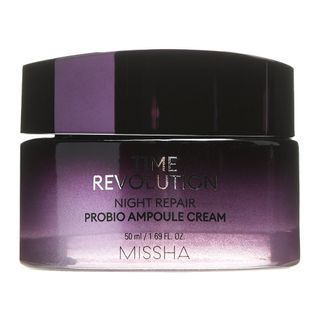
MISSHA Time Revolution Night Repair Probio Ampoule Cream
Works for
3 of 3 advertised claims delivered
MoisturizingNiacinamide, Ceramide np + 40 moreStrong evidence
“It also contains hydrating and moisturising hyaluronic acid, shea butter and beta-glucan to plump skin and a plethora of fermented anti-aging and antioxidant ingredients.”
This product can help improve hydration of the skin with the two types of ingredients.
The first type is called “humectants”:
these ingredients help attract water.
When humectants are on the surface of the skin, they “pull in” the moisture from the outside environment, or from
within deeper layers of the skin. The following ingredients in this product do the job:
biosaccharide gum-1, glycerin.
This product also contains ingredients called “occlusives”. They help reduce the speed with which our skin loses moisture to the outside environment. These ingredients also help soften the upper layer of the skin, so it feels less tight and nicer to the touch. The following ingredients in this product do the job: beeswax, caprylic/capric triglyceride.
The following ingredients in this product are especially good for supporting the skin barrier and helping with the hydration level: ceramide np, niacinamide
Evens skin toneNiacinamide, Bifida ferment lysate + 1 moreStrong evidence
“Missha Time Revolution Night Repair Probio Ampoule Cream 5X helps to improve skin elasticity and brighten skin tone.”
This product can help reduce hypepigmentation and even out the skin tone because it contains the following effective ingredients: niacinamide
The following ingredient (ingredients) in this product might be helpful, but there is no evidence to confirm that it actually can help even out the skin tone: bifida ferment lysate.
Keep in mind that you would need to apply any topical skincare targetted at hypigmentation consistently for a couple of months to get a result. No topical skincare product can help get rid of hyperpigmentation (including post-acne marks and age spots) instantly.
Anti-agingNiacinamide, Adenosine + 3 moreStrong evidence
“The new formula contains more than 50% Bifida Ferment Lysate, a fermented yeast that visibly reduces signs of ageing and improves skin elasticity while protecting the skin.”
This product can help reduce and prevent fine lines and wrinkles, improve skin elasticity and firmness because it contains adenosine, niacinamide.
These ingredients in the product can also be helpful, even though there is less evidence for their effectiveness: centella asiatica extract.
Keep in mind that it typically takes at least 6 weeks to notice any results because the changes that are needed to improve fine lines and elasticity happen in the deeper layers of the skin. No topical anti-aging product can “erase” wrinkles or fully reverse signs of aging.
Anti-blemishNot advertised by the brand · Niacinamide, Centella asiatica extractStrong evidence
This product can help reduce breakouts and clogged pores because it contains the following ingredient: niacinamide. This ingredient is used for treating acne and can have a noticeable effect.
Anti-oxidationNot advertised by the brand · Bifida ferment lysate, Ficus carica fruit extract + 14 moreModerate evidence
This product contains antioxidants (bifida ferment lysate, centella asiatica extract, ficus carica fruit extract) that might be able to help neutralize free radicals in skin to lessen the damage it gets from the UV light (sun). There is not enough evidence to confirm their effectiveness in skin though.
Can it cause trouble?
Irritancy9 strong irritants: Citrus aurantium bergamia fruit oil, Pelargonium graveolens flower oil + 7 more — patch-test recommendedHigh risk
Comedogenic2 ingredients rated 2 or more on the 0–5 pore-clogging scale2 flagged


User reviews
Be the first — your take helps the next person decide.
Ingredients
Filter by role to see what each ingredient is doing.
Bifida ferment lysate~25–31%
- Irritation risk
- Low
Consists of remains of dead yeast bacteria cells. Helps to hydrate the skin and reduce irritation. Might has some anti-oxidant effect
More about Bifida ferment lysateGlycerin~4–4.9%
- Irritation risk
- Low
One of the best moisturizing ingredients. Naturally present in skin. It attracts water to the upper layer of the skin working as a humectant
More about GlycerinMethylpropanediol~5–6.1%
Cyclohexasiloxane~4.1–5.1%
- Irritation risk
- Low
A silicone that serves as an emollient. Helps create a nice non-greasy feels
More about CyclohexasiloxaneHydrogenated polyisobutene~3.3–4%
- Irritation risk
- Low
Used to improve the product consistency and soften the upper layer of the skin
More about Hydrogenated polyisobuteneCaprylic/capric triglyceride~2.4–3%
- Irritation risk
- Medium
A good mix of fatty acids that forms a protective layer on the skin. Improves the shelf life of products. Derived from coconut and glycerin
More about Caprylic/capric triglycerideTriethylhexanoin~1.4–1.7%
- Irritation risk
- Medium
Helps soften the upper layer of the skin
More about TriethylhexanoinNiacinamide~1.4–1.7%
- Irritation risk
- Low
Is proven to be effective in reducing blemishes, evening out skin tone and helping to improve lines and wrinkles. It helps the skin to repair sun damage, calm down inflammation and keep maintain good levels of moisture. The concentration of about 2% is effective for supporting the skin barrier and evening out the skin tone. Concentration of 4-6% is better for helping with acne and balancing the sebum production
More about NiacinamideCetearyl alcohol~1.3–1.6%
- Irritation risk
- Low
- Comedogenicity
- 2/5
A non-drying alcohol. Works as an emollient. Helps water and oil mix together and creates a nice product texture
More about Cetearyl alcoholWater~1–1.2%
Dimethicone~0.95–1.15%
- Irritation risk
- Low
A silicone that helps to reduce water loss from the surface of the skin. Can temporarily "fill in" lines and wrinkles, absorb oil, and create a nice product finish
More about DimethiconeStearyl alcohol~0.8–1.15%
- Irritation risk
- Low
An emollient that helps soften the skin
More about Stearyl alcoholTrehalose~0.55–0.8%
- Irritation risk
- Low
A sugar that attracts water to the upper layer of the skin
More about TrehaloseCentella asiatica extract~0.6–0.85%
- Irritation risk
- Medium
A plant extract that has been shown to be able to reduce inflammation in skin, support restoration of skin barrier function, as well as support collagen production. Contains active compounds called centelloids: asiaticoside, madecasosside, asiatic acid and madecassic acid. Might be helpful in preventing stretch marks. It can be itself be irritating though.
More about Centella asiatica extractFicus carica fruit extract~0.5–0.7%
- Irritation risk
- Medium
A plant extract that can help neutralize free radicals. The concentrations typically used in cosmetics are too small to have an effect
More about Ficus carica fruit extractDioscorea japonica root extract~0.5–0.7%
- Irritation risk
- Low
Oryza sativa extract~0.5–0.75%
- Irritation risk
- Low
A grain extract that helps to create a thicker product consistency. It might have some anti-oxidant properties and help attract water to the upper layer of the skin
More about Oryza sativa extractPhellodendron amurense bark extract~0.4–0.65%
- Irritation risk
- Medium
A plant extract that might have an anti-inflammatory effect
More about Phellodendron amurense bark extractLactobacillus/punica granatum fruit ferment extract~0.35–0.65%
- Irritation risk
- High
An enzyme-based exfoliant
More about Lactobacillus/punica granatum fruit ferment extractLactobacillus/soybean ferment extract~0.35–0.6%
- Irritation risk
- Low
A fermentation product created by bacteria Lactobacillus out of soybean. The fermented product helps to attract water to the upper layer of the skin and has anti-bacterial properties. It might be helpful in calming down inflammation and could be helpful in evening out skin tone, but studies are lacking
More about Lactobacillus/soybean ferment extractMonascus extract~0.3–0.55%
- Irritation risk
- Low
A yeast extract that might help to attract water to the upper layer of the skin
More about Monascus extractSolanum melongena fruit extract~0.3–0.55%
- Irritation risk
- Medium
Eggplant fruit extract. Might have some anti-oxidant effect
More about Solanum melongena fruit extractDaucus carota sativa root extract~0.3–0.55%
- Irritation risk
- Low
Carrot extract. Might have anti-oxidant properties and be used to add orange color
More about Daucus carota sativa root extractVaccinium angustifolium fruit extract~0.25–0.5%
- Irritation risk
- Medium
A plant extract tha can have anti-oxidant properties, but evidence of effectiveness in skin is lacking
More about Vaccinium angustifolium fruit extractBeta vulgaris root extract~0.3–0.55%
- Irritation risk
- Medium
A plant extract that might have some antioxidant properties, but mostly used in cosmetics for its color
More about Beta vulgaris root extractBrassica oleracea capitata leaf extract~0.3–0.55%
- Irritation risk
- Medium
Plant extract that might help calm down inflammation and have some anti-oxidant properties
More about Brassica oleracea capitata leaf extractCitrus aurantium bergamia fruit oil~0.25–0.5%
- Irritation risk
- High
A plant oil with a high content of volatile compounds that can irritate the skin and lead to allergic reactions. Can lead to photosensitivity
More about Citrus aurantium bergamia fruit oilPelargonium graveolens flower oil~0.3–0.55%
- Irritation risk
- High
An essential oil. Can be irritating. Can become an allergen with oxidation
More about Pelargonium graveolens flower oilHydrogenated lecithin~0.3–0.55%
- Irritation risk
- Low
Helps to retain moisture by creating a protective barrier on the skin. Rich in fatty acids. Improves product texture and helps with the penetration of other ingredients.
More about Hydrogenated lecithinCamellia sinensis seed oil~0.35–0.65%
- Irritation risk
- Low
A plant oil that helps to soften the upper layer of the skin and can help restore the skin barrier. Might have some anti-oxidant effect
More about Camellia sinensis seed oilCamellia japonica seed oil~0.4–0.6%
- Irritation risk
- Low
A plant oil that helps to soften the upper layer of the skin and can help restore skin's barrier function. Might have an anti-oxidant effect
More about Camellia japonica seed oilArgania spinosa kernel oil~0.4–0.6%
- Irritation risk
- Medium
An emollient that helps soften the upper layer of the skin. Might have some weak anti-oxidant properties
More about Argania spinosa kernel oilOlea europaea fruit oil~0.35–0.6%
- Irritation risk
- Medium
An emollient that helps soften the skin but is not effective for restoring its barrier function. Might be helpful to calm down inflammation
More about Olea europaea fruit oilMacadamia integrifolia seed oil~0.4–0.6%
- Irritation risk
- Low
A plant oil that helps soften the upper layer of the skin
More about Macadamia integrifolia seed oilHelianthus annuus seed oil~0.45–0.65%
- Irritation risk
- Low
A great emollient due to its high linoleic acid content. One of the most effective plant oils in helping skin hydration and repairing skin barrier function
More about Helianthus annuus seed oilSimmondsia chinensis seed oil~0.45–0.7%
- Irritation risk
- Medium
Softens the upper layer of skin and helps restore the healthy skin barrier. Has shown to help calm down inflammation in skin. It is a stable oil, meaning that it retains its properties even when exposed to air.
More about Simmondsia chinensis seed oilLavandula angustifolia oil~0.3–0.6%
- Irritation risk
- High
An essential oil. Potential allergen and can be irritating. It has some anti-bacterial properties
More about Lavandula angustifolia oilCitrus aurantium dulcis peel oil~0.3–0.6%
- Irritation risk
- High
An essentil oil from orange peel. Potential allergen and can be irritating
More about Citrus aurantium dulcis peel oilAnthemis nobilis flower oil~0.3–0.55%
- Irritation risk
- High
An essential oil that is used as a fragrance and can be irritating. It might have some anti-oxidant effect in skin
More about Anthemis nobilis flower oilSantalum album oil~0.3–0.6%
Beeswax~0.45–0.7%
- Irritation risk
- Low
Forms a protective barrier that holds water and keeps dry skin hydrated. Keeps an emulsion from separating into its oil and liquid components, and increases the thickness of a product. Can be an allergen
More about BeeswaxCetyl alcohol~0.45–0.7%
- Irritation risk
- Low
A non-drying alcohol that works to soften the skin and stabilize product formulations helping oil and water mix together
More about Cetyl alcoholCetearyl glucoside~0.35–0.65%
- Irritation risk
- Medium
Helps water and oil in the product mix well together and improves product texture
More about Cetearyl glucosideVinyl dimethicone~0.45–0.65%
- Irritation risk
- Low
A type of silicone that helps to create a nice product texture and soften the upper layer of the skin
More about Vinyl dimethiconePolyglyceryl-2 triisostearate~0.35–0.65%
- Irritation risk
- Low
Helps to soften the upper layer of the skin and create a nice product texture
More about Polyglyceryl-2 triisostearateCetearyl olivate~0.35–0.65%
Sorbitan olivate~0.35–0.65%
Glyceryl stearate~0.45–0.7%
- Irritation risk
- Low
An emollient that softens the skin and forms a protective layer on its surface. Helps water and oil mix together
More about Glyceryl stearatePalmitic acid~0.45–0.7%
- Irritation risk
- Low
An emollient that is naturally present in skin and helps soften it
More about Palmitic acidStearic acid~0.5–0.75%
- Irritation risk
- Low
Helps oil and water mix together and works as an emollient
More about Stearic acidAmmonium acryloyldimethyltaurate/vp copolymer~0.35–0.6%
- Irritation risk
- Low
Increases thickness of a product. Texture enhancer for oil-in-water emulsions
More about Ammonium acryloyldimethyltaurate/vp copolymerGlycosyl trehalose~0.45–0.7%
Xanthan gum~0.35–0.6%
- Irritation risk
- Low
Used to create a thicker product consistency
More about Xanthan gumHydrogenated starch hydrolysate~0.3–0.6%
- Irritation risk
- Low
Helps to attract water to the upper layer of the skin. Can add sweet taste to lip products
More about Hydrogenated starch hydrolysateAdenosine~0.3–0.6%
- Irritation risk
- Low
Might help improve cell turnover and reduce inflammation in skin. One study shows that the ingredients might be able to help reduce dynamic wrinkles (for example, in the corners of the eyes or on the forehead)
More about AdenosineRaffinose~0.3–0.6%
- Irritation risk
- Low
Glyceryl polymethacrylate~0.45–0.65%
- Irritation risk
- Low
Used to create a nice product texture
More about Glyceryl polymethacrylateDextrin~0.4–0.6%
- Irritation risk
- Low
A sugar that is used to stabilize the product formulation. Can help attract water to the upper layer of the skin
More about DextrinTheobroma cacao shell powder~0.45–0.65%
- Irritation risk
- Low
Lactobacillus ferment~0.3–0.6%
- Irritation risk
- Low
A fermentation product created by bacteria Lactobacillus. The fermented product has anti-bacterial properties and might be helpful in calming down inflammation, but studies are lacking. Helps attract water to the upper layer of the skin. Can be used as a preservative
More about Lactobacillus fermentLactococcus ferment lysate~0.3–0.6%
- Irritation risk
- Low
Consists of remains of dead bacteria cells. Is likely helpful in attracting water to the upper layer of the skin. Might be helpful in reducing inflammation and neutralizing free radicals in skin
More about Lactococcus ferment lysateLactobacillus/acerola cherry ferment~0.35–0.6%
- Irritation risk
- Low
Lactobacillus ferment lysate~0.3–0.6%
- Irritation risk
- Low
A "broth" with parts of dead cells of lactobacteria. Might be helpful supporting diverse microbiome in skin, but evidence is lacking
More about Lactobacillus ferment lysateLactococcus ferment~0.3–0.6%
- Irritation risk
- Low
Leuconostoc/radish root ferment filtrate~0.35–0.6%
- Irritation risk
- Medium
A preservative that comes from radishes fermented by a bacteria. New research suggests that the preservation properties in the ingredient come from an ammonium salt that is not present naturally in radish root but used in its cultivation. Is problematic because the exact amount of the preservative agents is difficult to determine
More about Leuconostoc/radish root ferment filtrateBifida ferment lysate~0.3–0.6%
- Irritation risk
- Low
Consists of remains of dead yeast bacteria cells. Helps to hydrate the skin and reduce irritation. Might has some anti-oxidant effect
More about Bifida ferment lysateDisodium edta~0.3–0.6%
Lecithin~0.45–0.7%
- Irritation risk
- Low
Used mostly for creating emulsions - helping oil and water mix together. Helps soften the upper layer of the skin
More about LecithinGlucose~0.3–0.6%
- Irritation risk
- Low
Helps attract water to the upper layer of the skin. Could be helpful in restoring the skin barrier function
More about GlucosePolyquaternium-51~0.45–0.7%
- Irritation risk
- Low
An emollient that helps create a nice silky finish on the skin
More about Polyquaternium-51Ceramide np~0.45–0.65%
- Irritation risk
- Low
A type of lipid similar to ceramides naturally present in skin. Helps to soften the upper layer of the skin and supports the skin barrier function to keep it hydrated. Can help to prevent inflammation in skin
More about Ceramide npMyristic acid~0.4–0.6%
- Irritation risk
- Medium
- Comedogenicity
- 3/5
Helps oil and water mix together. Could be comedogenic
More about Myristic acidSucrose distearate~0.45–0.65%
Dipropylene glycol~0.3–0.55%
- Irritation risk
- Low
Helps to dissolve other ingredients in a formulation. Slows down the rate of product drying
More about Dipropylene glycolBiosaccharide gum-1~0.3–0.55%
- Irritation risk
- Low
Helps attract water to the upper layer of the skin and is claimed to provide a longer-lasting hydration because of its ability to create a water-binding film on the surface of the skin
More about Biosaccharide gum-1Saccharomyces ferment~0.3–0.55%
- Irritation risk
- Low
A product of yeast fermentation. Helps attract water to the upper layer of the skin
More about Saccharomyces fermentLactobacillus ferment~0.3–0.55%
- Irritation risk
- Low
A fermentation product created by bacteria Lactobacillus. The fermented product has anti-bacterial properties and might be helpful in calming down inflammation, but studies are lacking. Helps attract water to the upper layer of the skin. Can be used as a preservative
More about Lactobacillus fermentPhytosteryl/isostearyl/cetyl/stearyl/behenyl dimer dilinoleate~0.45–0.7%
- Irritation risk
- Low
Helps soften the upper layer of the skin and create a nice product consistency
More about Phytosteryl/isostearyl/cetyl/stearyl/behenyl dimer dilinoleate1,2-hexanediol~0.25–0.45%
Hydroxyacetophenone~0.25–0.45%
Ethylhexylglycerin~0.25–0.4%
Limonene~0.25–0.4%
- Irritation risk
- High
A common frangrance that can easily irritate skin, especially if exposed to air, light or heat
More about LimoneneCitronellol~0.2–0.4%
Geraniol~0.15–0.3%
Linalool~0.2–0.35%
Ingredient list view
Bifida ferment lysate, Glycerin, Methylpropanediol, Cyclohexasiloxane, Hydrogenated polyisobutene, Caprylic/capric triglyceride, Triethylhexanoin, Niacinamide, Cetearyl alcohol, Water, Dimethicone, Stearyl alcohol, Trehalose, Centella asiatica extract, Ficus carica fruit extract, Dioscorea japonica root extract, Oryza sativa extract, Phellodendron amurense bark extract, Lactobacillus/punica granatum fruit ferment extract, Lactobacillus/soybean ferment extract, Monascus extract, Solanum melongena fruit extract, Daucus carota sativa root extract, Vaccinium angustifolium fruit extract, Beta vulgaris root extract, Brassica oleracea capitata leaf extract, Citrus aurantium bergamia fruit oil, Pelargonium graveolens flower oil, Hydrogenated lecithin, Camellia sinensis seed oil, Camellia japonica seed oil, Argania spinosa kernel oil, Olea europaea fruit oil, Macadamia integrifolia seed oil, Helianthus annuus seed oil, Simmondsia chinensis seed oil, Lavandula angustifolia oil, Citrus aurantium dulcis peel oil, Anthemis nobilis flower oil, Santalum album oil, Beeswax, Cetyl alcohol, Cetearyl glucoside, Vinyl dimethicone, Polyglyceryl-2 triisostearate, Cetearyl olivate, Sorbitan olivate, Glyceryl stearate, Palmitic acid, Stearic acid, Ammonium acryloyldimethyltaurate/vp copolymer, Glycosyl trehalose, Xanthan gum, Hydrogenated starch hydrolysate, Adenosine, Raffinose, Glyceryl polymethacrylate, Dextrin, Theobroma cacao shell powder, Lactobacillus ferment, Lactococcus ferment lysate, Lactobacillus/acerola cherry ferment, Lactobacillus ferment lysate, Lactococcus ferment, Leuconostoc/radish root ferment filtrate, Bifida ferment lysate, Disodium edta, Lecithin, Glucose, Polyquaternium-51, Ceramide np, Myristic acid, Sucrose distearate, Dipropylene glycol, Biosaccharide gum-1, Saccharomyces ferment, Lactobacillus ferment, Phytosteryl/isostearyl/cetyl/stearyl/behenyl dimer dilinoleate, 1,2-hexanediol, Hydroxyacetophenone, Ethylhexylglycerin, Limonene, Citronellol, Geraniol, Linalool
Compare prices
Retailers ranked by price — lowest first.


Worth comparing, line by line.
Match % combines shared ingredients, the first five ingredients, shared actives and hero ingredients, irritancy (lower counts in the alternative's favour), texture and body area. Only products in the same routine step are compared.
| MISSHATime Revolution Night Repair Probio Ampoule CreamYOUR PRODUCT | BYROESALMON CREAM DUO | EvercellRadiance Lifting Cream | 23 years oldBakuchiol A Cream | |
|---|---|---|---|---|
| Match | — | 87% | 87% | 86% |
| Price | $27.52 | $168.00+$140.48 | $12.35−$15.17 | $18.00−$9.52 |
| Shared key ingredients | — | 9 of 22 | 7 of 22 | 9 of 22 |
| Key difference | — | Panthenol | Panthenol | Bakuchiol |
| Irritancy | High | Medium | Medium | Medium |
| Drying alcohol | — | — | — | — |
| View product | Shop | Shop | Shop |


Product summary
"MISSHA - Time Revolution Night Repair Probio Ampoule Cream" is effective for: Anti-inflammatory, Moisturizing, Anti-aging, Evens skin tone and Anti-blemish
Ingredient callouts
- Ceramides (ceramide np 0.45% - 0.65%). Ceramides are a type of lipids that our skin produces itself. They are a building block of the skin's barrier. Ceramides used in skincare are synthetic or extracted from plants. They work well for softening the skin surface and "patch holes" in the skin's barrier.
- Adenosine 0.30% - 0.60%. It is a chemical present inside our skin cells. A clinical trial confirmed that topical application of Adenosine in a low concentration can reduce dynamic wrinkles (these are the wrinkles that appear with age in a places where our mimic is the most active, for example, in the corners of the eyes or on the forehead).
- Humectants (lactobacillus ferment 0.30% - 0.55%, biosaccharide gum-1 0.30% - 0.55%, lactobacillus ferment 0.30% - 0.60%, trehalose 0.55% - 0.80% and glycerin 4.00% - 4.90%). These ingredients help attract water to the upper layer of the skin and improve the skin hydration.
Price
The product retails from 46.00A$ up to 65.91A$ in Australia, from 27.45$ up to 89.17$ in the United States and for 29.41£ in the United Kingdom.
For a detailed price comparison: click here.
Sources cited in this review
Every concentration estimate and effectiveness label is anchored to one of these 48 studies and safety reviews.
- 1Bifidobacterium longumlysate, a new ingredient forreactive skinonlinelibrary.wiley.com
- 2Use of Probiotics for Dermal Applicationsresearchgate.net
- 3
- 4
- 5
- 6

Affiliate links · As an Amazon Associate, WIMJ earns from qualifying purchases.