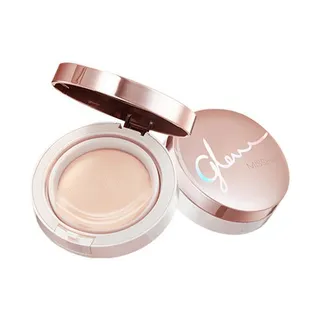
Works for
MoisturizingCyclopentasiloxane, Dimethicone + 24 moreWorks
“These moisturizing formulas leave a gloriously dewy finish on the skin, giving you a juicy complexion that's none to beat.”
This product can help improve hydration of the skin with the two types of ingredients.
The first type is called “humectants”:
these ingredients help attract water.
When humectants are on the surface of the skin, they “pull in” the moisture from the outside environment, or from
within deeper layers of the skin. The following ingredients in this product do the job:
hyaluronic acid, hydrolyzed hyaluronic acid.
This product also contains ingredients called “occlusives”. They help reduce the speed with which our skin loses moisture to the outside environment. These ingredients also help soften the upper layer of the skin, so it feels less tight and nicer to the touch. The following ingredients in this product do the job: dimethicone, cyclopentasiloxane.
Evens skin toneNiacinamide ~0.35–0.6%, below the ~1% it needsUnder-dosed
“Niacinamide - Brightens dull, dark spots”
Effective ingredients missing or their concentration is too low
Anti-agingSide benefit · Adenosine, Atelocollagen + 3 moreWorks well
This product can help reduce and prevent fine lines and wrinkles, improve skin elasticity and firmness because it contains adenosine.
These ingredients in the product can also be helpful, even though there is less evidence for their effectiveness: atelocollagen.
Keep in mind that it typically takes at least 6 weeks to notice any results because the changes that are needed to improve fine lines and elasticity happen in the deeper layers of the skin. No topical anti-aging product can “erase” wrinkles or fully reverse signs of aging.
Can it cause trouble?
Irritancy5 strong irritants: Citrus aurantium dulcis peel oil, Citrus aurantium amara peel oil + 3 more — patch-test recommendedHigh risk
ComedogenicClean of flagged comedogenic ingredientsNone flagged

User reviews
Be the first — your take helps the next person decide.
Ingredients
Filter by role to see what each ingredient is doing.
Sodium hyaluronate~28–34%
- Irritation risk
- Low
One of the best moisturizing ingredients. Attracts water into the upper layer of the skin
More about Sodium hyaluronateSodium hyaluronate crosspolymer~7–8.6%
- Irritation risk
- Medium
Attracts water into the upper layer of the skin
More about Sodium hyaluronate crosspolymerHydrolyzed hyaluronic acid~5–6.1%
- Irritation risk
- Low
One of the best moisturizing ingredients. Attracts water into the upper layer of the skin. A version of it is naturally present in skin
More about Hydrolyzed hyaluronic acidHyaluronic acid~3.4–4.1%
- Irritation risk
- Low
One of the best moisturizing ingredients. Attracts water into the upper layer of the skin. Naturally present in skin. Typically has large molecule size unless advertised otherwise on the product label. Helps support skin's barrier function and may help to reduce inflammation
More about Hyaluronic acidHydrolyzed sodium hyaluronate~2.4–3%
- Irritation risk
- Low
Attracts water into the upper layer of the skin
More about Hydrolyzed sodium hyaluronatePentaerythrityl tetraisostearate~2.2–2.7%
- Irritation risk
- Medium
Used to create a thicker product consistency
More about Pentaerythrityl tetraisostearateSilica dimethyl silylate~1.8–2.2%
Butylene glycol~1.4–1.7%
- Irritation risk
- Low
Used to create a nice product texture and help delivery of other ingredients. Might be somewhat helpful in attracting water to the upper layer of the skin
More about Butylene glycolPentylene glycol~1.3–1.5%
- Irritation risk
- Medium
Used to preserve products, dissolve other ingredients and create a nice product texture
More about Pentylene glycolSodium chondroitin sulfate~0.95–1.15%
- Irritation risk
- Low
Is naturally present in skin. Helps to attract water to its upper layer
More about Sodium chondroitin sulfateAtelocollagen~0.7–1.05%
- Irritation risk
- Low
A protein that helps to attract moisture to the upper layer of the skin and might be helpful in reducing fine lines and wrinkles
More about AtelocollagenWater~0.6–0.85%
Adenosine~0.55–0.8%
- Irritation risk
- Low
Might help improve cell turnover and reduce inflammation in skin. One study shows that the ingredients might be able to help reduce dynamic wrinkles (for example, in the corners of the eyes or on the forehead)
More about AdenosineTitanium dioxide~0.7–1.05%
- Irritation risk
- Low
Works as a UV filter when used in high concentrations. It is photostable and is effective mostly against the UVB light, with some protection in the UVA range. In small concentrations, used for its ability to improve the color of cosmetic products. Is usually well tolerated by the skin
More about Titanium dioxideTriphenyl trimethicone~0.55–0.8%
- Irritation risk
- Low
Cyclopentasiloxane~0.55–0.8%
- Irritation risk
- Low
A silicone that helps improve the product texture and spreadability. Can absorb oil creating a short-term mattifying effect on the skin
More about CyclopentasiloxaneEthylhexyl methoxycinnamate~0.6–0.95%
- Irritation risk
- High
Octinoxate. When used in higher concentrations, works as a sunscreen protecting the skin from UVB rays. When used in lower concentration, helps to preserve the product formulation. Is shown to be harmful to coral reefs - consider avoiding bathing in coral reef areas when wearing a product with this ingredient. It can be irritating
More about Ethylhexyl methoxycinnamateEthylhexyl salicylate~0.6–0.9%
- Irritation risk
- Low
Octisalate. A UV filter. It offers some protection against the sun rays that cause sunburn (UVB), but does not protect against the most aging sun rays (UVA). It loses its effectiveness quickly when exposed to sunlight. It is an organic, or so called "chemical" sunscreen
More about Ethylhexyl salicylateZinc oxide~0.65–0.95%
- Irritation risk
- Low
A broad spectrum sunblock (protects from both UVA and UVB rays). Is suitable for most sensitive skins. In small concentrations, can be used as a colorant
More about Zinc oxideTrimethylsiloxysilicate~0.45–0.65%
- Irritation risk
- Low
A type of silicone that helps create a nice product consistency and support the delivery of other ingredients
More about TrimethylsiloxysilicateLauryl peg-9 polydimethylsiloxyethyl dimethicone~0.3–0.55%
- Irritation risk
- Low
A type of silicone that helps to soften upper layer of the skin and create a nice product texture
More about Lauryl peg-9 polydimethylsiloxyethyl dimethiconeNiacinamide~0.35–0.6%
- Irritation risk
- Low
Is proven to be effective in reducing blemishes, evening out skin tone and helping to improve lines and wrinkles. It helps the skin to repair sun damage, calm down inflammation and keep maintain good levels of moisture. The concentration of about 2% is effective for supporting the skin barrier and evening out the skin tone. Concentration of 4-6% is better for helping with acne and balancing the sebum production
More about NiacinamideDiisostearyl malate~0.4–0.65%
- Irritation risk
- Medium
Helps to soften the upper layer of the skin
More about Diisostearyl malateTridecyl trimellitate~0.4–0.65%
- Irritation risk
- Medium
Used to create a thicker product consistency and soften the upper layer of the skin
More about Tridecyl trimellitatePentaerythrityl tetraisostearate~0.45–0.7%
- Irritation risk
- Medium
Used to create a thicker product consistency
More about Pentaerythrityl tetraisostearateMethyl methacrylate crosspolymer~0.35–0.65%
- Irritation risk
- Low
Helps thicken the product consistency
More about Methyl methacrylate crosspolymerDipentaerythrityl hexahydroxystearate/hexastearate/hexarosinate~0.3–0.55%
- Irritation risk
- Low
Lauryl peg-10 tris(trimethylsiloxy)silylethyl dimethicone~0.3–0.6%
- Irritation risk
- Low
Disteardimonium hectorite~0.3–0.6%
- Irritation risk
- Low
A type of clay that is used to thicken the product consistency
More about Disteardimonium hectoriteDiphenyl dimethicone~0.45–0.65%
Diethylamino hydroxybenzoyl hexyl benzoate~0.55–0.8%
- Irritation risk
- Medium
Uvinul A Plus. A new generation broad spectrum sunscreen that offers an effective protection especially in the UVA range. It is stable in formulations. Unfortunately, is not approved by the FDA (US) yet
More about Diethylamino hydroxybenzoyl hexyl benzoateMagnesium sulfate~0.35–0.65%
Citrus aurantium dulcis peel oil~0.3–0.55%
- Irritation risk
- High
An essentil oil from orange peel. Potential allergen and can be irritating
More about Citrus aurantium dulcis peel oilCitrus aurantium dulcis peel oil~0.3–0.55%
- Irritation risk
- High
An essentil oil from orange peel. Potential allergen and can be irritating
More about Citrus aurantium dulcis peel oilCitrus aurantium amara peel oil~0.3–0.55%
- Irritation risk
- High
Cananga odorata flower oil~0.3–0.55%
Citrus reticulata leaf oil~0.3–0.5%
- Irritation risk
- High
Camellia japonica seed oil~0.4–0.65%
- Irritation risk
- Low
A plant oil that helps to soften the upper layer of the skin and can help restore skin's barrier function. Might have an anti-oxidant effect
More about Camellia japonica seed oilRosa canina fruit oil~0.45–0.65%
- Irritation risk
- Medium
A great emollient. Contains vitamin E (tocopherol) which may give it some anti-oxidant properties. Can contain volatile compounds and can be irritating
More about Rosa canina fruit oilRosa damascena flower oil~0.3–0.55%
- Irritation risk
- High
Used as a fragrance. Can be irritating
More about Rosa damascena flower oilTrihydroxystearin~0.3–0.55%
- Irritation risk
- Low
Helps soften the upper layer of the skin and improve the product texture
More about TrihydroxystearinPolyglyceryl-4 isostearate~0.35–0.6%
- Irritation risk
- Medium
Helps water and oil mix together
More about Polyglyceryl-4 isostearateDimethicone~0.45–0.7%
- Irritation risk
- Low
A silicone that helps to reduce water loss from the surface of the skin. Can temporarily "fill in" lines and wrinkles, absorb oil, and create a nice product finish
More about DimethiconeAluminum hydroxide~0.45–0.65%
- Irritation risk
- Low
Is used to add opaque (non-transparent) appearance to formulations. Can be used to coat other ingredients for even dispersion. This is a different ingredient compared to the ones used in antipersperants (aluminium chloride and aluminium chlorohydrate)
More about Aluminum hydroxideGlyceryl caprylate~0.45–0.65%
- Irritation risk
- Low
An emollient that can also help water and oil mix together, as well as prevent bacteria growth in products
More about Glyceryl caprylateCaprylyl glycol~0.4–0.6%
- Irritation risk
- Medium
Helps preserve products and creates a nice product texture
More about Caprylyl glycolAminopropyl dimethicone~0.3–0.6%
- Irritation risk
- Low
A type of silicone. Helps soften the upper layer of the skin and create a nice product texture
More about Aminopropyl dimethiconeTriethoxycaprylylsilane~0.3–0.55%
- Irritation risk
- Low
A type of silicone that helps oil and water mix well together. Helps to disperse other ingredients, e.g. pigments, evenly in a formulation
More about TriethoxycaprylylsilanePolymethylsilsesquioxane~0.35–0.65%
- Irritation risk
- Low
A silicone that improves product texture and helps dissolve other ingredients. Can form a non-greasy film on the skin to prevent moisture loss
More about PolymethylsilsesquioxaneDimethicone/vinyl dimethicone crosspolymer~0.3–0.6%
- Irritation risk
- Low
Used to stabilize product formulations and create a nice product texture
More about Dimethicone/vinyl dimethicone crosspolymerStearic acid~0.5–0.75%
- Irritation risk
- Low
Helps oil and water mix together and works as an emollient
More about Stearic acidAlumina~0.5–0.75%
- Irritation risk
- Low
The same compound that is used safely in dental implants and bone cements. In cosmetics, it is used to improve the consistency of products
More about AluminaSilica~0.5–0.7%
Adenosine~0.3–0.55%
- Irritation risk
- Low
Might help improve cell turnover and reduce inflammation in skin. One study shows that the ingredients might be able to help reduce dynamic wrinkles (for example, in the corners of the eyes or on the forehead)
More about AdenosineTocopherol~0.3–0.6%
- Irritation risk
- Low
Pure form of vitamin E. Can help moisturise and protect the skin from free radicals. Often used to help stabilise other ingredients or the formula itself
More about TocopherolCaprylic/capric triglyceride~0.45–0.65%
- Irritation risk
- Medium
A good mix of fatty acids that forms a protective layer on the skin. Improves the shelf life of products. Derived from coconut and glycerin
More about Caprylic/capric triglycerideDimethicone/vinyltrimethylsiloxysilicate crosspolymer~0.35–0.6%
- Irritation risk
- Low
Pentylene glycol~0.45–0.65%
- Irritation risk
- Medium
Used to preserve products, dissolve other ingredients and create a nice product texture
More about Pentylene glycolSilica dimethyl silylate~0.4–0.65%
1,2-hexanediol~0.3–0.55%
Sodium chondroitin sulfate~0.3–0.5%
- Irritation risk
- Low
Is naturally present in skin. Helps to attract water to its upper layer
More about Sodium chondroitin sulfateSodium hyaluronate~0.3–0.5%
- Irritation risk
- Low
One of the best moisturizing ingredients. Attracts water into the upper layer of the skin
More about Sodium hyaluronateSodium hyaluronate crosspolymer~0.25–0.5%
- Irritation risk
- Medium
Attracts water into the upper layer of the skin
More about Sodium hyaluronate crosspolymerAtelocollagen~0.25–0.45%
- Irritation risk
- Low
A protein that helps to attract moisture to the upper layer of the skin and might be helpful in reducing fine lines and wrinkles
More about AtelocollagenEthylhexylglycerin~0.25–0.45%
Hyaluronic acid~0.2–0.4%
- Irritation risk
- Low
One of the best moisturizing ingredients. Attracts water into the upper layer of the skin. Naturally present in skin. Typically has large molecule size unless advertised otherwise on the product label. Helps support skin's barrier function and may help to reduce inflammation
More about Hyaluronic acidHydrolyzed sodium hyaluronate~0.2–0.35%
- Irritation risk
- Low
Attracts water into the upper layer of the skin
More about Hydrolyzed sodium hyaluronateHydrolyzed hyaluronic acid~0.15–0.3%
- Irritation risk
- Low
One of the best moisturizing ingredients. Attracts water into the upper layer of the skin. A version of it is naturally present in skin
More about Hydrolyzed hyaluronic acidHyaluronic acid~0.2–0.35%
- Irritation risk
- Low
One of the best moisturizing ingredients. Attracts water into the upper layer of the skin. Naturally present in skin. Typically has large molecule size unless advertised otherwise on the product label. Helps support skin's barrier function and may help to reduce inflammation
More about Hyaluronic acidCi 77492~0.15–0.3%
Ci 77491~0.1–0.2%
- Irritation risk
- Low
A red colorant made of iron oxide. Typically is not irritating
More about Ci 77491Ci 77499~0.1–0.2%
Ingredient list view
Sodium hyaluronate, Sodium hyaluronate crosspolymer, Hydrolyzed hyaluronic acid, Hyaluronic acid, Hydrolyzed sodium hyaluronate, Pentaerythrityl tetraisostearate, Silica dimethyl silylate, Butylene glycol, Pentylene glycol, Sodium chondroitin sulfate, Atelocollagen, Water, Adenosine, Titanium dioxide, Triphenyl trimethicone, Cyclopentasiloxane, Ethylhexyl methoxycinnamate, Ethylhexyl salicylate, Zinc oxide, Trimethylsiloxysilicate, Lauryl peg-9 polydimethylsiloxyethyl dimethicone, Niacinamide, Diisostearyl malate, Tridecyl trimellitate, Pentaerythrityl tetraisostearate, Methyl methacrylate crosspolymer, Dipentaerythrityl hexahydroxystearate/hexastearate/hexarosinate, Lauryl peg-10 tris(trimethylsiloxy)silylethyl dimethicone, Disteardimonium hectorite, Diphenyl dimethicone, Diethylamino hydroxybenzoyl hexyl benzoate, Magnesium sulfate, Citrus aurantium dulcis peel oil, Citrus aurantium dulcis peel oil, Citrus aurantium amara peel oil, Cananga odorata flower oil, Citrus reticulata leaf oil, Camellia japonica seed oil, Rosa canina fruit oil, Rosa damascena flower oil, Trihydroxystearin, Polyglyceryl-4 isostearate, Dimethicone, Aluminum hydroxide, Glyceryl caprylate, Caprylyl glycol, Aminopropyl dimethicone, Triethoxycaprylylsilane, Polymethylsilsesquioxane, Dimethicone/vinyl dimethicone crosspolymer, Stearic acid, Alumina, Silica, Adenosine, Tocopherol, Caprylic/capric triglyceride, Dimethicone/vinyltrimethylsiloxysilicate crosspolymer, Pentylene glycol, Silica dimethyl silylate, 1,2-hexanediol, Sodium chondroitin sulfate, Sodium hyaluronate, Sodium hyaluronate crosspolymer, Atelocollagen, Ethylhexylglycerin, Hyaluronic acid, Hydrolyzed sodium hyaluronate, Hydrolyzed hyaluronic acid, Hyaluronic acid, Ci 77492, Ci 77491, Ci 77499
Compare prices
Retailers ranked by price — lowest first.

Worth comparing, line by line.
Match % combines shared ingredients, the first five ingredients, shared actives and hero ingredients, irritancy (lower counts in the alternative's favour), texture and body area. Only products in the same routine step are compared.
| MISSHAGlow TensionYOUR PRODUCT | ArenciaDeep Water Surge Serum | VT CosmeticsHyaluronic H3 Hydro Ampoule | Slurp LaboratoriesHyaluid | |
|---|---|---|---|---|
| Match | — | 80% | 80% | 80% |
| Price | — | $22.35 | $13.08 | — |
| Shared key ingredients | — | 8 of 20 | 8 of 20 | 7 of 20 |
| Key difference | — | Copper Tripeptide-1 | Anhydroxylitol | Madecassoside |
| Irritancy | High | Medium | Medium | Medium |
| Drying alcohol | — | — | — | — |
| View product | Shop | Shop | Shop |


More alternatives: Anua PDRN Hyaluronic Acid Capsule 100 SerumBenton Snail Bee High Content Steam Cream
Sources cited in this review
Every concentration estimate and effectiveness label is anchored to one of these 23 studies and safety reviews.
- 1Hyaluronic acid: A key molecule in skin agingncbi.nlm.nih.gov
- 2
- 3Efficacy of a New Topical Nano-hyaluronic Acid in Humansncbi.nlm.nih.gov
- 4Physiochemical properties and application of hyaluronic acid: a systematic reviewonlinelibrary.wiley.com
- 5
- 6

Affiliate links · As an Amazon Associate, WIMJ earns from qualifying purchases.