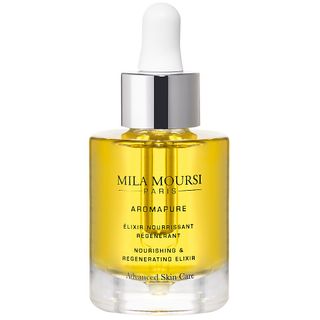
Mila Moursi Nourishing and Regenerating Elixir
Works for
1 of 1 advertised claim delivered
Moisturizing14 ingredients credited for this claimGood support
“A nourishing and regenerating 100% natural elixir formulated with a blend of fast-absorbing exotic Abyssinian, Inka Omegas 3,6,9, Rosehip and Tsubaki oils that deeply soothe dry skin, leaving it smooth and resilient.”
This product can help soften the skin and reduce its moisture loss with emollients and occlusives: caprylic/capric triglyceride, plukenetia volubilis seed oil.
Keep in mind that this product does not contain effective ingredients to attract water to the upper layer of the skin. This is why an additional product with humectants like glycerin or hyaluronic acid can be helpful (apply it before this product for the best results).
Anti-agingNot advertised by the brand · 2 ingredients credited for this claimModerate support
This product contains retinyl palmitate. This ingredient might be able to help reduce and prevent fine lines and wrinkles, improve skin elasticity and firmness, but there is not enough evidence that it actually works.
Evens skin toneNot advertised by the brand · 2 ingredients credited for this claimModerate support
The following ingredient (ingredients) in this product might be helpful, but there is no evidence to confirm that it actually works: ethyl linoleate, retinyl palmitate.
Anti-blemishNot advertised by the brand · 3 ingredients credited for this claimGood support
This product might be able to help reduce blemishes and clogged pores because it contains ethyl linoleate.
The following ingredient (ingredients) in this product might be helpful, but there is no evidence to confirm that it actually works: retinyl palmitate
Can it cause trouble?
Irritancy18 strong irritants: Rosa rubiginosa seed oil, Citrus aurantium amara leaf/twig oil + 16 more — patch-test recommendedHigh risk
Comedogenic1 ingredient rated 2 or more on the 0–5 pore-clogging scale1 flagged
User reviews
Be the first — your take helps the next person decide.
Ingredients
Filter by role to see what each ingredient is doing.
Simmondsia chinensis seed oil~25–37%
- Irritation risk
- Medium
Softens the upper layer of skin and helps restore the healthy skin barrier. Has shown to help calm down inflammation in skin. It is a stable oil, meaning that it retains its properties even when exposed to air.
More about Simmondsia chinensis seed oilCaprylic/capric triglyceride~6.2–9.3%
- Irritation risk
- Medium
A good mix of fatty acids that forms a protective layer on the skin. Improves the shelf life of products. Derived from coconut and glycerin
More about Caprylic/capric triglycerideSqualane~4.8–7.3%
- Irritation risk
- Low
An oil naturally present in skin. Works as an emollient to soften the skin and form a protective layer on its surface without a greasy feeling.
More about SqualaneCamellia japonica seed oil~3.4–5.1%
- Irritation risk
- Low
A plant oil that helps to soften the upper layer of the skin and can help restore skin's barrier function. Might have an anti-oxidant effect
More about Camellia japonica seed oilCrambe abyssinica seed oil~2.3–3.4%
- Irritation risk
- Medium
Helps soften the upper layer of the skin
More about Crambe abyssinica seed oilGlycine soja oil~1.9–2.9%
- Irritation risk
- Medium
- Comedogenicity
- 2/5
A good emollient that helps soften the skin and helps repair its barrier function. It can clog pores if used in high concentrations.
More about Glycine soja oilPlukenetia volubilis seed oil~1.8–2.7%
- Irritation risk
- Low
A plant oil that works as a good moisturizer by softening the upper layer of the skin. Might be helpful in reducing inflammation in skin and reducing blemishes due to the large content of linoleic acid
More about Plukenetia volubilis seed oilPpg-12/smdi copolymer~1.5–2.2%
Octyldodecanol~1.1–1.7%
- Irritation risk
- Low
An emollient that helps to soften the skin and create a pleasant product texture and stabilize the formulation
More about OctyldodecanolOenothera biennis oil~0.95–1.45%
- Irritation risk
- Medium
Helps soften the upper layer of the skin and can support skin barrier function
More about Oenothera biennis oilRosa rubiginosa seed oil~0.6–1.4%
- Irritation risk
- High
Plant oil that due to the high content of linoleic acid can support skin's barrier function and reduce moisture loss
More about Rosa rubiginosa seed oilLecithin~0.5–1.2%
- Irritation risk
- Low
Used mostly for creating emulsions - helping oil and water mix together. Helps soften the upper layer of the skin
More about LecithinCitrus aurantium amara leaf/twig oil~0.4–0.95%
- Irritation risk
- High
Anthemis nobilis flower oil~0.35–0.85%
- Irritation risk
- High
An essential oil that is used as a fragrance and can be irritating. It might have some anti-oxidant effect in skin
More about Anthemis nobilis flower oilLavandula angustifolia oil~0.35–0.8%
- Irritation risk
- High
An essential oil. Potential allergen and can be irritating. It has some anti-bacterial properties
More about Lavandula angustifolia oilPelargonium graveolens flower oil~0.35–0.85%
- Irritation risk
- High
An essential oil. Can be irritating. Can become an allergen with oxidation
More about Pelargonium graveolens flower oilCitrus aurantium amara flower oil~0.35–0.8%
- Irritation risk
- High
Used as a fragrance. Can be irritating
More about Citrus aurantium amara flower oilArachidyl propionate~0.35–0.85%
- Irritation risk
- Low
Tocopherol~0.2–0.8%
- Irritation risk
- Low
Pure form of vitamin E. Can help moisturise and protect the skin from free radicals. Often used to help stabilise other ingredients or the formula itself
More about TocopherolRetinyl palmitate~0.15–0.7%
- Irritation risk
- High
Three steps removed from the active form of vitamin A - retinoic acid. To have an effect in the skin, it first needs to be converted twice to become the retinoic acid. This means it is less potent than retinol, but could also be less irritating. Once converted to the retinoic acid in the skin, it helps against all signs of aging, improves skin cell turnover and helps fight blemishes and clogged pores. However, in many cosmetic formulations, it is used in a concentration that is too low to have the full effect
More about Retinyl palmitateAniba rosaeodora wood oil~0.15–0.6%
- Irritation risk
- High
Boswellia carterii oil~0.15–0.65%
Cananga odorata flower oil~0.15–0.6%
Ethyl linolenate~0.2–0.75%
- Irritation risk
- Low
Helichrysum angustifolium flower oil~0.15–0.55%
- Irritation risk
- Low
Rosa damascena flower oil~0.15–0.6%
- Irritation risk
- High
Used as a fragrance. Can be irritating
More about Rosa damascena flower oilEthyl linoleate~0.15–0.7%
- Irritation risk
- Medium
Helps reduce acne and blemishes. Helps to soften the upper layer of the skin and reduce inflammation. Might be helpful in reducing hyperpigmentation and evening out the skin tone, but evidence of effectiveness in skin are lacking
More about Ethyl linoleateEthyl oleate~0.15–0.7%
- Irritation risk
- Medium
Ethyl oleate is a long-chain fatty acid ethyl ester resulting from the formal condensation of the carboxy group of oleic acid with the hydroxy group of ethanol. It derives from an oleic acid. In skincare, it is used to soften the upper layer of the skin, improve the product texture and smell
More about Ethyl oleateCitral~0.1–0.45%
Citronellol~0.1–0.45%
Farnesol~0.1–0.4%
Geraniol~0.1–0.35%
Limonene~0.1–0.35%
- Irritation risk
- High
A common frangrance that can easily irritate skin, especially if exposed to air, light or heat
More about LimoneneLinalool~0.05–0.3%
Benzyl benzoate~0.05–0.2%
- Irritation risk
- High
Fragrance with sweet balsamic smell. Help to preserve products and dissolve other ingredients. Could trigger allergic reactions and be irritating
More about Benzyl benzoateBenzyl salicylate~0.05–0.2%
Ingredient list view
Simmondsia chinensis seed oil, Caprylic/capric triglyceride, Squalane, Camellia japonica seed oil, Crambe abyssinica seed oil, Glycine soja oil, Plukenetia volubilis seed oil, Ppg-12/smdi copolymer, Octyldodecanol, Oenothera biennis oil, Rosa rubiginosa seed oil, Lecithin, Citrus aurantium amara leaf/twig oil, Anthemis nobilis flower oil, Lavandula angustifolia oil, Pelargonium graveolens flower oil, Citrus aurantium amara flower oil, Arachidyl propionate, Tocopherol, Retinyl palmitate, Aniba rosaeodora wood oil, Boswellia carterii oil, Cananga odorata flower oil, Ethyl linolenate, Helichrysum angustifolium flower oil, Rosa damascena flower oil, Ethyl linoleate, Ethyl oleate, Citral, Citronellol, Farnesol, Geraniol, Limonene, Linalool, Benzyl benzoate, Benzyl salicylate
Compare prices
Retailers ranked by price — lowest first.
Affiliate links · prices updated regularly · As an Amazon Associate, WIMJ earns from qualifying purchases.
Sources cited in this review
Every concentration estimate and effectiveness label is anchored to one of these 9 studies and safety reviews.
- 1
- 2Safety Assessment of Anthemis nobilis– Derived Ingredients as Used in Cosmeticsjournals.sagepub.com
- 3
- 4Biological Activities and Safety of Citrus spp. Essential Oilsncbi.nlm.nih.gov
- 5Vitamin E in dermatologyncbi.nlm.nih.gov
- 6Vitamin E and Skin Healthlpi.oregonstate.edu

Affiliate links · As an Amazon Associate, WIMJ earns from qualifying purchases.