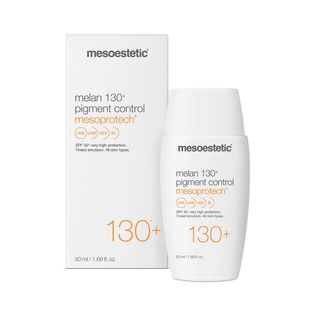
Mesoestetic Mesoprotech Melan SPF 130+ Pigment Control
Works for
3 of 3 advertised claims delivered
Sun protectionSPF 130 · 7 UV filtersBroad spectrum
This product offers a good level of protection against both UVB and UVA rays.
This sunscreen uses organic (so-called "chemical") sunscreen filters. Organic, or "chemical" filters usually provide reliable sun protection and rarely leave a white cast. Sunscreens with organic filters can sting eyes.
This product can be considered "reef safe" because it does not contain the UV filters (oxybenzone and octinoxate) that can be harmful to coral reefs when present in the water in high concentrations.
Anti-agingNo ingredient credited for this claimStrong support
“High quality sun protection with UVB 131 and UVA 67, offering superior protection against all ranges of damaging light that can lead to premature ageing.”
This product can help prevent early signs of skin aging because it offers a good level of broad spectrum sun protection. Sun damage is the main cause of premature skin aging, and protecting your skin from the sun is the best anti-aging strategy.
Evens skin tone1 ingredient credited for this claimStrong support
“Azeloglycine helps to regulate the enzyme responsible for melanin production, helping to prevent pigmentation.”
This product offers broad spectrum sun protection. It means that it can prevent hyperpigmentation and help keep the skin tone even (sun damage is the main factor causing age spots, darkening of post-acne marks and other discolorations).
MoisturizingNot advertised by the brand · 12 ingredients credited for this claimGood support
This product can help improve hydration of the skin with the two types of ingredients.
The first type is called “humectants”:
these ingredients help attract water.
When humectants are on the surface of the skin, they “pull in” the moisture from the outside environment, or from
within deeper layers of the skin. The following ingredients in this product do the job:
polyglycerin-3.
This product also contains ingredients called “occlusives”. They help reduce the speed with which our skin loses moisture to the outside environment. These ingredients also help soften the upper layer of the skin, so it feels less tight and nicer to the touch. The following ingredients in this product do the job: dimethicone, helianthus annuus seed oil.
Can it cause trouble?
Irritancy1 strong irritant: ParfumMedium risk
ComedogenicClean of flagged comedogenic ingredientsNone flagged

User reviews
Ingredients
Filter by role to see what each ingredient is doing.
Water~45–55%
Dibutyl adipate~5.8–7%
- Irritation risk
- Low
Helps soften the upper layer of the skin and create a nice product consistency
More about Dibutyl adipateOctocrylene~4.8–5.8%
- Irritation risk
- Medium
A weak sunscreen that protects against the sun rays that cause sunburn (UVB) and is somewhat effective against the UVA rays. It is quite stable and can help stabilize other, more vulnerable, sunscreen ingredients like Avobenzone. It is an organic, or so called "chemical" sunscreen
More about OctocryleneCyclopentasiloxane~3.2–4%
- Irritation risk
- Low
A silicone that helps improve the product texture and spreadability. Can absorb oil creating a short-term mattifying effect on the skin
More about CyclopentasiloxaneHomosalate~3.3–4%
- Irritation risk
- Medium
A weak sunscreen that offers some protection against the sun rays that cause sunburn (UVB), but does not offer meaningful protection against protect against the most aging sun rays (UVA). It loses its effectiveness quickly when exposed to sunlight. It is an organic, or so called "chemical" sunscreen. When used in low concentrations, helps to stabilize the product formulation
More about HomosalateBis-ethylhexyloxyphenol methoxyphenyl triazine~2.5–3.1%
- Irritation risk
- Medium
Tinosorb S. One of the most effective broad spectrum sunscreen ingredients. Protects from both UVA and UVB rays. It is photostable. Unfortunately, not approved by FDA (US) yet.
More about Bis-ethylhexyloxyphenol methoxyphenyl triazineAlcohol~1.7–2.1%
- Irritation risk
- High
Can be drying and contribute to skin irritation. Used in formulars to dissolve other ingredients, create a thinner product consistency or for its antibacterial properties
More about AlcoholButyl methoxydibenzoylmethane~2–2.4%
- Irritation risk
- Medium
Avobenzone. An organic, or so-called "chemical" UV filter. Protects against both UVA and UVB rays. Needs to be combined with other filters in a formulation to be stable.
More about Butyl methoxydibenzoylmethaneTitanium dioxide~1.6–1.9%
- Irritation risk
- Low
Works as a UV filter when used in high concentrations. It is photostable and is effective mostly against the UVB light, with some protection in the UVA range. In small concentrations, used for its ability to improve the color of cosmetic products. Is usually well tolerated by the skin
More about Titanium dioxideMethylene bis-benzotriazolyl tetramethylbutylphenol~1.3–1.6%
- Irritation risk
- Medium
Tinosorb M. A UV filter. Is effective against both UVA and UVB rays. It also provides some protection against visible light. It is photostable and can also be used to improve photostability of other sunscreen ingredients. Its physical properties help to create lightweight sunscreen formulations. It can leave a slight white cast. Unfortunately, it is not approved by the FDA (US) yet
More about Methylene bis-benzotriazolyl tetramethylbutylphenolCyclohexasiloxane~0.75–1.15%
- Irritation risk
- Low
A silicone that serves as an emollient. Helps create a nice non-greasy feels
More about CyclohexasiloxanePeg-30 dipolyhydroxystearate~0.6–0.95%
- Irritation risk
- Medium
Helps oil and water mix together
More about Peg-30 dipolyhydroxystearatePolysilicone-15~0.75–1.1%
- Irritation risk
- Medium
A UV filter. Effective against UVB rays, but does not protect against the most aging UVA light
More about Polysilicone-15Styrene/acrylates copolymer~0.55–0.8%
- Irritation risk
- Low
Used to create an even product consistency. Can help boost efficiency of sunscreen filters
More about Styrene/acrylates copolymerPeg-10 dimethicone~0.5–0.8%
- Irritation risk
- Low
A silicone that works to soften the upper layer of the skin and reduce its water loss
More about Peg-10 dimethiconeSilica~0.65–1%
Bis-ethylhexyl hydroxydimethoxy benzylmalonate~0.45–0.65%
- Irritation risk
- Low
Polyamide-5~0.45–0.7%
- Irritation risk
- Low
An emollient that helps soften the skin and create a nice product feel and texture
More about Polyamide-5Potassium azeloyl diglycinate~0.35–0.65%
- Irritation risk
- Low
A derivative of azelaic acid. It is obtained by reacting the chloride of azelaic acid with two molecules of glycine (an amino acid) and potassium hydroxide. It is less studied than azelaic acid, but the available research suggests that it also can be effective in reducing skin redness, hyperpigmentation and blemishes. There are claims that it is more bio-available and more effective than azelaic acid, but no comparison study is available. Potassium azeloyl diglycinate is better soluble in water compared with azelaic acid. Because of this property, products with potassium azeloyl digclycinate can have a nicer texture
More about Potassium azeloyl diglycinateJojoba esters~0.4–0.6%
- Irritation risk
- Medium
An emollient made of jojoba oil. Helps soften the skin and support its barrier function
More about Jojoba estersHexyl laurate~0.35–0.6%
- Irritation risk
- Medium
Helps soften the upper layer of the skin and create a nice product consistency
More about Hexyl laurateHelianthus annuus seed oil~0.3–0.6%
- Irritation risk
- Low
A great emollient due to its high linoleic acid content. One of the most effective plant oils in helping skin hydration and repairing skin barrier function
More about Helianthus annuus seed oilDimethicone~0.35–0.6%
- Irritation risk
- Low
A silicone that helps to reduce water loss from the surface of the skin. Can temporarily "fill in" lines and wrinkles, absorb oil, and create a nice product finish
More about DimethiconeEthylhexylglycerin~0.3–0.5%
Acacia decurrens flower wax~0.3–0.5%
Polyglycerin-3~0.3–0.55%
- Irritation risk
- Low
Helps to attract water to the upper layer of the skin
More about Polyglycerin-3Polyamide-3~0.3–0.55%
- Irritation risk
- Low
Cetyl peg/ppg-10/1 dimethicone~0.3–0.5%
- Irritation risk
- Low
A type of silicone that helps water and oil mix together. Can help to soften upper layer of the skin
More about Cetyl peg/ppg-10/1 dimethiconePolyglyceryl-4 isostearate~0.3–0.55%
- Irritation risk
- Medium
Helps water and oil mix together
More about Polyglyceryl-4 isostearateSodium chloride~0.3–0.55%
- Irritation risk
- Low
Used to stabilize mixtures of oil and water, and create thicker, gel-like product textures
More about Sodium chlorideVp/hexadecene copolymer~0.3–0.5%
- Irritation risk
- Low
Creates a nice product texture and can support water-resistance of sunscreens
More about Vp/hexadecene copolymerDecyl glucoside~0.35–0.6%
- Irritation risk
- High
Helps oil and water mix together. Can be irritating
More about Decyl glucosideDisteardimonium hectorite~0.25–0.5%
- Irritation risk
- Low
A type of clay that is used to thicken the product consistency
More about Disteardimonium hectoriteDisodium edta~0.25–0.45%
Peg-12 allyl ether~0.25–0.45%
- Irritation risk
- Low
Hydrogenated lecithin~0.25–0.45%
- Irritation risk
- Low
Helps to retain moisture by creating a protective barrier on the skin. Rich in fatty acids. Improves product texture and helps with the penetration of other ingredients.
More about Hydrogenated lecithinPropylene glycol~0.25–0.45%
- Irritation risk
- High
Helps oil and water mix together and can enhance the penetration of other ingredients into the skin. It can be irritating
More about Propylene glycolXanthan gum~0.25–0.45%
- Irritation risk
- Low
Used to create a thicker product consistency
More about Xanthan gumPentaerythrityl tetra-di-t-butyl hydroxyhydrocinnamate~0.2–0.4%
- Irritation risk
- Low
Used to increase stability of product formulations
More about Pentaerythrityl tetra-di-t-butyl hydroxyhydrocinnamatePhenoxyethanol~0.15–0.3%
- Irritation risk
- Low
A preservative. It helps prevent bacterial growth in cosmetic products
More about PhenoxyethanolParfum~0.15–0.3%
- Irritation risk
- High
An aromatic blend of unspecified and possibly irritating ingredients
More about ParfumCi 77492~0.15–0.3%
Ci 77491~0.1–0.2%
- Irritation risk
- Low
A red colorant made of iron oxide. Typically is not irritating
More about Ci 77491Ci 77499~0.1–0.2%
Ingredient list view
Water, Dibutyl adipate, Octocrylene, Cyclopentasiloxane, Homosalate, Bis-ethylhexyloxyphenol methoxyphenyl triazine, Alcohol, Butyl methoxydibenzoylmethane, Titanium dioxide, Methylene bis-benzotriazolyl tetramethylbutylphenol, Cyclohexasiloxane, Peg-30 dipolyhydroxystearate, Polysilicone-15, Styrene/acrylates copolymer, Peg-10 dimethicone, Silica, Bis-ethylhexyl hydroxydimethoxy benzylmalonate, Polyamide-5, Potassium azeloyl diglycinate, Jojoba esters, Hexyl laurate, Helianthus annuus seed oil, Dimethicone, Ethylhexylglycerin, Acacia decurrens flower wax, Polyglycerin-3, Polyamide-3, Cetyl peg/ppg-10/1 dimethicone, Polyglyceryl-4 isostearate, Sodium chloride, Vp/hexadecene copolymer, Decyl glucoside, Disteardimonium hectorite, Disodium edta, Peg-12 allyl ether, Hydrogenated lecithin, Propylene glycol, Xanthan gum, Pentaerythrityl tetra-di-t-butyl hydroxyhydrocinnamate, Phenoxyethanol, Parfum, Ci 77492, Ci 77491, Ci 77499
Compare prices
Retailers ranked by price — lowest first.

Worth comparing, line by line.
Match % combines shared ingredients, the first five ingredients, shared actives and hero ingredients, irritancy (lower counts in the alternative's favour), texture and body area. Only products in the same routine step are compared.
| MesoesteticMesoprotech Melan SPF 130+ Pigment ControlYOUR PRODUCT | RilastilACNESTIL SPF 50+ | |
|---|---|---|
| Match | — | 72% |
| Price | $47.29 | $32.34−$14.95 |
| Shared key ingredients | — | 3 of 14 |
| Key difference | — | Niacinamide |
| Irritancy | Medium | Medium |
| SPF | SPF 130 | SPF 50 |
| Drying alcohol | Contains drying alcohol | — |
| View product | Shop |

Product summary
We believe that "Mesoestetic - Mesoprotech Melan SPF 130+ Pigment Control" can provide reliable sun protection based on the ingredients listed. It can protect from both UVA and UVB rays. This is great news because not all sunscreens with SPF ratings give UVA protection. (UVA rays do not cause sunburn, but still damage our skin and lead to early aging).
As a plus, this sunscreen uses some of the new generation UV filters (Tinosorb M). These filters are more stable and more gentle on the skin.
Because it includes good moisturizing ingredients, it can also work as a hydrating day cream. Like all broad-spectrum sunscreens, this product has an anti-aging benefit.
Sunscreen filters
This sunscreen uses a mixture of both mineral and organic (so-called "chemical") UV filters. Here are the organic filters this product uses: tinosorb s, avobenzone, homosalate, tinosorb m, octocrylene and polysilicone-15. As for the mineral filters, this sunscreen uses titanium dioxide.
Irritation risk
We assess the overall irritancy of this sunscreen to be medium. For a detailed overview of all potential irritants: click here
You can see the detailed formula review with the breakdown of all actives in the product and the full ingredient list with estimated concentrations in the tables below.
What our users say
Based on 1 review 100% recommend this product- As for the white cast, it did not leave a noticeable white residue for the reviewer.
- When it comes to using this sunscreen under makeup, the user found that it pills under a foundation.
- As for using this sunscreen in the eye area, the reviewer reported that it does not sting eyes.
Price
The product retails for 56.10$ in the United States and for 52.99£ in the United Kingdom.
For a detailed price comparison: click here.
Sources cited in this review
Every concentration estimate and effectiveness label is anchored to one of these 18 studies and safety reviews.
- 1
- 2
- 3
- 4
- 5Azeloyl-Glycine: A new active in skin disequilibriumresearchgate.net
- 6

Affiliate links · As an Amazon Associate, WIMJ earns from qualifying purchases.