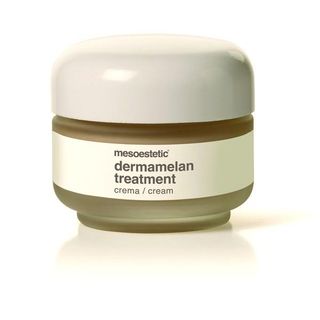
Mesoestetic Dermamelan Treatment Maintenance Cream
Works for
1 of 1 advertised claim delivered
Evens skin toneRetinol, Ferulic acid + 4 moreStrong evidence
“Dermamelan Treatment Maintenance Cream is an extremely effective lightening cream designed to reduce hyperpigmentation.”
This product can help reduce hypepigmentation and even out the skin tone because it contains the following effective ingredients: retinol.
The following ingredient (ingredients) in this product might be helpful, but there is no evidence to confirm that it actually can help even out the skin tone: ferulic acid, glycyrrhiza glabra root extract.
Keep in mind that you would need to apply any topical skincare targetted at hypigmentation consistently for a couple of months to get a result. No topical skincare product can help get rid of hyperpigmentation (including post-acne marks and age spots) instantly.
Anti-oxidationNot advertised by the brand · Ferulic acid, Hydroxydecyl ubiquinone + 4 moreStrong evidence
This product contains antioxidants (ferulic acid, hydroxydecyl ubiquinone, retinol) that can help neutralize free radicals in skin. By doing so, they can lessen the damage the skin gets from the UV light (sun).
Anti-agingNot advertised by the brand · Retinol, Ferulic acid + 4 moreStrong evidence
This product can help reduce and prevent fine lines and wrinkles, improve skin elasticity and firmness because it contains retinol.
These ingredients in the product can also be helpful, even though there is less evidence for their effectiveness: ferulic acid, hydroxydecyl ubiquinone.
Keep in mind that it typically takes at least 6 weeks to notice any results because the changes that are needed to improve fine lines and elasticity happen in the deeper layers of the skin. No topical anti-aging product can “erase” wrinkles or fully reverse signs of aging.
ExfoliationNot advertised by the brand · Retinol, Retinyl palmitateStrong evidence
This product can help exfoliate the skin. In other words, it helps break down the bonds between dead cells on the surface of the skin and speed up the skin turnover. Skin often appears softer and brighter after exfoliation, but overdoing it can result in disrupted skin barrier. The following ingredient is doing the exfoliating job in this product: retinol.
Anti-blemishNot advertised by the brand · Retinol, Niacinamide + 1 moreStrong evidence
This product can help reduce breakouts and clogged pores because it contains the following ingredient: retinol. This ingredient is used for treating acne and can have a noticeable effect.
MoisturizingNot advertised by the brand · Mannitol, Cholesterol + 11 moreGood evidence
This product can help improve hydration of the skin with the two types of ingredients.
The first type is called “humectants”:
these ingredients help attract water.
When humectants are on the surface of the skin, they “pull in” the moisture from the outside environment, or from
within deeper layers of the skin. The following ingredients in this product do the job:
glycerin, mannitol.
This product also contains ingredients called “occlusives”. They help reduce the speed with which our skin loses moisture to the outside environment. These ingredients also help soften the upper layer of the skin, so it feels less tight and nicer to the touch. The following ingredients in this product do the job: cholesterol, c12-15 alkyl benzoate.
Can it cause trouble?
Irritancy3 strong irritants: Retinol, Retinyl palmitate + 1 more — patch-test recommendedHigh risk
Comedogenic1 ingredient rated 2 or more on the 0–5 pore-clogging scale1 flagged


User reviews
Be the first — your take helps the next person decide.
Ingredients
Filter by role to see what each ingredient is doing.
Water~45–55%
Glyceryl stearate~4.8–5.9%
- Irritation risk
- Low
An emollient that softens the skin and forms a protective layer on its surface. Helps water and oil mix together
More about Glyceryl stearateGlycofurol~4.2–5.1%
- Irritation risk
- Low
Silica~3.1–3.7%
Peg-75 stearate~2.3–2.8%
Peg-8~1.9–2.3%
- Irritation risk
- Medium
Used to create a nice product consistency
More about Peg-8Polyamide-5~1.6–2%
- Irritation risk
- Low
An emollient that helps soften the skin and create a nice product feel and texture
More about Polyamide-5Kojic dipalmitate~1.4–1.7%
- Irritation risk
- Low
Glycereth-26~1.1–1.3%
Niacinamide~0.8–1.2%
- Irritation risk
- Low
Is proven to be effective in reducing blemishes, evening out skin tone and helping to improve lines and wrinkles. It helps the skin to repair sun damage, calm down inflammation and keep maintain good levels of moisture. The concentration of about 2% is effective for supporting the skin barrier and evening out the skin tone. Concentration of 4-6% is better for helping with acne and balancing the sebum production
More about NiacinamideEthoxydiglycol~0.6–0.9%
C12-15 alkyl benzoate~0.55–0.85%
- Irritation risk
- Low
Enhances the product texture and makes it more spreadable. Helps reduce water loss from the outer layer of skin. Extands the shelf life by preventing bacteria growth
More about C12-15 alkyl benzoateOctyldodecanol~0.5–0.75%
- Irritation risk
- Low
An emollient that helps to soften the skin and create a pleasant product texture and stabilize the formulation
More about OctyldodecanolPpg-15 stearyl ether~0.5–0.7%
- Irritation risk
- Low
Help soften the upper layer of the skin and create a nice product consistency
More about Ppg-15 stearyl ether4-butylresorcinol~0.35–0.65%
- Irritation risk
- Low
Coco-caprylate/caprate~0.45–0.65%
- Irritation risk
- Low
Helps to soften the upper layer of the skin without creating a greasy texture
More about Coco-caprylate/caprateGlyceryl behenate~0.45–0.65%
- Irritation risk
- Medium
Used to create a thicker product consistency and help soften the upper layer of the skin
More about Glyceryl behenatePoloxamer 338~0.35–0.6%
Glycyrrhiza glabra root extract~0.25–0.5%
- Irritation risk
- Medium
A plant extract that can help lighten the skin and calm down inflammation. Might be helpful in neutralizing free radicals
More about Glycyrrhiza glabra root extractDihydroxychalcone sulfonic acid~0.3–0.6%
- Irritation risk
- Low
Piper nigrum fruit extract~0.25–0.45%
- Irritation risk
- Low
Retinol~0.25–0.4%
- Irritation risk
- High
Two steps removed from the active form of vitamin A - retinoic acid. Once converted to the retinoic acid in the skin, retinol is proven to be effective against all signs of aging. It improves skin cell turnover, helps fight blemishes and clogged pores, can regulate excess oil production and even skin tone. It can, however, be quite irritating
More about RetinolHydroxydecyl ubiquinone~0.25–0.45%
- Irritation risk
- Medium
An analogue of coenzyme Q10 that has a lower molecular weight, which can improve its ability to penetrate the skin. It helps neutralize free radicals in skin, improves skin hydration and might be helpful agains fine lines and wrinkles. It can be an allergen
More about Hydroxydecyl ubiquinoneMagnesium ascorbyl phosphate~0.25–0.45%
- Irritation risk
- Medium
A derivative of vitamin C that is more stable, but less bioavailable than the pure form of vitamin C. It does not penetrate the skin well, but has been shown to convert to pure vitamin C once in skin. It can be helpful in stimulating collagen production and lightening the skin tone, but the required concentration is likely to be very high
More about Magnesium ascorbyl phosphateRetinyl palmitate~0.2–0.4%
- Irritation risk
- High
Three steps removed from the active form of vitamin A - retinoic acid. To have an effect in the skin, it first needs to be converted twice to become the retinoic acid. This means it is less potent than retinol, but could also be less irritating. Once converted to the retinoic acid in the skin, it helps against all signs of aging, improves skin cell turnover and helps fight blemishes and clogged pores. However, in many cosmetic formulations, it is used in a concentration that is too low to have the full effect
More about Retinyl palmitateDiosmine~0.25–0.45%
- Irritation risk
- Low
Ferulic acid~0.25–0.45%
- Irritation risk
- Low
A potent anti-oxidant that has been shown to be effective in neutralizing free radicals in skin. There seem to have a synergetic effect of ferulic acid, vitamin E and C, meaning that when the ingredients are used together, they enhance each other's ability protect the skin against free radicals. Ferulic acid also helps to stabilize other ingredients - including vitamins C and E. It can help to even out the skin tone. Ferulic acid is approved for use as a sunscreen ingredient in Japan in concentrations up to 10%
More about Ferulic acidTocopheryl acetate~0.25–0.45%
- Irritation risk
- Medium
A more stable but less bio-available form of vitamin E compared to Tocopherol. Might help moisturize and protect the skin from free radicals, but mostly used in low concentrations to stabilize other ingredients.
More about Tocopheryl acetateSilica dimethyl silylate~0.25–0.5%
Coconut alkanes~0.25–0.5%
- Irritation risk
- Medium
- Comedogenicity
- 2/5
An emollient that helps soften the skin
More about Coconut alkanesPpg-12/smdi copolymer~0.3–0.55%
Pentaerythrityl tetra-di-t-butyl hydroxyhydrocinnamate~0.25–0.5%
- Irritation risk
- Low
Used to increase stability of product formulations
More about Pentaerythrityl tetra-di-t-butyl hydroxyhydrocinnamateMannitol~0.25–0.4%
- Irritation risk
- Low
Helps to attract water to the upper layer of the skin
More about MannitolPhosphatidylcholine~0.25–0.45%
- Irritation risk
- Medium
Used to enhance the delivery of other ingredients
More about PhosphatidylcholineGlycerin~0.25–0.5%
- Irritation risk
- Low
One of the best moisturizing ingredients. Naturally present in skin. It attracts water to the upper layer of the skin working as a humectant
More about GlycerinCholesterol~0.3–0.55%
- Irritation risk
- Low
An emollient that is naturally found in skin
More about CholesterolSodium hydroxide~0.2–0.4%
Polysorbate 80~0.25–0.45%
Xanthan gum~0.25–0.4%
- Irritation risk
- Low
Used to create a thicker product consistency
More about Xanthan gumBht~0.2–0.35%
Potassium sorbate~0.2–0.4%
Sodium benzoate~0.2–0.35%
Phenoxyethanol~0.15–0.3%
- Irritation risk
- Low
A preservative. It helps prevent bacterial growth in cosmetic products
More about PhenoxyethanolSodium metabisulfite~0.1–0.2%
Methylparaben~0.1–0.15%
Propylparaben~0.1–0.2%
Ethylparaben~0.1–0.2%
Parfum~0.05–0.1%
- Irritation risk
- High
An aromatic blend of unspecified and possibly irritating ingredients
More about ParfumCaramel~0.05–0.1%
- Irritation risk
- Low
Ingredient list view
Water, Glyceryl stearate, Glycofurol, Silica, Peg-75 stearate, Peg-8, Polyamide-5, Kojic dipalmitate, Glycereth-26, Niacinamide, Ethoxydiglycol, C12-15 alkyl benzoate, Octyldodecanol, Ppg-15 stearyl ether, 4-butylresorcinol, Coco-caprylate/caprate, Glyceryl behenate, Poloxamer 338, Glycyrrhiza glabra root extract, Dihydroxychalcone sulfonic acid, Piper nigrum fruit extract, Retinol, Hydroxydecyl ubiquinone, Magnesium ascorbyl phosphate, Retinyl palmitate, Diosmine, Ferulic acid, Tocopheryl acetate, Silica dimethyl silylate, Coconut alkanes, Ppg-12/smdi copolymer, Pentaerythrityl tetra-di-t-butyl hydroxyhydrocinnamate, Mannitol, Phosphatidylcholine, Glycerin, Cholesterol, Sodium hydroxide, Polysorbate 80, Xanthan gum, Bht, Potassium sorbate, Sodium benzoate, Phenoxyethanol, Sodium metabisulfite, Methylparaben, Propylparaben, Ethylparaben, Parfum, Caramel
Compare prices
Retailers ranked by price — lowest first.

Affiliate links · prices updated regularly
Worth comparing, line by line.
Match % combines shared ingredients, the first five ingredients, shared actives and hero ingredients, irritancy (lower counts in the alternative's favour), texture and body area. Only products in the same routine step are compared.
| MesoesteticDermamelan Treatment Maintenance CreamYOUR PRODUCT | MedicubeKojic Acid Turmeric Vita Capsule Cream | Skincare by Dr VTRIO Blemish PM Gel Moisturiser | FranklyRetinol 0.1% Wrinkle Care Cream 30ml | |
|---|---|---|---|---|
| Match | — | 86% | 82% | 79% |
| Price | $240.75 | $25.68−$215.07 | $72.19−$168.56 | $11.90−$228.85 |
| Shared key ingredients | — | 4 of 8 | 4 of 8 | 4 of 8 |
| Key difference | — | Copper Tripeptide-1 | Retinal | Adenosine |
| Irritancy | High | Medium | Medium | Medium |
| Drying alcohol | — | — | — | — |
| View product | Shop | Shop | Shop |


Sources cited in this review
Every concentration estimate and effectiveness label is anchored to one of these 18 studies and safety reviews.
- 1
- 2
- 3
- 4
- 5Safety Assessment of Alkyl Esters as Used in Cosmeticscir-safety.org
- 6

Affiliate links · As an Amazon Associate, WIMJ earns from qualifying purchases.