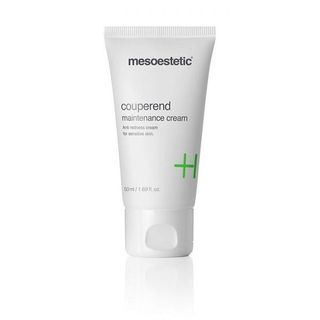
Mesoestetic Couperend Maintenance Cream
Works for
2 of 3 advertised claims delivered
MoisturizingPanthenol, Asiatic acid + 20 moreStrong evidence
“Hydrates & strengthens skin”
This product can help improve hydration of the skin with the two types of ingredients.
The first type is called “humectants”:
these ingredients help attract water.
When humectants are on the surface of the skin, they “pull in” the moisture from the outside environment, or from
within deeper layers of the skin. The following ingredients in this product do the job:
glycerin, glucosyl hesperidin.
This product also contains ingredients called “occlusives”. They help reduce the speed with which our skin loses moisture to the outside environment. These ingredients also help soften the upper layer of the skin, so it feels less tight and nicer to the touch. The following ingredients in this product do the job: butyrospermum parkii butter, caprylic/capric triglyceride.
The following ingredients in this product are especially good for supporting the skin barrier and helping with the hydration level: panthenol
Anti-agingAsiaticoside, Butyrospermum parkii butter + 3 moreModerate evidence
“Beta-glucan – Helps hydrate the skin, reduce wrinkles and strengthen the skin.”
This product contains asiaticoside. This ingredient might be able to help reduce and prevent fine lines and wrinkles, improve skin elasticity and firmness, but there is not enough evidence that it actually works.
Evens skin toneRetinyl palmitate, Ascorbyl glucosideWeak evidence
“Improves skin tone.”
Effective ingredients missing or their concentration is too low
Anti-oxidationNot advertised by the brand · Asiaticoside, Butyrospermum parkii butter + 5 moreStrong evidence
This product contains antioxidants (asiaticoside) that can help neutralize free radicals in skin. By doing so, they can lessen the damage the skin gets from the UV light (sun).
Can it cause trouble?
Irritancy6 strong irritants: Alcohol, Melilotus officinalis extract + 4 more — patch-test recommendedHigh risk
Comedogenic3 ingredients rated 2 or more on the 0–5 pore-clogging scale3 flagged


User reviews
Be the first — your take helps the next person decide.
Ingredients
Filter by role to see what each ingredient is doing.
Water~45–55%
Glycerin~4.9–6%
- Irritation risk
- Low
One of the best moisturizing ingredients. Naturally present in skin. It attracts water to the upper layer of the skin working as a humectant
More about GlycerinButyrospermum parkii butter~4.2–5.1%
- Irritation risk
- Low
- Comedogenicity
- 3/5
A great moisturising ingredient that softens the skin and reduces water loss from its upper layer. It also can be helpful in protecting skin from free radicals
More about Butyrospermum parkii butterC12-15 alkyl benzoate~3.1–3.8%
- Irritation risk
- Low
Enhances the product texture and makes it more spreadable. Helps reduce water loss from the outer layer of skin. Extands the shelf life by preventing bacteria growth
More about C12-15 alkyl benzoateCaprylic/capric triglyceride~2.4–3%
- Irritation risk
- Medium
A good mix of fatty acids that forms a protective layer on the skin. Improves the shelf life of products. Derived from coconut and glycerin
More about Caprylic/capric triglyceridePanthenol~1.9–2.3%
- Irritation risk
- Low
Helps attract water to the upper layer of the skin and can help improve skin barrier function
More about PanthenolPolyamide-5~1.7–2.1%
- Irritation risk
- Low
An emollient that helps soften the skin and create a nice product feel and texture
More about Polyamide-5C12-16 alcohols~1.5–1.8%
- Irritation risk
- Medium
Helps soften the upper layer of the skin and improve the product's texture
More about C12-16 alcoholsEthylhexyl methoxycinnamate~1.7–2.1%
- Irritation risk
- High
Octinoxate. When used in higher concentrations, works as a sunscreen protecting the skin from UVB rays. When used in lower concentration, helps to preserve the product formulation. Is shown to be harmful to coral reefs - consider avoiding bathing in coral reef areas when wearing a product with this ingredient. It can be irritating
More about Ethylhexyl methoxycinnamateSqualane~1–1.3%
- Irritation risk
- Low
An oil naturally present in skin. Works as an emollient to soften the skin and form a protective layer on its surface without a greasy feeling.
More about SqualaneAlcohol~0.7–1.05%
- Irritation risk
- High
Can be drying and contribute to skin irritation. Used in formulars to dissolve other ingredients, create a thinner product consistency or for its antibacterial properties
More about AlcoholGlyceryl stearate~0.65–0.95%
- Irritation risk
- Low
An emollient that softens the skin and forms a protective layer on its surface. Helps water and oil mix together
More about Glyceryl stearateMica~0.65–1%
- Irritation risk
- Low
Creates an illusion of smoother and more radiant skin tone. Adds shimmer to the skin by reflecting light
More about MicaCyclopentasiloxane~0.5–0.8%
- Irritation risk
- Low
A silicone that helps improve the product texture and spreadability. Can absorb oil creating a short-term mattifying effect on the skin
More about CyclopentasiloxaneGlyceryl stearate citrate~0.5–0.7%
- Irritation risk
- Low
Helps oil and water mix together while softening the upper layer of the skin
More about Glyceryl stearate citratePalmitic acid~0.5–0.75%
- Irritation risk
- Low
An emollient that is naturally present in skin and helps soften it
More about Palmitic acidGlucosyl hesperidin~0.4–0.6%
- Irritation risk
- Low
Might be able to neutralize free radicals in skin. Also works as a humectant
More about Glucosyl hesperidinDimethicone~0.45–0.7%
- Irritation risk
- Low
A silicone that helps to reduce water loss from the surface of the skin. Can temporarily "fill in" lines and wrinkles, absorb oil, and create a nice product finish
More about DimethiconeHydrogenated soybean oil~0.35–0.6%
- Irritation risk
- Low
- Comedogenicity
- 2/5
Melilotus officinalis extract~0.25–0.5%
- Irritation risk
- High
A plant extract that might have some anti-oxidant properties. Can be used as a fragrance and can be irritating
More about Melilotus officinalis extractPhospholipids~0.25–0.5%
- Irritation risk
- Low
Emollients that are naturaly present in skin. In addition, they help water and oil mix together in the product
More about PhospholipidsVaccinium myrtillus fruit/leaf extract~0.25–0.45%
- Irritation risk
- Low
Polyglyceryl-10 stearate~0.25–0.45%
- Irritation risk
- Medium
Helps water and oil mix together and softens the upper layer of the skin
More about Polyglyceryl-10 stearateRetinyl palmitate~0.2–0.4%
- Irritation risk
- High
Three steps removed from the active form of vitamin A - retinoic acid. To have an effect in the skin, it first needs to be converted twice to become the retinoic acid. This means it is less potent than retinol, but could also be less irritating. Once converted to the retinoic acid in the skin, it helps against all signs of aging, improves skin cell turnover and helps fight blemishes and clogged pores. However, in many cosmetic formulations, it is used in a concentration that is too low to have the full effect
More about Retinyl palmitateAsiaticoside~0.2–0.35%
- Irritation risk
- Medium
An active compound of Centella Asiatica plant extract. In combination with other active compounds of Centella Asiatica extract (madecasosside, asiatic acid and madecassic acid), asiaticoside has been shown to be helpful in wound-healing, restoring skin barrier function and supporting collagen production in skin. It can, however, itself be irritating
More about AsiaticosideRosmarinus officinalis leaf extract~0.2–0.4%
- Irritation risk
- High
Can be helpful in reducing inflammation in skin, including inflamed acne. It can be irritating
More about Rosmarinus officinalis leaf extractAsiatic acid~0.2–0.4%
- Irritation risk
- Medium
An active compound of Centella Asiatica plant extract. In combination with other active compounds of Centella Asiatica extract (asiaticoside, madecasosside and madecassic acid) asiatic acid has been shown to be helpful in wound-healing, restoring skin barrier function and supporting collagen production in skin. It can, however, itself be irritating
More about Asiatic acidMadecassic acid~0.2–0.4%
- Irritation risk
- Medium
An active compound of Centella Asiatica plant extract. In combination with other active compounds of Centella Asiatica extract (asiaticoside, madecasosside and asiatic acid), madecassic acid has been shown to be helpful in wound-healing, restoring skin barrier function and supporting collagen production in skin. It can, however, itself be irritating
More about Madecassic acidSodium carboxymethyl betaglucan~0.25–0.45%
- Irritation risk
- Low
Tocopherol~0.25–0.45%
- Irritation risk
- Low
Pure form of vitamin E. Can help moisturise and protect the skin from free radicals. Often used to help stabilise other ingredients or the formula itself
More about TocopherolGlycosaminoglycans~0.25–0.5%
- Irritation risk
- Low
Long sugars that help attract water to the upper layer of the skin
More about GlycosaminoglycansTitanium dioxide~0.3–0.6%
- Irritation risk
- Low
Works as a UV filter when used in high concentrations. It is photostable and is effective mostly against the UVB light, with some protection in the UVA range. In small concentrations, used for its ability to improve the color of cosmetic products. Is usually well tolerated by the skin
More about Titanium dioxideHydrogenated lecithin~0.25–0.45%
- Irritation risk
- Low
Helps to retain moisture by creating a protective barrier on the skin. Rich in fatty acids. Improves product texture and helps with the penetration of other ingredients.
More about Hydrogenated lecithinSorbitol~0.25–0.4%
- Irritation risk
- Low
Helps attract water to the upper layer of the skin and improves the product texture
More about SorbitolSodium acrylates copolymer~0.2–0.35%
- Irritation risk
- Medium
Used to create a thicker product consistency
More about Sodium acrylates copolymerAscorbyl glucoside~0.2–0.4%
- Irritation risk
- Medium
A vitamin C derivative that is more stable but less potent than pure form of vitamin C. Has a potential to boost collagen production, nutralise free radicals and reduce hyperpigmentation, but the required concentration is likely to be much higher than for the pure form of vitamin C, limiting the ingredient's effectiveness in products
More about Ascorbyl glucosideTriclosan~0.15–0.3%
- Irritation risk
- Low
Disodium edta~0.2–0.35%
Sodium metabisulfite~0.1–0.2%
Sodium laureth sulfate~0.45–0.7%
- Irritation risk
- High
- Comedogenicity
- 2/5
Works as a foaming cleansing agent
More about Sodium laureth sulfateBht~0.15–0.3%
Phenoxyethanol~0.15–0.25%
- Irritation risk
- Low
A preservative. It helps prevent bacterial growth in cosmetic products
More about PhenoxyethanolTin oxide~0.25–0.5%
- Irritation risk
- Low
A colorant that can add a pearl-like appearance to the formulation
More about Tin oxideImidazolidinyl urea~0.15–0.25%
- Irritation risk
- High
A preservative. Is more irritating than many other preservatives available
More about Imidazolidinyl ureaPotassium sorbate~0.15–0.3%
Trisodium edta~0.05–0.15%
Parfum~0.1–0.15%
- Irritation risk
- High
An aromatic blend of unspecified and possibly irritating ingredients
More about ParfumIngredient list view
Water, Glycerin, Butyrospermum parkii butter, C12-15 alkyl benzoate, Caprylic/capric triglyceride, Panthenol, Polyamide-5, C12-16 alcohols, Ethylhexyl methoxycinnamate, Squalane, Alcohol, Glyceryl stearate, Mica, Cyclopentasiloxane, Glyceryl stearate citrate, Palmitic acid, Glucosyl hesperidin, Dimethicone, Hydrogenated soybean oil, Melilotus officinalis extract, Phospholipids, Vaccinium myrtillus fruit/leaf extract, Polyglyceryl-10 stearate, Retinyl palmitate, Asiaticoside, Rosmarinus officinalis leaf extract, Asiatic acid, Madecassic acid, Sodium carboxymethyl betaglucan, Tocopherol, Glycosaminoglycans, Titanium dioxide, Hydrogenated lecithin, Sorbitol, Sodium acrylates copolymer, Ascorbyl glucoside, Triclosan, Disodium edta, Sodium metabisulfite, Sodium laureth sulfate, Bht, Phenoxyethanol, Tin oxide, Imidazolidinyl urea, Potassium sorbate, Trisodium edta, Parfum
Compare prices
Retailers ranked by price — lowest first.
.png)


Worth comparing, line by line.
Match % combines shared ingredients, the first five ingredients, shared actives and hero ingredients, irritancy (lower counts in the alternative's favour), texture and body area. Only products in the same routine step are compared.
| MesoesteticCouperend Maintenance CreamYOUR PRODUCT | TOSOWOONGJeju Mayu Cream | Alpha-HFirming Collagen Repair Cream | CiracleAnti-Redness K Cream | |
|---|---|---|---|---|
| Match | — | 61% | 60% | 59% |
| Price | $59.28 | — | $66.00+$6.72 | $22.80−$36.48 |
| Shared key ingredients | — | 8 of 17 | 9 of 17 | 9 of 17 |
| Key difference | — | Niacinamide | Anhydroxylitol | Niacinamide |
| Irritancy | High | Medium | Medium | Medium |
| Drying alcohol | Contains drying alcohol | — | — | — |
| View product | Shop | Shop | Shop |

Product summary
"Mesoestetic - Couperend Maintenance Cream" is a well-rounded moisturizing product. To work well, any moisturizer needs to include a combination of water-binding and emollient ingredients. Mesoestetic - Couperend Maintenance Cream ticks this box. Panthenol, glycerin, propylene glycol and sorbitol in this product (humectants) attract water molecules to the upper layer of the skin (the water comes from the outside air or from the deeper layers of the skin if the air is dry). Butyrospermum parkii butter, caprylic/capric triglyceride, dimethicone, helianthus annuus seed oil and squalane in this product help decrease the water evoporation from the skin, so that it stays hydrated for longer. These ingredients also soften the skin and take away the feeling of tightness and dryness.
Ingredient callouts
- this moisturizer includes a form of Retinoids (vitamin A) - retinyl palmitate 0.10% - 0.25%, but this type of vitamin A is not very effective. It could in theory help with fine lines and wrinkles, but the effect is most likely minimal.
- An effective concentration of Panthenol (pro-vitamin B5) - about 1.40% - 1.70%. Panthenol helps strengthen the skin barrier, improve hydration and reduce inflammation in skin.
Irritation risk
This formulation includes some common irritants, including ingredients that do not provide a benefit for the skin. We assess the overall irritancy of this moisturizer to be high. For a detailed overview of all potential irritants: click here
You can see the detailed formula review with the breakdown of all actives in the product and the full ingredient list with estimated concentrations in the tables below.
Price
The product retails from 92.25A$ up to 94.00A$ in Australia and for 67.00£ in the United Kingdom.
For a detailed price comparison: click here.
Sources cited in this review
Every concentration estimate and effectiveness label is anchored to one of these 23 studies and safety reviews.
- 1
- 2Skin moisturizing effects of panthenol-based formulationspdfs.semanticscholar.org
- 3
- 4
- 5Final Report on the Safety Assessment of Dimethicone Copolyoljournals.sagepub.com
- 6

Affiliate links · As an Amazon Associate, WIMJ earns from qualifying purchases.