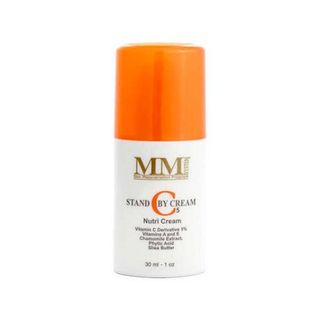
Works for
1 of 3 advertised claims delivered
MoisturizingSodium hyaluronate, Caprylic/capric triglyceride + 8 moreGood evidence
“The addition of shea butter, bisabolol and chamomile extract makes this cream soothing and intensely moisturising. p H 7.”
This product can help improve hydration of the skin with the two types of ingredients.
The first type is called “humectants”:
these ingredients help attract water.
When humectants are on the surface of the skin, they “pull in” the moisture from the outside environment, or from
within deeper layers of the skin. The following ingredients in this product do the job:
sodium hyaluronate, propylene glycol.
This product also contains ingredients called “occlusives”. They help reduce the speed with which our skin loses moisture to the outside environment. These ingredients also help soften the upper layer of the skin, so it feels less tight and nicer to the touch. The following ingredients in this product do the job: bis-diglyceryl polyacyladipate-2, caprylic/capric triglyceride.
ExfoliationRetinyl palmitateWeak evidence
“Vitamin C 5%, phytic acid 4%, vitamins A and E, grapeseed extract soothes the skin and encourages maximal collagen production following therapeutic peeling and when the skin is irritated by retinoic acid or hydroquinone.”
This product does not contain effective exfoliating ingredients. It might be able to deliver physical exfoliation, that is scrub off some of the dead cells on the surface of the skin. We do not recommend physical exfoliation, because it is not uniform (some bits of skin can get exfoliated too much while others not at all). It can also traumatize the skin and aggrevate acne and other skin conditions.
Evens skin toneRetinyl palmitateWeak evidence
“Vitamin C 5%, phytic acid 4%, vitamins A and E, grapeseed extract soothes the skin and encourages maximal collagen production following therapeutic peeling and when the skin is irritated by retinoic acid or hydroquinone.”
Effective ingredients missing or their concentration is too low
Anti-oxidationNot advertised by the brand · Vitis vinifera seed extract, Ascorbyl methylsilanol pectinate + 3 moreStrong evidence
This product contains antioxidants (vitis vinifera seed extract) that can help neutralize free radicals in skin. By doing so, they can lessen the damage the skin gets from the UV light (sun).
Anti-agingNot advertised by the brand · Vitis vinifera seed extract, Magnesium aluminum silicate + 2 moreModerate evidence
This product contains vitis vinifera seed extract. This ingredient might be able to help reduce and prevent fine lines and wrinkles, improve skin elasticity and firmness, but there is not enough evidence that it actually works.
Can it cause trouble?
Irritancy10 strong irritants: Retinyl palmitate, Diazolidinyl urea + 8 more — patch-test recommendedHigh risk
Comedogenic2 ingredients rated 2 or more on the 0–5 pore-clogging scale2 flagged
User reviews
Be the first — your take helps the next person decide.
Ingredients
Filter by role to see what each ingredient is doing.
Water~45–55%
Ascorbyl methylsilanol pectinate~5.8–7.1%
- Irritation risk
- Medium
A stable derivative of pectin and vitamin C. It might help neutralize free radicals in skin, but evidence of effectiveness is lacking. Helps create a thicker product consistency and stabilize the product formulation
More about Ascorbyl methylsilanol pectinateGlyceryl stearate~3.5–4.2%
- Irritation risk
- Low
An emollient that softens the skin and forms a protective layer on its surface. Helps water and oil mix together
More about Glyceryl stearatePeg-100 stearate~3.5–4.2%
- Irritation risk
- Low
Helps oil and water mix togehter and creates a nice product texture
More about Peg-100 stearateCaprylic/capric triglyceride~2.4–2.9%
- Irritation risk
- Medium
A good mix of fatty acids that forms a protective layer on the skin. Improves the shelf life of products. Derived from coconut and glycerin
More about Caprylic/capric triglyceridePhytic acid~1.8–2.2%
- Irritation risk
- Medium
An alpha-hydroxy acid (AHA), but is mostly used to stabilize product formulations in cosmetics
More about Phytic acidPropylene glycol~1.5–1.8%
- Irritation risk
- High
Helps oil and water mix together and can enhance the penetration of other ingredients into the skin. It can be irritating
More about Propylene glycolCetyl alcohol~1.3–1.6%
- Irritation risk
- Low
A non-drying alcohol that works to soften the skin and stabilize product formulations helping oil and water mix together
More about Cetyl alcoholIsopropyl palmitate~1.1–1.3%
- Irritation risk
- Medium
- Comedogenicity
- 3/5
Helps soften the upper layer of the skin and create a thicker product consistency
More about Isopropyl palmitateSodium hyaluronate~0.7–1.05%
- Irritation risk
- Low
One of the best moisturizing ingredients. Attracts water into the upper layer of the skin
More about Sodium hyaluronateBis-diglyceryl polyacyladipate-2~0.6–0.9%
- Irritation risk
- Low
Helps soften the upper layer of the skin and reduce water loss from its surface
More about Bis-diglyceryl polyacyladipate-2Butyrospermum parkii butter~0.55–0.8%
- Irritation risk
- Low
- Comedogenicity
- 3/5
A great moisturising ingredient that softens the skin and reduces water loss from its upper layer. It also can be helpful in protecting skin from free radicals
More about Butyrospermum parkii butterSorbitan stearate~0.45–0.65%
Dimethicone~0.45–0.7%
- Irritation risk
- Low
A silicone that helps to reduce water loss from the surface of the skin. Can temporarily "fill in" lines and wrinkles, absorb oil, and create a nice product finish
More about DimethiconeCholesterol~0.45–0.65%
- Irritation risk
- Low
An emollient that is naturally found in skin
More about CholesterolHydroxyethylcellulose~0.4–0.6%
- Irritation risk
- Low
Used to thicken product formulations and create gel-like textures
More about HydroxyethylcelluloseMagnesium aluminum silicate~0.35–0.65%
- Irritation risk
- Low
Might be helpful in restoring skin barrier function and, when combined with zinc carbonate and malonic acid, reducing fine lines and wrinkles by stimulating elastin production. Also helps stabilize the product formulation
More about Magnesium aluminum silicateDaucus carota sativa root extract~0.3–0.55%
- Irritation risk
- Low
Carrot extract. Might have anti-oxidant properties and be used to add orange color
More about Daucus carota sativa root extractRetinyl palmitate~0.25–0.45%
- Irritation risk
- High
Three steps removed from the active form of vitamin A - retinoic acid. To have an effect in the skin, it first needs to be converted twice to become the retinoic acid. This means it is less potent than retinol, but could also be less irritating. Once converted to the retinoic acid in the skin, it helps against all signs of aging, improves skin cell turnover and helps fight blemishes and clogged pores. However, in many cosmetic formulations, it is used in a concentration that is too low to have the full effect
More about Retinyl palmitateVitis vinifera seed extract~0.25–0.5%
- Irritation risk
- Low
A plant extract that contains resveratrol and other anti-oxidant compounds that can help neutralize free radicals, reduce inflammation in skin and even out its tone. Can be also used to stabilize the product formulation
More about Vitis vinifera seed extractDiazolidinyl urea~0.2–0.4%
- Irritation risk
- High
A preservative. Works by releasing formaldehyde. Can be irritating
More about Diazolidinyl ureaChamomilla recutita extract~0.2–0.35%
- Irritation risk
- High
Plant extract that can have healing and anti-inflammatory properties. It is a potential allergen and can be irritating
More about Chamomilla recutita extractMethylparaben~0.15–0.3%
Citrus aurantium dulcis peel oil~0.15–0.3%
- Irritation risk
- High
An essentil oil from orange peel. Potential allergen and can be irritating
More about Citrus aurantium dulcis peel oilCitrus aurantium dulcis seed extract~0.15–0.3%
- Irritation risk
- High
Cymbopogon martini oil~0.15–0.3%
- Irritation risk
- High
Aromatic plant oil used in cosmetics as a fragrance. A likely irritant
More about Cymbopogon martini oilMalt extract~0.15–0.3%
- Irritation risk
- Low
Citrus aurantifolia oil~0.2–0.4%
- Irritation risk
- High
Citrus aurantifolia fruit extract~0.2–0.35%
Lavandula angustifolia extract~0.2–0.35%
- Irritation risk
- High
Used for fragrance and contains volatile compounds that can irritate the skin
More about Lavandula angustifolia extractEvernia prunastri extract~0.15–0.25%
- Irritation risk
- Low
Ferula galbaniflua gum extract~0.1–0.25%
- Irritation risk
- Low
Tetrasodium edta~0.15–0.25%
Propylparaben~0.1–0.2%
Bisabolol~0.15–0.3%
- Irritation risk
- Low
An active component of chamomile plant that historically has been used to calm down irritated skin. A recent study shows that bisabolol indeed can have some anti-inflammatory effect on skin, even though conclusive data is lacking. Bisabolol has a sweet floral scent and can be added to products for its aromatic properties
More about BisabololMethylchloroisothiazolinone~0.00075–0.0015%
- Irritation risk
- High
A preservative. Is a frequent allergen in cosmetics
More about MethylchloroisothiazolinoneMethylisothiazolinone~0.00075–0.0015%
Ingredient list view
Water, Ascorbyl methylsilanol pectinate, Glyceryl stearate, Peg-100 stearate, Caprylic/capric triglyceride, Phytic acid, Propylene glycol, Cetyl alcohol, Isopropyl palmitate, Sodium hyaluronate, Bis-diglyceryl polyacyladipate-2, Butyrospermum parkii butter, Sorbitan stearate, Dimethicone, Cholesterol, Hydroxyethylcellulose, Magnesium aluminum silicate, Unknown, Daucus carota sativa root extract, Retinyl palmitate, Vitis vinifera seed extract, Diazolidinyl urea, Chamomilla recutita extract, Methylparaben, Citrus aurantium dulcis peel oil, Citrus aurantium dulcis seed extract, Cymbopogon martini oil, Unknown, Malt extract, Citrus aurantifolia oil, Citrus aurantifolia fruit extract, Lavandula angustifolia extract, Unknown, Evernia prunastri extract, Ferula galbaniflua gum extract, Tetrasodium edta, Propylparaben, Bisabolol, Methylchloroisothiazolinone, Methylisothiazolinone
Compare prices
Retailers ranked by price — lowest first.
Sources cited in this review
Every concentration estimate and effectiveness label is anchored to one of these 18 studies and safety reviews.
- 1Cosmetic and dermatologic use of alpha hydroxy acidsonlinelibrary.wiley.com
- 2
- 3Surfactants and experimental irritant contact dermatitisncbi.nlm.nih.gov
- 4Propylene Glycolpubmed.ncbi.nlm.nih.gov
- 5Skin-sensitizing and irritant properties of propylene glycolonlinelibrary.wiley.com
- 6Final Report on the Safety Assessment of Isopropyl Isostearatejournals.sagepub.com

Affiliate links · As an Amazon Associate, WIMJ earns from qualifying purchases.