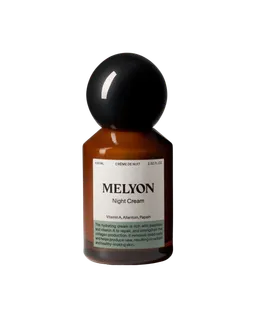
Melyon Night Cream - Vitamin A, Allantoin, Papain
Works for
Anti-agingRetinyl palmitate, Serine + 4 moreMay help
“Containing vitamin A to repair and strengthen collagen production, Melyon Night Cream is the perfect overnight pick-me-up for thirsty, ageing or damaged skin.”
This product contains acetyl hexapeptide-37, retinyl palmitate, serine. These ingredients might be able to help reduce and prevent fine lines and wrinkles, improve skin elasticity and firmness, but there is not enough evidence that it actually works.
MoisturizingSide benefit the brand mentions · Urea, Acetyl hexapeptide-37 + 17 moreWorks well
“Night Cream .”
This product contains good ingredients to attract water to the upper layer of the skin. These ingredients are called "humectants": alanine, glycerin.
When humectants are on the surface of the skin, they “pull in” the moisture from the outside environment, or from within deeper layers of the skin. If the air is dry, humectants can speed up the moisture loss from the skin. This is why it is a good idea to use another product on top of this one to help "seal in" the moisture (look for ingredients like dimethicone, squalane, oils and butters).
The following ingredients in this product are especially good for supporting the skin barrier and helping with the hydration level: acetyl hexapeptide-37, urea
Evens skin toneNot advertised by the brand · Retinyl palmitate, Alanine + 1 moreMay help
The following ingredient (ingredients) in this product might be helpful, but there is no evidence to confirm that it actually works: alanine, retinyl palmitate.
Can it cause trouble?
Irritancy2 strong irritants: Retinyl palmitate, ParfumMedium risk
ComedogenicClean of flagged comedogenic ingredientsNone flagged

User reviews
Be the first — your take helps the next person decide.
Ingredients
Filter by role to see what each ingredient is doing.
Water~45–55%
Glyceryl stearate citrate~4.3–5.3%
- Irritation risk
- Low
Helps oil and water mix together while softening the upper layer of the skin
More about Glyceryl stearate citrateDicaprylyl ether~4.2–5.1%
- Irritation risk
- Low
Helps soften the upper layer of the skin while creating a non-greasy feel on the skin. Helps to dissolve other ingredients
More about Dicaprylyl etherGlycerin~3–3.7%
- Irritation risk
- Low
One of the best moisturizing ingredients. Naturally present in skin. It attracts water to the upper layer of the skin working as a humectant
More about GlycerinPropanediol~2.3–2.8%
- Irritation risk
- Low
Acts as a solvent for other ingredients. Speeds up the absorption of other ingredients into the skin
More about PropanediolAdansonia digitata seed oil~1.9–2.4%
- Irritation risk
- Medium
Helps soften the upper layer of the skin
More about Adansonia digitata seed oilSodium ascorbyl phosphate~1.6–1.9%
- Irritation risk
- Medium
A stable derivative of vitamin C. It is oil-soluble which means it is more likely to penetrate the skin compared to the pure form of vitamin C (which is water-soluble), but it is less bio-available and is way less effective in stimulating collagen and reducing wrinkles compared to the pure form of vitamin C (L-ascorbic acid) and its other derivatives (for example, magnesium ascorbyl phosphate). At the same time, this vitamin C derivative has been shown in studies to be effective in reducing acne, blemishes and clogged pores. It is less irritating then the pure form of vitamin C
More about Sodium ascorbyl phosphateInulin~1.4–1.7%
- Irritation risk
- Low
Helps attract water to the upper layer of the skin. Is claimed to support the growth of "good" bacteria in skin (as a "prebiotic"), but the research is lacking
More about InulinBrassica oleracea italica extract~1.2–1.4%
- Irritation risk
- Medium
Might have some anti-inflammatory properties but research is lacking
More about Brassica oleracea italica extractBioflavonoids~0.7–1%
- Irritation risk
- Low
Retinyl palmitate~0.65–1%
- Irritation risk
- High
Three steps removed from the active form of vitamin A - retinoic acid. To have an effect in the skin, it first needs to be converted twice to become the retinoic acid. This means it is less potent than retinol, but could also be less irritating. Once converted to the retinoic acid in the skin, it helps against all signs of aging, improves skin cell turnover and helps fight blemishes and clogged pores. However, in many cosmetic formulations, it is used in a concentration that is too low to have the full effect
More about Retinyl palmitateNiacinamide~0.55–0.85%
- Irritation risk
- Low
Is proven to be effective in reducing blemishes, evening out skin tone and helping to improve lines and wrinkles. It helps the skin to repair sun damage, calm down inflammation and keep maintain good levels of moisture. The concentration of about 2% is effective for supporting the skin barrier and evening out the skin tone. Concentration of 4-6% is better for helping with acne and balancing the sebum production
More about NiacinamideAlpha-glucan oligosaccharide~0.55–0.85%
- Irritation risk
- Low
Helps attract water to the upper layer of the skin
More about Alpha-glucan oligosaccharideSodium hyaluronate~0.45–0.65%
- Irritation risk
- Low
One of the best moisturizing ingredients. Attracts water into the upper layer of the skin
More about Sodium hyaluronateCalcium pantothenate~0.4–0.65%
- Irritation risk
- Low
Helps support skin barrier function improving skin hydration and reducing sensitivity
More about Calcium pantothenateSodium starch octenylsuccinate~0.4–0.6%
- Irritation risk
- Low
Aloe barbadensis leaf extract~0.45–0.7%
- Irritation risk
- Medium
Traditionally used to treat sunburns, dermatitis and inflammation, but evidence for its effectiveness is lacking. The extract can contain humectants that help attract water into the skin
More about Aloe barbadensis leaf extractPapain~0.3–0.6%
- Irritation risk
- High
An enzyme extracted from papaya fruit. Can have an exfoliating effect on the skin. Can be irritating
More about PapainMaltodextrin~0.3–0.55%
- Irritation risk
- Low
Used to stabilize the product formulation and can help absorb oil
More about MaltodextrinAllantoin~0.25–0.45%
- Irritation risk
- Low
Helps calm down inflammation in skin and can help reduce itching. Helps to repair the skin barrier and keep skin hydrated
More about AllantoinPyridoxine hcl~0.25–0.45%
- Irritation risk
- Medium
Might help neutralize free radicals in skin
More about Pyridoxine hclHydroxyethyl acrylate/sodium acryloyldimethyl taurate copolymer~0.25–0.45%
- Irritation risk
- Medium
A gelling agent that thickens the product consistency and leaves the skin with a velvety finish
More about Hydroxyethyl acrylate/sodium acryloyldimethyl taurate copolymerPhenoxyethanol~0.25–0.45%
- Irritation risk
- Low
A preservative. It helps prevent bacterial growth in cosmetic products
More about PhenoxyethanolButylene glycol~0.25–0.45%
- Irritation risk
- Low
Used to create a nice product texture and help delivery of other ingredients. Might be somewhat helpful in attracting water to the upper layer of the skin
More about Butylene glycolParfum~0.2–0.4%
- Irritation risk
- High
An aromatic blend of unspecified and possibly irritating ingredients
More about ParfumBenzoic acid~0.25–0.45%
Dehydroacetic acid~0.25–0.4%
Xanthan gum~0.25–0.45%
- Irritation risk
- Low
Used to create a thicker product consistency
More about Xanthan gumCaprylyl glycol~0.25–0.5%
- Irritation risk
- Medium
Helps preserve products and creates a nice product texture
More about Caprylyl glycolUrea~0.2–0.4%
- Irritation risk
- Low
Naturally present in skin (urea makes up about 7% of natural moisturizing factors in skin). Attracts water to the upper layer of the skin. Also has a positive effect on the skin barrier beyond the humectant action. Can enhance penetration of other ingredients. Is an exfoliating ingredient when used in high concentrations
More about UreaMagnesium lactate~0.2–0.4%
- Irritation risk
- Low
Tocopheryl acetate~0.25–0.4%
- Irritation risk
- Medium
A more stable but less bio-available form of vitamin E compared to Tocopherol. Might help moisturize and protect the skin from free radicals, but mostly used in low concentrations to stabilize other ingredients.
More about Tocopheryl acetateEthylhexylglycerin~0.2–0.4%
Potassium lactate~0.2–0.4%
- Irritation risk
- Low
Tocopherol~0.2–0.35%
- Irritation risk
- Low
Pure form of vitamin E. Can help moisturise and protect the skin from free radicals. Often used to help stabilise other ingredients or the formula itself
More about TocopherolSerine~0.2–0.35%
- Irritation risk
- Low
An amino-acid that helps to attract water to the upper layer of the skin. In combination with other amino-acids, might help to reduce fine lines and wrinkles
More about SerineMagnesium chloride~0.15–0.3%
Proline~0.15–0.3%
Alanine~0.1–0.2%
- Irritation risk
- Low
An amino-acid that helps to attract water to the upper layer of the skin and might help to lighten the skin, but solid evidence is lacking
More about AlanineSilica~0.2–0.4%
Sodium citrate~0.05–0.1%
- Irritation risk
- Medium
Helps to control the skin's pH level. Maintains the skin's natural film of amino-lactic acids and oils. Helps to preserve products
More about Sodium citrateAcetyl hexapeptide-37~0.05–0.15%
- Irritation risk
- Low
A type of peptide. Peptides are excellent moisturizers and might be able support collagen production reducing fine lines and wrinkles
More about Acetyl hexapeptide-37Ingredient list view
Water, Glyceryl stearate citrate, Dicaprylyl ether, Glycerin, Propanediol, Adansonia digitata seed oil, Sodium ascorbyl phosphate, Inulin, Brassica oleracea italica extract, Bioflavonoids, Retinyl palmitate, Niacinamide, Alpha-glucan oligosaccharide, Sodium hyaluronate, Calcium pantothenate, Sodium starch octenylsuccinate, Aloe barbadensis leaf extract, Papain, Maltodextrin, Allantoin, Pyridoxine hcl, Hydroxyethyl acrylate/sodium acryloyldimethyl taurate copolymer, Phenoxyethanol, Butylene glycol, Parfum, Benzoic acid, Dehydroacetic acid, Xanthan gum, Caprylyl glycol, Urea, Magnesium lactate, Tocopheryl acetate, Ethylhexylglycerin, Potassium lactate, Tocopherol, Serine, Magnesium chloride, Proline, Alanine, Silica, Sodium citrate, Acetyl hexapeptide-37
Compare prices
Retailers ranked by price — lowest first.
Worth comparing, line by line.
Match % combines shared ingredients, the first five ingredients, shared actives and hero ingredients, irritancy (lower counts in the alternative's favour), texture and body area. Only products in the same routine step are compared.
| MelyonNight Cream - Vitamin A, Allantoin, PapainYOUR PRODUCT | MarudermHyaluronic Acid Moisturizer Face & Body Cream | Bali BodyCeramide cream | The Grey MenCOMFORT+ FACE CREAM | |
|---|---|---|---|---|
| Match | — | 77% | 76% | 76% |
| Price | — | $21.99 | — | $93.90 |
| Shared key ingredients | — | 5 of 14 | 8 of 14 | 5 of 14 |
| Key difference | — | Panthenol | Caprooyl Phytosphingosine | Saccharomyces/Copper Ferment |
| Irritancy | Medium | Low | Medium | Low |
| Drying alcohol | — | — | — | — |
| View product | Shop | Shop | Shop |


More alternatives: Simple Kind To Skin Replenishing Rich MoisturizerISDIN Isdinceutics Prevent Hyaluronic Moisture Sensitive Skin
Product summary
"Melyon - Night Cream - Vitamin A, Allantoin, Papain" is a well-rounded moisturizing product. To work well, any moisturizer needs to include a combination of water-binding and emollient ingredients. Melyon - Night Cream - Vitamin A, Allantoin, Papain ticks this box. Humectants in this product (urea, alanine, glycerin, sodium hyaluronate and aloe barbadensis extract) help to increase the water content in the upper layer of the skin. (These ingredients do so by "capturing" water molecules from the outside air or from within the deeper layers of the skin). Adansonia digitata oil, adansonia digitata seed oil, caprylyl glycol, dicaprylyl ether and glyceryl stearate citrate in this product help decrease the water evoporation from the skin, so that it stays hydrated for longer. These ingredients also soften the skin and take away the feeling of tightness and dryness.
Ingredient callouts
- this moisturizer includes a form of retinoids (vitamin A) - retinyl palmitate 0.55% - 0.80%, but this type of vitamin A is not very effective. It could in theory help with fine lines and wrinkles, but the effect is most likely minimal.
- This moistruizer also contains peptides (acetyl hexapeptide-37 0.05% - 0.15%). Peptides is a very big group of ingredients. They all consist of a different combination of amino-acids. Our skin produces peptides naturally. Some of them work as natural anti-biotics, promote wound-healing and production of collagen. The scientists are still studying how effective the topical application of peptides is, but it is very likely that peptides in skincare are helpful. They might be able to support skin barrier restoration and even have an anti-aging benefit. At the very least, they certainly help attract water to the skin and support the hydration in this way.
Irritation risk
This formulation includes some common irritants, including ingredients that do not provide a benefit for the skin. We assess the overall irritancy of this moisturizer to be medium. For a detailed overview of all potential irritants: click here
You can see the detailed formula review with the breakdown of all actives in the product and the full ingredient list with estimated concentrations in the tables below.
Price
The product retails from 37.00$ up to 38.00$ in the United States.
For a detailed price comparison: click here.
Sources cited in this review
Every concentration estimate and effectiveness label is anchored to one of these 23 studies and safety reviews.
- 1
- 2
- 3Sodium ascorbyl phosphate in topical microemulsionssciencedirect.com
- 4
- 5
- 6

Affiliate links · As an Amazon Associate, WIMJ earns from qualifying purchases.