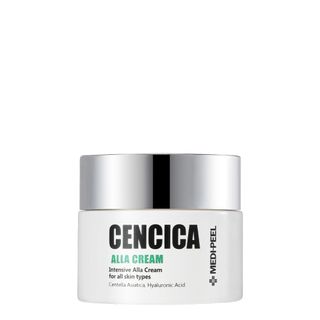
Medi Peel CENCICA ALLA CREAM
Works for
1 of 1 advertised claim delivered
Moisturizing36 ingredients credited for this claimStrong support
“The moisture barrier of urea and panthenol enhances moisture 4.”
This product can help improve hydration of the skin with the two types of ingredients.
The first type is called “humectants”:
these ingredients help attract water.
When humectants are on the surface of the skin, they “pull in” the moisture from the outside environment, or from
within deeper layers of the skin. The following ingredients in this product do the job:
arginine, betaine.
This product also contains ingredients called “occlusives”. They help reduce the speed with which our skin loses moisture to the outside environment. These ingredients also help soften the upper layer of the skin, so it feels less tight and nicer to the touch. The following ingredients in this product do the job: arginine, beeswax.
The following ingredients in this product are especially good for supporting the skin barrier and helping with the hydration level: madecassoside, panthenol, urea
Anti-oxidationNot advertised by the brand · 27 ingredients credited for this claimStrong support
This product contains antioxidants (asiaticoside, madecassoside) that can help neutralize free radicals in skin. By doing so, they can lessen the damage the skin gets from the UV light (sun).
The following ingredients - ginkgo biloba leaf extract also can have an antioxidant effect, but there is less evidence to confirm their effectiveness in skin.
ExfoliationNot advertised by the brand · 4 ingredients credited for this claimStrong support
This product can help exfoliate the skin. In other words, it helps break down the bonds between dead cells on the surface of the skin and speed up the skin turnover. Skin often appears softer and brighter after exfoliation, but overdoing it can result in disrupted skin barrier. The following ingredient is doing the exfoliating job in this product: capryloyl salicylic acid.
Anti-agingNot advertised by the brand · 10 ingredients credited for this claimModerate support
This product contains adenosine, asiaticoside, centella asiatica leaf extract, madecassoside. These ingredients might be able to help reduce and prevent fine lines and wrinkles, improve skin elasticity and firmness, but there is not enough evidence that it actually works.
Evens skin toneNot advertised by the brand · 9 ingredients credited for this claimModerate support
The following ingredient (ingredients) in this product might be helpful, but there is no evidence to confirm that it actually works: capryloyl salicylic acid, glycyrrhiza glabra root extract, madecassoside, prunus mume fruit extract, vigna radiata seed extract.
Can it cause trouble?
Irritancy21 strong irritants: Melaleuca alternifolia leaf water, Alcohol + 19 more — patch-test recommendedHigh risk
Comedogenic3 ingredients rated 2 or more on the 0–5 pore-clogging scale3 flagged
User reviews
Be the first — your take helps the next person decide.
Ingredients
Filter by role to see what each ingredient is doing.
Water~45–55%
Caprylic/capric triglyceride~5.7–7%
- Irritation risk
- Medium
A good mix of fatty acids that forms a protective layer on the skin. Improves the shelf life of products. Derived from coconut and glycerin
More about Caprylic/capric triglycerideGlycerin~4–4.8%
- Irritation risk
- Low
One of the best moisturizing ingredients. Naturally present in skin. It attracts water to the upper layer of the skin working as a humectant
More about GlycerinDipropylene glycol~2.9–3.6%
- Irritation risk
- Low
Helps to dissolve other ingredients in a formulation. Slows down the rate of product drying
More about Dipropylene glycolButylene glycol~2.3–2.8%
- Irritation risk
- Low
Used to create a nice product texture and help delivery of other ingredients. Might be somewhat helpful in attracting water to the upper layer of the skin
More about Butylene glycolGlyceryl stearate~1.9–2.4%
- Irritation risk
- Low
An emollient that softens the skin and forms a protective layer on its surface. Helps water and oil mix together
More about Glyceryl stearate1,2-hexanediol~0.7–1.05%
Beeswax~1.5–1.8%
- Irritation risk
- Low
Forms a protective barrier that holds water and keeps dry skin hydrated. Keeps an emulsion from separating into its oil and liquid components, and increases the thickness of a product. Can be an allergen
More about BeeswaxSorbitan stearate~1.1–1.3%
Niacinamide~0.75–1.1%
- Irritation risk
- Low
Is proven to be effective in reducing blemishes, evening out skin tone and helping to improve lines and wrinkles. It helps the skin to repair sun damage, calm down inflammation and keep maintain good levels of moisture. The concentration of about 2% is effective for supporting the skin barrier and evening out the skin tone. Concentration of 4-6% is better for helping with acne and balancing the sebum production
More about NiacinamidePolysorbate 60~0.6–0.9%
Peg-100 stearate~0.55–0.8%
- Irritation risk
- Low
Helps oil and water mix togehter and creates a nice product texture
More about Peg-100 stearateCentella asiatica leaf extract~0.3–0.6%
- Irritation risk
- Medium
A plant extract that has been shown to be able to reduce inflammation in skin, support restoration of skin barrier function, as well as support collagen production. It can be irritating to sensitive skin. Might be helpful in preventing stretch marks. It could, however, itself be irritating.
More about Centella asiatica leaf extractBetaine~0.25–0.5%
- Irritation risk
- Low
Helps attract water to the upper layer of the skin and improves the product texture
More about BetaineCetearyl alcohol~0.3–0.55%
- Irritation risk
- Low
- Comedogenicity
- 2/5
A non-drying alcohol. Works as an emollient. Helps water and oil mix together and creates a nice product texture
More about Cetearyl alcoholCarbomer~0.25–0.45%
- Irritation risk
- Low
Helps create a thicker or gel-like product texture. It is not a surfactant but can be used in gentle cleansing formulations
More about CarbomerArginine~0.2–0.4%
- Irritation risk
- Low
An amino acid that is naturally present in skin and helps keep it hydrated. When used together with AHAs, it can reduce their irritating effect on the skin
More about ArgininePanthenol~0.2–0.4%
- Irritation risk
- Low
Helps attract water to the upper layer of the skin and can help improve skin barrier function
More about PanthenolUrea~0.2–0.35%
- Irritation risk
- Low
Naturally present in skin (urea makes up about 7% of natural moisturizing factors in skin). Attracts water to the upper layer of the skin. Also has a positive effect on the skin barrier beyond the humectant action. Can enhance penetration of other ingredients. Is an exfoliating ingredient when used in high concentrations
More about UreaCetearyl olivate~0.15–0.3%
Sorbitan olivate~0.15–0.3%
Tocopheryl acetate~0.15–0.25%
- Irritation risk
- Medium
A more stable but less bio-available form of vitamin E compared to Tocopherol. Might help moisturize and protect the skin from free radicals, but mostly used in low concentrations to stabilize other ingredients.
More about Tocopheryl acetateGluconolactone~0.1–0.15%
- Irritation risk
- Medium
A polyhydroxy acid (PHA) that helps shed the dead cells from the skin surface revealing smoother skin. Is believed to be genter than AHAs. It helps attract water to the upper layer of the skin and can stimulate production of skin's own hyaluronic acid resulting in improved hydration levels. It has been shown to be helpful against acne and clogged pores if used consistently (e.g over a period of 12 weeks) in high enough concentration. It can help reduce fine lines and wrinkles and improve skin tone with long-term application. Can help neutralize free radicals
More about GluconolactoneMelaleuca alternifolia leaf water~0.1–0.15%
- Irritation risk
- High
Centella asiatica extract~0.15–0.25%
- Irritation risk
- Medium
A plant extract that has been shown to be able to reduce inflammation in skin, support restoration of skin barrier function, as well as support collagen production. Contains active compounds called centelloids: asiaticoside, madecasosside, asiatic acid and madecassic acid. Might be helpful in preventing stretch marks. It can be itself be irritating though.
More about Centella asiatica extractAdenosine~0.1–0.15%
- Irritation risk
- Low
Might help improve cell turnover and reduce inflammation in skin. One study shows that the ingredients might be able to help reduce dynamic wrinkles (for example, in the corners of the eyes or on the forehead)
More about AdenosineDisodium edta~0.1–0.2%
Buteth-3~0.1–0.2%
- Irritation risk
- Low
Alcohol~0.1–0.2%
- Irritation risk
- High
Can be drying and contribute to skin irritation. Used in formulars to dissolve other ingredients, create a thinner product consistency or for its antibacterial properties
More about AlcoholPropanediol~0.1–0.2%
- Irritation risk
- Low
Acts as a solvent for other ingredients. Speeds up the absorption of other ingredients into the skin
More about PropanediolAsiaticoside~0.05–0.1%
- Irritation risk
- Medium
An active compound of Centella Asiatica plant extract. In combination with other active compounds of Centella Asiatica extract (madecasosside, asiatic acid and madecassic acid), asiaticoside has been shown to be helpful in wound-healing, restoring skin barrier function and supporting collagen production in skin. It can, however, itself be irritating
More about AsiaticosideCapryloyl salicylic acid~0.1–0.15%
- Irritation risk
- High
Butyl avocadate~0.1–0.15%
- Irritation risk
- Low
Anthemis nobilis flower water~0.1–0.15%
- Irritation risk
- Low
Sodium benzotriazolyl butylphenol sulfonate~0.1–0.2%
- Irritation risk
- Medium
Helps protect the ingredients in the formulation against UV light
More about Sodium benzotriazolyl butylphenol sulfonateBambusa arundinacea stem extract~0.1–0.15%
- Irritation risk
- Low
Triticum vulgare sprout extract~0.1–0.15%
- Irritation risk
- Low
Rosmarinus officinalis extract~0.1–0.15%
- Irritation risk
- High
Salix alba bark extract~0.05–0.15%
- Irritation risk
- High
A plant extract that can help neutralize free radicals in skin. It contains a compound salicin that can theoretically be converted into salicylic acid that, in turn, helps reduce inflammation in skin, but the evidence of effectiveness in skin is lacking and the extract is usually not used in a concentration that would enable an exfoliating effect
More about Salix alba bark extractArtemisia absinthium extract~0.1–0.15%
- Irritation risk
- Low
Aloe arborescens leaf extract~0.05–0.1%
- Irritation risk
- Low
Spirulina platensis extract~0.1–0.2%
- Irritation risk
- Low
- Comedogenicity
- 3/5
An algae extract. Might help to attract water to the upper layer of the skin and have an anti-oxidant effect
More about Spirulina platensis extractSodium hyaluronate crosspolymer~0.1–0.2%
- Irritation risk
- Medium
Attracts water into the upper layer of the skin
More about Sodium hyaluronate crosspolymerCamellia sinensis leaf extract~0.1–0.2%
- Irritation risk
- Low
Can contain potent anti-oxidant compounds (abbreviated ECG, GCG, EGC, and EGCG) that might help protect the skin from free radicals. Can help calm down inflammation and has some anti-bacterial properties. Unfortunately, these antioxidants are unstable and lose their effectiveness very quickly in products. The concentration of the antioxidant compounds in the extract also tends to be low to be effective in topical formulation
More about Camellia sinensis leaf extractPortulaca oleracea extract~0.1–0.2%
- Irritation risk
- Medium
A plant extract that has some anti-oxidant activity, but solid research is lacking. Can help attract water to the upper layer of the skin
More about Portulaca oleracea extractFarnesyl acetate~0.05–0.1%
- Irritation risk
- Low
Hydrolyzed glycosaminoglycans~0.1–0.15%
- Irritation risk
- Low
Long sugars that help attract water to the upper layer of the skin
More about Hydrolyzed glycosaminoglycansFarnesol~0.1–0.15%
Panthenyl triacetate~0.1–0.2%
- Irritation risk
- Low
A stable oil-soluble derivative of vitamin B5. It can help support skin barrier and reduce inflammation in skin
More about Panthenyl triacetateTris(tetramethylhydroxypiperidinol) citrate~0.1–0.2%
- Irritation risk
- Low
Ci 19140~0.1–0.2%
Ci 42090~0.1–0.2%
Sodium hyaluronate~0.1–0.2%
- Irritation risk
- Low
One of the best moisturizing ingredients. Attracts water into the upper layer of the skin
More about Sodium hyaluronateJuniperus communis fruit extract~0.05–0.1%
- Irritation risk
- Medium
Berry extract that might have some anti-oxidant effect
More about Juniperus communis fruit extractBenzyl glycol~0.1–0.2%
- Irritation risk
- Medium
Helps dissolve other ingredients and preserve products
More about Benzyl glycolTributyl citrate~0.1–0.2%
Eucalyptus globulus leaf extract~0.05–0.1%
- Irritation risk
- High
Used as a fragrance. Can be irritating
More about Eucalyptus globulus leaf extractMannan~0.1–0.2%
- Irritation risk
- Low
Propylene glycol~0.1–0.15%
- Irritation risk
- High
Helps oil and water mix together and can enhance the penetration of other ingredients into the skin. It can be irritating
More about Propylene glycolOlea europaea leaf extract~0.05–0.1%
- Irritation risk
- Medium
A plant extract that might have some anti-oxidant and anti-inflammatory properties but evidence for effectiveness in skin is missing
More about Olea europaea leaf extractChamaecyparis obtusa leaf extract~0.1–0.15%
Eugenia caryophyllus leaf extract~0.05–0.1%
- Irritation risk
- Low
Citrullus lanatus fruit extract~0.1–0.15%
- Irritation risk
- Medium
A plant extract that can contain an antioxidant compound
More about Citrullus lanatus fruit extractCitrus aurantifolia fruit extract~0.1–0.15%
Cucumis melo fruit extract~0.1–0.15%
- Irritation risk
- Medium
A fruit extract that might have some anti-oxidant properties
More about Cucumis melo fruit extractCucumis sativus fruit extract~0.1–0.2%
- Irritation risk
- Medium
Might be somewhat helpful in reducing hyperpigmentation and neutralizing free radicals but its typical concentration in a product is too low for having an effect
More about Cucumis sativus fruit extractCyclopia intermedia leaf extract~0.1–0.15%
- Irritation risk
- Low
Cynara scolymus leaf extract~0.1–0.15%
- Irritation risk
- High
A plant extract that might have some anti-oxidant properties. It might be irritating
More about Cynara scolymus leaf extractDiospyros kaki leaf extract~0.1–0.15%
- Irritation risk
- Low
Fructan~0.1–0.15%
- Irritation risk
- Low
Ginkgo biloba leaf extract~0.1–0.15%
- Irritation risk
- High
A plant extract that might help neutralize free radicals and reduce inflammation in skin. It can be irritating
More about Ginkgo biloba leaf extractLaminaria japonica extract~0.1–0.2%
- Irritation risk
- Low
- Comedogenicity
- 3/5
Seaweed extract that might help to attract water to the upper layer of the skin and have some anti-oxidant properties
More about Laminaria japonica extractLaurus nobilis leaf extract~0.1–0.15%
- Irritation risk
- Low
Camellia japonica leaf extract~0.1–0.15%
- Irritation risk
- Medium
A plant extract that might help neutralize free radicals in skin
More about Camellia japonica leaf extractCaprylyl glycol~0.1–0.25%
- Irritation risk
- Medium
Helps preserve products and creates a nice product texture
More about Caprylyl glycolCarica papaya fruit extract~0.1–0.15%
- Irritation risk
- High
Carum petroselinum extract~0.1–0.15%
- Irritation risk
- Low
Brassica oleracea acephala leaf extract~0.1–0.2%
- Irritation risk
- Medium
Might be helpful in neutralizing free radicals in skin but solid research is lacking. Helps attract water to the upper layer of the skin
More about Brassica oleracea acephala leaf extractBrassica oleracea capitata leaf extract~0.1–0.15%
- Irritation risk
- Medium
Plant extract that might help calm down inflammation and have some anti-oxidant properties
More about Brassica oleracea capitata leaf extractBrassica oleracea gemmifera extract~0.1–0.2%
- Irritation risk
- Low
Brassica oleracea italica extract~0.1–0.2%
- Irritation risk
- Medium
Might have some anti-inflammatory properties but research is lacking
More about Brassica oleracea italica extractActinidia chinensis fruit extract~0.1–0.25%
- Irritation risk
- High
A plant extract that might have some anti-oxidant properties, but evidence of effectiveness in skin is lacking
More about Actinidia chinensis fruit extractAdansonia digitata seed extract~0.1–0.15%
- Irritation risk
- Low
Adenium obesum leaf cell extract~0.1–0.25%
- Irritation risk
- Low
Artemisia princeps leaf extract~0.1–0.25%
- Irritation risk
- Low
Asparagus officinalis stem extract~0.1–0.25%
- Irritation risk
- Low
Bambusa arundinacea stem extract~0.1–0.25%
- Irritation risk
- Low
Ocimum basilicum leaf extract~0.1–0.25%
- Irritation risk
- High
Used as a frangrance. Can be irritating. Might have some anti-bacterial properties
More about Ocimum basilicum leaf extractMelaleuca alternifolia leaf oil~0.1–0.2%
- Irritation risk
- High
An essential oil that can be irritating. Has some anti-bacterial properties
More about Melaleuca alternifolia leaf oilMelissa officinalis leaf extract~0.15–0.25%
- Irritation risk
- High
A plant extract that is added for its fragrance. Can be irritating
More about Melissa officinalis leaf extractMentha arvensis leaf extract~0.15–0.3%
- Irritation risk
- High
Used as a fragrance and can be irritating
More about Mentha arvensis leaf extractMentha piperita leaf extract~0.15–0.25%
- Irritation risk
- High
Used as a fragrance and can be irritating
More about Mentha piperita leaf extractMentha rotundifolia leaf extract~0.15–0.25%
- Irritation risk
- High
Used as a fragrance and can be irritating
More about Mentha rotundifolia leaf extractMorinda citrifolia fruit extract~0.15–0.25%
- Irritation risk
- Low
Moringa oleifera leaf extract~0.15–0.25%
- Irritation risk
- Low
Prunus armeniaca fruit extract~0.15–0.25%
- Irritation risk
- Medium
A fruit extract that might have some antioxidant properties and might help attract water to the skin, but evidence of effectiveness is lacking
More about Prunus armeniaca fruit extractPrunus mume fruit extract~0.15–0.25%
- Irritation risk
- Low
A plant extract that might have an anti-oxidant effect and help even out skin tone, but solid evidence of effectiveness is lacking
More about Prunus mume fruit extractRosmarinus officinalis leaf extract~0.1–0.25%
- Irritation risk
- High
Can be helpful in reducing inflammation in skin, including inflamed acne. It can be irritating
More about Rosmarinus officinalis leaf extractPhyllostachys nigra leaf extract~0.15–0.3%
- Irritation risk
- Low
Pinus densiflora leaf extract~0.2–0.35%
- Irritation risk
- Low
Pisum sativum extract~0.15–0.3%
- Irritation risk
- Medium
Might be helpful in protecting skin collagen and elastin from breaking down but solid research is lacking
More about Pisum sativum extractThuja orientalis leaf extract~0.2–0.35%
- Irritation risk
- Low
Spinacia oleracea leaf extract~0.15–0.3%
- Irritation risk
- Medium
A plant extract that might have some anti-oxidant properties
More about Spinacia oleracea leaf extractSalvia officinalis leaf extract~0.2–0.35%
- Irritation risk
- High
Sage leaf extract. It can be irritating
More about Salvia officinalis leaf extractSaponaria officinalis leaf extract~0.2–0.4%
- Irritation risk
- Low
Vigna radiata seed extract~0.15–0.3%
- Irritation risk
- Low
Bean extract that in theory might help to reduce hyperpigmentation, but evidence of effectiveness in skin are missing
More about Vigna radiata seed extractAlteromonas ferment extract~0.15–0.3%
- Irritation risk
- Low
A marine extract that helps attract water to the upper layer of the skin. It is claimed to have anti-inflammatory properties but research is lacking
More about Alteromonas ferment extractHydrolyzed hyaluronic acid~0.15–0.3%
- Irritation risk
- Low
One of the best moisturizing ingredients. Attracts water into the upper layer of the skin. A version of it is naturally present in skin
More about Hydrolyzed hyaluronic acidGlycyrrhiza glabra root extract~0.15–0.25%
- Irritation risk
- Medium
A plant extract that can help lighten the skin and calm down inflammation. Might be helpful in neutralizing free radicals
More about Glycyrrhiza glabra root extractTaraxacum officinale leaf extract~0.15–0.3%
- Irritation risk
- Low
Origanum vulgare leaf extract~0.15–0.3%
- Irritation risk
- High
A plant extract. Can have an anti-oxidant effect, but can also contain irritants
More about Origanum vulgare leaf extractMadecassic acid~0.15–0.3%
- Irritation risk
- Medium
An active compound of Centella Asiatica plant extract. In combination with other active compounds of Centella Asiatica extract (asiaticoside, madecasosside and asiatic acid), madecassic acid has been shown to be helpful in wound-healing, restoring skin barrier function and supporting collagen production in skin. It can, however, itself be irritating
More about Madecassic acidAsiatic acid~0.15–0.3%
- Irritation risk
- Medium
An active compound of Centella Asiatica plant extract. In combination with other active compounds of Centella Asiatica extract (asiaticoside, madecasosside and madecassic acid) asiatic acid has been shown to be helpful in wound-healing, restoring skin barrier function and supporting collagen production in skin. It can, however, itself be irritating
More about Asiatic acidSodium guaiazulene sulfonate~0.15–0.3%
Scutellaria baicalensis root extract~0.15–0.25%
- Irritation risk
- High
A plant extract that might contain a compound baicalin that could be helpful in neutralizing free radicals and reducing inflammation in skin. The baicalin concentration in skincare products is often too low for an effective action. Can be used for its fragrant properties
More about Scutellaria baicalensis root extractLactobacillus/soybean ferment extract~0.15–0.3%
- Irritation risk
- Low
A fermentation product created by bacteria Lactobacillus out of soybean. The fermented product helps to attract water to the upper layer of the skin and has anti-bacterial properties. It might be helpful in calming down inflammation and could be helpful in evening out skin tone, but studies are lacking
More about Lactobacillus/soybean ferment extractCinnamomum cassia bark extract~0.2–0.35%
Citric acid~0.15–0.3%
- Irritation risk
- Medium
Can work as an exfoliant but is typically used to adjust the product pH
More about Citric acidEthylhexylglycerin~0.2–0.35%
Dehydroacetic acid~0.15–0.3%
Benzyl alcohol~0.15–0.25%
- Irritation risk
- High
A preservative. Can be used to mask unpleasant smell. Can be irritating
More about Benzyl alcoholRhodiola rosea root extract~0.2–0.4%
- Irritation risk
- Low
Rosa damascena flower extract~0.15–0.3%
Polysorbate 20~0.2–0.4%
Pulsatilla koreana extract~0.2–0.35%
- Irritation risk
- Low
Zanthoxylum piperitum fruit extract~0.2–0.35%
- Irritation risk
- High
Plant extract that has some anti-oxidant properties. It can be irritating. Can be used to improve the product's smell
More about Zanthoxylum piperitum fruit extractUsnea barbata extract~0.15–0.3%
- Irritation risk
- Low
Hyaluronic acid~0.15–0.3%
- Irritation risk
- Low
One of the best moisturizing ingredients. Attracts water into the upper layer of the skin. Naturally present in skin. Typically has large molecule size unless advertised otherwise on the product label. Helps support skin's barrier function and may help to reduce inflammation
More about Hyaluronic acidPropyl gallate~0.2–0.35%
- Irritation risk
- Medium
Helps preserve product formulations and can mask the smell of other ingredients in a product
More about Propyl gallateRaspberry ketone~0.15–0.25%
- Irritation risk
- High
Used as a fragrance. It can reduce skin pigmentation, but it is not safe to use for these purposes in high concentrations as use of raspberry ketone and its derivative is linked to causing loss of skin pigmentation in people (leukoderma)
More about Raspberry ketoneMadecassoside~0.1–0.2%
- Irritation risk
- Medium
An antioxidant that is typically derived from plant Centella Asiatica. It can help neutralize free radicals in skin and support skin barrier function. It could, however, itself be irritating. It is often unstable in formulations
More about MadecassosideParfum~0.1–0.15%
- Irritation risk
- High
An aromatic blend of unspecified and possibly irritating ingredients
More about ParfumIngredient list view
Water, Caprylic/capric triglyceride, Glycerin, Dipropylene glycol, Butylene glycol, Glyceryl stearate, 1,2-hexanediol, Beeswax, Sorbitan stearate, Niacinamide, Polysorbate 60, Peg-100 stearate, Centella asiatica leaf extract, Betaine, Cetearyl alcohol, Carbomer, Arginine, Panthenol, Urea, Cetearyl olivate, Sorbitan olivate, Tocopheryl acetate, Gluconolactone, Melaleuca alternifolia leaf water, Centella asiatica extract, Adenosine, Disodium edta, Buteth-3, Alcohol, Propanediol, Asiaticoside, Capryloyl salicylic acid, Butyl avocadate, Anthemis nobilis flower water, Sodium benzotriazolyl butylphenol sulfonate, Bambusa arundinacea stem extract, Triticum vulgare sprout extract, Rosmarinus officinalis extract, Salix alba bark extract, Artemisia absinthium extract, Aloe arborescens leaf extract, Spirulina platensis extract, Sodium hyaluronate crosspolymer, Camellia sinensis leaf extract, Portulaca oleracea extract, Farnesyl acetate, Hydrolyzed glycosaminoglycans, Farnesol, Panthenyl triacetate, Tris(tetramethylhydroxypiperidinol) citrate, Ci 19140, Ci 42090, Sodium hyaluronate, Juniperus communis fruit extract, Benzyl glycol, Tributyl citrate, Eucalyptus globulus leaf extract, Mannan, Propylene glycol, Olea europaea leaf extract, Chamaecyparis obtusa leaf extract, Eugenia caryophyllus leaf extract, Citrullus lanatus fruit extract, Citrus aurantifolia fruit extract, Cucumis melo fruit extract, Cucumis sativus fruit extract, Cyclopia intermedia leaf extract, Cynara scolymus leaf extract, Diospyros kaki leaf extract, Fructan, Ginkgo biloba leaf extract, Laminaria japonica extract, Laurus nobilis leaf extract, Camellia japonica leaf extract, Caprylyl glycol, Carica papaya fruit extract, Carum petroselinum extract, Brassica oleracea acephala leaf extract, Brassica oleracea capitata leaf extract, Brassica oleracea gemmifera extract, Brassica oleracea italica extract, Actinidia chinensis fruit extract, Adansonia digitata seed extract, Adenium obesum leaf cell extract, Artemisia princeps leaf extract, Asparagus officinalis stem extract, Bambusa arundinacea stem extract, Ocimum basilicum leaf extract, Unknown, Melaleuca alternifolia leaf oil, Unknown, Melissa officinalis leaf extract, Mentha arvensis leaf extract, Mentha piperita leaf extract, Mentha rotundifolia leaf extract, Morinda citrifolia fruit extract, Moringa oleifera leaf extract, Prunus armeniaca fruit extract, Prunus mume fruit extract, Rosmarinus officinalis leaf extract, Phyllostachys nigra leaf extract, Pinus densiflora leaf extract, Pisum sativum extract, Thuja orientalis leaf extract, Spinacia oleracea leaf extract, Salvia officinalis leaf extract, Saponaria officinalis leaf extract, Vigna radiata seed extract, Alteromonas ferment extract, Hydrolyzed hyaluronic acid, Glycyrrhiza glabra root extract, Taraxacum officinale leaf extract, Origanum vulgare leaf extract, Madecassic acid, Asiatic acid, Sodium guaiazulene sulfonate, Scutellaria baicalensis root extract, Lactobacillus/soybean ferment extract, Cinnamomum cassia bark extract, Citric acid, Ethylhexylglycerin, Dehydroacetic acid, Benzyl alcohol, Rhodiola rosea root extract, Rosa damascena flower extract, Polysorbate 20, Pulsatilla koreana extract, Zanthoxylum piperitum fruit extract, Usnea barbata extract, Hyaluronic acid, Propyl gallate, Raspberry ketone, Madecassoside, Parfum
Compare prices
Retailers ranked by price — lowest first.

Affiliate links · prices updated regularly
Worth comparing, line by line.
Match % combines shared ingredients, the first five ingredients, shared actives and hero ingredients, irritancy (lower counts in the alternative's favour), texture and body area. Only products in the same routine step are compared.
| Medi PeelCENCICA ALLA CREAMYOUR PRODUCT | Skin79Cica Pine Intense Relief Cream | Bring greenArtemisia Calming Water Cream | Some By MiPropolis B5 Glow Barrier Calming Cream | |
|---|---|---|---|---|
| Match | — | 84% | 81% | 79% |
| Price | — | $58.04 | $20.70 | $19.11 |
| Shared key ingredients | — | 12 of 26 | 15 of 26 | 15 of 26 |
| Key difference | — | Corallina Officinalis Extract | Corallina Officinalis Extract | Ceramide Np |
| Irritancy | High | Medium | High | High |
| Drying alcohol | Contains drying alcohol | — | Contains drying alcohol | — |
| View product | Shop | Shop | Shop |


Sources cited in this review
Every concentration estimate and effectiveness label is anchored to one of these 68 studies and safety reviews.
- 1
- 2
- 3
- 4
- 5Centella asiatica in Dermatology: An Overviewonlinelibrary.wiley.com
- 6Contact dermatitis due to Madecassolonlinelibrary.wiley.com

Affiliate links · As an Amazon Associate, WIMJ earns from qualifying purchases.