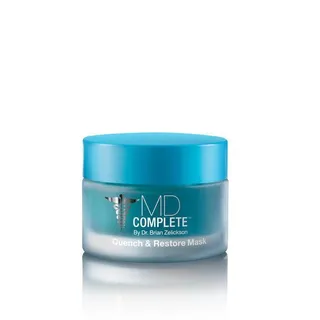
MD Complete by Dr. Brian Zelickson Quench Restore Advanced Hyaluronic Treatment
Works for
Evens skin toneNiacinamide, Lactic acidWorks well
“Niacinamide —revitalizes, nourishes and reenergize stressed skin to restore healthy, even skin tone and maintain the skin’s moisture barrier.”
This product can help reduce hypepigmentation and even out the skin tone because it contains the following effective ingredients: niacinamide
Keep in mind that you would need to apply any topical skincare targetted at hypigmentation consistently for a couple of months to get a result. No topical skincare product can help get rid of hyperpigmentation (including post-acne marks and age spots) instantly.
MoisturizingNiacinamide, Panthenol + 12 moreWorks well
“Niacinamide —revitalizes, nourishes and reenergize stressed skin to restore healthy, even skin tone and maintain the skin’s moisture barrier.”
This product can help improve hydration of the skin with the two types of ingredients.
The first type is called “humectants”:
these ingredients help attract water.
When humectants are on the surface of the skin, they “pull in” the moisture from the outside environment, or from
within deeper layers of the skin. The following ingredients in this product do the job:
acetamidoethoxyethanol, arginine.
This product also contains ingredients called “occlusives”. They help reduce the speed with which our skin loses moisture to the outside environment. These ingredients also help soften the upper layer of the skin, so it feels less tight and nicer to the touch. The following ingredients in this product do the job: arginine, caprylyl glycol.
The following ingredients in this product are especially good for supporting the skin barrier and helping with the hydration level: niacinamide, panthenol, urea
Anti-blemishSide benefit · NiacinamideWorks well
This product can help reduce breakouts and clogged pores because it contains the following ingredient: niacinamide. This ingredient is used for treating acne and can have a noticeable effect.
Anti-agingSide benefit · Niacinamide, Lactic acidWorks well
This product can help reduce and prevent fine lines and wrinkles, improve skin elasticity and firmness because it contains niacinamide.
Keep in mind that it typically takes at least 6 weeks to notice any results because the changes that are needed to improve fine lines and elasticity happen in the deeper layers of the skin. No topical anti-aging product can “erase” wrinkles or fully reverse signs of aging.
Anti-oxidationSide benefit · Epilobium angustifolium flower/leaf/stem extractMay help
This product contains antioxidants (epilobium angustifolium flower/leaf/stem extract) that can help neutralize free radicals in skin to lessen the damage it gets from the UV light (sun). There is some human evidence for this effect in skin, though it is smaller or less consistent than the evidence for the best antioxidants.
Can it cause trouble?
Irritancy2 strong irritants: Citrus aurantium amara leaf/twig oil, Lavandula angustifolia oilMedium risk
ComedogenicClean of flagged comedogenic ingredientsNone flagged

User reviews
Be the first — your take helps the next person decide.
Ingredients
Filter by role to see what each ingredient is doing.
Water~40–60%
Polysorbate 20~4–5.9%
Propylene glycol~3–4.5%
- Irritation risk
- High
Helps oil and water mix together and can enhance the penetration of other ingredients into the skin. It can be irritating
More about Propylene glycolAcetamidoethoxyethanol~2.5–3.7%
- Irritation risk
- Low
A new synthetic humectant that, according to the first tests, works better than glycerin in attracting moisture to the skin surface. It might be able to keep attracting water to the upper layer of the skin for longer compared with glycerin. Its texture is also nicer. Because of this, products with it are likely to be less sticky and more pleasant on application. It is unlikely to cause irritation and products with it work for sensitive skin. For best hydration results, it should be used at about 5-10% in a formulation. This ingredient is developed by a supplier Nouryon and is sold to skincare brands under the name Elfamoist AC.
More about AcetamidoethoxyethanolAmmonium acryloyldimethyltaurate/vp copolymer~1.9–2.9%
- Irritation risk
- Low
Increases thickness of a product. Texture enhancer for oil-in-water emulsions
More about Ammonium acryloyldimethyltaurate/vp copolymerBetaine~1.5–2.3%
- Irritation risk
- Low
Helps attract water to the upper layer of the skin and improves the product texture
More about BetaineGlycerin~1.4–2%
- Irritation risk
- Low
One of the best moisturizing ingredients. Naturally present in skin. It attracts water to the upper layer of the skin working as a humectant
More about GlycerinNiacinamide~1.2–1.7%
- Irritation risk
- Low
Is proven to be effective in reducing blemishes, evening out skin tone and helping to improve lines and wrinkles. It helps the skin to repair sun damage, calm down inflammation and keep maintain good levels of moisture. The concentration of about 2% is effective for supporting the skin barrier and evening out the skin tone. Concentration of 4-6% is better for helping with acne and balancing the sebum production
More about NiacinamidePanthenol~0.9–1.35%
- Irritation risk
- Low
Helps attract water to the upper layer of the skin and can help improve skin barrier function
More about PanthenolUrea~0.55–1.3%
- Irritation risk
- Low
Naturally present in skin (urea makes up about 7% of natural moisturizing factors in skin). Attracts water to the upper layer of the skin. Also has a positive effect on the skin barrier beyond the humectant action. Can enhance penetration of other ingredients. Is an exfoliating ingredient when used in high concentrations
More about UreaArginine~0.45–1%
- Irritation risk
- Low
An amino acid that is naturally present in skin and helps keep it hydrated. When used together with AHAs, it can reduce their irritating effect on the skin
More about ArginineBenzoic acid~0.25–0.5%
Ci 42090~0.35–0.75%
Butylene glycol~0.3–0.7%
- Irritation risk
- Low
Used to create a nice product texture and help delivery of other ingredients. Might be somewhat helpful in attracting water to the upper layer of the skin
More about Butylene glycolCaprylyl glycol~0.2–0.8%
- Irritation risk
- Medium
Helps preserve products and creates a nice product texture
More about Caprylyl glycolCitrus aurantium amara leaf/twig oil~0.2–0.75%
- Irritation risk
- High
Epilobium angustifolium flower/leaf/stem extract~0.15–0.7%
- Irritation risk
- High
A plant extract that might contain antioxidants
More about Epilobium angustifolium flower/leaf/stem extractEthylhexylglycerin~0.15–0.6%
Glycogen~0.1–0.45%
- Irritation risk
- Low
Helps attract water to the upper layer of the skin
More about GlycogenHydrolyzed sodium hyaluronate~0.1–0.35%
- Irritation risk
- Low
Attracts water into the upper layer of the skin
More about Hydrolyzed sodium hyaluronateLactic acid~0.1–0.3%
- Irritation risk
- Medium
An exfoliating and moisturizing alpha-hydroxy acid (AHA). Typically causes less irritation than other AHAs, for example, glycolic acid. At high concentrations (about 15%), lactic acid can help reduce lines and wrinkles. Recent studies show that lactic acid can support the "good" bacteria living on skin's surface (healthy skin microbiome)
More about Lactic acidLavandula angustifolia oil~0.05–0.25%
- Irritation risk
- High
An essential oil. Potential allergen and can be irritating. It has some anti-bacterial properties
More about Lavandula angustifolia oilPhenoxyethanol~0.05–0.15%
- Irritation risk
- Low
A preservative. It helps prevent bacterial growth in cosmetic products
More about PhenoxyethanolSaccharomyces/copper ferment~0.05–0.2%
- Irritation risk
- Low
Yeast extract that contains copper. Can help to attract water to the upper layer of the skin and can help in skin wound healing
More about Saccharomyces/copper fermentSchizophyllan~0.05–0.2%
- Irritation risk
- Low
Sodium butyroyl hyaluronate~0.05–0.15%
- Irritation risk
- Low
Triethyl citrate~0.01–0.05%
Zinc citrate~0.01–0.1%
- Irritation risk
- Low
Ingredient list view
Water, Polysorbate 20, Propylene glycol, Acetamidoethoxyethanol, Ammonium acryloyldimethyltaurate/vp copolymer, Betaine, Glycerin, Niacinamide, Panthenol, Urea, Arginine, Benzoic acid, Ci 42090, Butylene glycol, Caprylyl glycol, Citrus aurantium amara leaf/twig oil, Epilobium angustifolium flower/leaf/stem extract, Ethylhexylglycerin, Unknown, Glycogen, Hydrolyzed sodium hyaluronate, Lactic acid, Lavandula angustifolia oil, Phenoxyethanol, Saccharomyces/copper ferment, Schizophyllan, Sodium butyroyl hyaluronate, Triethyl citrate, Zinc citrate
Worth comparing, line by line.
Match % combines shared ingredients, the first five ingredients, shared actives and hero ingredients, irritancy (lower counts in the alternative's favour), texture and body area. Only products in the same routine step are compared.
| MD Complete by Dr. Brian ZelicksonQuench Restore Advanced Hyaluronic TreatmentYOUR PRODUCT | endota spaPeptide 8 Hyaluronic Serum | UltraceuticalsUltra B2 Hydrating Serum | ZelensPower B - Revitalising & Clearing | |
|---|---|---|---|---|
| Match | — | 86% | 84% | 81% |
| Price | — | — | — | $109.12 |
| Shared key ingredients | — | 4 of 11 | 3 of 11 | 5 of 11 |
| Key difference | — | Acetyl Octapeptide-3 | Sodium Hyaluronate | Chondrus Crispus Extract |
| Irritancy | Medium | Low | Low | Medium |
| Drying alcohol | — | — | — | — |
| View product | Shop | Shop | Shop |


More alternatives: TBH Skincare rebound serumBABOR AMPOULE CONCENTRATES Collagen Concentrate
Product summary
"MD Complete by Dr. Brian Zelickson - Quench Restore Advanced Hyaluronic Treatment" has a good moisturizing formula. The formulation is based on a combination of good humectants and emollients. Both are needed to increase the skin hydration level. Panthenol, urea, acetamidoethoxyethanol, arginine and betaine in this product (humectants) attract water molecules to the upper layer of the skin (the water comes from the outside air or from the deeper layers of the skin if the air is dry). Emollients in this formulation (arginine and caprylyl glycol) help to reduce the moisture loss from the skin. They also soften the skin surface and relieve the feeling of dryness and tightness.
Ingredient callouts
- An effective concentration of Panthenol (pro-vitamin B5) - about 0.90% - 1.35%. Panthenol helps strengthen the skin barrier, improve hydration and reduce inflammation in skin.
Irritation risk
This moisturizer contains some common irritants, including those without a benefit for the skin. We assess the overall irritancy of this moisturizer to be medium. For a detailed overview of all potential irritants: click here
You can see the detailed formula review with the breakdown of all actives in the product and the full ingredient list with estimated concentrations in the tables below.
Price
The product retails for 34.99$ in the United States.
For a detailed price comparison: click here.
Sources cited in this review
Every concentration estimate and effectiveness label is anchored to one of these 15 studies and safety reviews.
- 1Surfactants and experimental irritant contact dermatitisncbi.nlm.nih.gov
- 2Propylene Glycolpubmed.ncbi.nlm.nih.gov
- 3Skin-sensitizing and irritant properties of propylene glycolonlinelibrary.wiley.com
- 4
- 5ElfaMoist AC humectant (manufacturer's report)krahnnordics.com
- 6
