Works for
1 of 1 advertised claim delivered
MoisturizingCeramide np, Niacinamide + 34 moreStrong evidence
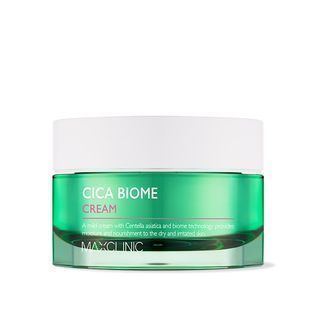
“Cica Biome Cream”
This product can help improve hydration of the skin with the two types of ingredients.
The first type is called “humectants”:
these ingredients help attract water.
When humectants are on the surface of the skin, they “pull in” the moisture from the outside environment, or from
within deeper layers of the skin. The following ingredients in this product do the job:
alanine, arginine.
This product also contains ingredients called “occlusives”. They help reduce the speed with which our skin loses moisture to the outside environment. These ingredients also help soften the upper layer of the skin, so it feels less tight and nicer to the touch. The following ingredients in this product do the job: arginine, c12-15 alkyl benzoate.
The following ingredients in this product are especially good for supporting the skin barrier and helping with the hydration level: ceramide np, niacinamide, phytosphingosine
Anti-oxidationNot advertised by the brand · Asiaticoside, Camellia sinensis extract + 11 moreStrong evidence
This product contains antioxidants (asiaticoside) that can help neutralize free radicals in skin. By doing so, they can lessen the damage the skin gets from the UV light (sun).
The following ingredients - camellia sinensis extract also can have an antioxidant effect, but there is less evidence to confirm their effectiveness in skin.
Anti-agingNot advertised by the brand · Adenosine, Niacinamide + 5 moreStrong evidence
This product can help reduce and prevent fine lines and wrinkles, improve skin elasticity and firmness because it contains adenosine, niacinamide.
These ingredients in the product can also be helpful, even though there is less evidence for their effectiveness: asiaticoside, aspartic acid, serine.
Keep in mind that it typically takes at least 6 weeks to notice any results because the changes that are needed to improve fine lines and elasticity happen in the deeper layers of the skin. No topical anti-aging product can “erase” wrinkles or fully reverse signs of aging.
Anti-blemishNot advertised by the brand · Niacinamide, Taurine + 4 moreStrong evidence
This product can help reduce breakouts and clogged pores because it contains the following ingredient: niacinamide. This ingredient is used for treating acne and can have a noticeable effect.
Evens skin toneNot advertised by the brand · Niacinamide, Alanine + 2 moreStrong evidence
This product can help reduce hypepigmentation and even out the skin tone because it contains the following effective ingredients: niacinamide
The following ingredient (ingredients) in this product might be helpful, but there is no evidence to confirm that it actually can help even out the skin tone: alanine.
Keep in mind that you would need to apply any topical skincare targetted at hypigmentation consistently for a couple of months to get a result. No topical skincare product can help get rid of hyperpigmentation (including post-acne marks and age spots) instantly.
Can it cause trouble?
Irritancy7 strong irritants: Rosmarinus officinalis leaf extract, Citrus aurantium dulcis flower extract + 5 more — patch-test recommendedHigh risk
Comedogenic1 ingredient rated 2 or more on the 0–5 pore-clogging scale1 flagged

User reviews
Be the first — your take helps the next person decide.
Ingredients
Filter by role to see what each ingredient is doing.
Water~45–55%
Dipropylene glycol~6.4–7.8%
- Irritation risk
- Low
Helps to dissolve other ingredients in a formulation. Slows down the rate of product drying
More about Dipropylene glycolPropanediol~4–4.9%
- Irritation risk
- Low
Acts as a solvent for other ingredients. Speeds up the absorption of other ingredients into the skin
More about PropanediolNiacinamide~3.1–3.8%
- Irritation risk
- Low
Is proven to be effective in reducing blemishes, evening out skin tone and helping to improve lines and wrinkles. It helps the skin to repair sun damage, calm down inflammation and keep maintain good levels of moisture. The concentration of about 2% is effective for supporting the skin barrier and evening out the skin tone. Concentration of 4-6% is better for helping with acne and balancing the sebum production
More about NiacinamideButylene glycol~2.3–2.8%
- Irritation risk
- Low
Used to create a nice product texture and help delivery of other ingredients. Might be somewhat helpful in attracting water to the upper layer of the skin
More about Butylene glycol1,2-hexanediol~0.65–0.95%
Betaine~1.5–1.8%
- Irritation risk
- Low
Helps attract water to the upper layer of the skin and improves the product texture
More about BetaineIsopentyldiol~1.3–1.6%
C12-14 pareth-12~1.1–1.3%
C12-14 pareth-7~0.75–1.1%
Diphenyl dimethicone~0.6–0.9%
Erythritol~0.45–0.7%
- Irritation risk
- Low
Helps to attract water to the upper layer of the skin
More about ErythritolTriethylhexanoin~0.3–0.6%
- Irritation risk
- Medium
Helps soften the upper layer of the skin
More about TriethylhexanoinTromethamine~0.3–0.6%
Acrylates/c10-30 alkyl acrylate crosspolymer~0.3–0.55%
- Irritation risk
- Medium
Maintains the texture of skincare products. Allows the product to spread evenly. Helps oil and water mix together
More about Acrylates/c10-30 alkyl acrylate crosspolymerCarbomer~0.3–0.55%
- Irritation risk
- Low
Helps create a thicker or gel-like product texture. It is not a surfactant but can be used in gentle cleansing formulations
More about CarbomerPanthenol~0.25–0.5%
- Irritation risk
- Low
Helps attract water to the upper layer of the skin and can help improve skin barrier function
More about PanthenolCentella asiatica extract~0.3–0.55%
- Irritation risk
- Medium
A plant extract that has been shown to be able to reduce inflammation in skin, support restoration of skin barrier function, as well as support collagen production. Contains active compounds called centelloids: asiaticoside, madecasosside, asiatic acid and madecassic acid. Might be helpful in preventing stretch marks. It can be itself be irritating though.
More about Centella asiatica extractEthylhexylglycerin~0.2–0.4%
Cellulose gum~0.2–0.4%
- Irritation risk
- Low
Used to create thicker product consistency and stabilize emulsions
More about Cellulose gumAdenosine~0.15–0.3%
- Irritation risk
- Low
Might help improve cell turnover and reduce inflammation in skin. One study shows that the ingredients might be able to help reduce dynamic wrinkles (for example, in the corners of the eyes or on the forehead)
More about AdenosineDipotassium glycyrrhizate~0.15–0.3%
- Irritation risk
- Low
A salt derived from licorice. Works as an emollient to soften the upper layer of the skin and can help calm down inflammation. Might be helpful for skin lightening
More about Dipotassium glycyrrhizateLactobacillus ferment filtrate~0.15–0.25%
- Irritation risk
- Low
Helps attract water to the upper layer of the skin and might support the healthy skin microbiome
More about Lactobacillus ferment filtrateDisodium edta~0.15–0.25%
Glycerin~0.15–0.3%
- Irritation risk
- Low
One of the best moisturizing ingredients. Naturally present in skin. It attracts water to the upper layer of the skin working as a humectant
More about GlycerinMoringa oleifera seed extract~0.15–0.25%
- Irritation risk
- Medium
Helps soften the upper layer of the skin and might have some antioxidant effect
More about Moringa oleifera seed extractPolyglutamic acid~0.15–0.25%
- Irritation risk
- Low
Helps attract water to the upper layer of the skin.
More about Polyglutamic acidAsiaticoside~0.1–0.2%
- Irritation risk
- Medium
An active compound of Centella Asiatica plant extract. In combination with other active compounds of Centella Asiatica extract (madecasosside, asiatic acid and madecassic acid), asiaticoside has been shown to be helpful in wound-healing, restoring skin barrier function and supporting collagen production in skin. It can, however, itself be irritating
More about AsiaticosideMadecassic acid~0.15–0.25%
- Irritation risk
- Medium
An active compound of Centella Asiatica plant extract. In combination with other active compounds of Centella Asiatica extract (asiaticoside, madecasosside and asiatic acid), madecassic acid has been shown to be helpful in wound-healing, restoring skin barrier function and supporting collagen production in skin. It can, however, itself be irritating
More about Madecassic acidAsiatic acid~0.15–0.25%
- Irritation risk
- Medium
An active compound of Centella Asiatica plant extract. In combination with other active compounds of Centella Asiatica extract (asiaticoside, madecasosside and madecassic acid) asiatic acid has been shown to be helpful in wound-healing, restoring skin barrier function and supporting collagen production in skin. It can, however, itself be irritating
More about Asiatic acidScutellaria baicalensis root extract~0.1–0.2%
- Irritation risk
- High
A plant extract that might contain a compound baicalin that could be helpful in neutralizing free radicals and reducing inflammation in skin. The baicalin concentration in skincare products is often too low for an effective action. Can be used for its fragrant properties
More about Scutellaria baicalensis root extractPolygonum cuspidatum root extract~0.15–0.3%
- Irritation risk
- Medium
A plant extract that can contain resveratrol, an antioxidant that can help neutralize free radicals in skin. The effectiveness depends on the extract quality and concentration in the product
More about Polygonum cuspidatum root extractCamellia sinensis extract~0.1–0.2%
- Irritation risk
- Low
Tea extract. Might be helpful in neutralizing free radicals in skin
More about Camellia sinensis extractRosmarinus officinalis leaf extract~0.1–0.2%
- Irritation risk
- High
Can be helpful in reducing inflammation in skin, including inflamed acne. It can be irritating
More about Rosmarinus officinalis leaf extractChamomilla recutita flower extract~0.15–0.25%
- Irritation risk
- High
Plant extract that can have healing and anti-inflammatory properties. It is a potential allergen and can be irritating
More about Chamomilla recutita flower extractPrunella vulgaris extract~0.15–0.3%
- Irritation risk
- Low
Fucus vesiculosus extract~0.15–0.3%
- Irritation risk
- Low
- Comedogenicity
- 3/5
Melissa officinalis extract~0.1–0.25%
- Irritation risk
- Low
Chaenomeles sinensis fruit extract~0.15–0.3%
- Irritation risk
- Low
Citrus aurantium dulcis flower extract~0.15–0.25%
- Irritation risk
- High
Lactobacillus/milk ferment filtrate~0.15–0.25%
- Irritation risk
- Low
Caprylic/capric triglyceride~0.2–0.4%
- Irritation risk
- Medium
A good mix of fatty acids that forms a protective layer on the skin. Improves the shelf life of products. Derived from coconut and glycerin
More about Caprylic/capric triglycerideCandida bombicola/glucose/methyl rapeseedate ferment~0.2–0.4%
- Irritation risk
- Low
Helps water and oil mix together and preserve the product formulation
More about Candida bombicola/glucose/methyl rapeseedate fermentOlea europaea fruit oil~0.15–0.3%
- Irritation risk
- Medium
An emollient that helps soften the skin but is not effective for restoring its barrier function. Might be helpful to calm down inflammation
More about Olea europaea fruit oilOriganum vulgare leaf extract~0.15–0.3%
- Irritation risk
- High
A plant extract. Can have an anti-oxidant effect, but can also contain irritants
More about Origanum vulgare leaf extractChamaecyparis obtusa leaf extract~0.15–0.3%
Salix alba bark extract~0.15–0.25%
- Irritation risk
- High
A plant extract that can help neutralize free radicals in skin. It contains a compound salicin that can theoretically be converted into salicylic acid that, in turn, helps reduce inflammation in skin, but the evidence of effectiveness in skin is lacking and the extract is usually not used in a concentration that would enable an exfoliating effect
More about Salix alba bark extractMacadamia ternifolia seed oil~0.2–0.4%
- Irritation risk
- Medium
Plant oil from nuts that helps soften the upper layer of the skin. Contains a high concentration of oleic acid that can weaken skin's barrier function and increase water-loss while enhancing penetration of other ingredients
More about Macadamia ternifolia seed oilLactobacillus/soybean ferment extract~0.15–0.3%
- Irritation risk
- Low
A fermentation product created by bacteria Lactobacillus out of soybean. The fermented product helps to attract water to the upper layer of the skin and has anti-bacterial properties. It might be helpful in calming down inflammation and could be helpful in evening out skin tone, but studies are lacking
More about Lactobacillus/soybean ferment extractPortulaca oleracea extract~0.15–0.3%
- Irritation risk
- Medium
A plant extract that has some anti-oxidant activity, but solid research is lacking. Can help attract water to the upper layer of the skin
More about Portulaca oleracea extractCinnamomum cassia bark extract~0.2–0.35%
C12-15 alkyl benzoate~0.2–0.35%
- Irritation risk
- Low
Enhances the product texture and makes it more spreadable. Helps reduce water loss from the outer layer of skin. Extands the shelf life by preventing bacteria growth
More about C12-15 alkyl benzoateCeramide np~0.2–0.4%
- Irritation risk
- Low
A type of lipid similar to ceramides naturally present in skin. Helps to soften the upper layer of the skin and supports the skin barrier function to keep it hydrated. Can help to prevent inflammation in skin
More about Ceramide npPhytosphingosine~0.2–0.4%
- Irritation risk
- Low
A type of lipid that is naturally present in skin. It might help in repairing skin barrier function and has anti-bacterial effect
More about PhytosphingosineHydrogenated lecithin~0.2–0.35%
- Irritation risk
- Low
Helps to retain moisture by creating a protective barrier on the skin. Rich in fatty acids. Improves product texture and helps with the penetration of other ingredients.
More about Hydrogenated lecithinGlycine~0.15–0.3%
- Irritation risk
- Low
Helps to attract water to the upper layer of the skin and can help restore the skin barrier function
More about GlycineGlutamic acid~0.15–0.3%
- Irritation risk
- Low
An amino-acid that helps attract water to the upper layer of the skin
More about Glutamic acidLeucine~0.15–0.3%
- Irritation risk
- Low
Methionine~0.15–0.3%
- Irritation risk
- Low
Valine~0.15–0.3%
- Irritation risk
- Low
Serine~0.15–0.3%
- Irritation risk
- Low
An amino-acid that helps to attract water to the upper layer of the skin. In combination with other amino-acids, might help to reduce fine lines and wrinkles
More about SerineAspartic acid~0.15–0.3%
- Irritation risk
- Low
An amino-acid that helps increase skin hydration and might help to slightly improve skin firmness, potentially reducing lines and wrinkles
More about Aspartic acidIsoleucine~0.15–0.3%
- Irritation risk
- Low
An amino acid that can help attract water to the upper layer of the skin and support skin's barrier function
More about IsoleucineAlanine~0.15–0.3%
- Irritation risk
- Low
An amino-acid that helps to attract water to the upper layer of the skin and might help to lighten the skin, but solid evidence is lacking
More about AlanineArginine~0.15–0.3%
- Irritation risk
- Low
An amino acid that is naturally present in skin and helps keep it hydrated. When used together with AHAs, it can reduce their irritating effect on the skin
More about ArginineOrnithine~0.15–0.3%
- Irritation risk
- Low
An amino-acid. Helps attract water to the upper layer of the skin
More about OrnithineTaurine~0.15–0.3%
- Irritation risk
- Medium
Could be helpful in reducing inflammation in skin, evening out the skin tone and neutralizing free radicals, but more research is needed to confirm its effectiveness
More about TaurinePhenylalanine~0.15–0.3%
- Irritation risk
- Low
Proline~0.2–0.35%
Histidine~0.15–0.3%
Glycol~0.15–0.3%
- Irritation risk
- Low
Sodium surfactin~0.25–0.45%
Tocopherol~0.15–0.25%
- Irritation risk
- Low
Pure form of vitamin E. Can help moisturise and protect the skin from free radicals. Often used to help stabilise other ingredients or the formula itself
More about TocopherolCentella asiatica oil~0.15–0.25%
- Irritation risk
- Low
Parfum~0.05–0.1%
- Irritation risk
- High
An aromatic blend of unspecified and possibly irritating ingredients
More about ParfumHexyl cinnamal~0.05–0.1%
Ingredient list view
Water, Dipropylene glycol, Propanediol, Niacinamide, Butylene glycol, 1,2-hexanediol, Betaine, Isopentyldiol, C12-14 pareth-12, C12-14 pareth-7, Diphenyl dimethicone, Erythritol, Triethylhexanoin, Tromethamine, Acrylates/c10-30 alkyl acrylate crosspolymer, Carbomer, Panthenol, Centella asiatica extract, Ethylhexylglycerin, Cellulose gum, Adenosine, Dipotassium glycyrrhizate, Lactobacillus ferment filtrate, Disodium edta, Glycerin, Moringa oleifera seed extract, Polyglutamic acid, Asiaticoside, Madecassic acid, Asiatic acid, Scutellaria baicalensis root extract, Polygonum cuspidatum root extract, Camellia sinensis extract, Rosmarinus officinalis leaf extract, Chamomilla recutita flower extract, Prunella vulgaris extract, Fucus vesiculosus extract, Melissa officinalis extract, Chaenomeles sinensis fruit extract, Citrus aurantium dulcis flower extract, Lactobacillus/milk ferment filtrate, Caprylic/capric triglyceride, Candida bombicola/glucose/methyl rapeseedate ferment, Olea europaea fruit oil, Origanum vulgare leaf extract, Chamaecyparis obtusa leaf extract, Salix alba bark extract, Macadamia ternifolia seed oil, Lactobacillus/soybean ferment extract, Portulaca oleracea extract, Cinnamomum cassia bark extract, C12-15 alkyl benzoate, Ceramide np, Phytosphingosine, Hydrogenated lecithin, Glycine, Glutamic acid, Leucine, Methionine, Valine, Serine, Aspartic acid, Isoleucine, Alanine, Arginine, Ornithine, Taurine, Phenylalanine, Proline, Histidine, Glycol, Sodium surfactin, Tocopherol, Centella asiatica oil, Parfum, Hexyl cinnamal
Compare prices
Retailers ranked by price — lowest first.

Affiliate links · prices updated regularly
Worth comparing, line by line.
Match % combines shared ingredients, the first five ingredients, shared actives and hero ingredients, irritancy (lower counts in the alternative's favour), texture and body area. Only products in the same routine step are compared.
| MAXCLINICCica Biome CreamYOUR PRODUCT | TIRTIRMatcha Calming Cream 50ml | mixsoonCica Hyal Deep Soothing Cream 50ml | Centellian24Madeca Cream Time Reverse | |
|---|---|---|---|---|
| Match | — | 87% | 87% | 86% |
| Price | $17.10 | $23.14+$6.04 | $14.01−$3.09 | $12.36−$4.74 |
| Shared key ingredients | — | 14 of 27 | 11 of 27 | 15 of 27 |
| Key difference | — | Dipeptide-2 | Bacillus Ferment | Madecassoside |
| Irritancy | High | Medium | Medium | High |
| Drying alcohol | — | — | — | — |
| View product | Shop | Shop | Shop |


Product summary
"MAXCLINIC - Cica Biome Cream" is a well-rounded moisturizing product. The formulation is based on a combination of good humectants and emollients. Both are needed to increase the skin hydration level. Alanine, arginine, aspartic acid, betaine and erythritol in this product (humectants) attract water molecules to the upper layer of the skin (the water comes from the outside air or from the deeper layers of the skin if the air is dry). Emollients in this formulation (ceramide np, phytosphingosine, arginine, c12-15 alkyl benzoate and macadamia ternifolia seed oil) help to reduce the moisture loss from the skin. They also soften the skin surface and relieve the feeling of dryness and tightness.
Ingredient callouts
- We particularly like that there is a good concentration of Niacinamide (3.10% - 3.80%) in this moisturizer. Niacinamide is a well-studied multi-tasking active. It is a great ingredient to have in a moisturizer. It is stable, and can work well in almost any hydrating formulation. There is solid evidence that Niacinamide can help support skin barrier, regulate oil production and reduce acne and clogged pores. It also helps to fight photodamage and help improve the skin tone, reducing pigmentation marks.
- As a plus, this moisturizer also contains Ceramides (phytosphingosine 0.20% - 0.40% and ceramide np 0.20% - 0.40%). Ceramides are a type of lipids that our skin produces itself. They are a building block of the skin's barrier. Ceramides used in skincare are synthetic or extracted from plants. They work well for softening the skin surface and "patch holes" in the skin's barrier.
- Adenosine 0.15% - 0.30%. It is a compound that in involved in many biological processes inside the skin cells. According one high-quality clinical trial, topical Adenosine in low concentrations can somewhat help improve "deep wrinkles" - the wrinkles that appear with age in places where our faces are most dynamic (for example, on the forehead or in the corners of the eyes).
- Actives derived from an extract of the Centella Asiatica plant (also known as Gotu Kola) - asiatic acid 0.15% - 0.25%, madecassic acid 0.15% - 0.25% and asiaticoside 0.10% - 0.20% The Centella Asiatica Actives help strengthen and restore the skin barrier, decrease inflammation in skin and neutralize free radicals. They also can help to reduce scarring. The good news is that these actives work even in low concentrations.
Irritation risk
This moisturizer contains a bunch of common irritants, including ingredients that do not provide any known benefit for the skin. It might not be the best choice if your skin is sensitive. We assess the overall irritancy of this moisturizer to be high. For a detailed overview of all potential irritants: click here
You can see the detailed formula review with the breakdown of all actives in the product and the full ingredient list with estimated concentrations in the tables below.
Price
The product retails from 17.10$ up to 23.50$ in the United States.
For a detailed price comparison: click here.
Sources cited in this review
Every concentration estimate and effectiveness label is anchored to one of these 52 studies and safety reviews.
- 1
- 2
- 3
- 4
- 5Safety Assessment of Tromethamine as Used in Cosmeticscir-safety.org
- 6Skin moisturizing effects of panthenol-based formulationspdfs.semanticscholar.org

Affiliate links · As an Amazon Associate, WIMJ earns from qualifying purchases.