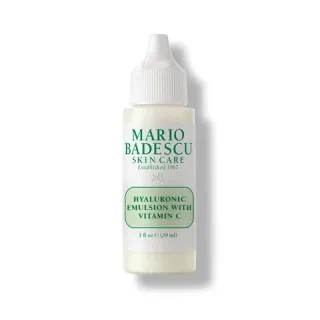
Mario Badescu Hyaluronic Emulsion With Vitamin C
Works for
MoisturizingUrea, Zea mays oil + 7 moreWorks well
“Absorbs seamlessly to deliver essential moisture without feeling heavy”
This product can help improve hydration of the skin with the two types of ingredients.
The first type is called “humectants”:
these ingredients help attract water.
When humectants are on the surface of the skin, they “pull in” the moisture from the outside environment, or from
within deeper layers of the skin. The following ingredients in this product do the job:
glycerin, sodium hyaluronate.
This product also contains ingredients called “occlusives”. They help reduce the speed with which our skin loses moisture to the outside environment. These ingredients also help soften the upper layer of the skin, so it feels less tight and nicer to the touch. The following ingredients in this product do the job: chondrus crispus extract, isododecane.
The following ingredients in this product are especially good for supporting the skin barrier and helping with the hydration level: urea
Anti-agingRetinyl palmitate, Ascorbic acidMay help
“Helps diminish the appearance of dry lines while boosting brightness”
This product contains retinyl palmitate. There is some human evidence that this ingredient helps reduce and prevent fine lines and wrinkles and improve skin elasticity and firmness, though it is smaller or less consistent than the evidence for the best anti-aging ingredients.
Evens skin toneSide benefit · Retinyl palmitate, Ascorbic acidMay help
The following ingredient (ingredients) in this product might be helpful, but there is no evidence to confirm that it actually works: retinyl palmitate.
Can it cause trouble?
Irritancy3 strong irritants: Diazolidinyl urea, Retinyl palmitate + 1 more — patch-test recommendedHigh risk
Comedogenic3 ingredients rated 2 or more on the 0–5 pore-clogging scale3 flagged


User reviews
Be the first — your take helps the next person decide.
Ingredients
Filter by role to see what each ingredient is doing.
Water~45–55%
Zea mays oil~10–13%
- Irritation risk
- Low
- Comedogenicity
- 3/5
A good moisturizing plant oil. Due to the high linoleic acid content, it helps soften the upper layer of the skin, reduce water loss and support skin barrier function
More about Zea mays oilStearic acid~5–6.1%
- Irritation risk
- Low
Helps oil and water mix together and works as an emollient
More about Stearic acidTriethanolamine~3.1–3.8%
- Irritation risk
- Medium
Used to adjust pH of the product and can help improve the product's smell
More about TriethanolamineIsododecane~2.6–3.2%
- Irritation risk
- Low
An emollient that helps soften the skin and can decrease moisture loss. Helps create a nice product texture
More about IsododecanePropylene glycol~2.2–2.7%
- Irritation risk
- High
Helps oil and water mix together and can enhance the penetration of other ingredients into the skin. It can be irritating
More about Propylene glycolUrea~1.8–2.2%
- Irritation risk
- Low
Naturally present in skin (urea makes up about 7% of natural moisturizing factors in skin). Attracts water to the upper layer of the skin. Also has a positive effect on the skin barrier beyond the humectant action. Can enhance penetration of other ingredients. Is an exfoliating ingredient when used in high concentrations
More about UreaHydrolyzed elastin~1.7–2.1%
- Irritation risk
- Low
Acrylates/c10-30 alkyl acrylate crosspolymer~1.5–1.8%
- Irritation risk
- Medium
Maintains the texture of skincare products. Allows the product to spread evenly. Helps oil and water mix together
More about Acrylates/c10-30 alkyl acrylate crosspolymerDiazolidinyl urea~0.25–0.5%
- Irritation risk
- High
A preservative. Works by releasing formaldehyde. Can be irritating
More about Diazolidinyl ureaChondrus crispus extract~0.9–1.1%
- Irritation risk
- Low
- Comedogenicity
- 3/5
Red algae extract that helps attract water to the upper layer of the skin and create a nicer product consistency
More about Chondrus crispus extractSoluble collagen~0.75–1.1%
- Irritation risk
- Low
A typically plant-derived compound that is supposed mimic human collagen. Cannot penetrate the skin barrier so is not particularly useful in skincare products beyond attracting water to the upper layer of the skin
More about Soluble collagenAscorbic acid~0.6–0.95%
- Irritation risk
- High
The most well-researched antioxidant that works in skin. Helps neutralize free radicals supporting collagen production, helping to even out the skin tone and preventing early signs of aging
More about Ascorbic acidMethylparaben~0.15–0.3%
Dimethicone crosspolymer-3~0.55–0.8%
- Irritation risk
- Low
Phenoxyethanol~0.6–0.9%
- Irritation risk
- Low
A preservative. It helps prevent bacterial growth in cosmetic products
More about PhenoxyethanolGlycerin~0.55–0.85%
- Irritation risk
- Low
One of the best moisturizing ingredients. Naturally present in skin. It attracts water to the upper layer of the skin working as a humectant
More about GlycerinLeuconostoc/radish root ferment filtrate~0.5–0.75%
- Irritation risk
- Medium
A preservative that comes from radishes fermented by a bacteria. New research suggests that the preservation properties in the ingredient come from an ammonium salt that is not present naturally in radish root but used in its cultivation. Is problematic because the exact amount of the preservative agents is difficult to determine
More about Leuconostoc/radish root ferment filtrateSodium hyaluronate~0.45–0.7%
- Irritation risk
- Low
One of the best moisturizing ingredients. Attracts water into the upper layer of the skin
More about Sodium hyaluronateRetinyl palmitate~0.35–0.6%
- Irritation risk
- High
Three steps removed from the active form of vitamin A - retinoic acid. To have an effect in the skin, it first needs to be converted twice to become the retinoic acid. This means it is less potent than retinol, but could also be less irritating. Once converted to the retinoic acid in the skin, it helps against all signs of aging, improves skin cell turnover and helps fight blemishes and clogged pores. However, in many cosmetic formulations, it is used in a concentration that is too low to have the full effect
More about Retinyl palmitateCymbopogon schoenanthus leaf extract~0.3–0.55%
- Irritation risk
- High
Bht~0.3–0.55%
Ergocalciferol~0.25–0.5%
- Irritation risk
- Low
Propylparaben~0.15–0.3%
Hydrolyzed dna~0.15–0.25%
- Irritation risk
- Low
Hydrolyzed rna~0.15–0.25%
- Irritation risk
- Low
Citric acid~0.1–0.2%
- Irritation risk
- Medium
Can work as an exfoliant but is typically used to adjust the product pH
More about Citric acidCi 19140~0.1–0.15%
Ci 16035~0.05–0.1%
Ingredient list view
Water, Zea mays oil, Stearic acid, Triethanolamine, Isododecane, Propylene glycol, Urea, Hydrolyzed elastin, Acrylates/c10-30 alkyl acrylate crosspolymer, Diazolidinyl urea, Chondrus crispus extract, Soluble collagen, Ascorbic acid, Methylparaben, Dimethicone crosspolymer-3, Phenoxyethanol, Glycerin, Leuconostoc/radish root ferment filtrate, Sodium hyaluronate, Retinyl palmitate, Cymbopogon schoenanthus leaf extract, Bht, Ergocalciferol, Propylparaben, Hydrolyzed dna, Hydrolyzed rna, Citric acid, Ci 19140, Ci 16035
Worth comparing, line by line.
Match % combines shared ingredients, the first five ingredients, shared actives and hero ingredients, irritancy (lower counts in the alternative's favour), texture and body area. Only products in the same routine step are compared.
| Mario BadescuHyaluronic Emulsion With Vitamin CYOUR PRODUCT | SVR[C] Ampoule Anti-Ox Radiance Concentrate | iS ClinicalSuper Serum Advance Plus | B. KaminsC-Resveratrol Serum Kx | |
|---|---|---|---|---|
| Match | — | 82% | 79% | 75% |
| Price | $30.00 | $34.45+$4.45 | $124.00+$94.00 | — |
| Shared key ingredients | — | 3 of 8 | 3 of 8 | 3 of 8 |
| Key difference | — | Anhydroxylitol | Tripeptide-1 | Acetyl Hexapeptide-8 |
| Irritancy | High | Medium | Low | High |
| Drying alcohol | — | Contains drying alcohol | — | Contains drying alcohol |
| View product | Shop | Shop | Shop |

More alternatives: Oce’ane Sérum Facial de Vitamina C e Ácido Ferulico - Vitamin C + Ferulic Acid SerumDr Dennis Gross Clinical Grade Dark Spot Correcting Serum | Dr. Dennis Gross
Sources cited in this review
Every concentration estimate and effectiveness label is anchored to one of these 9 studies and safety reviews.
- 1Content of fatty acids in corn (Zea mays L.) oil from Ecuadorresearchgate.net
- 2Surfactants and experimental irritant contact dermatitisncbi.nlm.nih.gov
- 3Propylene Glycolpubmed.ncbi.nlm.nih.gov
- 4Skin-sensitizing and irritant properties of propylene glycolonlinelibrary.wiley.com
- 5Topical urea in skincare: A reviewpubmed.ncbi.nlm.nih.gov
- 6
