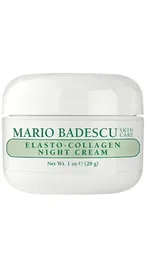
Mario Badescu Elasto-Collagen Night Cream
Works for
MoisturizingPetrolatum, Paraffinum liquidum + 10 moreWorks well
“Ultra-rich in texture and infused with skin-conditioning oils, this face cream deeply nourishes to restore moisture to parched skin.”
This product can help improve hydration of the skin with the two types of ingredients.
The first type is called “humectants”:
these ingredients help attract water.
When humectants are on the surface of the skin, they “pull in” the moisture from the outside environment, or from
within deeper layers of the skin. The following ingredients in this product do the job:
glycerin, glyceryl acrylate/acrylic acid copolymer.
This product also contains ingredients called “occlusives”. They help reduce the speed with which our skin loses moisture to the outside environment. These ingredients also help soften the upper layer of the skin, so it feels less tight and nicer to the touch. The following ingredients in this product do the job: cera alba, cetyl esters.
The following ingredients in this product are especially good for supporting the skin barrier and helping with the hydration level: paraffinum liquidum, petrolatum
Anti-agingTocopherol, Retinyl palmitateNot delivered
“Antioxidant Vitamin E, Collagen, and Elastin soften and smooth the look of dry fine lines and wrinkles to reveal a more youthful-looking complexion come morning.”
This product does not contain ingredients that are able to reduce fine lines and wrinkles or help with skin elasticity, but it can improve the look of the skin temporarily through moisturization. Well-moisturized skin might also be able to repair the sun damage better.
Can it cause trouble?
Irritancy12 strong irritants: Parfum, Diazolidinyl urea + 10 more — patch-test recommendedHigh risk
Comedogenic1 ingredient rated 2 or more on the 0–5 pore-clogging scale1 flagged


User reviews
Be the first — your take helps the next person decide.
Ingredients
Filter by role to see what each ingredient is doing.
Water~45–55%
Arachis hypogaea oil~6.2–7.6%
- Irritation risk
- Low
Olus oil~4.3–5.2%
- Irritation risk
- Low
An oil from a mixture of different vegetables. Helps soften the upper layer of the skin
More about Olus oilGlycerin~3–3.6%
- Irritation risk
- Low
One of the best moisturizing ingredients. Naturally present in skin. It attracts water to the upper layer of the skin working as a humectant
More about GlycerinPetrolatum~2.4–2.9%
- Irritation risk
- Low
One of the most effective and the most studied occlusive ingredients that creates a protective layer on top of the skin preventing moisture loss
More about PetrolatumTocopheryl acetate~1.7–2.1%
- Irritation risk
- Medium
A more stable but less bio-available form of vitamin E compared to Tocopherol. Might help moisturize and protect the skin from free radicals, but mostly used in low concentrations to stabilize other ingredients.
More about Tocopheryl acetateCetyl esters~1.5–1.9%
- Irritation risk
- Low
Helps soften upper layer of the skin and can enhance penetration of other ingredients into the upper layer of the skin
More about Cetyl estersParaffinum liquidum~1.4–1.7%
- Irritation risk
- Low
Mineral oil. One of the most effective and well studied occlusive and emollient moisturizing ingredients. Helps reduce moisture loss in skin and repair skin barrier function
More about Paraffinum liquidumCera alba~1.4–1.8%
- Irritation risk
- Medium
Forms a protective barrier that holds water and keeps dry skin hydrated. Keeps an emulsion from separating into its oil and liquid components, and increases the thickness of a product. Can be an allergen
More about Cera albaZea mays oil~0.75–1.15%
- Irritation risk
- Low
- Comedogenicity
- 3/5
A good moisturizing plant oil. Due to the high linoleic acid content, it helps soften the upper layer of the skin, reduce water loss and support skin barrier function
More about Zea mays oilTridecyl stearate~0.65–1%
- Irritation risk
- Medium
Used to create a thicker product consistency and soften the upper layer of the skin
More about Tridecyl stearateC10-30 cholesterol/lanosterol esters~0.55–0.8%
Sodium borate~0.5–0.7%
Tocopherol~0.45–0.65%
- Irritation risk
- Low
Pure form of vitamin E. Can help moisturise and protect the skin from free radicals. Often used to help stabilise other ingredients or the formula itself
More about TocopherolPropylene glycol~0.35–0.65%
- Irritation risk
- High
Helps oil and water mix together and can enhance the penetration of other ingredients into the skin. It can be irritating
More about Propylene glycolGlyceryl acrylate/acrylic acid copolymer~0.35–0.65%
- Irritation risk
- Medium
Helps attract water to the upper layer of the skin and provide a longer-lasting hydration. Can create a thicker product consistency
More about Glyceryl acrylate/acrylic acid copolymerPropylparaben~0.2–0.4%
Sodium benzoate~0.25–0.5%
Hydrolyzed elastin~0.3–0.55%
- Irritation risk
- Low
Parfum~0.25–0.45%
- Irritation risk
- High
An aromatic blend of unspecified and possibly irritating ingredients
More about ParfumDiazolidinyl urea~0.25–0.45%
- Irritation risk
- High
A preservative. Works by releasing formaldehyde. Can be irritating
More about Diazolidinyl ureaMethylparaben~0.15–0.3%
Soluble collagen~0.2–0.4%
- Irritation risk
- Low
A typically plant-derived compound that is supposed mimic human collagen. Cannot penetrate the skin barrier so is not particularly useful in skincare products beyond attracting water to the upper layer of the skin
More about Soluble collagenLeuconostoc/radish root ferment filtrate~0.2–0.4%
- Irritation risk
- Medium
A preservative that comes from radishes fermented by a bacteria. New research suggests that the preservation properties in the ingredient come from an ammonium salt that is not present naturally in radish root but used in its cultivation. Is problematic because the exact amount of the preservative agents is difficult to determine
More about Leuconostoc/radish root ferment filtratePhenoxyethanol~0.25–0.45%
- Irritation risk
- Low
A preservative. It helps prevent bacterial growth in cosmetic products
More about PhenoxyethanolSodium chloride~0.25–0.45%
- Irritation risk
- Low
Used to stabilize mixtures of oil and water, and create thicker, gel-like product textures
More about Sodium chlorideRetinyl palmitate~0.2–0.4%
- Irritation risk
- High
Three steps removed from the active form of vitamin A - retinoic acid. To have an effect in the skin, it first needs to be converted twice to become the retinoic acid. This means it is less potent than retinol, but could also be less irritating. Once converted to the retinoic acid in the skin, it helps against all signs of aging, improves skin cell turnover and helps fight blemishes and clogged pores. However, in many cosmetic formulations, it is used in a concentration that is too low to have the full effect
More about Retinyl palmitateHexyl cinnamal~0.2–0.35%
Hydroxycitronellal~0.2–0.35%
- Irritation risk
- High
A fragrance. A likely allergen and can be irritating
More about HydroxycitronellalBenzyl benzoate~0.2–0.35%
- Irritation risk
- High
Fragrance with sweet balsamic smell. Help to preserve products and dissolve other ingredients. Could trigger allergic reactions and be irritating
More about Benzyl benzoateBenzyl salicylate~0.15–0.3%
Linalool~0.15–0.3%
Citronellol~0.15–0.25%
Eugenol~0.1–0.2%
Butylphenyl methylpropional~0.1–0.2%
- Irritation risk
- High
A fragrance. Can trigger allergic reactions and be irritating
More about Butylphenyl methylpropionalAlpha-isomethyl ionone~0.1–0.15%
- Irritation risk
- High
A fragrance. Potential allergen and can be irritating
More about Alpha-isomethyl iononeCi 19140~0.05–0.15%
Ci 42090~0.05–0.1%
Ingredient list view
Water, Arachis hypogaea oil, Olus oil, Glycerin, Petrolatum, Tocopheryl acetate, Cetyl esters, Paraffinum liquidum, Cera alba, Zea mays oil, Tridecyl stearate, C10-30 cholesterol/lanosterol esters, Sodium borate, Tocopherol, Propylene glycol, Glyceryl acrylate/acrylic acid copolymer, Propylparaben, Sodium benzoate, Hydrolyzed elastin, Parfum, Diazolidinyl urea, Methylparaben, Soluble collagen, Leuconostoc/radish root ferment filtrate, Phenoxyethanol, Sodium chloride, Retinyl palmitate, Hexyl cinnamal, Hydroxycitronellal, Benzyl benzoate, Benzyl salicylate, Linalool, Citronellol, Eugenol, Butylphenyl methylpropional, Alpha-isomethyl ionone, Ci 19140, Ci 42090
Compare prices
Retailers ranked by price — lowest first.

Worth comparing, line by line.
Match % combines shared ingredients, the first five ingredients, shared actives and hero ingredients, irritancy (lower counts in the alternative's favour), texture and body area. Only products in the same routine step are compared.
| Mario BadescuElasto-Collagen Night CreamYOUR PRODUCT | Mixaanti redness moisturising cream | NEOSTRATAHydra Filling Cream | QVFace Revitalising Eye Cream | |
|---|---|---|---|---|
| Match | — | 59% | 58% | 58% |
| Price | $20.00 | $15.12−$4.88 | $52.00+$32.00 | $16.56−$3.44 |
| Shared key ingredients | — | 4 of 9 | 3 of 9 | 3 of 9 |
| Key difference | — | Beeswax | Urea | Carthamus Tinctorius Seed Oil |
| Irritancy | High | Low | Medium | Low |
| Drying alcohol | — | — | — | — |
| View product | Shop | Shop | Shop |

More alternatives: POND'S Face Cream Dry SkinPure Glycerine Cream
Product summary
"Mario Badescu - Elasto-Collagen Night Cream" is effective for: Moisturizing
Ingredient callouts
- this product includes a form of Retinoids (vitamin A) - retinyl palmitate 0.25% - 0.40%, but this type of vitamin A is not very effective. It could in theory help with fine lines and wrinkles, but the effect is most likely minimal.
- Humectants (glyceryl acrylate/acrylic acid copolymer 0.30% - 0.55%, soluble collagen 0.40% - 0.65% and glycerin 2.50% - 3.10%). These ingredients help attract water to the upper layer of the skin and improve the skin hydration.
About the brand
According to Cruelty-Free Kitty "Mario Badescu" is cruelty free and so is its parent company.
Price
The product retails for 38.98A$ in Australia, at around 19.56$ in the United States and for 71.07£ in the United Kingdom.
For a detailed price comparison: click here.
Sources cited in this review
Every concentration estimate and effectiveness label is anchored to one of these 12 studies and safety reviews.
- 1
- 2
- 3
- 4A review on the extensive skin benefits of mineral oilncbi.nlm.nih.gov
- 5
- 6Content of fatty acids in corn (Zea mays L.) oil from Ecuadorresearchgate.net

Affiliate links · As an Amazon Associate, WIMJ earns from qualifying purchases.