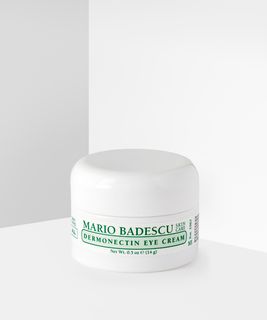
Mario Badescu Dermonectin Eye Cream
Works for
1 of 1 advertised claim delivered
Moisturizing12 ingredients credited for this claimStrong support
“Super concentrated and richly moisturising, Dermonectin Eye Cream is ideal for overnight use.”
This product can help improve hydration of the skin with the two types of ingredients.
The first type is called “humectants”:
these ingredients help attract water.
When humectants are on the surface of the skin, they “pull in” the moisture from the outside environment, or from
within deeper layers of the skin. The following ingredients in this product do the job:
glycerin, glyceryl acrylate/acrylic acid copolymer.
This product also contains ingredients called “occlusives”. They help reduce the speed with which our skin loses moisture to the outside environment. These ingredients also help soften the upper layer of the skin, so it feels less tight and nicer to the touch. The following ingredients in this product do the job: beeswax, cocos nucifera oil.
The following ingredients in this product are especially good for supporting the skin barrier and helping with the hydration level: oligopeptide-5, paraffinum liquidum
Anti-agingNot advertised by the brand · 3 ingredients credited for this claimModerate support
This product contains oligopeptide-5, retinyl palmitate. These ingredients might be able to help reduce and prevent fine lines and wrinkles, improve skin elasticity and firmness, but there is not enough evidence that it actually works.
Evens skin toneNot advertised by the brand · 1 ingredient credited for this claimModerate support
The following ingredient (ingredients) in this product might be helpful, but there is no evidence to confirm that it actually works: retinyl palmitate.
Can it cause trouble?
Irritancy2 strong irritants: Retinyl palmitate, Diazolidinyl ureaMedium risk
Comedogenic6 ingredients rated 2 or more on the 0–5 pore-clogging scale6 flagged
User reviews
Be the first — your take helps the next person decide.
Ingredients
Filter by role to see what each ingredient is doing.
Water~45–55%
Glycerin~4.5–5.5%
- Irritation risk
- Low
One of the best moisturizing ingredients. Naturally present in skin. It attracts water to the upper layer of the skin working as a humectant
More about GlycerinArachis hypogaea oil~4.6–5.7%
- Irritation risk
- Low
Olus oil~3.6–4.3%
- Irritation risk
- Low
An oil from a mixture of different vegetables. Helps soften the upper layer of the skin
More about Olus oilParaffinum liquidum~2.8–3.5%
- Irritation risk
- Low
Mineral oil. One of the most effective and well studied occlusive and emollient moisturizing ingredients. Helps reduce moisture loss in skin and repair skin barrier function
More about Paraffinum liquidumBeeswax~2.4–3%
- Irritation risk
- Low
Forms a protective barrier that holds water and keeps dry skin hydrated. Keeps an emulsion from separating into its oil and liquid components, and increases the thickness of a product. Can be an allergen
More about BeeswaxCocos nucifera oil~2–2.5%
- Irritation risk
- Low
- Comedogenicity
- 3/5
An emollient. Found to be as effective as a moisturizer for dry skin as mineral oil. Could be comedogenic
More about Cocos nucifera oilButter~1.8–2.3%
- Irritation risk
- Low
Tocopheryl acetate~1.5–1.8%
- Irritation risk
- Medium
A more stable but less bio-available form of vitamin E compared to Tocopherol. Might help moisturize and protect the skin from free radicals, but mostly used in low concentrations to stabilize other ingredients.
More about Tocopheryl acetateZea mays oil~1.3–1.6%
- Irritation risk
- Low
- Comedogenicity
- 3/5
A good moisturizing plant oil. Due to the high linoleic acid content, it helps soften the upper layer of the skin, reduce water loss and support skin barrier function
More about Zea mays oilCetyl esters~1.2–1.5%
- Irritation risk
- Low
Helps soften upper layer of the skin and can enhance penetration of other ingredients into the upper layer of the skin
More about Cetyl estersTheobroma cacao seed butter~1–1.2%
- Irritation risk
- Low
- Comedogenicity
- 3/5
Helps soften the upper layer of the skin and can be helpful in restoring the skin barrier function. Might have some anti-oxidant effect
More about Theobroma cacao seed butterOligopeptide-5~0.8–1.15%
- Irritation risk
- Low
A type of peptide. Peptides are excellent moisturizers and might be able support collagen production reducing fine lines and wrinkles
More about Oligopeptide-5Tocopherol~0.65–1%
- Irritation risk
- Low
Pure form of vitamin E. Can help moisturise and protect the skin from free radicals. Often used to help stabilise other ingredients or the formula itself
More about TocopherolRetinyl palmitate~0.65–1%
- Irritation risk
- High
Three steps removed from the active form of vitamin A - retinoic acid. To have an effect in the skin, it first needs to be converted twice to become the retinoic acid. This means it is less potent than retinol, but could also be less irritating. Once converted to the retinoic acid in the skin, it helps against all signs of aging, improves skin cell turnover and helps fight blemishes and clogged pores. However, in many cosmetic formulations, it is used in a concentration that is too low to have the full effect
More about Retinyl palmitatePropylene glycol~0.7–1.05%
- Irritation risk
- High
Helps oil and water mix together and can enhance the penetration of other ingredients into the skin. It can be irritating
More about Propylene glycolCetearyl alcohol~0.75–1.1%
- Irritation risk
- Low
- Comedogenicity
- 2/5
A non-drying alcohol. Works as an emollient. Helps water and oil mix together and creates a nice product texture
More about Cetearyl alcoholTriethanolamine~0.65–1%
- Irritation risk
- Medium
Used to adjust pH of the product and can help improve the product's smell
More about TriethanolamineCarbomer~0.6–0.9%
- Irritation risk
- Low
Helps create a thicker or gel-like product texture. It is not a surfactant but can be used in gentle cleansing formulations
More about CarbomerCeteareth-20~0.7–1%
- Irritation risk
- Medium
- Comedogenicity
- 2/5
Helps oil and water mix together. Has some emollient properties
More about Ceteareth-20Glyceryl acrylate/acrylic acid copolymer~0.55–0.8%
- Irritation risk
- Medium
Helps attract water to the upper layer of the skin and provide a longer-lasting hydration. Can create a thicker product consistency
More about Glyceryl acrylate/acrylic acid copolymerSodium benzoate~0.25–0.5%
Propylparaben~0.2–0.4%
Methylparaben~0.15–0.3%
Sea salt~0.45–0.7%
- Irritation risk
- Medium
Used to thicken the product formulation and might help to add minerals to the surface of the skin. It is used in scrubs as a physical exfoliant. Can increase sensitivity to other ingredients if left on the skin or used in high concentration
More about Sea saltDiazolidinyl urea~0.25–0.5%
- Irritation risk
- High
A preservative. Works by releasing formaldehyde. Can be irritating
More about Diazolidinyl ureaCi 42090~0.4–0.6%
Ci 45410~0.35–0.6%
Ci 19140~0.25–0.45%
Ingredient list view
Water, Glycerin, Arachis hypogaea oil, Olus oil, Paraffinum liquidum, Beeswax, Cocos nucifera oil, Unknown, Butter, Tocopheryl acetate, Zea mays oil, Cetyl esters, Theobroma cacao seed butter, Oligopeptide-5, Tocopherol, Retinyl palmitate, Propylene glycol, Cetearyl alcohol, Triethanolamine, Carbomer, Ceteareth-20, Glyceryl acrylate/acrylic acid copolymer, Sodium benzoate, Propylparaben, Methylparaben, Sea salt, Diazolidinyl urea, Ci 42090, Ci 45410, Ci 19140
Compare prices
Retailers ranked by price — lowest first.
Affiliate links · prices updated regularly · As an Amazon Associate, WIMJ earns from qualifying purchases.
Sources cited in this review
Every concentration estimate and effectiveness label is anchored to one of these 13 studies and safety reviews.
- 1
- 2A review on the extensive skin benefits of mineral oilncbi.nlm.nih.gov
- 3Content of fatty acids in corn (Zea mays L.) oil from Ecuadorresearchgate.net
- 4
- 5
- 6

Affiliate links · As an Amazon Associate, WIMJ earns from qualifying purchases.