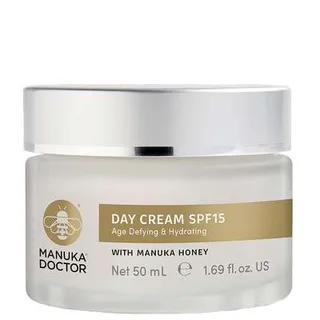
Manuka Doctor Manuka Skincare Day Cream SPF15
Works for
Sun protectionSPF 15 · 4 UV filters · Broad spectrumWeak protectionSPF under 30
This product offers broad spectrum sun protection, but it is weak. We recommend to use a broad spectrum sunscreen with at least SPF 30.
Anti-agingAdenosine, Butyrospermum parkii butter + 1 moreWorks well
“Collagen boosting Purified Bee Venom (PBV™) helps to reduce the appearance of fine lines and wrinkles.”
This product can help reduce and prevent fine lines and wrinkles, improve skin elasticity and firmness because it contains adenosine.
Keep in mind that it typically takes at least 6 weeks to notice any results because the changes that are needed to improve fine lines and elasticity happen in the deeper layers of the skin. No topical anti-aging product can “erase” wrinkles or fully reverse signs of aging.
MoisturizingC12-15 alkyl benzoate, Cetearyl alcohol + 15 moreWorks
“Manuka Doctor, Manuka Skincare Thanks to the highly moisturising properties of Mānuka honey, this revitalising day cream leaves skin glowingly soft and naturally plumped.”
This product can help improve hydration of the skin with the two types of ingredients.
The first type is called “humectants”:
these ingredients help attract water.
When humectants are on the surface of the skin, they “pull in” the moisture from the outside environment, or from
within deeper layers of the skin. The following ingredients in this product do the job:
glycerin, glucose.
This product also contains ingredients called “occlusives”. They help reduce the speed with which our skin loses moisture to the outside environment. These ingredients also help soften the upper layer of the skin, so it feels less tight and nicer to the touch. The following ingredients in this product do the job: butyrospermum parkii butter, dimethicone.
ExfoliationNo ingredient credited for this claimNot delivered
“Cell regenerating Royal jelly rejuvenates the skin by renewing damaged skin cells and boosting skin’s radiance.”
This product does not contain effective exfoliating ingredients. It might be able to deliver physical exfoliation, that is scrub off some of the dead cells on the surface of the skin. We do not recommend physical exfoliation, because it is not uniform (some bits of skin can get exfoliated too much while others not at all). It can also traumatize the skin and aggrevate acne and other skin conditions.
Can it cause trouble?
Irritancy5 strong irritants: Parfum, Linalool + 3 more — patch-test recommendedHigh risk
Comedogenic4 ingredients rated 2 or more on the 0–5 pore-clogging scale4 flagged


User reviews
Be the first — your take helps the next person decide.
Ingredients
Filter by role to see what each ingredient is doing.
Water~45–55%
Octocrylene~5.1–6.2%
- Irritation risk
- Medium
A weak sunscreen that protects against the sun rays that cause sunburn (UVB) and is somewhat effective against the UVA rays. It is quite stable and can help stabilize other, more vulnerable, sunscreen ingredients like Avobenzone. It is an organic, or so called "chemical" sunscreen
More about OctocryleneEthylhexyl methoxycinnamate~4.4–5.4%
- Irritation risk
- High
Octinoxate. When used in higher concentrations, works as a sunscreen protecting the skin from UVB rays. When used in lower concentration, helps to preserve the product formulation. Is shown to be harmful to coral reefs - consider avoiding bathing in coral reef areas when wearing a product with this ingredient. It can be irritating
More about Ethylhexyl methoxycinnamateEthylhexyl salicylate~3.5–4.2%
- Irritation risk
- Low
Octisalate. A UV filter. It offers some protection against the sun rays that cause sunburn (UVB), but does not protect against the most aging sun rays (UVA). It loses its effectiveness quickly when exposed to sunlight. It is an organic, or so called "chemical" sunscreen
More about Ethylhexyl salicylateButyl methoxydibenzoylmethane~3.1–3.7%
- Irritation risk
- Medium
Avobenzone. An organic, or so-called "chemical" UV filter. Protects against both UVA and UVB rays. Needs to be combined with other filters in a formulation to be stable.
More about Butyl methoxydibenzoylmethaneC12-15 alkyl benzoate~1.9–2.4%
- Irritation risk
- Low
Enhances the product texture and makes it more spreadable. Helps reduce water loss from the outer layer of skin. Extands the shelf life by preventing bacteria growth
More about C12-15 alkyl benzoateIsopropyl palmitate~1.6–1.9%
- Irritation risk
- Medium
- Comedogenicity
- 3/5
Helps soften the upper layer of the skin and create a thicker product consistency
More about Isopropyl palmitateParfum~1.4–1.7%
- Irritation risk
- High
An aromatic blend of unspecified and possibly irritating ingredients
More about ParfumCetearyl alcohol~1.2–1.5%
- Irritation risk
- Low
- Comedogenicity
- 2/5
A non-drying alcohol. Works as an emollient. Helps water and oil mix together and creates a nice product texture
More about Cetearyl alcoholButyrospermum parkii butter~1–1.2%
- Irritation risk
- Low
- Comedogenicity
- 3/5
A great moisturising ingredient that softens the skin and reduces water loss from its upper layer. It also can be helpful in protecting skin from free radicals
More about Butyrospermum parkii butterGlyceryl stearate se~0.65–1%
- Irritation risk
- Low
- Comedogenicity
- 2/5
Used to stabilize the product formulations and works as an emollient
More about Glyceryl stearate seGlycerin~0.6–0.9%
- Irritation risk
- Low
One of the best moisturizing ingredients. Naturally present in skin. It attracts water to the upper layer of the skin working as a humectant
More about GlycerinLauryl laurate~0.5–0.75%
- Irritation risk
- Medium
Helps soften the upper layer of the skin
More about Lauryl laurateBenzyl alcohol~0.4–0.65%
- Irritation risk
- High
A preservative. Can be used to mask unpleasant smell. Can be irritating
More about Benzyl alcoholPhenoxyethanol~0.45–0.65%
- Irritation risk
- Low
A preservative. It helps prevent bacterial growth in cosmetic products
More about PhenoxyethanolDimethicone~0.5–0.75%
- Irritation risk
- Low
A silicone that helps to reduce water loss from the surface of the skin. Can temporarily "fill in" lines and wrinkles, absorb oil, and create a nice product finish
More about DimethiconeMel~0.45–0.65%
- Irritation risk
- Low
Helps to soften the upper layer of the skin and attract water to it
More about MelHoney~0.3–0.6%
- Irritation risk
- Low
Helps attract water to the skin and might have some anti-bacterial properties. Can be an allergen
More about HoneyPolyacrylamide~0.35–0.65%
- Irritation risk
- Medium
Used to improve product texture and help oil and water mix together
More about PolyacrylamideCarbomer~0.3–0.55%
- Irritation risk
- Low
Helps create a thicker or gel-like product texture. It is not a surfactant but can be used in gentle cleansing formulations
More about CarbomerSodium stearoyl glutamate~0.3–0.55%
- Irritation risk
- Medium
Helps oil and water mix together
More about Sodium stearoyl glutamateCetearyl glucoside~0.25–0.5%
- Irritation risk
- Medium
Helps water and oil in the product mix well together and improves product texture
More about Cetearyl glucosideC13-14 isoparaffin~0.25–0.5%
- Irritation risk
- Low
Helps soften the upper layer of the skin, dissolve other ingredients and create a thicker product consistency
More about C13-14 isoparaffinDisodium edta~0.2–0.4%
Tocopheryl acetate~0.25–0.45%
- Irritation risk
- Medium
A more stable but less bio-available form of vitamin E compared to Tocopherol. Might help moisturize and protect the skin from free radicals, but mostly used in low concentrations to stabilize other ingredients.
More about Tocopheryl acetateDehydroacetic acid~0.2–0.4%
Ethylhexylglycerin~0.25–0.4%
Hydrolyzed silk~0.2–0.4%
- Irritation risk
- Medium
Can help attract water to the upper layer of the skin
More about Hydrolyzed silkViscum album leaf extract~0.2–0.35%
- Irritation risk
- Medium
A plant extract that has anti-inflammatory and anti-bacterial properties and might help neutralize free radicals in skin, but solid research is lacking
More about Viscum album leaf extractLinalool~0.2–0.35%
Laureth-7~0.25–0.45%
Sodium hydroxide~0.25–0.4%
Limonene~0.2–0.35%
- Irritation risk
- High
A common frangrance that can easily irritate skin, especially if exposed to air, light or heat
More about LimoneneAlpha-isomethyl ionone~0.2–0.35%
- Irritation risk
- High
A fragrance. Potential allergen and can be irritating
More about Alpha-isomethyl iononeMethyl methacrylate crosspolymer~0.2–0.4%
- Irritation risk
- Low
Helps thicken the product consistency
More about Methyl methacrylate crosspolymerHydroxycitronellal~0.2–0.35%
- Irritation risk
- High
A fragrance. A likely allergen and can be irritating
More about HydroxycitronellalCarthamus tinctorius seed oil~0.25–0.45%
- Irritation risk
- Low
An emollient that helps soften the skin and might help calm down inflammation
More about Carthamus tinctorius seed oilRoyal jelly~0.2–0.35%
- Irritation risk
- High
Helps attract water to the upper layer of the skin
More about Royal jellyCamellia sinensis leaf extract~0.2–0.35%
- Irritation risk
- Low
Can contain potent anti-oxidant compounds (abbreviated ECG, GCG, EGC, and EGCG) that might help protect the skin from free radicals. Can help calm down inflammation and has some anti-bacterial properties. Unfortunately, these antioxidants are unstable and lose their effectiveness very quickly in products. The concentration of the antioxidant compounds in the extract also tends to be low to be effective in topical formulation
More about Camellia sinensis leaf extractBee venom~0.15–0.3%
- Irritation risk
- Low
Glucose~0.15–0.25%
- Irritation risk
- Low
Helps attract water to the upper layer of the skin. Could be helpful in restoring the skin barrier function
More about GlucoseMethyl 2-octynoate~0.15–0.25%
- Irritation risk
- Low
Potassium sorbate~0.15–0.3%
Sodium benzoate~0.1–0.25%
Adenosine~0.1–0.15%
- Irritation risk
- Low
Might help improve cell turnover and reduce inflammation in skin. One study shows that the ingredients might be able to help reduce dynamic wrinkles (for example, in the corners of the eyes or on the forehead)
More about AdenosineIngredient list view
Water, Octocrylene, Ethylhexyl methoxycinnamate, Ethylhexyl salicylate, Butyl methoxydibenzoylmethane, C12-15 alkyl benzoate, Isopropyl palmitate, Parfum, Cetearyl alcohol, Butyrospermum parkii butter, Glyceryl stearate se, Glycerin, Lauryl laurate, Benzyl alcohol, Phenoxyethanol, Dimethicone, Mel, Honey, Polyacrylamide, Carbomer, Sodium stearoyl glutamate, Cetearyl glucoside, C13-14 isoparaffin, Disodium edta, Tocopheryl acetate, Dehydroacetic acid, Ethylhexylglycerin, Hydrolyzed silk, Viscum album leaf extract, Linalool, Laureth-7, Sodium hydroxide, Limonene, Alpha-isomethyl ionone, Methyl methacrylate crosspolymer, Hydroxycitronellal, Carthamus tinctorius seed oil, Royal jelly, Camellia sinensis leaf extract, Bee venom, Glucose, Methyl 2-octynoate, Potassium sorbate, Sodium benzoate, Adenosine
Worth comparing, line by line.
Match % combines shared ingredients, the first five ingredients, shared actives and hero ingredients, irritancy (lower counts in the alternative's favour), texture and body area. Only products in the same routine step are compared.
| Manuka DoctorManuka Skincare Day Cream SPF15YOUR PRODUCT | The SaemEco Earth Light Sun Cream | PhilosophyUltimate Miracle Worker SPF 30 | EyenlipPure Perfection Natural Sun Cream | |
|---|---|---|---|---|
| Match | — | 66% | 60% | 59% |
| Price | — | $11.79 | $89.00 | $7.85 |
| Shared key ingredients | — | 7 of 10 | 6 of 10 | 6 of 10 |
| Key difference | — | Niacinamide | Retinol | Niacinamide |
| Irritancy | High | Medium | High | High |
| SPF | SPF 15 | SPF 50 | SPF 30 | SPF 50 |
| Drying alcohol | — | — | Contains drying alcohol | — |
| View product | Shop | Shop | Shop |

More alternatives: Deoproce Hyaluronic Cooling Sun Gel | Whitening & Anti-Wrinkle Sun Gel Sun Screen Sunblock UV Protection SPF50+ PA+++The Elixir USA TOV Korean Camellia Aerosol Cooling Effect CC Color Correcting Cream Anti-Wrinkle, Whitening, UV Protection SPF50+, PA+++
Product summary
"Manuka Doctor - Manuka Skincare Day Cream SPF15" "is a broad spectrum sunscreen meaning that it protects both from UVB rays (" burning "- they cause sunburn) and UVA rays (" aging "- they don't cause sunburn but lead to premature aging and pigmentation issues). However, it does not offer enough sun protection. We recommend to use a sunscreen with at least SPF 30 daily.
Because it includes good moisturizing ingredients, it can also work as a hydrating day cream. Like all broad-spectrum sunscreens, this product helps prevent early signs of aging.
Sunscreen filters
This is a so-called" chemical "sunscreen. It means that it uses organic UV filters. They typically offer good sun protection and rarely leave a white cast, but they can be irritating for some people with sensitive skin. The UV filters in this sunscreen are: avobenzone 3.10% - 3.70%, octinoxate 4.40% - 5.40%, octisalate 3.50% - 4.20% and octocrylene 5.10% - 6.20%.
Irritation risk
It contains a bunch of common irritants, including ingredients that do not provide any known benefit for the skin. It might not be the best choice if your skin is sensitive. We assess the overall irritancy of it to be high. For a detailed overview of all potential irritants: click here
You can see the detailed formula review with the breakdown of all actives in the product and the full ingredient list with estimated concentrations in the tables below.
Sources cited in this review
Every concentration estimate and effectiveness label is anchored to one of these 10 studies and safety reviews.
- 1Final Report on the Safety Assessment of Isopropyl Isostearatejournals.sagepub.com
- 2
- 3
- 4Final Report on the Safety Assessment of Dimethicone Copolyoljournals.sagepub.com
- 5Safety Assessment of Isoparaffins as Used in Cosmeticsjournals.sagepub.com
- 6
