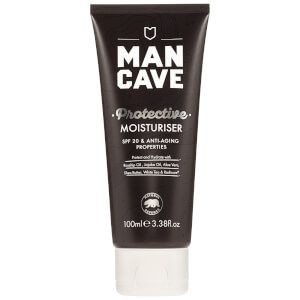
ManCave Protective Moisturiser
Works for
1 of 3 advertised claims delivered
Sun protectionSPF 20 · 3 UV filters · Broad spectrumWeak protectionSPF under 30
This product offers broad spectrum sun protection, but it is weak. We recommend to use a broad spectrum sunscreen with at least SPF 30.
This product can be considered "reef safe" because it does not contain the UV filters (oxybenzone and octinoxate) that can be harmful to coral reefs when present in the water in high concentrations.
MoisturizingThermus thermophillus ferment, Caprylic/capric triglyceride + 10 moreGood evidence
“Protective Moisturiser”
This product can help improve hydration of the skin with the two types of ingredients.
The first type is called “humectants”:
these ingredients help attract water.
When humectants are on the surface of the skin, they “pull in” the moisture from the outside environment, or from
within deeper layers of the skin. The following ingredients in this product do the job:
glycerin, sodium hyaluronate.
This product also contains ingredients called “occlusives”. They help reduce the speed with which our skin loses moisture to the outside environment. These ingredients also help soften the upper layer of the skin, so it feels less tight and nicer to the touch. The following ingredients in this product do the job: butyrospermum parkii butter, caprylic/capric triglyceride.
Anti-agingButyrospermum parkii butter, Camellia sinensis leaf extract + 3 moreLimited evidence
“Ideal for dry to normal skin types, the age-defying moisturiser has a thick, non-greasy texture that melts into skin, hydrating and conditioning while protecting against the sun's rays with UVA filters.”
This product does not contain ingredients that are able to reduce fine lines and wrinkles or help with skin elasticity, but it can improve the look of the skin temporarily through moisturization. Well-moisturized skin might also be able to repair the sun damage better.These ingredients - butyrospermum parkii butter, camellia sinensis leaf extract, thermus thermophillus ferment - could be helpful for preventing or repairing signs of aging in theory, but there is no evidence that it actually works.
This ingredient camellia sinensis leaf extract might be able to help neutralize free radicals in skin and help it fight off some of the sun damage.
The biggest anti-aging effect in this product comes from sun protection. Sun damage is the main factor causing early signs of skin aging. We, however, do not recommend using this product as a sunscreen because the protection it offers is not strong enough).
Anti-oxidationNot advertised by the brand · Camellia sinensis leaf extract, Rosmarinus officinalis leaf oil + 5 moreModerate evidence
This product contains antioxidants (camellia sinensis leaf extract) that might be able to help neutralize free radicals in skin to lessen the damage it gets from the UV light (sun). There is not enough evidence to confirm their effectiveness in skin though.
Can it cause trouble?
Irritancy14 strong irritants: Parfum, Linalool + 12 more — patch-test recommendedHigh risk
Comedogenic4 ingredients rated 2 or more on the 0–5 pore-clogging scale4 flagged
User reviews
Be the first — your take helps the next person decide.
Ingredients
Filter by role to see what each ingredient is doing.
Water~45–55%
Octocrylene~5.2–6.3%
- Irritation risk
- Medium
A weak sunscreen that protects against the sun rays that cause sunburn (UVB) and is somewhat effective against the UVA rays. It is quite stable and can help stabilize other, more vulnerable, sunscreen ingredients like Avobenzone. It is an organic, or so called "chemical" sunscreen
More about OctocryleneEthylhexyl salicylate~4.3–5.3%
- Irritation risk
- Low
Octisalate. A UV filter. It offers some protection against the sun rays that cause sunburn (UVB), but does not protect against the most aging sun rays (UVA). It loses its effectiveness quickly when exposed to sunlight. It is an organic, or so called "chemical" sunscreen
More about Ethylhexyl salicylateButyl methoxydibenzoylmethane~3.4–4.2%
- Irritation risk
- Medium
Avobenzone. An organic, or so-called "chemical" UV filter. Protects against both UVA and UVB rays. Needs to be combined with other filters in a formulation to be stable.
More about Butyl methoxydibenzoylmethaneCetearyl alcohol~2.4–2.9%
- Irritation risk
- Low
- Comedogenicity
- 2/5
A non-drying alcohol. Works as an emollient. Helps water and oil mix together and creates a nice product texture
More about Cetearyl alcoholC12-15 alkyl benzoate~2–2.4%
- Irritation risk
- Low
Enhances the product texture and makes it more spreadable. Helps reduce water loss from the outer layer of skin. Extands the shelf life by preventing bacteria growth
More about C12-15 alkyl benzoateCaprylic/capric triglyceride~1.7–2.1%
- Irritation risk
- Medium
A good mix of fatty acids that forms a protective layer on the skin. Improves the shelf life of products. Derived from coconut and glycerin
More about Caprylic/capric triglycerideThermus thermophillus ferment~1.4–1.8%
- Irritation risk
- Medium
Might be helpful in neutralising free radicals in skin and have some hydration properties
More about Thermus thermophillus fermentCeteareth-20~1.3–1.6%
- Irritation risk
- Medium
- Comedogenicity
- 2/5
Helps oil and water mix together. Has some emollient properties
More about Ceteareth-20Glycerin~1.1–1.3%
- Irritation risk
- Low
One of the best moisturizing ingredients. Naturally present in skin. It attracts water to the upper layer of the skin working as a humectant
More about GlycerinButyrospermum parkii butter~0.8–1.2%
- Irritation risk
- Low
- Comedogenicity
- 3/5
A great moisturising ingredient that softens the skin and reduces water loss from its upper layer. It also can be helpful in protecting skin from free radicals
More about Butyrospermum parkii butterZea mays starch~0.6–0.95%
- Irritation risk
- Medium
- Comedogenicity
- 3/5
Used to thicken the product's consistency
More about Zea mays starchPhenoxyethanol~0.55–0.85%
- Irritation risk
- Low
A preservative. It helps prevent bacterial growth in cosmetic products
More about PhenoxyethanolPrunus amygdalus dulcis oil~0.55–0.85%
- Irritation risk
- Low
An emollient that softens the skin
More about Prunus amygdalus dulcis oilAloe barbadensis leaf juice~0.5–0.75%
- Irritation risk
- Medium
Traditionally used to treat sunburns, dermatitis and inflammation, but evidence for its effectiveness is lacking. The extract can contain humectants that help attract water into the skin
More about Aloe barbadensis leaf juiceSodium polyacrylate~0.55–0.8%
- Irritation risk
- Low
Used to create a gel-like product texture, as well as to stabilize emulsions
More about Sodium polyacrylateParfum~0.45–0.7%
- Irritation risk
- High
An aromatic blend of unspecified and possibly irritating ingredients
More about ParfumCarbomer~0.45–0.7%
- Irritation risk
- Low
Helps create a thicker or gel-like product texture. It is not a surfactant but can be used in gentle cleansing formulations
More about CarbomerSodium stearoyl glutamate~0.45–0.7%
- Irritation risk
- Medium
Helps oil and water mix together
More about Sodium stearoyl glutamateBenzoic acid~0.25–0.5%
Rosa canina fruit oil~0.4–0.6%
- Irritation risk
- Medium
A great emollient. Contains vitamin E (tocopherol) which may give it some anti-oxidant properties. Can contain volatile compounds and can be irritating
More about Rosa canina fruit oilSimmondsia chinensis seed oil~0.45–0.65%
- Irritation risk
- Medium
Softens the upper layer of skin and helps restore the healthy skin barrier. Has shown to help calm down inflammation in skin. It is a stable oil, meaning that it retains its properties even when exposed to air.
More about Simmondsia chinensis seed oilSodium hydroxide~0.3–0.55%
Tocopheryl acetate~0.3–0.55%
- Irritation risk
- Medium
A more stable but less bio-available form of vitamin E compared to Tocopherol. Might help moisturize and protect the skin from free radicals, but mostly used in low concentrations to stabilize other ingredients.
More about Tocopheryl acetateDehydroacetic acid~0.3–0.55%
Linalool~0.3–0.5%
Bulnesia sarmientoi wood oil~0.3–0.55%
- Irritation risk
- Low
Benzyl salicylate~0.25–0.5%
Hexyl cinnamal~0.25–0.5%
Abies sibirica oil~0.25–0.5%
- Irritation risk
- Low
Artemisia herba-alba oil~0.3–0.55%
- Irritation risk
- Low
Cedrus atlantica bark oil~0.25–0.5%
- Irritation risk
- Low
Citrus aurantifolia oil~0.3–0.55%
- Irritation risk
- High
Eucalyptus globulus leaf oil~0.25–0.5%
- Irritation risk
- High
An essential oil that can be very irritating. Has some anti-bacterial properties
More about Eucalyptus globulus leaf oilLavandula hybrida oil~0.3–0.55%
- Irritation risk
- High
Plant extract that can be irritating and is a known allergen
More about Lavandula hybrida oilOriganum majorana herb oil~0.25–0.5%
- Irritation risk
- High
Rosmarinus officinalis leaf oil~0.3–0.5%
- Irritation risk
- High
A plant oil with high content of volatile compounds that can irritate the skin. Can be used as a fragrance. Has anti-bacterial properties and might help neutralize free radicals on the surface of the skin
More about Rosmarinus officinalis leaf oilSodium hyaluronate~0.3–0.5%
- Irritation risk
- Low
One of the best moisturizing ingredients. Attracts water into the upper layer of the skin
More about Sodium hyaluronateCoumarin~0.25–0.5%
Limonene~0.25–0.45%
- Irritation risk
- High
A common frangrance that can easily irritate skin, especially if exposed to air, light or heat
More about LimoneneCamellia sinensis leaf extract~0.3–0.5%
- Irritation risk
- Low
Can contain potent anti-oxidant compounds (abbreviated ECG, GCG, EGC, and EGCG) that might help protect the skin from free radicals. Can help calm down inflammation and has some anti-bacterial properties. Unfortunately, these antioxidants are unstable and lose their effectiveness very quickly in products. The concentration of the antioxidant compounds in the extract also tends to be low to be effective in topical formulation
More about Camellia sinensis leaf extractAlpha-isomethyl ionone~0.25–0.4%
- Irritation risk
- High
A fragrance. Potential allergen and can be irritating
More about Alpha-isomethyl iononePotassium sorbate~0.25–0.45%
Sodium benzoate~0.2–0.4%
Abies balsamea extract~0.25–0.45%
- Irritation risk
- Low
Juniperus communis fruit oil~0.15–0.3%
- Irritation risk
- Low
Melissa officinalis leaf extract~0.15–0.3%
- Irritation risk
- High
A plant extract that is added for its fragrance. Can be irritating
More about Melissa officinalis leaf extractPiper nigrum fruit oil~0.15–0.25%
- Irritation risk
- Low
Thymus vulgaris flower/leaf oil~0.15–0.3%
- Irritation risk
- High
Disodium rutinyl disulfate~0.15–0.25%
- Irritation risk
- Low
Hordeum distichon extract~0.1–0.2%
- Irritation risk
- Low
Citric acid~0.05–0.15%
- Irritation risk
- Medium
Can work as an exfoliant but is typically used to adjust the product pH
More about Citric acidIngredient list view
Water, Octocrylene, Ethylhexyl salicylate, Butyl methoxydibenzoylmethane, Cetearyl alcohol, C12-15 alkyl benzoate, Caprylic/capric triglyceride, Thermus thermophillus ferment, Ceteareth-20, Glycerin, Butyrospermum parkii butter, Zea mays starch, Phenoxyethanol, Prunus amygdalus dulcis oil, Aloe barbadensis leaf juice, Sodium polyacrylate, Parfum, Carbomer, Sodium stearoyl glutamate, Benzoic acid, Rosa canina fruit oil, Simmondsia chinensis seed oil, Sodium hydroxide, Tocopheryl acetate, Dehydroacetic acid, Linalool, Bulnesia sarmientoi wood oil, Benzyl salicylate, Hexyl cinnamal, Abies sibirica oil, Artemisia herba-alba oil, Cedrus atlantica bark oil, Citrus aurantifolia oil, Eucalyptus globulus leaf oil, Lavandula hybrida oil, Origanum majorana herb oil, Rosmarinus officinalis leaf oil, Sodium hyaluronate, Coumarin, Limonene, Camellia sinensis leaf extract, Alpha-isomethyl ionone, Potassium sorbate, Sodium benzoate, Abies balsamea extract, Juniperus communis fruit oil, Melissa officinalis leaf extract, Piper nigrum fruit oil, Thymus vulgaris flower/leaf oil, Disodium rutinyl disulfate, Hordeum distichon extract, Citric acid
Compare prices
Retailers ranked by price — lowest first.
Affiliate links · prices updated regularly · As an Amazon Associate, WIMJ earns from qualifying purchases.
Product summary
"ManCave - Protective Moisturiser" "is a broad spectrum sunscreen meaning that it protects both from UVB rays (" burning "- they cause sunburn) and UVA rays (" aging "- they don't cause sunburn but lead to premature aging and pigmentation issues). However, this moisturizer does not offer enough sun protection. We recommend to use a sunscreen with at least SPF 30 daily.
This moisturizer should also be hydrating enough to use without an additional moisturizer during the day.
Sunscreen filters
This sunscreen uses so-called" chemical ", or organic UV filters (organic simply means that their molecules contain atoms of carbon). These filters typically give good sun protection and rarely leave a white cast, but they can be irritating for sensitive skin. The UV filters in this sunscreen are: avobenzone 3.40% - 4.20%, octisalate 4.30% - 5.30% and octocrylene 5.20% - 6.30%.
Irritation risk
There are quite a few common irritants in this product, including ingredients without particular skin benefits. We would not recommend it for sensitive skin. We assess the overall irritancy of this moisturizer to be high. For a detailed overview of all potential irritants: click here
You can see the detailed formula review with the breakdown of all actives in the product and the full ingredient list with estimated concentrations in the tables below.
Price
The product retails at around 10.25£ in the United Kingdom.
For a detailed price comparison: click here.
Sources cited in this review
Every concentration estimate and effectiveness label is anchored to one of these 11 studies and safety reviews.
- 1
- 2
- 3
- 4
- 5
- 6Occupational contact dermatitis due to essential oilsonlinelibrary.wiley.com

Affiliate links · As an Amazon Associate, WIMJ earns from qualifying purchases.